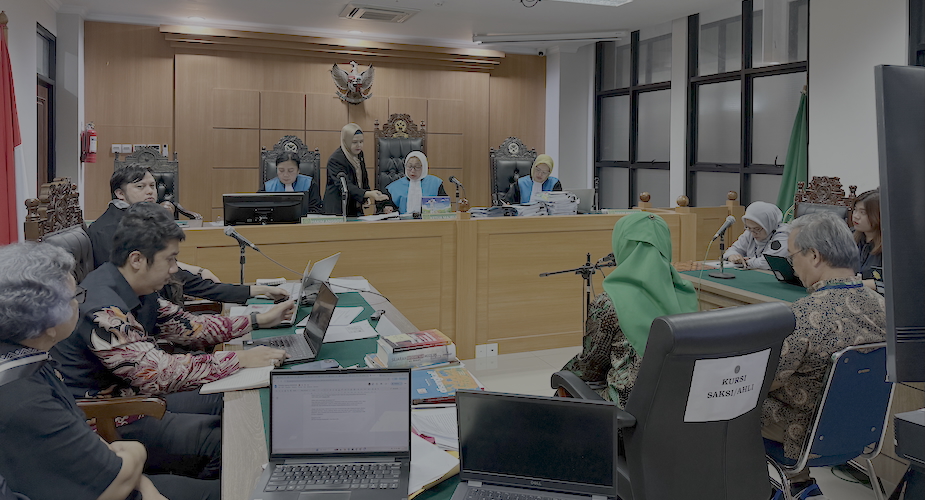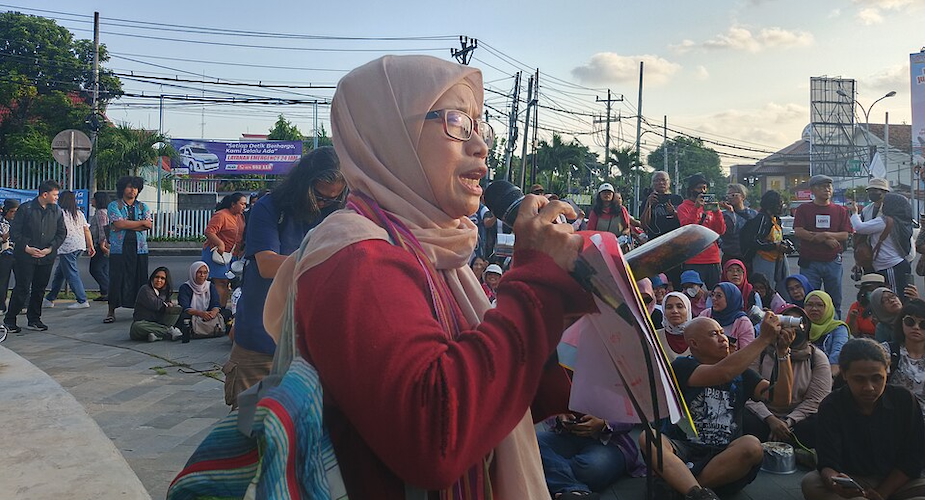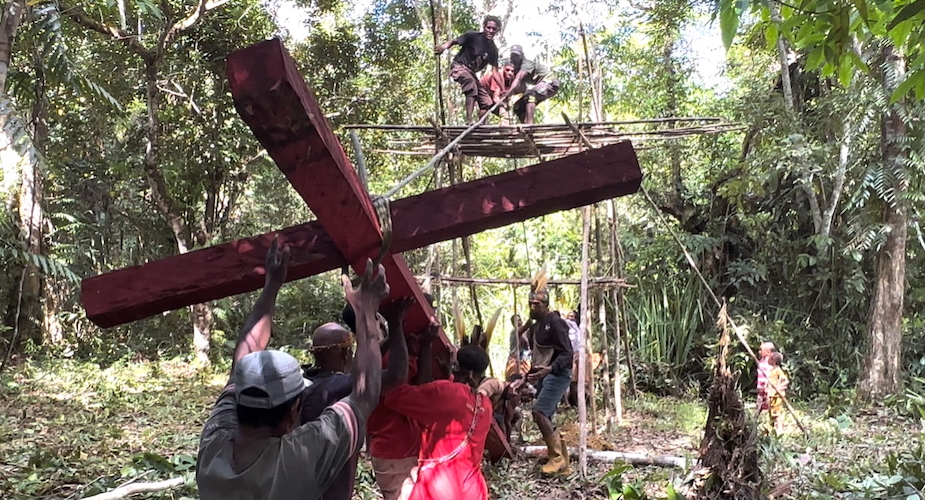
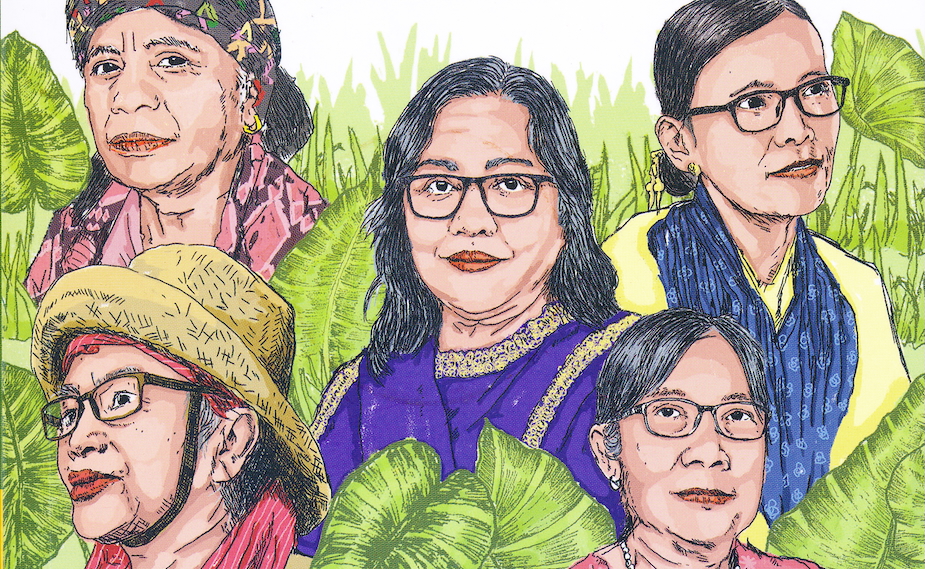
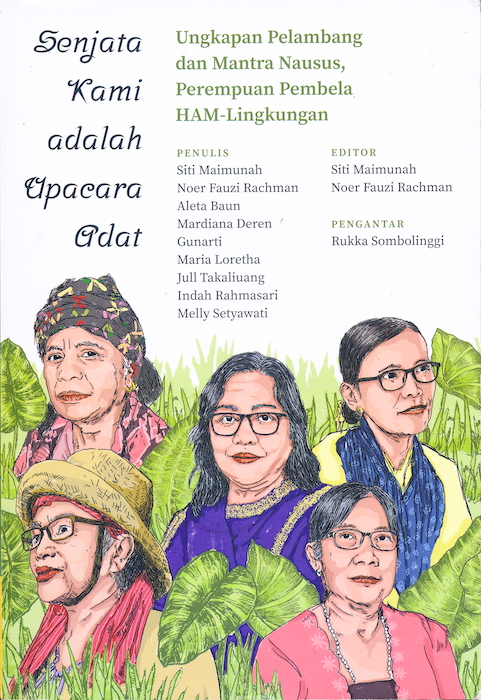
Indonesian women play a special role in environmental activism. This edition profiles several defenders of Mother Earth. Out of their holistic traditional knowledge, they campaign against the miners who seek to destroy it for short-term gain. They appear in the new book, Senjata kami adalah upacara adat (Our weapon is traditional ritual) edited by Siti Maimunah and Noer Fauzi Rachman.
Rukka Sombolinggi introduces the edition with a vivid depiction of just how formidable these women are. ‘The indigenous women in this book show that singing prayers is not a form of surrender, but a declaration of resistance,’ she writes.
We then highlight the stories of three of these women, accompanied by their mantras.
- Gunarti is a leader in the Samin movement in Central Java – perhaps the oldest social movement in Indonesia. The mantras she has for those she seeks to inspire, breathe a spirit of non-violent resistance and a fierce love of the Kendeng Mountains. ‘To farm is to fight,’ she says, and ‘to fight is to farm.’ She continues: ‘I view Mother Earth as my mother – the one who sustains me…. [But] I feel I have not yet been able to make Mother Earth completely happy, make her smile.’
- Aleta Baun leads a community in the Mollo region of West Timor who have fought to protect their mountain, Nausus. ‘Traditional rituals are our weapon,’ she says, ‘so together with our ancestors we resist the destroyers of Mother Earth.’
- Jull Takaliuang leads a successful resistance to gold mines in and around Sangihe Island in North Sulawesi. It is a heavy responsibility. ‘Since the universe has chosen us to be its guardians,’ she says, ‘we as humans cannot refuse it. We must use all our strength and resilience to protect nature, whatever the risk.’
In conversation with Gerry van Klinken, Siti Maimunah closes the edition, explaining how she learned from the women of Mollo that the body of nature and the body of humans are inextricably connected: ‘When we damage nature’s body, we damage our body.’ A life-long history of environmental activism led her from the coalfields of Kalimantan, past the nickel mines of Sulawesi, to Germany, where she developed her ideas into a dissertation.
We hope you find this edition as inspiring to read as we found it to prepare.
Siti Maimunah and Noer Fauzi Rachman (eds). Senjata kami adalah upacara adat: ungkapan pelambang dan mantra Nausus, perempuan pembela HAM-Lingkungan. Sleman, Yogyakarta: Mama Aleta Fund & Insist Press, 2025.
Siti Maimunah (mai.jebing@gmail.com) is director of the Mama Aleta Fund that supports women who defend nature’s rights. Noer Fauzi Rachman (noerfauziberkeley@gmail.com) leads Pondok Cikedokan, a centre for learning and discussion, especially about community psychology, agrarian studies, and social movements in Garut district, West Java. Gerry van Klinken (gvanklinken@gmail.com) is on the board of Inside Indonesia magazine. Translations into English were by Aloysia Yosephin Fibriana and Le Ahn Nguyen Long.