
In 2024, Jemaah Islamiyah (JI) quietly disbanded. This news drew far less public attention than when the terrorist organisation was in the international spotlight following the 2002 Bali bombings. Having existed for three decades, the jihadist group declared its return to the fold of the Negara Kesatuan Republik Indonesia (NKRI). In JI Sampai NKRI: Deradikalisasi Kolektif Jemaah Islamiyah, Solahudin seeks to examine whether JI has indeed undergone a process of collective deradicalisation.
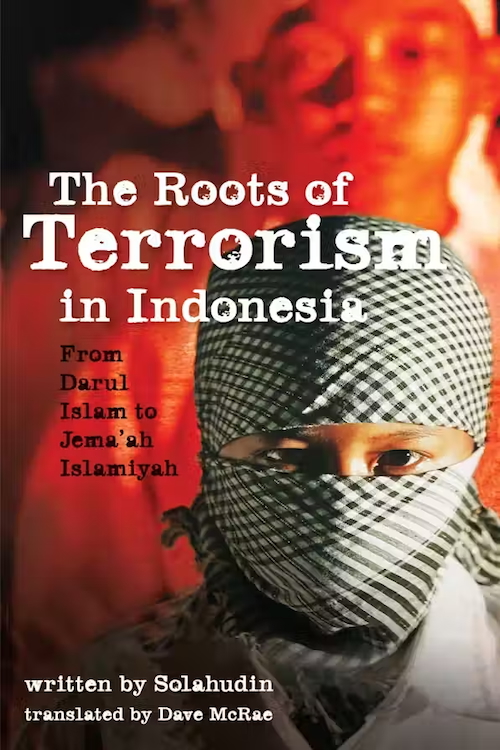
The book is a sequel to NII Sampai JI: Salafy Jihadisme di Indonesia published in 2011 and in English translation in 2013, in which Solahudin focused on the ideological foundations of JI’s Salafi-jihadism—whose seeds had existed since the pre-independence era. In this volume he pays greater attention to the dynamics of JI’s engagement with Densus 88, the state’s counterterrorism apparatus.
The 2002 Bali bombing on the evening of 12 October, which claimed 202 lives, triggered a massive law enforcement response by the Indonesian government through the establishment of an antiterrorism unit now known as Densus 88. The plan to carry out the Bali bombing had already sparked internal disputes among JI’s leaders. The state’s crackdown through the arrest of terrorists following the bombing plunged JI into further disarray. Solahudin opens the book by describing the emergence of factions within JI: those who aspired to global jihad and others who rejected it.
As a Salafi-jihadi group, JI was formed with the aim of overthrowing the Indonesian government through a strategy combining da‘wah (religious propagation) and armed jihad. An ideology similar to Salafi-jihadism had in fact taken root in Indonesia since the 1940s within the Darul Islam (DI) movement led by Kartosoewirjo. This jihadist doctrine later matured through its encounter with global jihadist ideology, culminating in the formation of JI under the leadership of Abdullah Sungkar in the mid-1990s.
The issuance of Osama bin Laden’s global jihad fatwa in 1998 sparked controversy within JI over whether to fight the ‘near enemy’ (the government) or the ‘far enemy’, namely the United States and its allies. Armed jihadist fervour intensified, particularly as JI’s military wing had by then become well-developed after years of sending cadres to training camps run by the Moro Islamic Liberation Front (MILF) in the Philippines and Al-Qaeda in Afghanistan. The new JI amir, Abu Bakar Ba’asyir, who succeeded Abdullah Sungkar after his death in 1999, failed to control this military wing. Throughout the year 2000 alone, JI carried out a total of 34 terrorist attacks.
The climax came in 2002 when the pro–Al-Qaeda faction executed what would become the first Bali bombing. The government responded by issuing the Anti-Terrorism Law and establishing a special counterterrorism unit within the Indonesian National Police, which later became Densus 88. This unit succeeded in arresting not only the trio responsible for the bombing—Amrozi, Imam Samudra, and Ali Gufron (alias Mukhlas)—but also senior JI leaders who had opposed the bombing.
Amid leadership turmoil within JI, the global jihad mission continued led by Noordin M. Top and Dr. Azahari, Malaysian JI members and disciples of Mukhlas. As explained Solahuddin explains in the opening chapter of the book, it was these jihadist thoifah (cells) that actively carried out subsequent waves of bombings in Indonesia. The deaths of Dr Azahari and Noordin M. Top during Densus 88 operations in 2005 and 2009, ultimately brought an end to JI’s experiment with global jihad.
Alongside the Bali bombings, JI was also experimenting with the establishment of a qoidah aminah (secure base area) in Poso, Central Sulawesi, as a precursor to an Islamic state. Since the outbreak of horizontal conflict in Poso in 1998, JI’s role as a protective and resistance force for Muslim communities earned them the trust of local residents.
The Indonesian government’s law enforcement actions against JI terrorists involved in the Bali bombings did not initially reach JI’s base in Poso. Although the arrest of JI figures disrupted plans for a qoidah aminah in the region, JI nonetheless continued to operate freely, carrying out bombings, shootings, and even mutilations until 2006. It was only in 2007, following armed confrontations, that JI in Poso was finally subdued.
After Poso, JI entered a period of crisis due to the loss of many leaders and askari (jihad fighters). It was during this time that a new amir, Para Wijayanto, was appointed. His background was unusual: he was neither a pesantren (Islamic boarding school) alumnus nor a former Afghan combatant, but rather a product of elite public schools and universities. Under Wijayanto’s leadership, JI shifted course from a jihadist organization to a da‘wah-oriented organisation. During this phase, JI was officially designated a banned organisation by the Indonesian government and its movements were constrained.
This period of leadership emphasised Islamic juristic inquiry, leading to a redefinition of JI’s ideology, including its takfiri doctrine. The definition of who qualifies as a Muslim was loosened, as long as one still performed prayers facing the same qibla. Sinful acts or deviations no longer automatically nullified a person’s Islam. Da‘wah became the primary activity, while jihad was subordinated to it—jihad was seen as a means rather than an ultimate goal. Although JI continued to envision the establishment of a Daulah Khilafah, it no longer relied solely on jihadist strategies but also pursued da‘wah and even siyasah (politics). These changes reduced state repression against JI, allowing it to reconsolidate its networks.
During the Wijayanto era, JI shifted its focus for establishing the Daulah Khilafah from Indonesia to Syria, in line with a prophecy it believed in. Its target was the overthrow of the US-led global political system (the far enemy). Once the global system collapsed, JI believed Muslims would be able to seize power through collective jihad. To build this ‘jihad of the ummah’ JI intensified da‘wah activities that leaned toward Salafism, but these were not aggressively promoted, in order to gain broader public sympathy.
JI’s da‘wah strategy expanded rapidly through religious study circles, cadre recruitment, and charitable institutions, which managed to raise more than Rp 100 billion annually to fund organisational operations, pesantren construction, and humanitarian missions. JI also began political manoeuvring by cooperating with organisations considered to share overlapping goals, such as participating in the Tauhid Parade in Solo in 2015 and the Aksi Bela Islam protests in Jakarta in 2016. This era marked JI’s transition from mere survival to revival.
After freezing its military activities for a long time, JI viewed the armed conflict in Syria as an opportunity to reactivate its military strength. It began sending cadres to Syria for military training and adopted a two-pronged strategy by cooperating with ISIS in Syria and Al-Qaeda in the Arabian Peninsula (AQAP) in Yemen. This cooperation was supported by JI’s charitable organisation, Syam Organiser, as a manifestation of the prophecy concerning the birth of the Daulah Khilafah.
This collaborative project ended in 2018 following internal splits within Syria’s armed opposition groups. JI also began to recognise the ideological deviations of ISIS. Meanwhile, the government detected links between JI and ISIS, leading to the arrest of several cadres, including senior figures and JI amir Para Wijayanto. JI once again entered a period of crisis, exacerbated by the enactment of the new Anti-Terrorism Law in 2023, which reclassified activities previously not considered terrorism—such as ties with foreign terrorist groups—as terrorist crimes.
Densus 88’s repression of JI faced significant challenges when the number of identified JI members reached approximately 6000, far exceeding the capacity of Indonesia’s law enforcement apparatus to handle through punitive measures alone. This led to the development of preventive deradicalisation strategies aimed at reducing commitment to violence. Densus 88 implemented dialogue programs between deradicalised former detainees and inmates who remained radical and provided reference texts to support counter-narratives. Dialogues were also conducted outside prisons with JI figures who were still at liberty. This non-aggressive cognitive approach significantly altered JI detainees’ perceptions of Densus 88.
In 2024, Densus 88 facilitated dialogue among JI members both inside and outside prison. These discussions concluded that Indonesia is an Islamic state, albeit an imperfect one. Consequently, jihad was deemed no longer relevant because it lacked a valid shar‘i basis. The meeting culminated in a declaration dissolving JI, announced by senior JI figures and more than a hundred members.
Some observers remain sceptical about this dissolution, viewing it as yet another survival tactic. However, drawing on Omar Ashur’s analytical framework, Solahudin argues that JI has undergone three key transformations. First, organisational change through the dissolution of JI’s military structure. Second, demilitarisation through the surrender of weapons assets and membership lists to the police. Third, ideological revision, encapsulated in an 800-page book affirming the NKRI as an Islamic state rather than a thaghut (oppressive or un-Islamic) regime. Solahudin concludes that these three indicators constitute a clear manifestation of JI’s collective deradicalisation.
The book demonstrates that this process of collective deradicalisation had in fact begun earlier through internal ideological revision within JI. Solahudin meticulously traces how relations between JI and Densus 88 evolved from confrontation to dialogue. This book is a careful historical account of JI and offers important lessons for the nation. It concludes that the effectiveness of deradicalisation depends on the government’s serious commitment to maintaining institutional infrastructure and programs, as well as ensuring that democracy is preserved so that legal mechanisms operate in an accountable and transparent manner.
Solahudin. JI Sampai NKRI: Deradikalisasi Kolektif Jemaah Islamiyah. Jakarta: Komunitas Bambu, 2025.
Khalimatu Nisa (khalimatu.nisa@uinsa.ac.id) is a lecturer in Religious Studies at the Universitas Islam Negeri Sunan Ampel Surabaya.