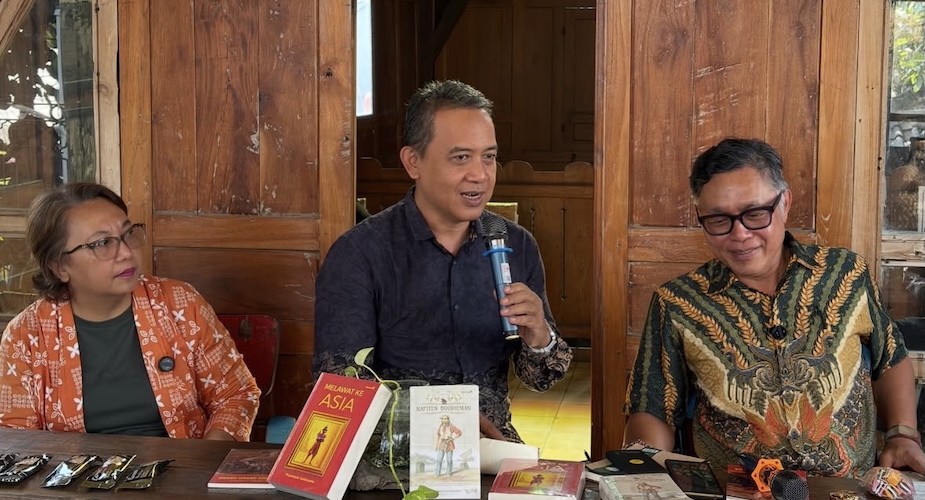
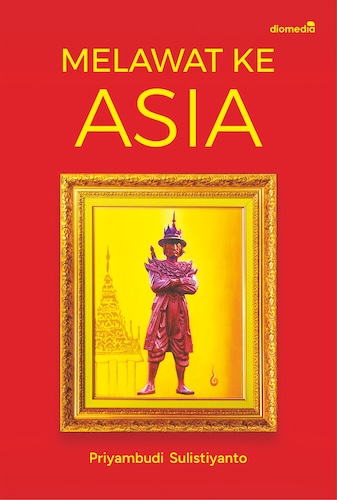
Asia is often described by big numbers related to economic growth, trade, population or strategic importance. In his new book, Melawat ke Asia (Travels to Asia), Priyambudi Sulistiyanto offers a very different way to understand the region. Instead of focusing on governments or policies (about which his academic work was previously focused), Sulistiyanto writes about Asia through travel, daily life, history, and personal encounters. The result is a book that presents Asia as a lived space shaped by people, memory, and long historical processes.
The book draws inspiration from Anthony Reid’s classic Southeast Asia in the Age of Commerce, 1450–1680 (1988). Like Reid, Sulistiyanto emphasises long historical connections across the region rather than viewing countries as isolated units. Each chapter centres on a country he has visited — from China, Nepal, Sri Lanka (Ceylon), and India, to most of Southeast Asia. This approach highlights Asia as a network of interconnected societies shaped by trade, migration, empire, and cultural exchange.
It is not a typical travel diary. Each destination is carefully linked to its historical and political background, often reaching back to precolonial times to explain present conditions. Sulistiyanto’s use of the names ‘Burma’ for Myanmar and ‘Muangthai’ for Thailand reflects attention to historical context and shifting national identities, reminding readers that names themselves carry political meaning.
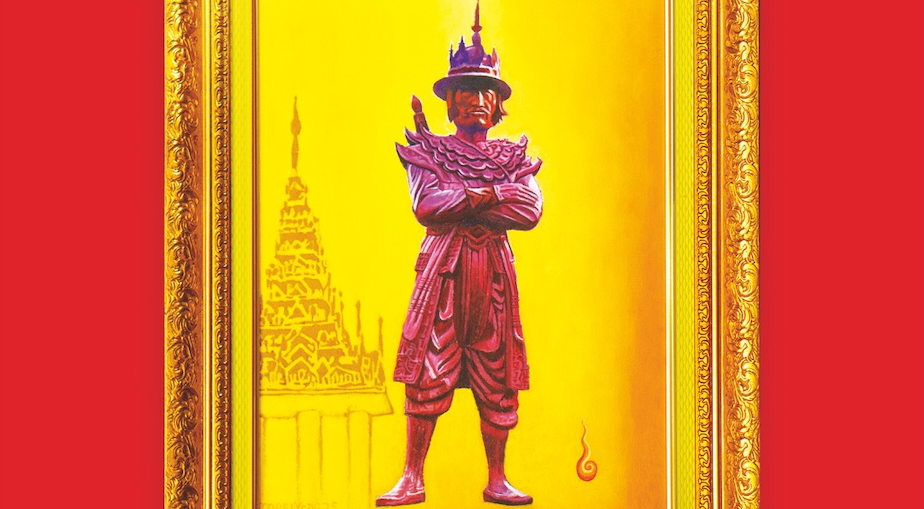
One of the most engaging chapters focuses on Yangon. Sulistiyanto traces relations between Indonesia and Burma from the early post-independence period, roughly between 1962 and 1998, while also referring to earlier connections from the Nusantara era. He mentions Majapahit’s links with smaller kingdoms in Martaban recorded in the fourteenth-century Javanese text Negarakertagama. The chapter also highlights figures such as General Maha Bandula, who resisted British colonial expansion, underscoring how colonial history continues to shape national memory.
Food serves as another lens for understanding history and identity. In Singapore, Sulistiyanto explains how roti prata is made — from simple ingredients such as flour, eggs, and butter — and traces its origins to Indian migrants during the colonial period. Over time, the dish evolved from immigrant food into a symbol of Singapore’s multicultural identity. Similar examples throughout the book show how migration and colonial labour movements shaped everyday culture across the region.
Small observations — food, conversations, streets, and buildings — lead to reflections on broader issues such as inequality, governance, and identity. Encounters with taxi drivers, shopkeepers, and fellow travellers provide insight into how ordinary people experience political and economic change, making the book engaging and accessible to readers beyond academic circles.
The book’s structure — organised by countries visited — reflects an attempt to understand Asia through movement rather than fixed boundaries. By moving across regions from South Asia to Southeast Asia and East Asia, Sulistiyanto highlights both shared experiences and significant differences among societies shaped by colonialism and globalisation. The narrative suggests that Asia cannot be understood through a single framework, but through attention to local histories and everyday realities.
Reliance on personal observation also has its limitations. Individual experiences cannot fully represent complex societies, and some themes are introduced without deeper analysis. Readers seeking systematic arguments may find the reflections suggestive rather than conclusive.
Importantly, the book does not romanticise travel. It notes poverty, infrastructure challenges, and political tensions across the region. Asia appears not as a single rising power but as a diverse landscape shaped by different colonial histories, political systems, and development paths. By avoiding technical language, Sulistiyanto makes regional reflection accessible to a wide readership. The book suggests that understanding Asia requires attention to everyday life as much as to formal institutions.
At a time when Asia is often reduced to markets, supply chains, and geopolitical competition, Melawat ke Asia reminds readers that the region is first and foremost a human landscape shaped by history, culture, and lived experience.
Priyambudi Sulistiyanto, Melawat ke Asia, Diomedia, 2025.
Jusuf Ariz Wahyuono (jusufarizw@gmail.com) is a doctoral student at Flinders University, South Australia. His research focuses on the political economy of Indonesia’s game industry, digital platforms, and creative labour in Southeast Asia. He is a lecturer in the Department of Communication Science at Universitas Gadjah Mada, Indonesia.