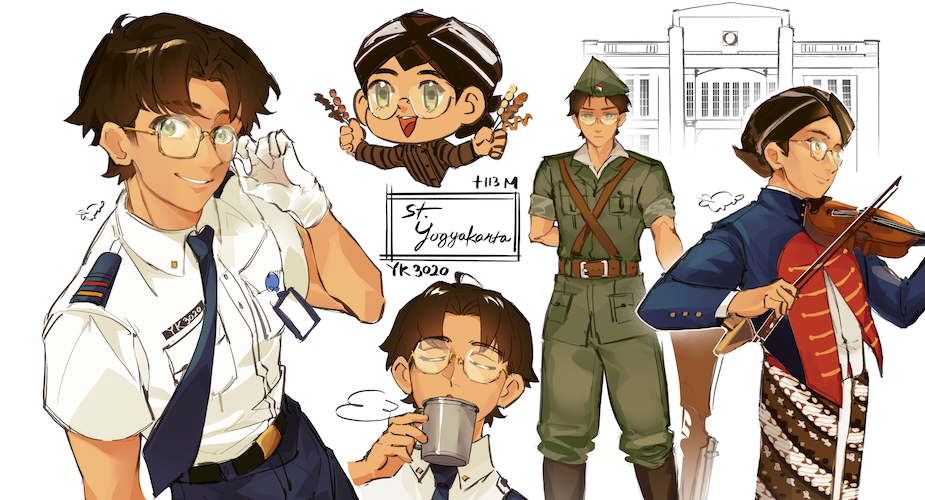
In the Indonesian online sphere, illustrators who are invested in railway history have begun reimagining train stations across the archipelago through anthropomorphic forms
An illustration of a spectacled boy in a masinis (train driver) uniform stole my attention as I was scrolling through social media. A character from an animated series? No.
The boy is a train station.
I was looking at a humanised, anthropomorphic figure of Tugu Yogyakarta railway station illustrated by Indonesian artist Poffymeelk17. Inspired by the structure, its multi-layered history, and the building’s engagement with commuters and people around it, Poffy makes human counterparts of historical train stations built during the colonial administration and its newer counterparts. His other ‘characters’ include Stasiun Depok Lama and Depok Baru. Aside from Poffymeelk17, other illustrators contribute to this fanwork scene online, mainly observed through X; be it railfans, history buffs or frequent commuters. (An anthropomorphised Stasiun Madiun of East Java by @jejenjreng and Stasiun Cikarang of Bekasi by @chrmagdaa)
I was struck with the realisation that to love is to preserve; and in a world that is rapidly changing, preservation of heritage or history no longer needs to take a rigid or institutional form.
Anthropomorphism in this context means rendering a station fully human, as a character shaped by its architectural style, geography, and the emotional residue of those who inhabit it daily. In discussions about preservation of buildings, the conversation often leans towards the tangible, like facades and engineering longevity. Yet the tangible and intangible are two sides of a coin; they are in constant dialogue. Buildings absorb micro-histories that far outlast official narratives. These sentiments and routines exist as intangible dimensions lingering in the imagination; enabling people to attach soul, memory and personality to a space that might otherwise remain inert. This is how these heritage railway stations are reimagined in the minds of artists.
Imagination, as always, remains our oldest tool. The mind finds its own ways to visualise sentiment so that it becomes graspable and relatable. Reimagining train stations across the archipelago through anthropomorphic forms is an uncanny yet tender idea; picture how the station you pass through every day has a human form that is always waiting for you, watching over the comings and goings of commuters.
Railway stations were initially built as instruments of extraction and control, but are now reimagined through the eyes of Indonesians who move through them on their own terms. Fan art becomes an act of remembering and transformation. It has long functioned as a way for communities to humanise the inanimate, to express attachment and to rewrite established hierarchies of meaning.And since imagination is limitless, who is there to forbid us from applying this to heritage railway structures, rendered as a young man with gentle eyes or an aloof station master? In this form, they become characters whose meaning is decided by the perceiver. A station is never just a station. Along with its commuters, it has captured the changing spirits of various eras. This reimagination becomes a subtle form of atonement, an imaginative way of reclaiming spaces inherited through a colonial past.
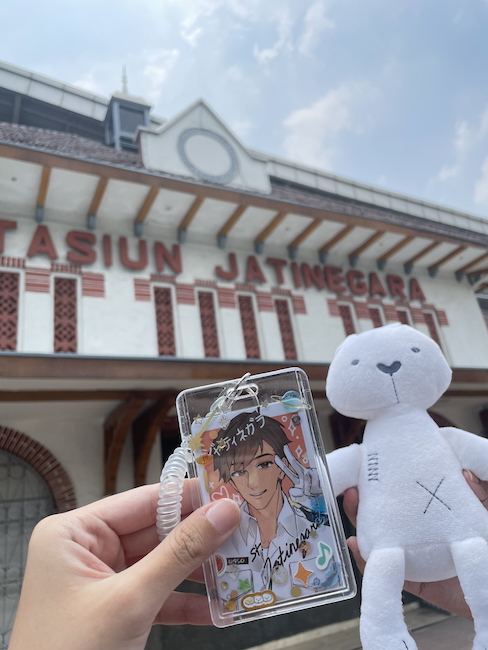
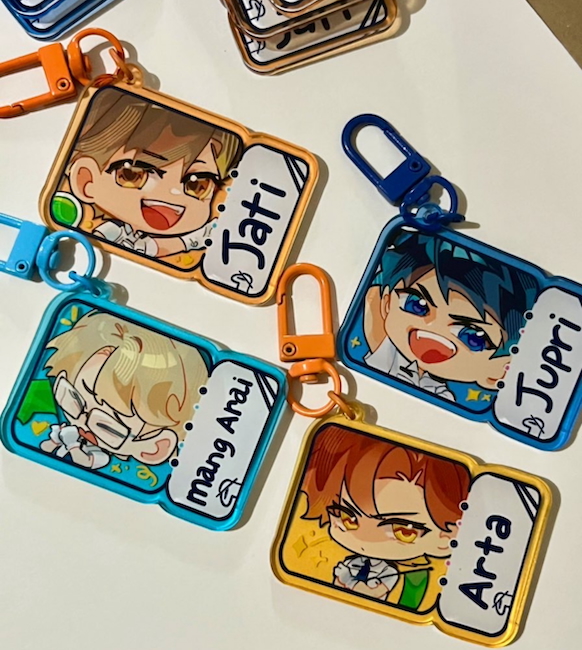
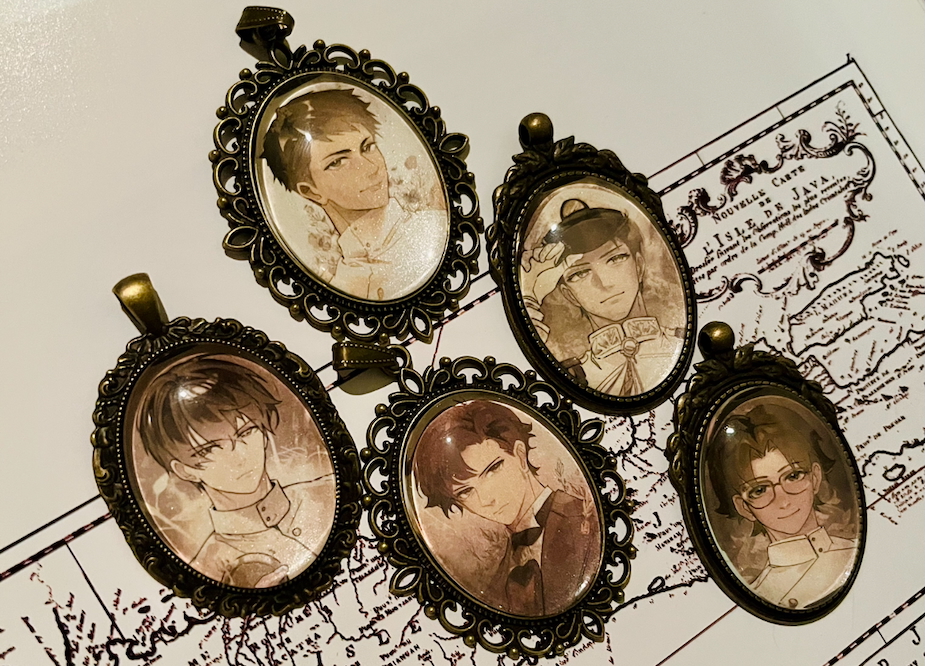
Fan art of anthropomorphised stations allows Indonesians to reframe, rather than erase, the station’s history of occupation. I observed the tendencies of communities to reinterpret colonial structures through instagrammable experiences, ghost stories, rituals, humour or simple pragmatism. When formal heritage plaques freeze a building into a static narrative, communities infuse it with emotion and personal meaning. The anthropomorphised stations in the minds of many transformed a static infrastructure into a familiar companion. Driven by such sentiment, people are eager not only to enjoy the artwork but also to purchase merchandise of these anthropomorphised stations from various artists.
Romanticising your commute
Fanworks symbolically flip the hierarchy once embedded in these structures. Infrastructure once catered to the colonising forces, lasting in its function, becomes characters one can adore on one hand and a form of critique on the other, reflected in their characteristics. We were once excluded from both the ownership and symbolic imagination of these spaces; now we can become the primary storytellers of their afterlives through creative means. Through this reimagination, the artist becomes the postcolonial narrator, recasting infrastructure historically tied to domination as companions of everyday mobility and memory. And perhaps, this goes beyond mere romanticisation. It shows inclination towards narrative reversal; driven by the will to write our own stories.
Indonesia’s railway system began as an explicitly colonial infrastructure. The first line was inaugurated in 1867 by the Nederlandsch-Indische Spoorweg Maatschappij to transport sugar, coffee, tobacco and other commodities from plantation interiors to ports. Yet they were also early conduits of modernity. After independence, nationalisation folded these buildings into Indonesia’s narrative of development; the legacy of the colonial administration is reclaimed, reinterpreted as our own and woven into the country’s everyday fabric.
This layered history of colonial origin, national appropriation and contemporary routines creates a complexity few plaques can fully capture. Complementing formal preservation, fan-creation activates the emotional life of the building. A plaque may assert: ‘This station was built in 1911’. Fan art might instead suggest: ‘This station is quiet in the mornings, strict about timeliness, and secretly loves the rainy season’. One gives history; the other gives feeling. And both are still forms of preservation. Both can also be infused with memories and emotions.
Preserving heritage, especially in its intangible dimensions, need not be confined to monumentalisation or museumisation. A historic building that remains alive through daily use fosters an intimacy no official framing can produce. Commuters, snack vendors, railway staff and security guards all unconsciously perform preservation simply by occupying the space, stitching it into their daily rhythms.

The anthropomorphic versions of stations drawn by artists like Poffymeelk17 serve as visuals which invite the public into an intuitive, emotional relationship with the past that is accessible and profoundly human. These characters are accessible to wider audiences who might not engage with discussions of colonial infrastructure, but could immediately recognise the feeling of attachment to a place that quietly shapes their everyday routine. Fan-creation thus opens a small yet significant doorway into Indonesia’s railway history, reminding us that heritage is not simply about what is archived; it is also what is loved and remembered.
Noandha Dhegaska (noahdegaskark@gmail.com) is completing her MA in Contemporary Southeast Asia at the National University of Singapore. She explores themes of coloniality/decoloniality, contested heritage, heritage from below, memory, dark tourism and hauntology.