What really caused Sumatra’s deadly floods?
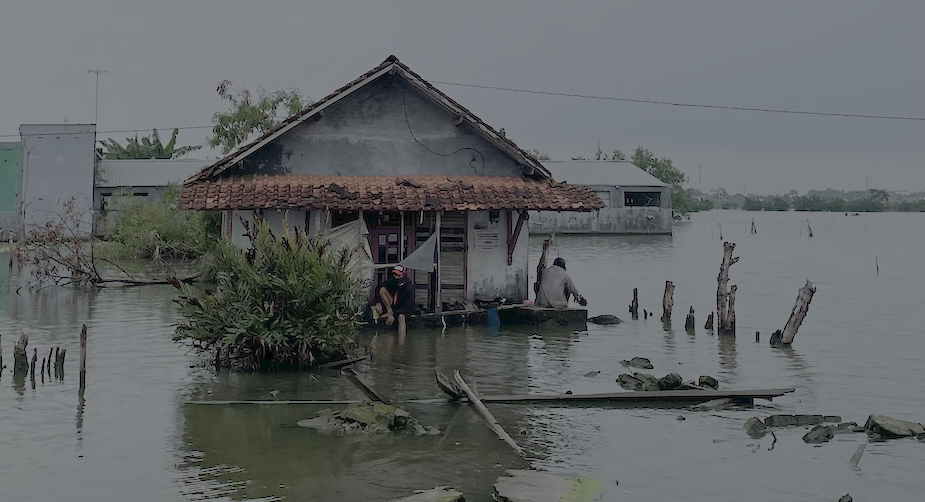
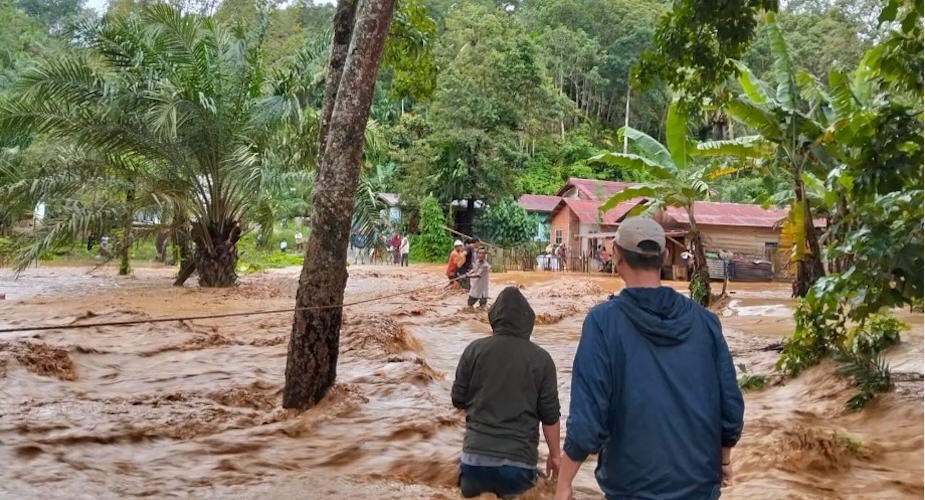
At the end of November 2025, Cyclonic Storm Senyar formed over the Straits of Malacca and lingered there for days. Massive rains caused flash floods and landslides all over northern Sumatra and the Malay Peninsula. Indonesia suffered by far the greatest number of deaths: at least 1140, with 163 still missing.
Amid the outpouring of public solidarity for the victims in Sumatra, one development deserves close attention. On social media in particular, the term ‘natural disaster’ was being increasingly questioned and replaced with a more political framing. The Indonesian Forum for the Environment (WALHI) adopted the term 'ecological disaster.' The tragedy was not merely the result of extreme rainfall, it said, but of reckless forest governance policies.
Logs swept away by flash floods, numerous landslides, residential areas washed away – these were indicators of massive landscape transformations. Changes of this scale do not occur without political decisions that open space for exploitation, followed by business activities that take advantage of it. Ecological disasters are the result of political choices—not simply acts of nature. Indonesians who understood this started to blame the state and corporations.
Yet a more important question must be asked: why do the state and corporations collaborate so persistently to destroy the environment? Is this merely the result of individual greed, or is there a development logic that systematically drives limitless exploitation?
Deforestation
Data from Global Forest Watch shows that between 2001 and 2024, North Sumatra lost approximately 1.6 million hectares of forest cover, with 84 per cent closely linked to deforestation. Mining, oil palm plantations, logging, and energy projects are frequently cited as the main drivers. But if these business activities consistently lead to environmental damage, why does the state continue to issue concession permits? This question points toward a more fundamental critique of the development model itself.
Many observers identify extractive business models as the main engine behind deforestation, reckless licensing regimes, and ultimately ecological disasters. Large-scale resource extraction in Indonesia has indeed been underway for decades. American sociologist Paul K. Gellert shows that the extraction of natural resources—land, minerals, timber, and marine products—has formed the backbone of Indonesia’s development strategy since the mid-1960s. This pattern did not end with the New Order but continued into the era of decentralisation, now wrapped in new slogans such as 'economic growth' and ‘poverty alleviation’.
The key question, then, is not only what is extracted, but why development remains dependent on destructive extraction. Why has development failed to take more environmentally sustainable forms? Similar critiques have emerged in the broader Southeast Asian context too. Australian climate justice activist Annika Reynolds notes that although many countries in the region—including Indonesia—have formally recognised the right to a healthy environment, extractivism in practice continues to erode that very right.
The American anthropologist Ann L. Stoler provides critical insight into this question in her classic study on the history of plantations in North Sumatra. Dutch, British, American and other colonial powers transformed the region with their plantations of rubber, coffee, tobacco and other products over the century between 1870 and 1979. Stoler introduces what she calls ‘plantation perspectives’—a way of seeing plantations not merely as sites of production or economic units, but as a logic of power that governs nearly all aspects of surrounding life. Plantations functioned as colonial 'command centres'. Through the plantation system, Dutch colonialism did not simply extract value from land and labour, but reorganised entire living spaces. It separated labour barracks from European settlements, redrew village boundaries, classified populations by race and origin, and divided nature into production zones fully subordinated to commodity needs. Forests, land, and people were treated as components of a single production landscape that had to be disciplined, measured, and controlled. From here, Stoler invites us to reconsider the analytical units we use to understand development and its consequences—from poverty and ecological disasters to resistance and alternative responses.
Underlying logic
Most importantly, Stoler shows that the root of the problem does not lie solely in state policies or corrupt officials, but in the underlying logic governing how natural wealth is extracted and circulated. Rather than beginning with chaotic licensing regimes or collusion between officials and business elites, Stoler urges us to ask how the logic of dispossession—embedded in the plantation system—became the foundational way colonial powers imagined and built their civilisation.
Plantations were the heart of colonial civilisation, and North Sumatra served as one of its primary laboratories. State policies were only a small (though significant) part of this plantation logic. In short, plantation perspectives push us to understand social problems by asking what is produced, why and how it is produced, who controls production, who benefits, who loses out, and how the consequences of this regulatory logic are distributed.
Another crucial insight from Stoler’s work is that, although formal colonialism ended in 1945, its underlying logic did not disappear. Yes, after 1945 there were attempts to nationalise concessions once controlled by foreign companies, and yes, new labour unions defended the rights of workers. But when the New Order regime was established in 1966 it returned the concessions to foreigners; it dismantled independent unions and controlled labour by military force. Far from dismantling colonial legacies, it recalibrated them to suit new development designs. It effectively improved the colonial plantation system using more modern instruments.
Contemporary ecological disasters, therefore, can be traced back to a development logic that prioritises corporate accumulation both over public welfare—especially for communities near production zones— and over environmental integrity. The devastating disasters that emerge as the endpoint of this logic are rooted in a colonial legacy that has never been fundamentally transformed, but rather preserved and repeatedly reconfigured over time.
Global
This leads to the next question: why has this colonial development pattern been continuously maintained—and even refined? Has Indonesia not been independent for decades?
Drawing on world-systems thinking, Gellert offers a key insight often overlooked: development patterns inherited from colonialism must be understood within global political-economic formations. Indonesia is not a self-contained unit able to freely determine its development trajectory, particularly in managing natural resources. Since independence, the Republic has confronted an international system characterised by hierarchy and imperialism.
When, during the 1950s and 1960s, Indonesia leaned left and President Sukarno sought to challenge this global order through populist politics, major powers perceived a threat and responded with a violent political coup. Suharto’s rise restored colonial-style relations, repositioning Indonesia as a peripheral frontier supplying cheap labour and raw materials to Europe and the United States—the core.
During this period, the New Order was deemed successful. Economic growth increased and industrialisation advanced. The reason: exports of extractive commodities such as oil, gas, timber, and minerals to core countries, at a rate determined by global prices and demand. The regime succeeded precisely because it linked domestic extraction in the periphery to capital accumulation in the core. Corruption, cronyism, reckless licensing, and aggressive business expansion were not aberrations. They simply reflected how global capitalism operates in peripheral regions; they were legitimised by the international system. Colonial-style development was repackaged under slogans such as 'stability and development'.
After the fall of the New Order in 1998, hopes for a new development trajectory briefly emerged. Yet the global formation remained unchanged. Indonesia continues to occupy a frontier position, where natural resources are extracted to sustain capital accumulation elsewhere. Intan Suwandi describes this as ‘new imperialism.’ Domination no longer takes the form of direct colonial rule but operates through global value chains and multinational corporate control. Suwandi shows that the greatest profits from the Global South continue to flow to the Global North, despite claims that globalisation levels the playing field for developing countries.
This new imperial mechanism operates through multinational control over domestic suppliers—via delivery-on-demand strategies, international certification, and open-costing systems. It also ensures labour discipline through ‘lean and flexible’ production. The system rests on international hierarchies established in the twentieth century, particularly after the Cold War ended in 1991. Multinational firms outsource production responsibilities to domestic companies or governments, while retaining control over standards, pricing, and wages. These dynamics are evident in mining, oil palm, and timber operations across Sumatra today.
Batang Toru
One of the areas worst affected by the Senyar disaster is the Batang Toru River catchment area, which stretches from South Tapanuli near Lake Toba southwestwards to the Indian Ocean coast. Land clearing here was identified as a factor exacerbating flood and landslide risks. Gold mining, logging, and oil palm plantations have profoundly altered the landscape. All these operations are nodes within transnational value chains.
Following a public outcry during the most recent disasters, the government investigated several companies frequently cited in media reports, and ordered temporary suspensions. They included PT Agincourt Resources (the Martabe gold mine), PT North Sumatra Hydro Energy (Batang Toru hydropower), and the state plantation company PT Perkebunan Nusantara III (PTPN III).
Gold extracted from fragile upstream ecosystems in North Sumatra is exported along global trade routes in the form of semi-pure ‘doré’ bars. It passes from one key node to another, linking extraction sites to refining hubs and then to financial and industrial markets downstream such as Singapore, Switzerland, and Hong Kong.
For palm oil, Reuters explains that Indonesia’s core production zones lie in Sumatra and Kalimantan. These feed global supply chains for processed foods, cosmetics, and biofuels. Domestic biodiesel policies further illustrate how energy strategies function as demand engines within broader commodity chains.
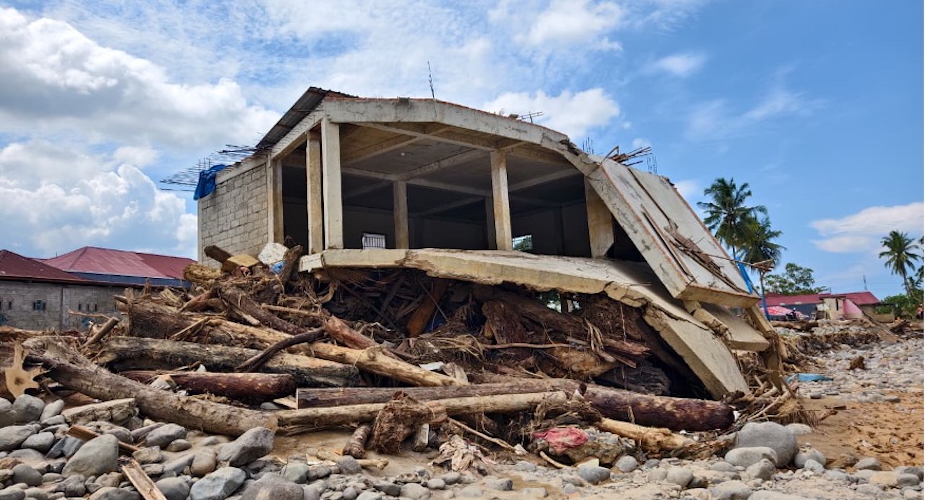
Meanwhile, the timber appearing as a symbol of disaster—logs swept away by floods—is under investigation for possible links to illegal logging or land clearing for plantations and mining. All are tied to transnational timber trade networks.
Across these chains, ecological and social risks—flash floods, landslides, habitat loss—remain concentrated in production areas, while added value moves along trade and industrial routes far from disaster zones.
Within this framework, the state does not act as a neutral guardian of the public interest, but as a mediator aligning regulation, spatial planning, and licensing regimes with global market demands. Collusion between political elites, bureaucrats, and business actors is not an anomaly, but the normal functioning of an economy oriented toward extraction and raw commodity exports. When environmental regulations are weakened, concessions expanded, and forests opened in the name of development, what is actually being protected is Indonesia’s position within global production chains—not ecological sustainability or citizen safety.
Under such conditions, public responses often turn quickly toward practical solutions: moratoria on permits, concession reviews, law enforcement, or even crowdfunding (patungan) to buy forests. These measures matter, but they risk remaining superficial if they fail to address deeper structural causes. Without understanding how disasters are produced by broader political-economic structures, proposed solutions easily become short-term fixes—managing symptoms without addressing roots. Critical reflection is therefore essential—not to delay action, but to ensure that responses do not reproduce the same extractive logic in greener, more technocratic packaging.
Ask, and ask further
Understanding ecological disasters in Sumatra requires us to keep asking—and to ask further: not only who issued permits or who caused damage, but how the global economic system produces the demand for destruction in the first place. Without the courage to shift this perspective, disasters will continue to occur—not as anomalies, but as near-inevitable consequences of a system that treats nature as a resource and peripheral regions as recurring casualties.
Khalid Syaifullah is a sociology lecturer at the Faculty of Social and Political Sciences, Universitas Negeri Surabaya, and a researcher at Yayasan Daulat Umat. Wardatul Adawiah is a sociology lecturer in the same faculty, and a research consultant at the Center for Forestry Organizational Capacity and Institutional Studies (FORCI), IPB University.