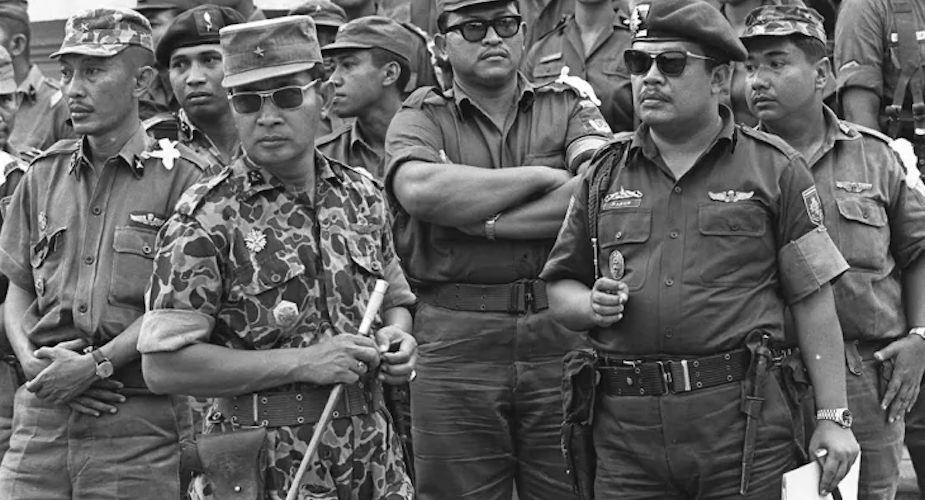
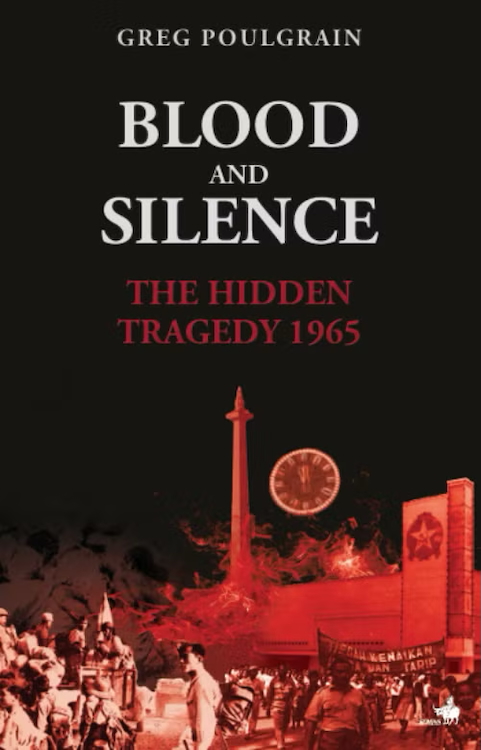
Did Indonesia's autocratic second president Suharto have blood on his hands from seizing power six decades ago? Greg Poulgrain joins a growing chorus of scholarship arguing precisely this. Blood and Silence: The Hidden Tragedy 1965 (Gramedia, 2025) tells the story of the lead up to and execution of the 1965 attempted coup, which the US Central Intelligence Agency labelled ‘one of the worst mass murders of the 20th century’. Poulgrain is also author of The Incubus of Intervention: Conflicting Indonesia Strategies of John F. Kennedy and Allen Dulles (2015) an expert study on US involvement in Indonesia in this period. He explained that he felt compelled to open his keyboard and old files again after hearing that the Minister for Culture, Fadli Zon, had commissioned an ‘official history of Indonesia', which was ‘soft-launched’ in late 2025.
Millions born closer to the present than the past have been nurtured on a New Order version of this period in Indonesia’s history with such conviction that they can't digest an alternative. Flags are flown half-mast every Hari Kesaktian Pancasila (Pancasila Sanctity Day) commemorated on 1 October, the anniversary of the deaths of military generals in an ‘attempted coup’ on 30 September/1 October 1965, and in recognition of the role of the Army in ‘rescuing the nation from communism’.
Decades since the fall of the New Order, Indonesian school children are still taken on excursions to see dioramas at the Pancasila Sakti museum celebrating the horrors and watch the pornography of violence depicted in the film Pengkhianatan G30S/PKI (Betrayal of the Communists) (Arifin C. Noer, dir., 1984). Former President Joko 'Jokowi' Widodo endorsed the film and bragged he'd seen it three times.
Alternative versions to this depiction are slowly proliferating within Indonesian activist and survivor networks, and from filmmakers and academics. As are acts of commemoration, remembrance and rehabilitation of those who were killed. Jess Melvin's 2018 book The Army and the Indonesian Genocide: Mechanics of Mass Murder proved that Suharto orchestrated the killing of maybe more than half a million unarmed citizens, earning the slaughter the overpowering condemnation as genocide.
Poulgrain's Blood and Silence adds to this growing body of work. His thesis is that Suharto knew of the coup in advance. For evidence he draws on his previous work in the US and CIA archives, and interviews with key players collected when he was researching his PhD thesis. These are precious, for many of the protagonists are now dead.
In one such account, journalist Pat Price recalled how she was driving past a Jakarta radio station shortly after the coup and initially thought she was being greeted, ‘(a)s she drew closer, however, the waving arms became limbs of dead bodies dangling from the windows. The RRI staff had been killed in the office, and their arms were hanging from the window as if trying to escape from their attackers.’
Blood and Silence is divided into two sections: The first covers the 1961–1963 sovereignty dispute over West New Guinea and the start of Konfrontasi, ostensibly Indonesia's opposition to the creation of Malaysia from the colonial Federation of Malaya. However, many think it was designed as a diversion when the Indonesian economy was floundering under Sukarno's rule. As Sukarno courted Moscow and Beijing in the middle of the last century, Washington feared Indonesia might turn communist. US interference in the affairs of the maturing nation led to the attempted take-over by hastening its delivery and crushing response.
In Part Two, Poulgrain dissects the historic turning-point, the night of what is coded as G30S (30 September Movement), after which anti-communist purges were unleashed. Suharto would ultimately assume the presidency in March 1966. Poulgrain asserts this all followed a period of extensive planning over many years.
The strength of this book is in its first-hand accounts of the events and personalities of that period, told to him by some of the key protagonists. As Poulgrain writes, ‘(r)eleased CIA documents attest to the fact that Suharto and Abdoel Haris Nasution (former head of the Indonesian army) were the two generals noted for their anti-communist sentiment’ and as such Suharto thought Nasution, ‘posed the strongest competition for him to reach the pinnacle of power’. History shows Suharto won the US’ favour, and the two generals remained archrivals. Fifteen years after the ‘attempted coup’, in 1980, Nasution signed Petisi 50, a petition of fifty leading Indonesians protesting against Suharto’s assertion that critics of his regime were attacking the national ideology of Pancasila.
Beginning in 1983 and over the course of the next 13 years, Nasution became a key informant for Poulgrain:
‘Indeed, he was the very person who told me that Suharto was responsible for killing the generals. Nasution was a military man - with a Batak (Central Sumatra) straightforward approach. He had none of the political wiliness of Suharto.’
Nasution was on the list of those to be assassinated on the night of 30 September; he escaped by jumping a wall into the adjacent compound of the Iraqi ambassador, though his five-year-old daughter Irma was killed. Poulgrain writes that her mother, Johanna Sunarti, forever blamed Suharto and never spoke to him again.
Against widespread opposition from the public, academics and human rights organisations, in late 2025 the ‘Smiling General’ was made a National Hero by his former son-in-law, the current president, Prabowo Subianto. So far, the book is published in English only. It will be interesting to watch how it is received when the translated Indonesian edition is released later this year.
Greg Poulgrain, Blood and Silence: The Hidden Tragedy 1965, Jakarta: Gramedia, 2025.
Duncan Graham (wordstars@hotmail.com) is an Australian journalist living in East Java.