The Hare Krishna minority performs and accepts tolerance in pluralistic Yogyakarta
The Special Region of Yogyakarta offers compelling, grounded stories rich in messages of tolerance. This photo essay draws on fieldwork conducted at the Narayana Smrti Ashram to examine how a religious minority negotiates its place within a pluralistic social landscape. Between September and early November 2025, we visited the ashram on five occasions, combining participant observation with informal interviews involving ashram members. This fieldwork allowed us to trace how tolerance is not merely an abstract ideal but is enacted and negotiated through everyday practices.
Focusing on the Hare Krishna community in Yogyakarta, this photo essay highlights a group widely recognised for its vegetarian lifestyle and the incorporation of Indian cultural elements into daily life. Through routine activities, embodied rituals and interactions with the surrounding community, Hare Krishna practitioners actively sustain their presence while navigating the expectations and sensibilities of a predominantly Muslim Society.
The Hare Krishna group can be found not only in Yogyakarta but also in other parts of Indonesia. In Bali, an island with a Hindu-majority population, the group has experienced forms of rejection and restriction by local customary authorities, reflecting internal boundary-making within the broader Hindu community. In contrast, our fieldwork revealed a markedly different situation in Yogyakarta
Established in 1991, the Krishna temple at Narayana Smriti Ashram has endured over time within the city’s plural religious landscape. The ashram is affiliated with ISKCON, an organisation that places particular emphasis on religious education for the younger generation. Although its residents are fluid, the spirit of bhakti remains a constant presence. This devotion extends beyond ritual practice to include the cultivation of interfaith relationships, notably with members of the local Hindu community in Yogyakarta. As articulated by the ashram’s founder, sustaining the group’s presence depends less on formal recognition than nurturing harmonious relationships with surrounding communities through ongoing social engagement.
Openness, discipline and cultural adjustment
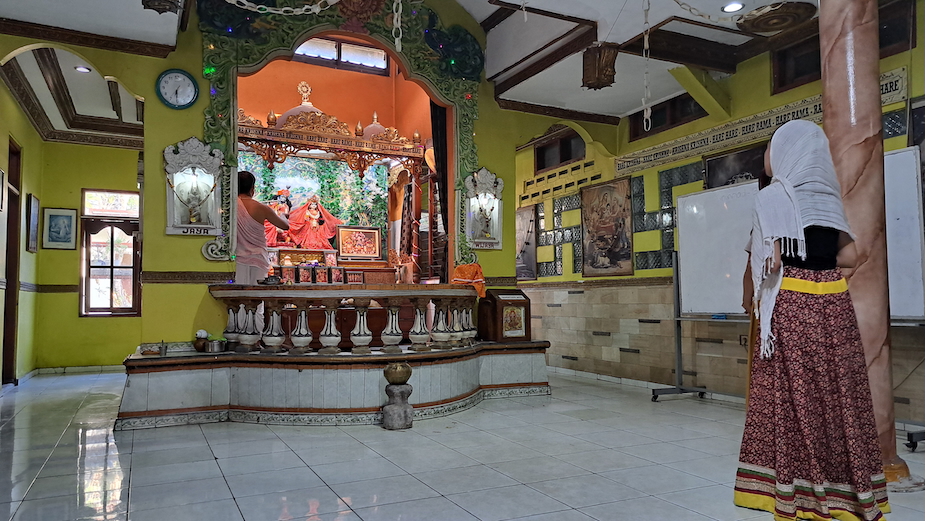
The Krishna temple and the ashram are hidden behind a living room of a strikingly similar house to those in the surrounding area. It is rare to find a house in the city that leaves its door open for a whole day. So we carefully ensured we did not enter someone else's house for the first time without permission. In the living room, we noticed a very powerful Hindu decoration, including ‘ongkara,’ a sacred script used in Hindu life as a symbol of God, and a large painting of Krishna and Radha. Venturing further in, we entered a shared dining area. We symbolise this area as a bridge between the outside world (the street) and the temple (the sacred place). As a ‘bridge’, we can only see the temple clearly from this place. Before we enter the temple, there is a bell hanging next to the front door, so we simply ring it. Later, we met one of the ashram members, Govinda. He is a final-year student at a university in Yogyakarta.
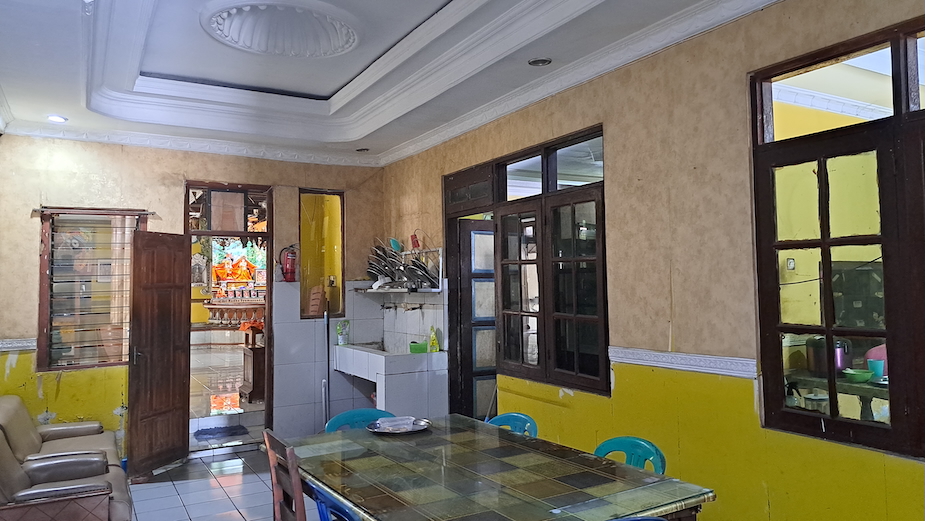
After chatting with Govinda, we began to understand why the front door is always left open. Although it might be a simple custom, it reflects the group’s openness towards visitors. Without any security at the entrance, the door remains open from dawn to dusk. According to Govinda, this temple is a place of worship for Lord Krishna, so it should always be accessible not only to devotees who wish to come and pray, but also to the general public who often come for their own reasons. Govinda added that the number of ashram residents is less than before the COVID-19 pandemic. At present, the Narayana Smrti Ashram is a temporary home to eight people (mostly college students), led by the temple's head and his wife.
After our initial conversation with Govinda, we received permission to visit and observe their activities over the following weeks. During the first week, we were invited to attend the dawn ritual, a regular practice at the ashram. Although we come from different faith backgrounds, we were welcomed to observe and, at certain intervals, were invited to pray according to our own beliefs.
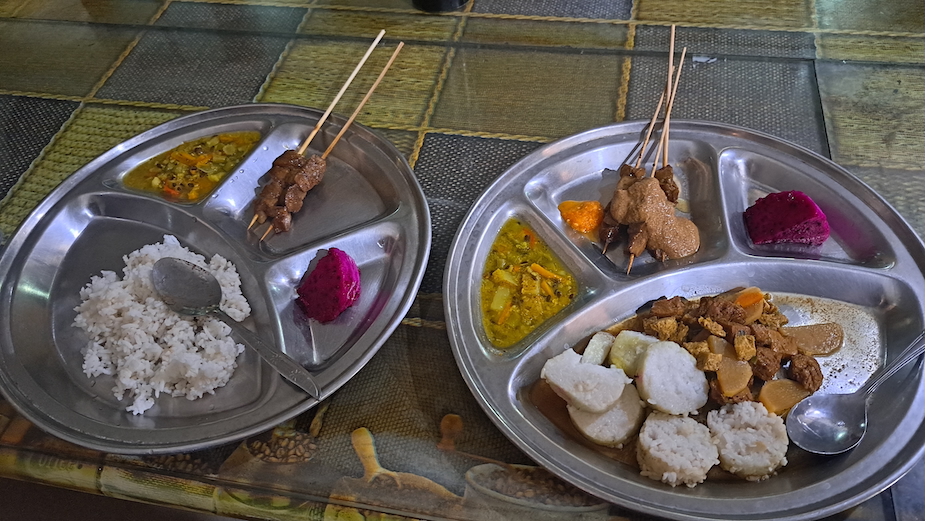
Afterwards, we were invited to share breakfast in the shared dining room, previously mentioned as a bridge. For them, allowing guests to eat first is appropriate, based on their ancient scriptures. We were offered a variety of vegetarian food, according to the group’s commitment to being vegetarian. It was a unique breakfast: a dhal (an Indian dish made from green beans and herbs) and a vegetarian satay with peanut sauce. Indonesians also cannot leave out carbohydrates, so they provided lontong (compressed rice cakes). For most people, this combination may reflect the acculturation of two foods. But it was more than that. It reflects their agency in balancing their identities by negotiating a culture that adheres to both the Indian and local customs - not to impose solely Indian culture, but also respect the local practices.
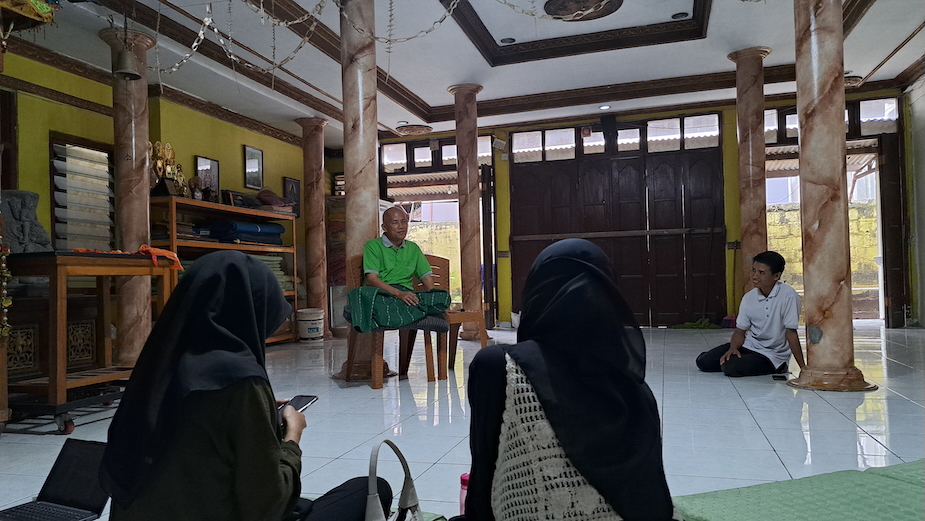
According to the temple's head, one of their messages on tolerance is a sloka that states, ‘One should be more patient than a tree, free from all pride and arrogance, and ready to offer respect to anyone.’ These values are also internalised by the ashram’s residents through their respect for everyone, regardless of faith. A clear example of tolerance that we witnessed was an interfaith dialogue held at the ashram. I met a group of students from UIN Sunan Kalijaga Yogyakarta who had been assigned from their campus to conduct an interview with the temple’s head. Rather than a one-sided interview, the discussion flowed naturally between the two parties. They explored the similarities and differences between Hare Krishna beliefs and Islam in general. I was genuinely impressed by the dialogue, which lasted for approximately 90 minutes. Not a single statement diminished another faith, and the discussion concluded with a message strongly grounded in tolerance.
Managing difference through public engagement
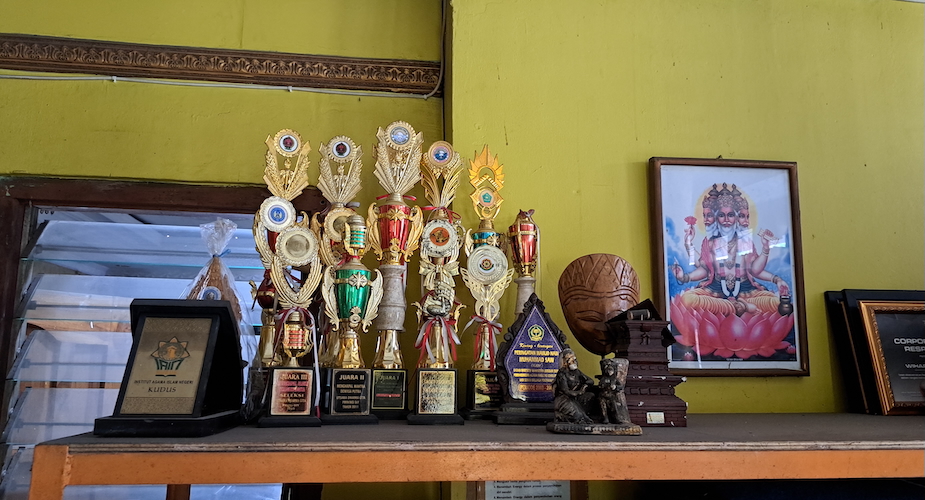
So, tolerance is not automatically present just because people coexist in the same place. I sampled the interactions between this group and the Islamic majority in Yogyakarta. Nevertheless, both groups actively seek opportunities to meet and negotiate their differences. Hare Krishna welcomes the outsider, and Islam, as a majority group, is mindful enough to see another faith’s perspective. We also observed how various plaques serve as silent witnesses to the tolerance that has been built over time. For instance, the Hare Krishna group regularly receives field study visits from the STAIN (Islamic school) in Kudus. The head’s temple also mentioned that the ashram is expecting another by STAIN Kudus in early December this year.
Tolerance within Yogyakarta’s plural social landscape is neither natural nor guaranteed. Through everyday practices, spatial arrangements, symbols, rituals and public engagement, the Hare Krishna community continuously negotiates its presence as a religious minority. Openness, interfaith dialogue, cultural adjustment and strategic participation emerge not as signs of total acceptance, but as forms of ongoing relational work aimed at managing difference, visibility and stigma. The coexistence observed here is thus fragile and contingent, shaped by repeated encounters and mutual adjustments rather than shared identity or harmony. In this sense, tolerance appears not as an inherited virtue of place, but as a negotiated process—maintained through effort, vulnerable to disruption, and always unfinished.
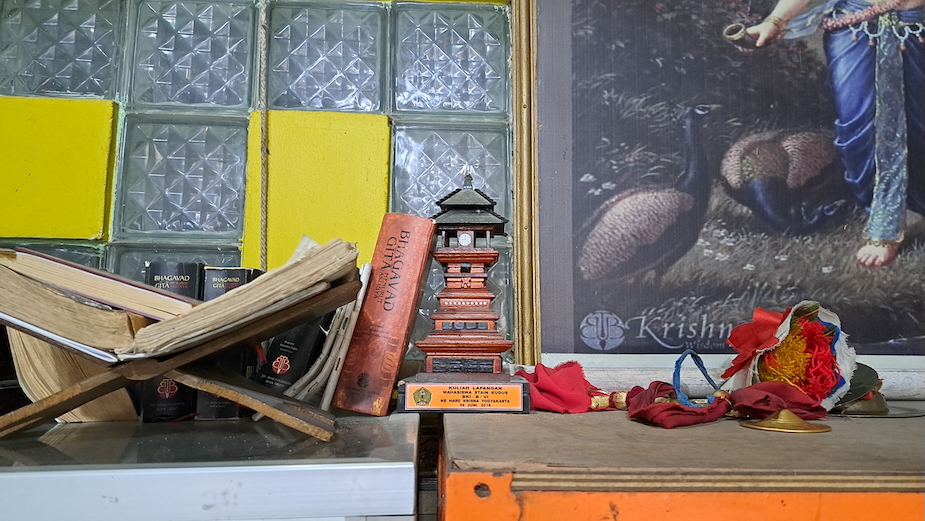
They also actively participate in activities organised by PHDI (a Hindu organisation) in Yogyakarta. During our visit, we met Gopala, a postgraduate student who has lived in the ashram longer than Govinda. He shared his experience of representing the ashram in a PHDI friendship competition in Yogyakarta. His account is echoed by the material traces displayed inside the temple trophies and medals arranged subtley, not as declarations of achievement, but as reminders of ongoing engagement with external religious communities.
One striking arrangement is the placement of souvenirs from Islamic schools in Kudus, symbolised by a miniature of the Menara Kudus, positioned alongside the Bhagavad Gita. This juxtaposition is neither accidental nor merely decorative. The sacred text represents the theological core of Hare Krishna devotion, while the Menara Kudus, a symbol closely associated with Islamic heritage in Java—marks the history of encounters beyond the group’s religious boundaries. Rather than signifying seamless harmony, this spatial arrangement reflects a deliberate act of recognition: an acknowledgment of difference that is kept visible within a sacred space.
According to Gopala, participating in interfaith competitions and public events on behalf of the ashram is a conscious effort to address negative public perceptions that often frame the group as exclusive. In this sense, symbols and rituals within the ashram do not function solely as expressions of faith, but also as social strategies. They register the group’s attempts to manage stigma, negotiate visibility and sustain relationships in a plural environment where acceptance is never fully guaranteed.
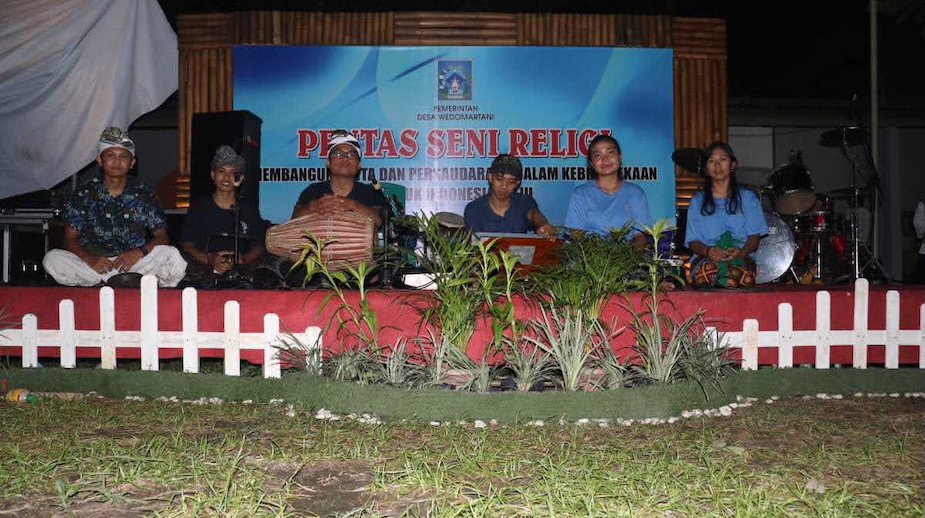
They are also frequently invited to perform kīrtan at inter-religious arts festivals held in Wedomartani Village. While the people of Yogyakarta generally present wayang orang, jatilan, or other traditional performances at such events, the Hare Krishna group contributes by performing devotional music (kīrtan). In Hare Krishna teachings, anyone who hears the holy name of God is considered blessed, even if the listener is an animal or a tree.
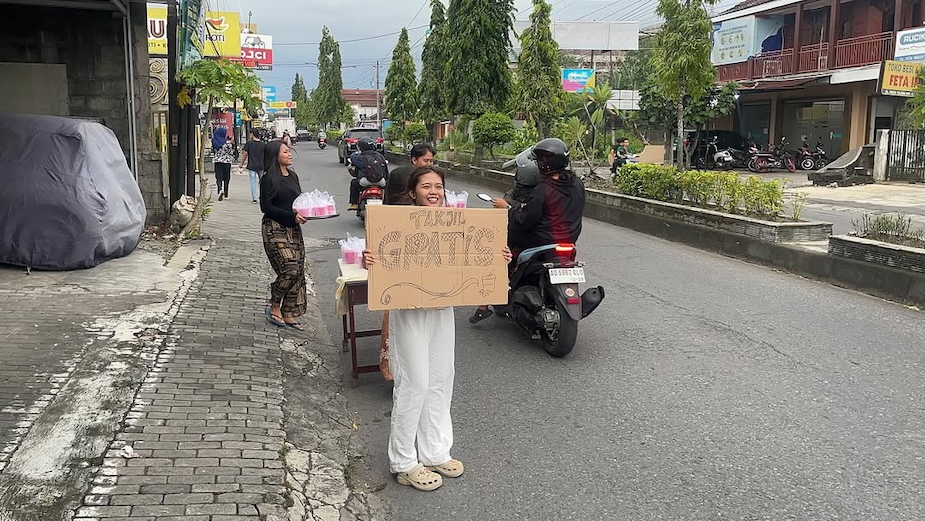
In the Hare Krishna belief system, food offered to Krishna is called prasādam. By consuming prasādam, one is believed not to bear the consequences of one’s own sins. One of the ashram residents' regular activities is the Food for Life program. Earlier this year, Food for Life was held during Ramadan, with takjil (light snacks and drinks) distributed in front of the ashram. In addition, during the Abhiseka celebration, they distributed snacks to local Hindu worshippers and visitors to Prambanan Temple.
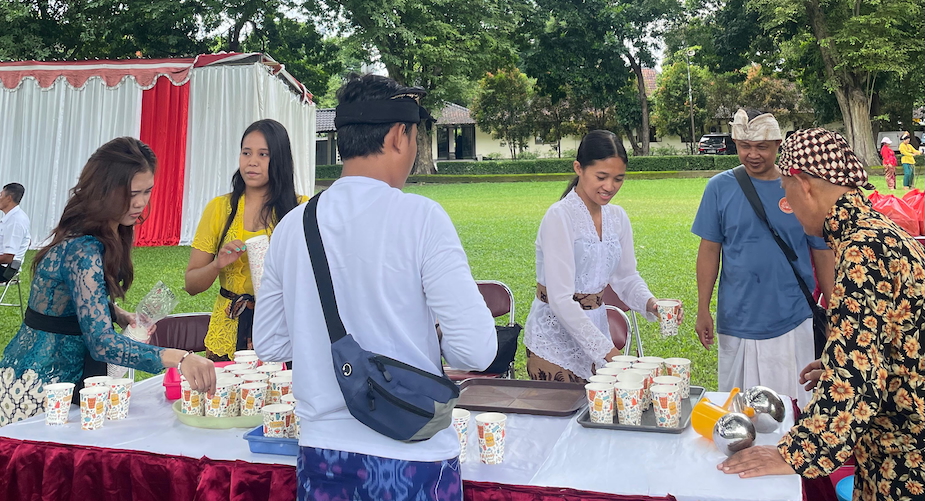
Their openness to outsiders is demonstrated not only in their words but also in their broader actions that cross interfaith boundaries. From their experience, tolerance is not innate but the result of continuous, active negotiation. It evolves through repeated interfaith interactions, mutual adjustments and deliberate efforts to bridge differences. Building tolerance demands ongoing relationship management across communities and careful negotiation by both majority and minority groups seeking to coexist in Yogyakarta's pluralistic society.
Ahmad Yusrifan Amrullah (ahmadyusrifanamrullah@mail.ugm.ac.id) is a Research Officer at Center for Indigenous and Cultural Psychology (CICP) Faculty of Psychology, Universitas Gadjah Mada. His current research interests are Cultural psychology, youth, livelihood, social relation, resistance and epistemic injustice. Putu Angita Gayatri (putuangitagayatri@mail.ugm.ac.id) is a Research Intern at Center for Indigenous and Cultural Psychology (CICP) Faculty of Psychology, Universitas Gadjah Mada. Her current research interests include the socio-cultural experiences of Balinese youth, close interpersonal relationships and commitment trajectories.