
Notes from a Balinese compound
We stood beneath a coconut palm, its fronds swaying above an alang-alang field. Dayu Mas looked toward the Petanu river and said, ‘This place listens.’ It was 1983. We had been speaking for weeks about tourism that bypasses the Balinese—about the need for a place that could hold presence without performance.
Dayu Mas, a brahman Balinese woman, and I, an anthropologist, found that our temperaments could shape something rare: a space where guests might approach Bali through attention, not consumption. We searched for land in a village untouched by tourism’s glare. I purchased the land; she became its legal caretaker. Together we built the first pavilions—open-sided structures aligned with Balinese form. A kitchen for cooking classes, a space for Indonesian language lessons, a place for quiet continuity.
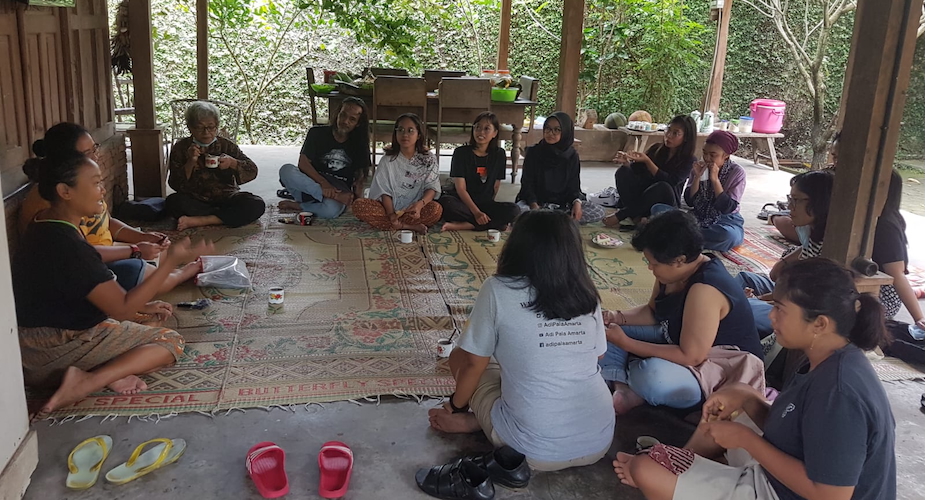
By 1985, we welcomed our first guests. They came not for luxury, but for clarity. We offered conversations about ritual, cooking with local ingredients, and language as a way of listening. The village was poor—unpaved roads, no electricity, no running water. Our presence stirred quiet reactions: not voiced but felt. In Bali, suspicion travels slowly. There was envy, yes, and unease—especially toward Dayu Mas’s caste and our shared position. But over time, the atmosphere settled.
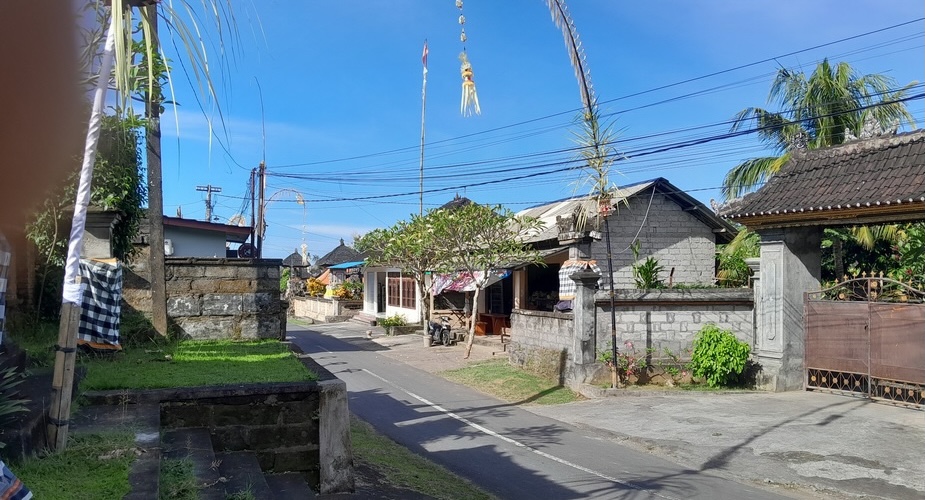
In the early years, tempo mattered. We did not schedule activities—we allowed them to unfold. Guests learned to wait for the right moment to ask questions, to observe without interpreting. Dayu Mas moved with quiet authority, preparing offerings, tending to the compound, and teaching through gesture. Her presence shaped the rhythm of the place. I translated, adapted, and listened. Our roles were not fixed—they responded to weather, ceremony, and quiet.
Local perception and quiet negotiation
The villagers of Medahan (Kemenuh) did not oppose SUA Bali directly. There were no protests, no petitions. But silence is not absence. In the early years, some neighbours watched from a distance—curious, cautious, uncertain. The compound was not gated, but it was marked by difference: guests arrived in taxis, spoke foreign languages, and stayed for weeks. The rhythms of the compound were not yet the rhythms of the village.
Dayu Mas’s caste added complexity in a village with only ‘commoners’. As a brahman woman, she carried both reverence and suspicion. Some villagers saw her role as rightful; others questioned the arrangement. Our collaboration was unusual—neither fully Balinese nor fully foreign. It required constant adjustment, quiet listening, and the refusal to simplify. We did not explain ourselves—we adapted.
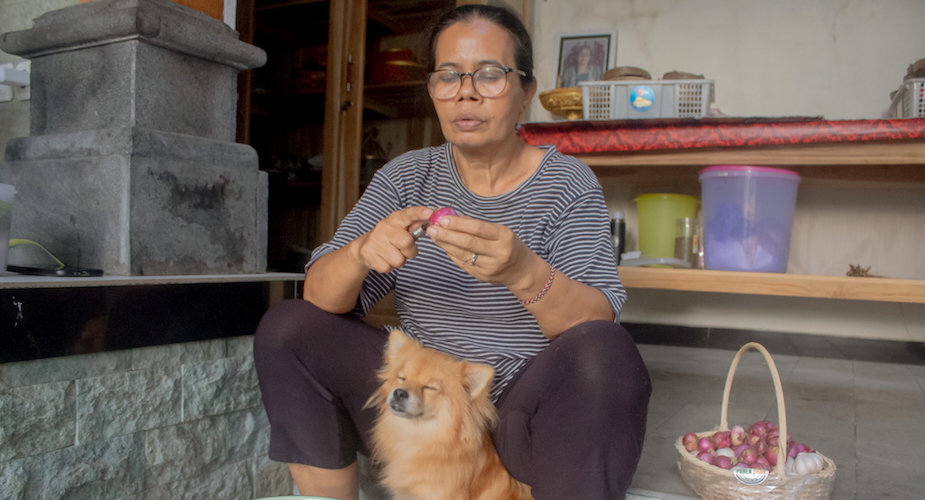
Over time, the compound became part of the village rhythm. We attended ceremonies, hosted language classes for local youth, and adjusted our routines to village events. When a neighbour died, we paused our activities. When a procession passed, we stepped aside. Integration was not declared—it was practiced. The compound became porous. Children wandered in. Dogs slept under the pavilions. Offerings were placed at the threshold.
Still, there were moments of tension. A neighbour once accused us of withholding temple contributions. Another questioned our use of water during the dry season. These were not confrontations—they were tests. We responded not with defence, but with presence. We showed up, listened, adjusted. In Bali, opposition is rarely loud. It is atmospheric. It arrives through gesture, timing, and tone.
The rise of enclaves
Just a few kilometres away, a different vision of refuge is taking shape. Nuanu (and the controversial PARQ Ubud)—both funded by Russian entrepreneur Sergey Solonin—present themselves as ecological sanctuaries. Their websites speak of creativity, sustainability, and community. Their buildings are striking, their activities selective, and their boundaries firm.
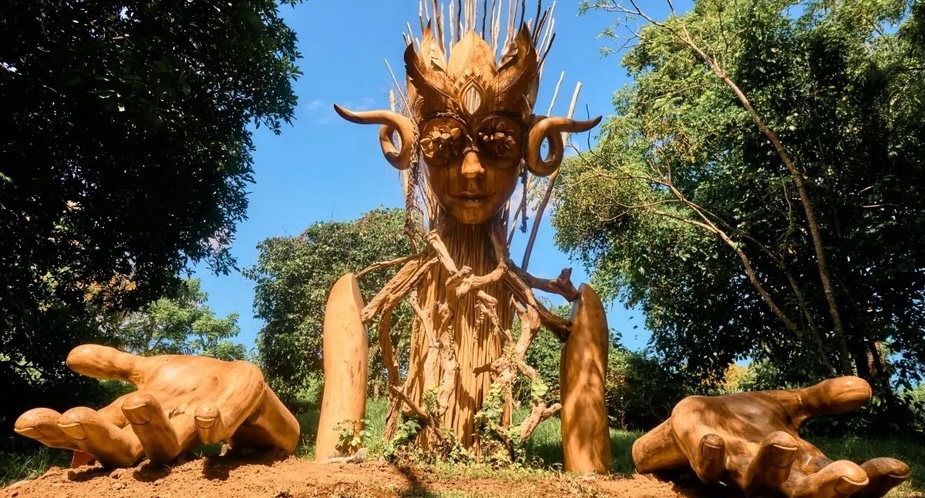
But beneath the surface lies a deeper impulse: to create separation. These compounds are not neutral. They aestheticise refuge while eroding its meaning. Their design signals exclusivity, their language flattens nuance, and their presence reshapes local geographies. Nuanu, with its ‘creative city’ language, turns community into a managed experience—selective, insulated, and sealed. Under new management since it was shutdown by Gianyar Regency Government in early 2025 after the owners failed to comply with various regulations, PARQ Ubud offers luxury not to the displaced, but to the elite.
The compounds are often described as ‘visionary’, but their vision rarely includes the surrounding village. Their entrances are guarded, their programming inward-facing. Guests arrive for workshops, festivals, and retreats—but rarely walk the village paths or attend local ceremonies. The compounds speak of transformation, but their transformation is vertical: towers, domes, and amphitheatres that rise above the rice fields.
This verticality matters. It signals control, not care. It interrupts the horizon, reorders the landscape, and teaches the eye to look up—not across. In Bali, ritual space is not horizontal—it is directional. Offerings are placed in relation to the mountain and the sea, shrines are nestled beneath trees but oriented upward, and processions move not just slowly, but with spatial intent. Orientation begins with the mountain—kaja—and moves clockwise: to the east, to the sea, to the west. The compounds echo this layout—many are aligned toward the mountain, toward the sea, to the east, and to the west. The orientation is architectural, not ritual. They elevate with precision, isolate through scale, and perform without resonance.
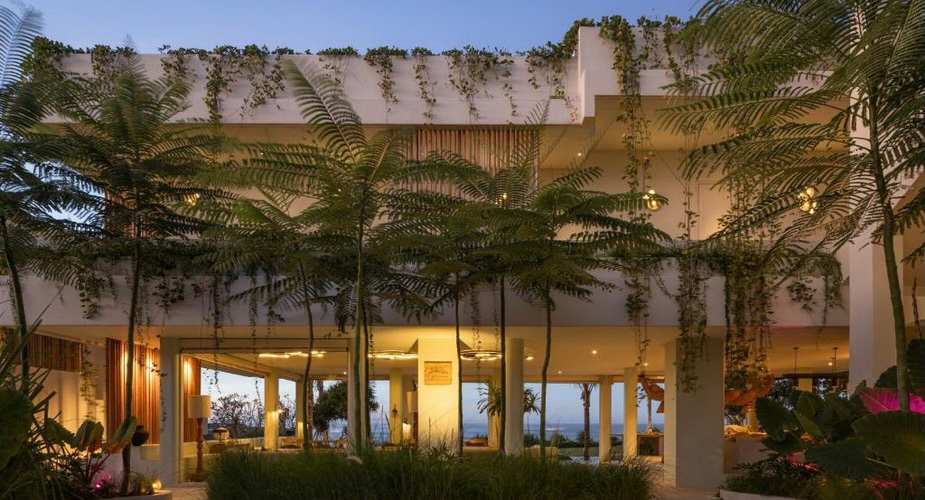
Local villagers, meanwhile, are hired as staff—gardeners, drivers, cooks—but rarely invited into the social fabric. Their presence is functional, not relational. The compounds promise innovation but rarely engage with the cultural labour that sustains the land they occupy. The architecture is not modest—it performs.
Architecture as ideology
Architecture encodes intent. In Bali today, it increasingly displays power—through scale, symmetry, and spectacle. Oversized temple entrances at places like Pura Gumang, Pura Ulu Watu and Pura Lempuyang no longer invite—they dominate. Their proportions are not for ritual passage, but for photographic awe. They reshape sacred space into backdrop.
State-funded sculptures such as Garuda Wisnu Kencana and the Arjuna chariot near Ngurah Rai Airport teach the public to equate size with significance. These monuments do not emerge from communal need—they are imposed. Built with taxpayer money, they serve a visual ideology: grandeur as governance, iconography as control.
This ideology is not just visual—it is spatial. It teaches people to move differently, to pause for spectacle rather than for prayer. Visitors are guided by signage, not by intuition. Paths are widened for selfies, not for processions. The architecture no longer holds ritual—it holds attention.

And yet, opposition exists. Not in headlines, but in gestures: a priest who refuses to bless a new gate, a village that declines to host a ceremony, a grandmother who continues to place offerings at a modest shrine rather than the monumental padmasana. These are not protests—they are refusals to be absorbed.
Sound, silence, and ritual
Music has always been part of the compound’s rhythm—not as performance, but as presence. I’ve spent years listening, recording, and tracing how sound moves through ritual, weather, and daily life. Gamelan drifts in from a nearby banjar, a flute may rise at dusk, kendang echoes during a temple ceremony. These recordings are not collections—they are continuities, prepared for a website-based archive. The compound does not curate sound—it receives it. Each note, each silence, becomes part of the living record.
Listening itself becomes a form of care. We do not amplify—we receive. A dog barking, a rooster calling, the rustle of bamboo in wind—each sound carries a signal. When the compound falls silent at night, it is not empty. It is attentive. Silence after rain, silence before a ceremony, silence when a guest leaves—these are not gaps. They are transitions.
I have spent years recording and tracing how ritual and music shape each other. The archives we care for are not collections—they are echoes. I prepare them for a website-based archive, not to display, but to offer continuity. Sound, like ritual, does not insist—it returns.
Care as response
In a landscape increasingly shaped by display, quiet care becomes a form of resistance. At SUA Bali, we do not reject change—we adapt carefully. We engage with regulations, navigate digital migration, and respond to ethical dilemmas. But we do so without spectacle. The work is quiet: repairing roofs before the monsoon, adjusting drainage, documenting each shift as part of a living archive.
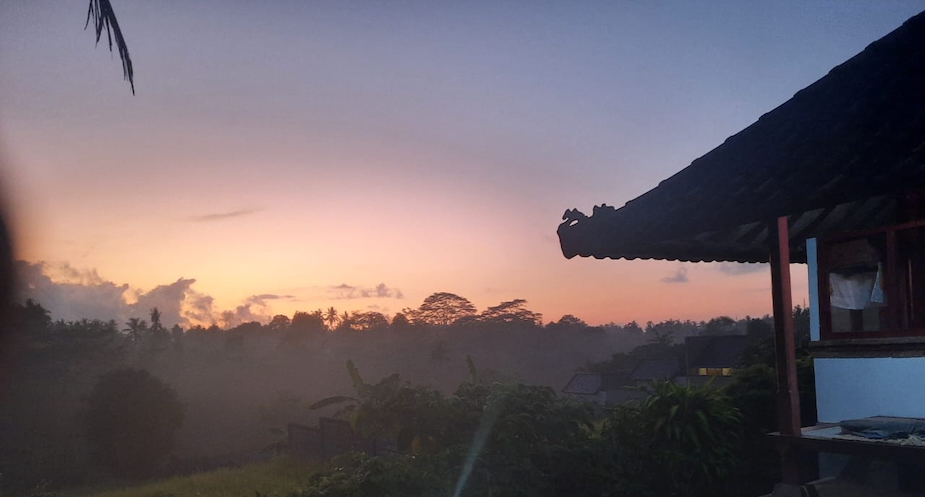
This is not nostalgia. It is attention. It is a way of holding space—for reflection, for continuity, for the dignity of care. Guests who stay longer begin to notice what is not said: the rhythm of offerings, the silence after rain, the way a procession moves through the village without announcement.
SUA Bali does not isolate—it listens. It does not display—it shelters. In doing so, it offers a modest answer to the forces reshaping Bali: a place where presence is not staged, and meaning is not lost to scale.
Danker Schaareman is an anthropologist who has worked in Bali since 1972. After periods in Tabanan and Jakarta, he now lives permanently in Gianyar, where he works with ritual and cultural practice as part of daily life. His research includes the relationship between music and ritual, the care of historical music archives being prepared for a website-based archive, and a PhD thesis on adat and social organisation in an East Balinese village.