From Koperasi Merah Putih to hedge funds and IPOs
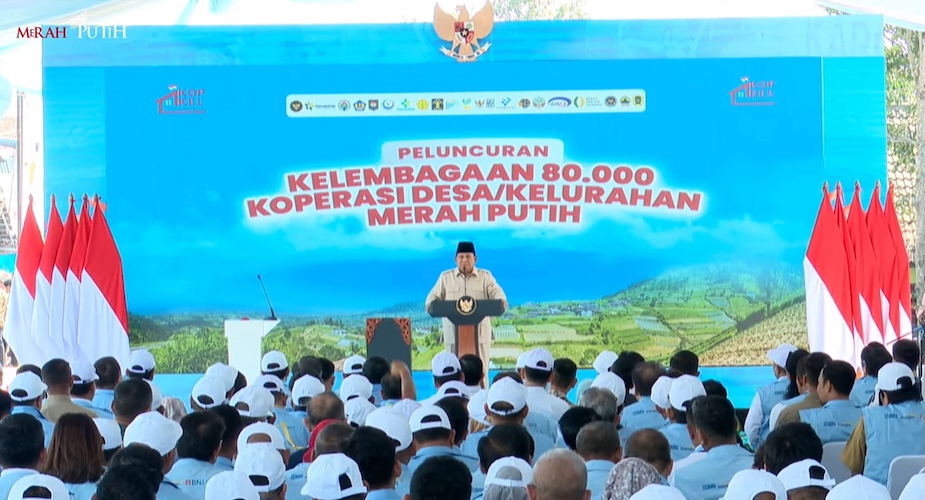
Cooperatives are making a comeback. This time, they are coloured in red and white. The government’s Koperasi Merah Putih (Red and White Cooperative) promises to revive Indonesia’s long-standing ideal of small-scale collective enterprise while ushering them into a new financial age. But behind the patriotic palette lies a different ambition: to make rural poverty investible, turning what was once a bottom-up solidarity model into something treated as an investible asset.
This idea of cooperatives as engines of rural development is not new. Since their colonial inception, cooperatives have been positioned as instruments of collective risk-buffering in the absence of collateral. But Koperasi Merah Putih imagines something far larger. Its goals are built around scaling up, absorbing land and infrastructure, and competing like a business. The future it projects is shaped less by rural realities than by financial fantasies, asking communities to operate at a scale and with an investment logic few can sustain.
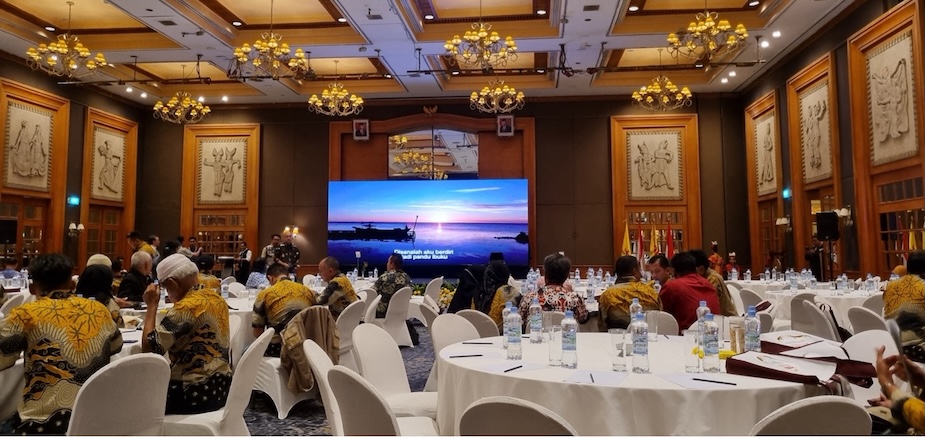
So, what kind of cooperative is this and what future does it imagine? The clearest clues came not from policy documents, but from the people who believe they can shape how future financing is imagined. During my fieldwork on plantation debt between 2023 and 2024, I attended several national consolidation meetings for palm oil smallholders. These gatherings, usually held in hotel ballrooms near Jakarta’s financial district, were organised by smallholder unions with financial support from the state to socialise new labour and environmental regulations. In Indonesia’s palm oil sector, company-bind smallholders, known as plasma, have been organised into cooperatives since the 1990s, which mediate access to credit, supply chains and state subsidies.
At one such meeting in mid-2023, a young sustainable finance consultant, invited by the union as an outside expert, stood before hundreds of cooperative leaders, district officials and company representatives. With the confidence of an investment banker in a Hollywood film, he spoke of cooperative Initial Public Offerings (IPOs), hedge fund interest and the importance of taking on 'productive debt'. His vision was bold, even seductive, and yet detached from the structural limits smallholders face.
What follows is an attempt to unpack that moment. Not because it was exceptional, but because it captures the sweeping dreams of scale now shaping how cooperatives are imagined, financed, and, through Koperasi Merah Putih, governed.
The pitch begins
The lights of the five-star hotel ballroom dimmed as the moderator announced the final session of the day. Titled ‘Searching for Alternative Financing Models for Smallholders’, the session promised to move beyond familiar discussions of subsidies and productivity towards new financial arrangements that could make cooperatives appear more autonomous, scalable and investible. The room had already sat through seven hours of dense PowerPoint presentations and glossy promotional videos about soaring yields and biofuel futures. Then, from the back, a group of young men in crisp shirts and sneakers stood up, carrying laptops and tablets that set them apart from the rest of the room.
The moderator, eager to wrap up the session with a hopeful note, introduced them as representatives from a sustainable-finance NGO. Officials from the Ministry of Finance, district heads and corporate managers from the previous session were still on stage, but the participants had already started adjusting their seats in anticipation of the next speaker. As the microphone travelled from the stage, the first speaker offered a polished opening line.
‘I’ll come at this from an investment angle, thinking specifically about how we accelerate sustainable growth for smallholders while keeping environmental goals in focus.’
‘The big story globally right now is impact investing. Environmental, Social Governance (ESG) funds are gaining serious momentum, and investors are increasingly asking what kind of return they’re getting, not just financially but also socially and environmentally.’
The room, half-lit by the glow of the LCD screen, fell silent. District officials shuffled papers, trying to keep pace with a presentation that was drifting into unfamiliar territory. Smallholders leaned forward, curious about the promise of new investment opportunities. The consultant’s steady, confident cadence filled the space.
Opportunity in sustainability
After conferring briefly with his colleague, the consultant shifted tone. ‘So if we’re all here talking about sustainability, then let’s unpack that. What kind of sustainability are we actually aiming for?’ A pause. A practiced, strategic suspension.
‘Is it about existing partnership schemes that can be built into financial structures like blended finance, multi-stakeholder partnerships backed by institutional capital? Where do banks, hedge funds, and maybe even capital markets fit into this equation?’
Then, a pivot.
'But really, this is all to say, from an investor’s perspective, the shift toward sustainable plantations isn’t just a moral imperative—it’s a business opportunity. So what does that actually mean on the ground?’
The consultant’s use of we folded everyone in the room, from smallholders and bureaucrats to managers and financiers, into a single imagined community of investors. Sustainability no longer referred to ecological balance or collective welfare. It was recast as a strategy for attracting capital and securing returns.
In the ballroom, this way of thinking was already taking shape as common sense: the assumption that rural transformation required scale, that debt could be recast as productive rather burdensome, and that access to markets was the primary pathway to progress.
By 2025, the state began speaking in a strikingly similar register. Palm oil estates were reclassified as ‘strategic national assets,’ and over 1.5 million hectares of ‘confiscated’ corporate plantations were transferred to a new state-owned firm, Agrinas Palma Nusantara, led largely by military officers. Replanting aging crops and refinancing were no longer agricultural policy; they were matters of national security.
The consultant was not a state representative. Yet his pitch articulated a financial logic increasingly shared by banks and policymakers alike: the belief that financial instruments could succeed where decades of agricultural policy had fallen short. As he spoke of hedge funds and blended finance, his optimism carried a harder edge – the conviction that capital, properly mobilised, could achieve what public programs had repeatedly failed to deliver.
The debt doctrine
With a shift in tone, blending technical and provocation, the consultant pressed on. This time, with a touch of dry humour.
‘There are basically two main sources of capital: grants and loans. And debt? As long as it’s productive, it’s not a problem—in fact, it’s essential.’
He paused, letting the provocation sink in. Then:
‘Sir and madam, I assure you, there’s no such thing as a serious company that doesn’t carry some debt. Sure, debt comes with interest, but for businesses to be sustainable, the terms can actually be more favourable if they meet the right standards.’
Previous speakers nodded approvingly from the stage. In the audience, however, reactions were mixed. Some were curious but many were uneasy. I could understand why. For smallholders present, debt was not an emblem of seriousness but a shadow that stretched across generations. Some had spent decades paying off loans from earlier state-promoted planting credit; others were still waiting for promised subsidies to materialise. This was a point they have been making throughout the day but always dismissed by whomever had the floor.
Here, indebtedness was rehabilitated as a marker of modern enterprise rather than a source of vulnerability. Debt, usually a source of anxiety and precarity, was rebranded as ‘productive,’ even patriotic. The speaker’s certainty echoed the confidence of motivational speakers in personal and household financial planning and literacy classes.
An economy of scale
The consultant moved toward his conclusion.
‘If debt isn’t an option [for you], then cooperatives can look at long-term investors or equity financing. But the bigger picture here is scale. That’s the real gap.’
‘Corporations grow faster largely because they can secure funding more easily, If they need capital, they can issue bonds and access the market relatively quickly. And now, there’s a growing pool of investors actively looking for opportunities in sustainable markets.’
‘That said, if a cooperative has strong growth potential—say, through replanting—it’s doing many of the same things corporations do, just on a smaller scale. That’s an opportunity. With the right partners and a solid business case, cooperatives can function as business incubators.’
Then, the crescendo.
‘We’ve already seen examples, like in Japan, where cooperatives operate with the sophistication of corporations. Some even create corporate entities to manage and aggregate smaller groups underneath them. If they grow big enough, they can even go public through an IPO and attract institutional investors.’
A hush. The phrase ‘go public’ hung in the air like a glitch in translation.
The image was dazzling but surreal: a cooperative IPO, complete with ticker symbols and hedge-fund backers swirling through their plantation villages. I typed a note to myself: ‘does he know what he’s talking about?’
At my table, a cooperative leader whispered to a colleague that his group had not received a single grant payment in two years and the government kept sending vague signals. While financiers dreamed of equity and liquidity, smallholders still struggled to access subsidised credit. The dream of scale masked the deep inequalities already in the system. To attract investors, cooperatives were expected to behave like corporations, whether or not that made sense for them.
What lingered after the presentation was not conviction but awe, the kind of suspended disbelief that keeps a dream alive. Everyone knew a cooperative IPO was unlikely. Yet its improbability gave it moral weight. The pitch was less a plan than a fantasy; a belief about what rural life might become if it aligned itself with financial markets and kept hoping.
Here I was reminded of anthropologist Hirokazu Miyazaki’s notion of an economy of dreams. Writing about a small group of derivative traders in Japan, Miyazaki described how capitalism endures through belief, by acting as if the future it imagines has already arrived. Arbitrage was not just calculation of potential profit to come, but a form of faith. It is a way of holding doubt and hope together to sustain capitalism’s motion even when its promises falter.
The consultant’s pitch worked in precisely this way. He did not persuade the room so much as give confident, compelling form to a financial common sense already circulating among banks and development intermediaries – one in which scale, debt and market access did not need to be immediately achievable to be taken seriously, only imaginable and worth aspiring to. Even those who doubted the proposal were drawn, if only briefly, into its imaginative horizon. In that moment of suspended disbelief, the dream acquired its power.
State discipline
What appeared as a distant fantasy in the ballroom soon reappeared in institutional form. In the months that followed, the dream he sketched where cooperatives are scalable, mounting debt turns productive, and rural enterprises began IPOs has found a concrete policy vehicle in the Koperasi Merah Putih.
Framed as patriotic renewal, the Koperasi Merah Putih promises to unify smallholders – and rural populations more broadly – under the red-and-white banner while ‘democratising’ financial access. The new finance minister’s injection of roughly Rp.200 trillion from the central bank into state-owned banks to ease credit for the scheme turned this vision into something the state could fund. Dana Desa (village funds), Dana Alokasi Umum (general allocation funds) and Dana Bagi Hasil (revenue-sharing) are now accepted as collateral for a cooperative’s loan to state-owned banks. In this framework, taking on debt becomes a sign of empowerment, and the circulation of credit stands in as evidence of national progress.
For many smallholders, the shift must have feel like déjà vu. Cooperatives have collapsed faster than crops mature. Savings have vanished without clear explanation. Plantation partnership schemes and grant programmes promise prosperity and deliver dependency. Only the vocabulary has changed: ESG, impact investing, digital inclusion. The language of global finance now fuses with the idioms of nationalism, repainting old hierarchies in red and white.
Looking back, the consultant’s words read almost like prophecy. His vision of debt as virtue and scale as destiny was not adopted literally, but its logic shaped policy thinking. Koperasi Merah Putih does not demand IPOs or hedge funds. Yet it treats cooperatives as if they must behave like investment-ready firms, assuming rural futures can be secured through liquidity and large-scale consolidation.
Smallholders, meanwhile, remain burdened by old debts, uneven support and the collapse of earlier cooperative schemes. These dreams of scale were never only about money. They were about who gets to imagine the future, and who bears the costs of that imagination. And once again, smallholders are being asked to shoulder the risks of someone else’s dream now coloured in red and white.
Atmaezer H. Simanjuntak (Ara) (Ara.simanjuntak@outlook.com) is research fellow at the Institute for Advanced Research (IFAR) Atma Jaya University. He received his Ph.D. from Northwestern University’s Department of Anthropology with a research interest on the intersections of finance, land and labour in Southeast Asia.