
Citizens act to reclaim democracy
Civil disobedience arises when a significant number of citizens have become convinced either that the normal channels of change no longer function, and grievances will not be heard or acted upon, or that, on the contrary, the government has embarked upon and persists in modes of action whose legality and constitutionality are open to grave doubt.
— Hannah Arendt, Crises of the Republic, 1972
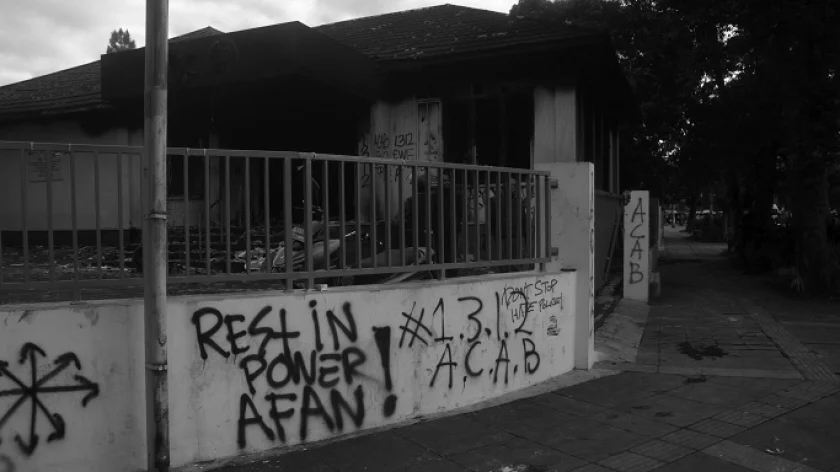
To equate dissent with crime is to undermine the foundations of democracy. This danger became clear after the August 2025 protests across Indonesia. On the evening of 28 August 2025, a police tactical vehicle drove into a crowd in Central Jakarta, killing Affan Kurniawan, a young online motorbike driver. Within hours videos circulated on social media. Affan’s name became a rallying cry as solidarity actions and protests spread beyond Jakarta to other major cities such as Yogyakarta, Bandung and Makassar. His death was more than an isolated tragedy, as outrage over his death merged with broader criticism of police violence, state neglect, and the perceived arrogance of political elites.
Protesters condemned the hasty implementation of national programs like Makan Bergizi Gratis (Free Nutritious Meals) and questioned the proposal to fund housing allowances for members of parliament during times of economic hardship. Though diverse in their specific concerns, protesters shared a growing sense that the government was no longer accountable to those being governed.
Criminalising protest, controlling dissent
The wave of protests eventually subsided after a coalition of policy analysts and activists united around ‘17+8’ demands that got widely circulated on social media. The list combines 17 immediate demands and eight longer-term reforms drawn from civil society statements. The immediate demands called for urgent government action, including investigating protest-related deaths and releasing detained demonstrators. The longer-term demands aimed for structural reforms, such as fairer tax policies, stronger anti-corruption laws and reform of the police. However, this was followed by a crackdown on protest and digital activism, with over 1000 people detained (reported numbers vary).
Among those that were detained were human rights activists and community organisers like Delpedro Marhaen, Syahdan Hussein, Muzaffar Salim and Khariq Anhar, as well as Laras Faizati, an ordinary citizen arrested for expressing her support for the protest online. Laras Faizati was charged with incitement after prosecutors alleged that her social media posts encouraged protesters to attack the National Police Headquarters. On 15 January 2026, the South Jakarta District Court found her guilty but imposed a six-month probationary sentence, ordering her immediate release from detention.
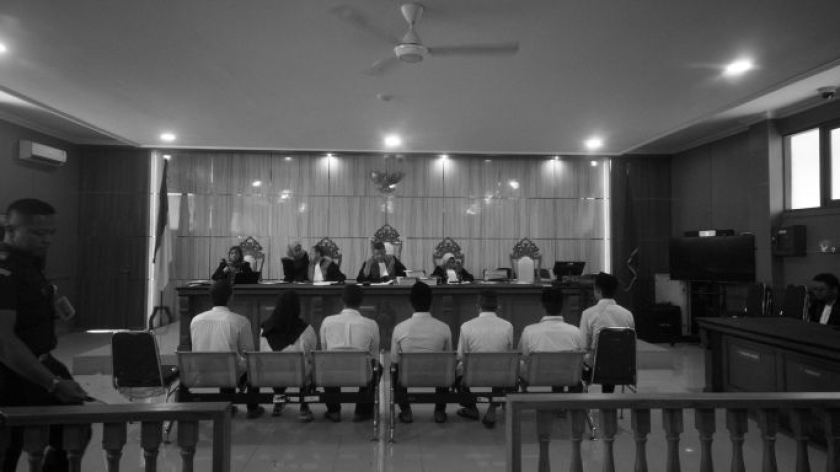
On 2 March, Delpedro Marhaen, Syahdan Hussein, Muzaffar Salim and Khariq Anhar appeared before the Central Jakarta District Court to deliver their personal defense notes. Prosecutors demanded two-year prison sentences, accusing them of spreading social media posts that incited demonstrations and hostility towards the government. The defendants denied the charges. On 6 March, the Central Jakarta District Court acquitted all four activists of incitement charges linked to the August 2025 protests. Coordinating Minister for Law, Human Rights, Immigration and Correctional Institutions, Yusril Ihza Mahendra, urged prosecutors not to pursue a cassation, stating that the decision should be treated as final. Khariq Anhar must still face a separate trial under the Electronic Information and Transactions Law (UU ITE).
Elsewhere in the country, activists Aditya Dwi Laksana and Mochamad Naufal Taufiqurahman, were detained after joining solidarity protests for Affan Kurniawan in Bandung. Both were reportedly seized on 14 September 2025 by individuals believed to be security officers and taken in for questioning. They were allegedly subjected to physical violence during the arrest, and several of their personal belongings were confiscated. It was noted that several of the confiscated items were not clearly recorded in the official list of evidence. On 23 February 2026, Adit and Naufal were found guilty by the Bandung District Court of violence causing injuries and property damage in the August–September protests. However, the defence team at LBH Bandung (Bandung Legal Aid) argued that the judges’ decision was excessive, as it failed to adequately consider the defense arguments, evidence, and witness testimonies presented during the trial. Both have filed appeals through the Bandung District Court.
Some arrests were also reported in online media and social media, but it was underreported in mainstream outlets. In one case, eight defendants, including Rifa Rahnabila, were prosecuted for posting messages on social media during the August–September demonstrations in Bandung that authorities deemed offensive towards the police. However, others passed largely unnoticed, leaving the fate of those detained unclear.
In mid-February 2026, the Komisi Pencari Fakta (Fact-Finding Commission), established by a coalition of civil society organisations, released its report on the protests and the violence surrounding them. The report documented 13 deaths linked to the protests, including the death of Alfarisi, who was allegedly abused by state security officers while in detention at a facility in Surabaya. It also reported that, as of 14 February 2026, the Gerakan Muda Lawan Kriminalisasi (Youth Movement Against Criminalisation) had recorded 703 political detainees facing prosecution, with 506 already convicted despite the absence of clear causal links between the alleged acts and the charges brought against them. The fate of 31 others remains unknown.
To understand these events, it’s important to recognise that protest is not unusual in a democratic society. In the field of contentious politics, sociologists like Charles Tilly and Sidney Tarrow describe such actions as part of a ‘repertoire of contention,’ recognisable forms of collective action used by citizens to make demands on political authorities. The August 2025 protests revealed growing frustration with perceived impunity and the gap between democratic promises and reality. However, instead of addressing these concerns, the government has increasingly tried to frame protesting as criminal activity that causes public disorder, even going as far as accusing protesters of engaging in treason(makar) and terrorism.
Protesters and digital activists were arrested under provisions of the Criminal Code, public order regulations and the Undang-Undang Informasi dan Transaksi Elektronik (Electronic Information and Transactions Law). Digital space, once celebrated for expanding democratic participation, became a medium for monitoring and controlling dissent.
This shift raises a fundamental question: what does the criminalisation of dissent reveal about the current state of democracy in Indonesia?
Civil disobedience and democracy
Political theorist Hannah Arendt offers a useful framework for understanding these events. Writing in the context of civil rights and anti-war protests in the United States, she argues that civil disobedience signals a democratic crisis – a rupture in the relationship between citizens and the state. It arises when citizens lose faith in institutions because existing mechanisms – legal procedures, representative bodies and bureaucratic channels – fail to address their concerns. Civil disobedience is not simply a rejection of authority. While it may indicate a revolutionary situation, civil disobedience rarely results in revolution. Protesters primarily highlight that there is a breach in the contract between the governed and those who govern. Throughout the history of Indonesia, civil disobedience usually results in counterrevolution or inaction, although it may also lead to regime change, as was witnessed in 1998. The government may double down to suppress dissent and public attention may eventually drift. Yet, even when it does not deliver immediate transformation, civil disobedience can disrupt the appearance of consensus and air uncomfortable questions in the open. Thus, challenging the legitimacy of those in power.
A defining feature of civil disobedience, Arendt argues, is its public character. Unlike criminal acts, which are concealed, civil disobedience deliberately makes itself visible. Protesters publicly confront injustice and invite scrutiny by taking to the streets or using social media to voice their demands and show support. Protest becomes an ongoing process of articulation through which citizens transform their grievances into political claims and assert their demands.
Arendt also challenges the idea that civil disobedience is simply a matter of individual conscience or personal morality – a view often associated with Henry David Thoreau. While Thoreau’s refusal to pay taxes in protest against slavery is frequently celebrated as an act of moral courage, such acts remain fundamentally individual. Civil disobedience, by contrast, is essentially collective and grounded in shared political judgement.
Whether an act of protest can be attributed to individual conscience or collective action for the common good is an important question for jurists, through which the character of the nation-state can be drawn. Framing dissent as mere expressions of individual wrongdoing allows for the dismissal of protesters as irresponsible or disruptive. Labelling them as rioters or ‘agent provocateurs’ relies on such a moralising frame. By individualising dissent, the government can dismiss the legitimate political concerns that gave rise to the August 2025 protests.
Protesters were not simply seeking to maintain their own moral integrity or to engage in what might be dismissed as ‘feel-good politics’ . They sought to draw attention to shared injustices – impunity, devaluation of life, flawed national programs and eroded accountability. The aftermath of the August 2025 protests reveals that the struggle over the right to voice dissent is ultimately a struggle over democracy itself.
In times of crisis, civil disobedience becomes not only legitimate but necessary. As Arendt understood, it is not a threat to democracy but one of the essential conditions for its renewal. Ultimately, it affirms the principle that political authority is derived from the consent of the governed.
Mirna Nadia (mirnanadia@u.northwestern.edu) studied sociology at Northwestern University. Her research examines citizenship, state power, and the politics of belonging.
This article is part of a collection of articles examining the August 2025 protests.