
Is KGMP working to assist workers or to nullify resistance?
The gig economy has continuously served as a backup plan when formal jobs are hard to find. In Indonesia, the number of people working in this sector has reached a considerable level, with more than two million people involved in 2019. In online transportation alone, the number of drivers increased from just 4000 in 2015 to around seven million by 2025. The total could even higher as more digital platforms offering different services continue to grow.
Despite the growing number of gig workers, their working conditions remain far from decent. Many studies have shown how precarious work in this sector continues to be. This is also echoed by findings from Fairwork Indonesia’s research, in which I was involved, showing that all ten assessed platform companies fell short of guaranteeing a decent work environment for their workers. Many workers report declining earnings, rising platform commissions, longer working hours and minimal insurance coverage. At the same time, opaque algorithms determine how orders are distributed, leaving workers totally clueless whether distance, performance or other factors actually matter.
When it comes to building collective representation, gig workers in Indonesia face significant structural barriers. Communities or associations established by gig workers cannot be formally recognised due to the absence of a clear legal framework governing the gig economy and the limited political space for collective organising. These obstacles are further exacerbated by the nature of gig work itself, where workers are dispersed and operate on an individual basis, making collective action even harder to sustain. Yet, worker solidarity remains essential, as collective organising is one of the new ways gig workers can push for better working conditions.
Despite these challenges, gig workers in Indonesia have continued to organise independently, particularly in the online transportation sector. Various associations have emerged, including ADO (Asosiasi Driver Online), GARDA (Gabungan Aksi Roda Dua), and SPAI (Serikat Pekerja Online Indonesia), among others. These groups have consistently fought for better working conditions by organising demonstrations in several cities. Their demands are clear: the government must introduce specific regulations for gig workers; platform companies must roll back harmful policies, especially those related to tariffs that continue to rise for consumers while drivers’ earnings stagnate, and also reconsider platform commission fees that take a substantial share of each trip, sometimes exceeding the legally mandated maximum of 20 per cent.
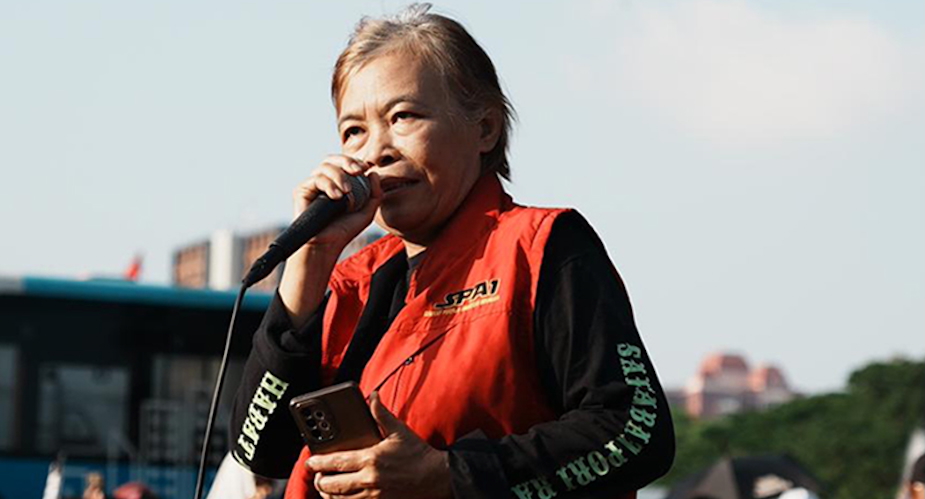
Yet the growth of gig worker organising has also prompted a response from platform companies. Rather than addressing workers’ grievances directly, some companies have begun establishing their own ‘official’ driver communities. By offering selective benefits to drivers who join these groups, companies can co-opt influential drivers and weaken independent organising. As a result, the demands raised by self-organised gig worker associations are often discouraged by fellow drivers who participate in these platform-initiated communities. This dynamic reflects a familiar pattern in Indonesian politics: patron-client relations that divide workers and redirect grievances away from the companies themselves.
When representation becomes an illusion
Isn’t it a good measure when platform companies provide a channel for workers through an ‘official’ community? On the surface, yes, but when we examine how these communities are designed and controlled, the answer tells a different story. Under the logic of capitalism, platform companies seek to maximise profits. Undermining workers’ attempts to organise can become part of this strategy, as collective bargaining could lead to better working conditions and higher pay that may reduce company margins. In this context, forming a drivers’ community is one of the ways to secure their goals while discouraging collective action.
One platform company that has formed a drivers’ community is Gojek–one of Indonesia’s largest ride-hailing platforms. In late 2024, Gojek’s management launched KGMP (Keluarga Gojek Merah Putih/Gojek Red and White Family), a program presented as a means of supporting and protecting its drivers. Drivers can register to become members of this family and subsequently receive some benefits, such as health protection and accident insurance–benefits that should, in principle, apply to all drivers in the first place.
This community operates on a regional basis (e.g. KGMP Jakarta Barat, KGMP Depok, KGMP Bandung, KGMP Semarang). Through KGMP, platform management and drivers regularly hold in-person meetings to share information about platform policies. This might sound ideal. However, the forum is not designed around principles of equality, leaving drivers with little room to negotiate with management or simply challenge policies they consider unjust. ‘No one really pushes back in the forum with the platform. If anything, dissatisfaction is more often expressed informally afterwards,’ a member explained. KGMP therefore falls short of providing meaningful representation for drivers.
Platform management is deeply involved in the formation of KGMP. This top-down process begins with the designation of regions and the appointment of a leader for each area. Each leader, known as Kepala Keluarga (Head of Family), is responsible for coordinating the community at the regional level and acting as a bridge between drivers and platform representatives.
In mid-2025, I interviewed one of KGMP’s Kepala Keluarga. She described the process that led to her appointment. ‘I received a message from the head office inviting me to take part in a Zoom interview. To ensure that the interview ran smoothly, I was advised to go to a branch office so I could use their laptop and internet connection. The interview was pleasant, although it felt like a formal job interview,’ she recalled. She believed that platform management had first identified drivers who had influence within their social circle (tongkrongan) and invited them to participate in the selection process. ‘Thankfully, I was chosen as Kepala Keluarga,’ she said.
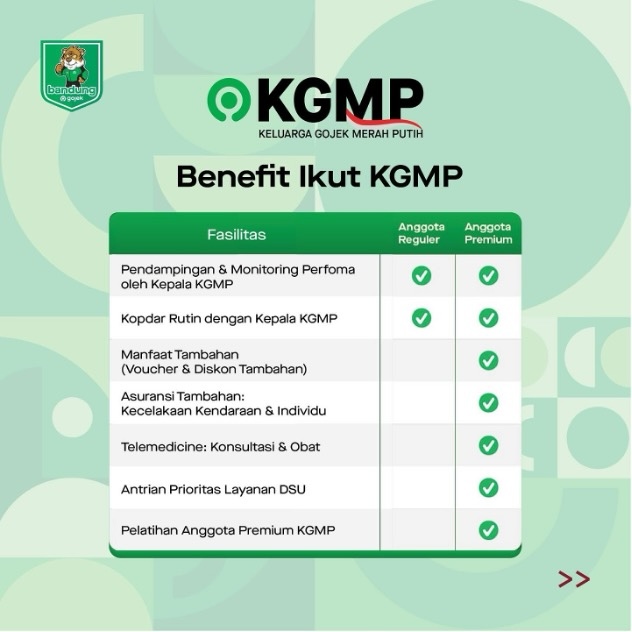
The Kepala Keluarga position comes with significant privileges. They receive applications from drivers seeking to join KGMP and have the authority to decide which applications are accepted or rejected, sometimes merely based on personal preference. This arrangement raises concerns about inclusivity, suggesting that not all drivers have equal access to the community. This exclusion is reinforced by the way membership itself is structured. KGMP membership is divided into regular and premium categories. Drivers who opt for premium membership are required to contribute Rp.3000 (US$0.18) per day or a maximum of Rp.75,000 (US$4.42) per month. In return, they receive additional benefits, including discount vouchers, advanced training programs, insurance and health coverage, telemedicine services and faster responses to reported issues. The incentive extend upwards as well: the more premium members enrolled, the greater the benefit for the Kepala Keluarga, who receives an incentive equal to 30 per cent of the total premium contributions–adding a financial dimension to the role’s privileges.
The creation of KGMP appears to reflect a strategy of co-optation, offering selective privileges to drivers who join the community. In doing so, it subtly draws a line between “insiders” and “others”, fragmenting drivers who might otherwise act collectively and steering them instead toward a form of social hierarchy within the driver community. One driver who joined KGMP told me that his account became more gacor (slang term from ‘gampang cari order’ meaning ‘easier to receive orders’) after he registered a member. More broadly, being part of platform-initiated community often places drivers closer to platform decision-makers, allowing everyday problems to be resolved through informal channels. When issues such as account suspensions occur, members can rely on the Kepala Keluarga to act as intermediaries, often speeding up resolutions compared to the formal routes available to non-members.
Turning workers against each other
With these benefits in place, the platform company effectively reassures KGMP members that the work ecosystem is functioning as intended. Consequently registered members tend to feel more valued and more inclined to believe that policies adopted by platform management–including those related to tariffs and platform deduction fees–will work in their favour through KGMP. They are therefore more likely to defend the platform company when their fellow drivers engage in public protests to demand better working conditions. One Kepala Keluarga even told me that the platform company has full authority to determine which policies to implement. ‘As the owner of the technology, they are entitled to set the rules. After all, no one is forced to register as an online driver in the first place,’ she noted.
There have long been competing narratives between self-organised gig worker associations and platform-initiated communities. For instance, when several associations call for a reduction in platform fees from 20 to 10 per cent, members of platform-initiated communities often oppose the proposal with the argument that the decrease would harm the ecosystem. They firmly believe that platform fees enable all online drivers to enjoy various benefits, such as insurance, protection and other favourable programs. However, the actual allocation of these platform fees remains obscure, as companies rarely detail how the commissions are used or what proportion directly supports driver welfare.
Furthermore, when public protests organised by independent associations take place, platform-initiated communities frequently dilute the movement by encouraging their peers to boycott and instead continue working to earn income. One driver who is not a KGMP member and has been actively advocating for drivers’ rights shared this view, ‘Drivers who are part of platform-initiated communities rarely join street demonstrations because they have already been told by the platform that our demand (to reduce the platform fees to 10 per cent) is unreasonable.’
Whether drivers genuinely accept this claim or are influenced by the benefits attached to membership, the outcome is similar. Drivers affiliated with these communities tend to stay away from collective protest, weakening mobilisation efforts led by independent associations.
Self-organised gig worker associations have staged continuous strikes, with at least 27 public protests taking place between 2023 and 2025. While these actions have helped raise public awareness, workers’ conditions have not significantly improved. In fact, some drivers perceive conditions as worsening, particularly with new mechanisms introduced by platform companies that require drivers to pay a deposit to increase their chances of receiving orders. In July 2025, the Ministry of Transportation held a focus group discussion with several worker associations to discuss the appropriate level of platform fees. Out of 16 associations invited, only two supported capping the platform fee at ten per cent, while the remaining associations favoured a higher rate. The forum reportedly became chaotic as a result, and it was suspected to be unfair because it mainly invited associations whose members were affiliated with platform-initiated communities.
Such fragmentation has made efforts to demand better working conditions far more arduous. Workers are not only forced to confront the platform companies but must also contend with divisions among their fellow workers. Platform-initiated communities can thus be understood as a divide-and-rule strategy designed to weaken workers’ collective bargaining power. Meanwhile, it is still the industry’s behemoth–armed with technology and capital–that continue to shape the new landscape of work and must ultimately be held accountable.
In this context, gig worker associations need to build alliances beyond their own circles, reaching out to civil society groups that may differ in identity but share similar struggles and aspirations. Partnering with traditional trade unions, for instance, could also help amplify their voices. Through broader solidarity, such alliances can generate greater public and political pressure in support of fairer and more decent working conditions.
Adriansyah Dhani Darmawan (adriansyahdhani@cipg.or.id) is a Research Associate at the Centre for Innovation Policy and Governance (CIPG).