A Christian city makes space for inclusion
This is a story about Easter in Kupang, where the celebration takes shape through two processions across sea and streets. I did not witness the first directly. I reconstruct it from conversations with those who took part. I stood along the roadside for the second, the largest, and watched it pass.
Easter Sunday 2026. It is mid-morning and the weather is calm. Along Kupang Bay, dozens of boats move toward the shore near the old town square. Some carry crosses and banners. Others remain plain fishing vessels. Muslim fishing communities join the movement and travel alongside Christian groups at the same pace. All boats fly the red and white flag, marking a shared national frame.
From the shore, people watch the boats approach in a loose formation. The sea is calm. The movement is steady and unhurried.
Before dispersing, a short scene takes place on the beach. It recalls the moment when Jesus shows himself to his disciples by the shore of Galilee. The staging is minimal. A figure stands near the water. Others gather around him. The sea itself becomes the backdrop.
Then the scene gives way to something more familiar. Fires are lit. Fish are placed on grills. Smoke drifts across the sand. The smell of grilled fish spreads through the crowd. People sit, stand, and wait. Then they begin to eat.
What begins as a biblical scene becomes a shared meal.
Just above the shoreline, on a raised concrete platform, a small cluster of women’s stalls appears. They sell drinks, snacks, and prepared food. Some bring coolers filled with water and ice. Others cook on the spot. Their presence sustains the gathering. People buy, share, and linger longer because of them.
I see this as the first parade. It moves across the sea, then settles on land. It shifts from boats to shore, from scripture to food, from performance to livelihood. The sea carries the story inward. The land receives it and turns it into everyday practice.
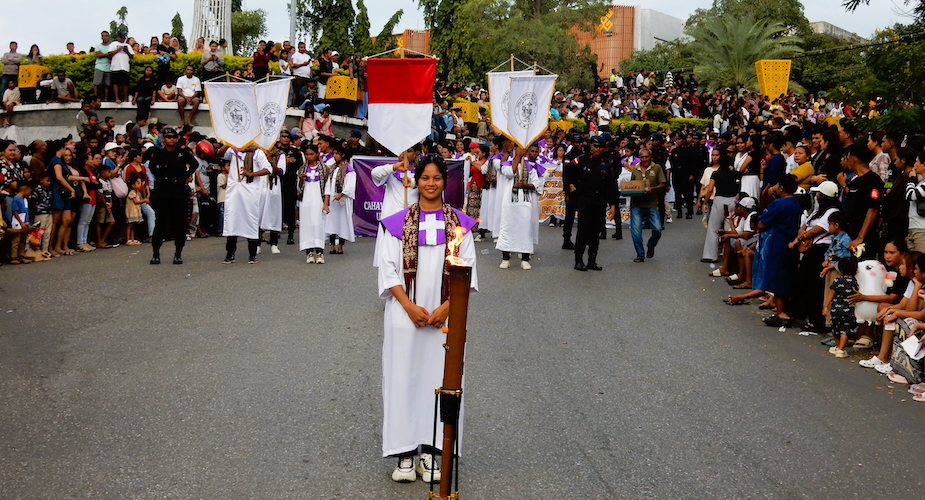
The second parade moves in the opposite direction. It begins on land and spreads across the city.
By mid-morning on Easter Monday, the heat is already rising. The city begins to slow. Traffic thins, then gives way entirely to a convoy of modified freight trucks.
This parade began in 1996 and has grown over time. It paused during the COVID-19 pandemic and resumed last year. This year, it connects more closely with the movement at the sea. It has also drawn national attention, with the Vice President of Indonesia travelling from Jakarta to open the procession.
Yet what stands out is not its scale. It is how it is ordered, how it moves, and how people take part along the way.
Before any biblical scenes appear, a different procession moves first.
An open pick-up approaches. Elderly men and women sit close together in the back. One person near the driver holds a microphone. As the vehicle passes, he begins by wishing the crowd a Happy Easter. He then adds greetings for Eid and Nyepi, both of which have just passed. His words move across religious moments, linking them together. He encourages people to respect one another and to live in peace. He speaks of Indonesia, then of the Middle East, and then of the wider world. The vehicle moves slowly as his voice carries across the crowd.
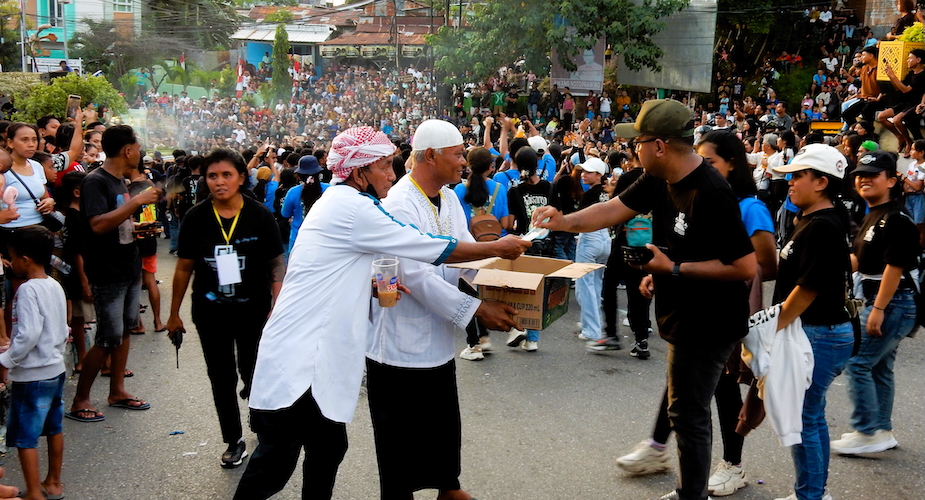
This opening sets the terms of the parade. Before any biblical scene appears, the procession begins with an act of recognition that crosses religious and social boundaries. It places communities alongside one another and establishes a shared ground for what follows.
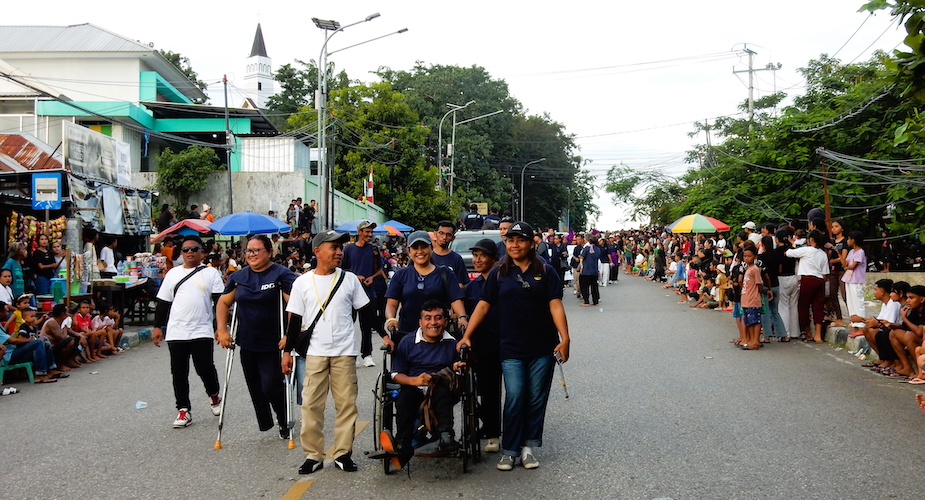
Behind them come people with disabilities. They walk together at their own pace, holding banners that call for inclusion. Others adjust without being asked. Space opens around them as they pass.
Then a group of women follows. They sing as they move. Their voices rise above the crowd. Banners tied to both sides of their truck call for an end to violence against women and children. The message is visible from a distance and carried forward as they move. Some spectators begin to sing along.
These groups pass first. They lead. They set the rhythm for everything that follows.
Watching them, I see how the parade reshapes public life. Those often placed at the edges appear at the front. The elderly open the procession with a language of respect and coexistence. People with disabilities shape the pace and make inclusion visible through their movement. Women carry voice and message into the street, naming forms of violence that often remain unspoken.
The biblical narrative does not open the procession. It enters a space already defined by these acts.
Only after they pass do the trucks carrying biblical scenes begin to arrive.
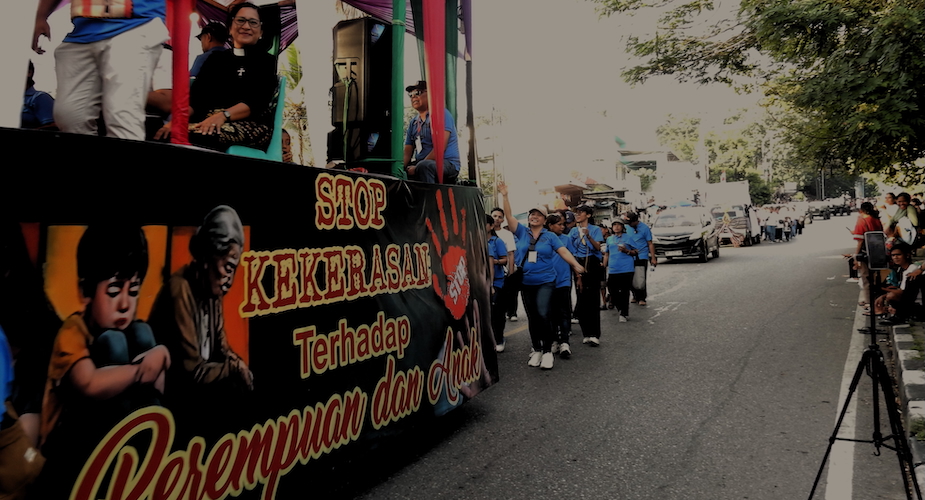
Each truck becomes a moving stage. Young people perform Adam and Eve, Abraham, Moses, David, the birth of Jesus, the Passion, the crucifixion, and the ascension. Between the trucks, groups walk and sing. Loudspeakers and small bands carry hymns and praise through the streets.
These vehicles are part of the city’s everyday infrastructure. They usually carry goods, crops, and materials across the island. Here, they carry stories. They continue to move and transport, but what they carry changes.
From time to time, the convoy slows and stops. Performers step down and reenact short scenes on the road. The flow pauses. People draw closer. Voices quiet. For a moment, the story stands still and takes place in front of us.
Around me, the response shifts with it. A young man points at the serpent in the Adam and Eve scene and jokes that it looks like a character from a film. As the Passion scene passes, a woman encourages her son to step forward and take a photo with the figure of Jesus. The boy hesitates, then walks up, poses briefly, and returns to her side.
Phones rise across the crowd. Some record short videos. Others stream the procession live. Screens glow as each scene passes. The story moves through the street and across digital networks at the same time.
Anthropologist Webb Keane reminds us that religion becomes perceptible through material forms. In Kupang, I see this across settings, from sea to land, from neighbourhoods to the city, through costumes, sound systems, painted props, and vehicles. These elements do not simply display the biblical story. They carry it into public space and place it within familiar forms.
Ikat textiles and local dance anchor biblical figures in local settings, from Moses and the Israelites to the men carrying the cross. The scenes do not feel out of place. They move easily within the flow of the procession, as if these figures have always belonged here.
This is most striking in the moment of ascension. A bucket truck lifts the figure of Jesus above the crowd. The movement is slow and mechanical, the same motion used for roadside maintenance and repair. Yet it marks a passage from ground to sky. For a brief moment, the machinery of the city makes transcendence visible, before lowering the figure again as the convoy moves on.
Along the roadside, women’s micro and small enterprises appear again. Stalls line the route. They sell drinks, food, and small goods. Their work sustains the flow of the parade. People walk for hours under the sun. Others stand and watch. These stalls make that possible.
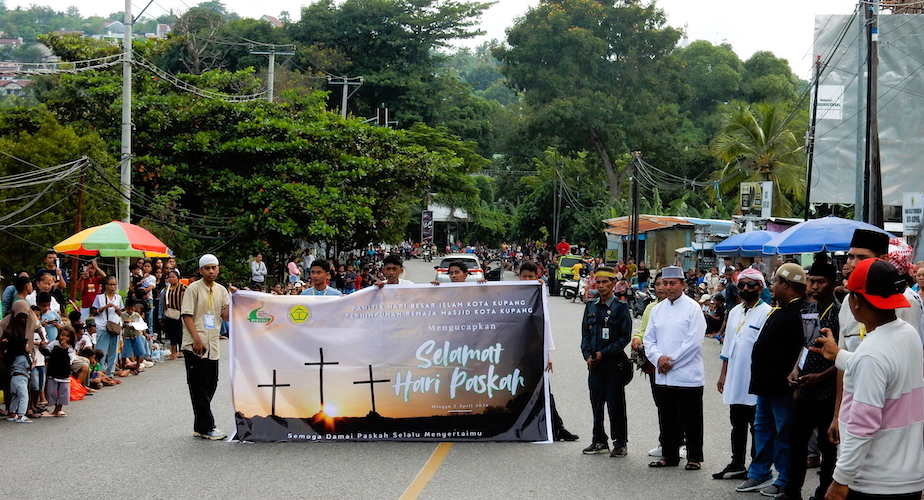
Members of the Muslim community also stand along parts of the route. They hold banners wishing a happy Easter. Some pass water to those walking. Others help clear space as the convoy approaches. These gestures are small but repeated. Like the fishing communities the day before, they move alongside the event without interrupting it.
As a whole, the two parades reveal a pattern. One moves from sea to land. The other moves across land through the city. One gathers and settles. The other circulates and extends. One turns scripture into a shared meal. The other carries it through infrastructure and public space.
For me, this is where their significance lies. These parades do more than express faith. They organise how people appear together in public. It shows that Christian practice does not remain confined to church walls but moves with people through the everyday life and public infrastructure that sustain it. They also reorder what comes first. The elderly lead with prayer. People with disabilities lead with presence. Women lead with voice and organisation. Women’s small enterprises sustain the crowd across both shore and street.
The biblical story remains central. But it moves within a wider field of action. It follows people who make claims about respect, care, and inclusion. What emerges is not only a religious event, but a way of imagining how a city might hold together. Not by erasing difference, but by organising space so that difference can be seen, heard, and sustained. In this arrangement, coexistence is not an abstract ideal. It is practiced, negotiated, and made visible in real time.
By the end of Monday, traffic returns. The crowds disperse. The city resumes its routine.
Yet something remains. The two parades leave a trace of how Kupang imagines itself. Not only as a Christian city, but as a place where people move together, work together, eat together, and make space for one another in public.
For a brief time, I see that possibility made visible.
Andrey Damaledo (Andrey.Damaledo@anu.edu.au) is a visiting fellow in the School of Culture, History and Language at the Australian National University. All photos are by the author.