Indigenous Papuans use culture and Christianity to defend the land
Indigenous communities of several ethnolinguistic groups across South Papua province have erected customary barricades (palang adat) and red-painted crosses (salib merah) to stop the government and corporations from seizing their lands and destroying their forests. Known as the Red Crosses Movement (Gerakan Salib Merah), it blends elements of custom, Christianity, and law to resist land-grabbing and deforestation carried out under the banner of ‘National Strategic Projects’ (Proyek Strategis Nasional, PSN) for food and energy production, targeting an area of two and a half million hectares.
At least 1,800 customary barricades and red crosses have been erected over the past few years. The movement continues to spread throughout Papua, particularly among the Awyu, Mandobo, Yei and Marind people in the regencies of Boven Digoel, Mappi, and Merauke. These areas in South Papua are being rapidly colonised by massive new plantations. More recently, a red cross has also been planted in Jayapura, one of Papua’s major cities.
I was fortunate to visit more than a hundred of these blockades. I witnessed firsthand how some were erected in an Awyu community in Boven Digoel in September 2024, and another in Jayapura on Human Rights Day, 10 December 2024. Most of the crosses I visited stood about seven metres tall.
Beside the red cross there stood a ‘customary marker’ — either a single upright pole or two wooden beams bound together to form a cross. Another marker is referred to as Papan MK 35. Papan means ‘plank,’ and MK stands for Mahkamah Konstitusi, the country’s Constitutional Court. On it was written an excerpt from Constitutional Court Decision No. 35/ 2012: ‘Customary land is not state land.’ And next to it, the inscription: ‘This land belongs to Sonu Sobu Subang,’ that is, the Supreme Divine Being in the Awyu language.
Hendrikus Frangky Woro, one of the leaders of the red crosses movement, told me:
This land belongs to God. God gave it to our ancestors and us to care for. We will protect it and pass it down to our children and grandchildren. We don’t want companies to take this land away.
This is clearly a socio-religious movement with economic, political, and ecological dimensions. It aims to defend land and territory, identity, and the right to determine one’s own future. Eclectic in nature, the movement blends elements of tradition, religion (both indigenous and Christian), and law as the foundations of indigenous struggle.
‘Our homeland’
The process of erecting blockades that I witnessed unfolded as follows. The wood for the crosses had been prepared months or weeks in advance at predetermined locations. In the days leading up to the event, community meetings were held among kin groups, clans, and communities. The chosen site was cleared, and a tower-like structure called para-para was built to raise the cross. The wood for both the customary marker and the red cross was painted red.
On the day, participants arrived wearing traditional costumes and accessories. Besides clan members, there were representatives from customary alliances with other clans or tribes. Once all materials had been prepared, the ceremony commenced.
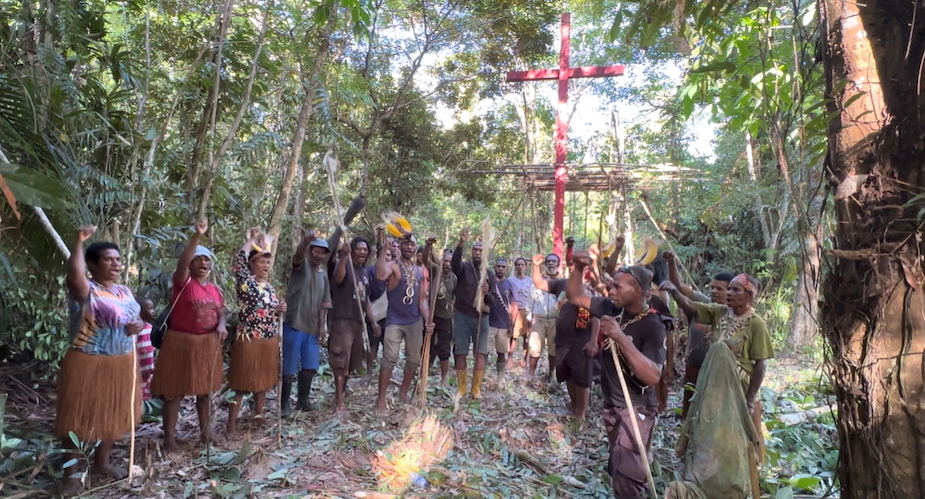
A senior leader first spoke, emphasising the importance of the cross at that specific location and its link to other crosses placed elsewhere. Everyone then participated in a procession, singing and dancing to the rhythm of the tifa drum.
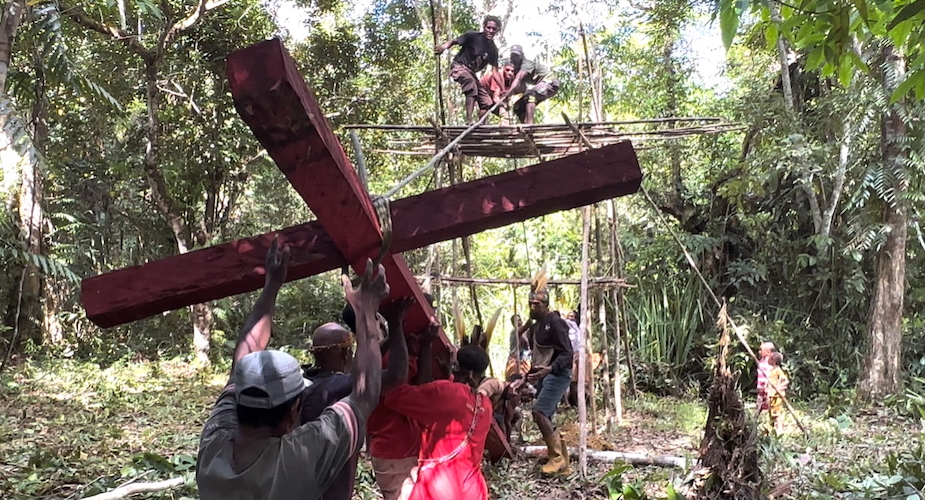
The cross was attached to a long rope running over the tower and a beam used as a pulley. Several women standing behind the tower held the end of the rope. During the lifting, several men in front of the tower pushed the cross upward. Other men on top of it pulled the cross upward, while the women helped by pulling on the rope. Amid songs and shouts, they raised the cross together. Singing and dancing continued as several men reinforced the base of the cross.
This was followed by planting the customary barricade and the MK 35 signboard, again accompanied by singing and dancing. Afterwards, there were Christian prayers and hymns.
The ceremony was conducted mainly in the Awyu language, with occasional use of Indonesian.
After everything was complete, I was asked to record a video of their declaration. This opened and closed with the shout Wiha Nasohoa! — meaning ‘This is our homeland!’ A leader then led the declaration, echoed by the crowd:
Papua
# Not Empty Land
Indigenous People
# We Are Still Here
Customary Land
# Not State Property
Corporations
# Reject! Reject! Reject!
The entire event concluded with a leader’s words of thanks, followed by shared food and drink.
I heard that in some places, especially at special sites like sacred locations, installing crosses was accompanied by more elaborate traditional rituals. At other times, the Christian liturgy, including a mass, was incorporated. This occurred during the earlier phase of the movement from 2016 to 2019, when a Catholic priest in the area, Father Nikodemus Rumbayan MSC, actively supported the movement.
Warning
The red cross movement started around 2014 in response to large-scale projects that seized indigenous lands and destroyed the forest - living space for indigenous Papuans and some of the world’s remaining rich biodiversity.
The Merauke Integrated Food and Energy Estate (MIFEE) was later continued under the National Strategic Projects (PSN) for Food and Energy. Under both, the Indonesian government issued extensive corporate concessions for oil palm plantations, sugarcane, rice fields, and other agribusiness ventures. In South Papua alone, the targeted area reached up to two and a half million hectares.
To oppose these projects, traditional barricades and red crosses were set up as blockades at key locations important to indigenous people: clan lands, sacred sites, historical locations, ancestral routes, subsistence areas, and sites of vital biodiversity.
Some of these areas had already been designated as concessions by the government to corporations; others were suspected by customary owners to be under covert negotiation between the Jakarta government, corporations, and local elites. These landscapes are also crucial ecological ones for Papua’s biodiversity.
The blockades are forms of direct action familiar in modern social movement strategies. But they also revitalise and transform traditional marking practices. These were used in the past to protect territories during conflicts with neighbouring groups. Hayo and Miri are two significant marking practices among the Awyu people.
A Hayo can be placed on a tree in a clan’s communal forest. It signals that the person who placed it intends to use that tree, perhaps to build a canoe or a house. A Hayo sign next to an aromatic Agarwood tree signals that other clan members cannot harvest it because it has already been taken.
Miri is typically placed at territorial boundaries to mark the edges of a clan or tribal area. It serves to prevent intruders or to contest claims by other groups. Miri functions as a warning signal. When outsiders cross or remove the sign, they are seen as ignoring or violating the warning — an act viewed as a deliberate provocation of conflict or war. Conversely, respecting a Miri indicates peaceful intent.
When asked about the origins of the movement, leaders explained that the red crosses are both signs of prohibition (drawing on the meanings of Hayo and Miri) and signs of peace (tanda perdamaian).
They will sometimes also use the term Sasi. This traditional custom, widely recognised across eastern Indonesia, restricts the harvesting of certain natural resources, on land or at sea, for a period to preserve ecological balance and promote sustainability.
Unlike Sasi, however, Miri serves as a warning for outsiders not to enter a clan’s or tribe’s territory. It commands respect for the rights of the community that erected it. Violating a Miri is equivalent to provoking war.
Although non-violent in nature, customary blockades are a new articulation of indigenous resistance. They are signs of prohibition. Corporations, the government, or their local collaborators who violate them are seen as deliberate provoking conflict, or even war, with the indigenous communities that put them up.
‘We really hoped for justice’
The blockades are just one of many efforts by indigenous Papuans to defend their land and forests. They also collaborate with NGOs to form a broader social movement. Together, they develop strategies of resistance and advocacy, learn data collection and analysis, strengthen community organisation, engage in campaigns, and pursue legal action.
Members of the Awyu community, from the Woro clan, filed an administrative lawsuit against the permit granted to PT Indo Asiana Lestari. This company wanted to ‘develop’ 36,000 hectares of their ancestral lands and forests. Unfortunately, they lost their case in the Administrative Courts (PTUN) in Jayapura, and again in Manado. They then appealed to the Supreme Court in Jakarta, where the justices again rejected it. The verdict was issued in September 2024, just a week after I saw three additional crosses being installed in Yare village. This village is part of Woro clan territory, and lies within Fofi district, Boven Digoel regency, South Papua province.
Frangky Woro and his community were disappointed over the ruling, but did not appear defeated. ‘The struggle continues,’ he told me. Having failed to secure justice through the legal process, they now rely on the forms of defence they have built over the past ten years: erecting customary barricades and red crosses in the locations targeted by companies. Frangky continued:
‘We really hoped for justice from the Supreme Court, but it seems this country offers no justice. We are not thieves. The land and forest do not belong to the companies. We will continue to fight.’
Yet the activists of the red cross movement I followed still hope that Indonesian and Papuan officials will respect their rights. They continue to demand state recognition of those rights. As Kaspar Mukri from Yare village put it: ‘We ask the government to give us weapons to fight the companies.’ By ‘weapons,’ he meant official documents — legal proof that they can use to face companies that come to steal their land and forests.
Direct action
Some might view this continued hope in the Indonesian state as naïve. Yet, isn’t that what a state is supposed to provide — justice and protection? Sadly, what Papuans face today is a state that is extractive, colonial, and racist in nature. The state seizes indigenous land and hands it over to corporations and settlers (pendatang). It treats Papua as empty land. They see its inhabitants as incapable of managing themselves — requiring supervision by colonial authorities and instruction from settlers considered more advanced in agriculture and modern life.
Their traditional ways of living — how they manage, care for, and make use of the landscape and the forest — are dismissed as primitive and in need of replacement by Indonesia’s version of ‘modern’ agriculture.
The Papuan people reject this colonial and racist state. After failing through lawsuits and negotiations, the movement has now become their main strategy. Kasimilus Awe, another Awyu leader I followed, testified:
‘In our efforts to defend our land and forest, we ask for help from God as the Creator of the universe and our ancestors as the owners of this land…. Attributes of war inscribed or drawn on the crosses are meant to show that we strictly prohibit anyone from entering or disturbing our territory. These are warning blockades. If anyone breaches these blockades or threatens the safety of our ancestral lands and rights, we are prepared to fight a war.’
Indeed, the movement represents a physical and spiritual resistance, which confronts the government and corporations at the very sites of their extractive projects. It is nonviolent yet brave, progressive, and radical. The movement has spread widely: 1,800 crosses have been erected across three administrative regencies. And it is still growing. It is a mass movement.
Unlike legal struggles in court, which remain under state control, this direct action is led and owned by the communities themselves. Unlike the conspiracies of Jakarta’s elites to exploit Papua’s natural wealth and repress its people, this direct action is carried out openly, so that it can be witnessed by the world.
While welcoming researchers, journalists, filmmakers, and other activists as witnesses to the erection of the crosses, indigenous Papuans also seek to build transnational solidarity.
Immediately after the cross-planting ceremony in Yare, I was asked to disseminate the video and share their message with the government, corporations, journalists, and networks of civil society in Indonesia and internationally. They also asked that it be shared online.
Their words were clear:
‘Please tell the whole world. This is a sign of prohibition. We don’t want the government or companies to enter and destroy our land. Papua is not an empty land.’
Their blockades are also performative acts, for the world to see and pay attention.
Indigenous Christianity
Two interconnected issues have spurred my interest in following the movement in South Papua in recent years.
First, I study the forms of resistance and self-determination developed by indigenous Papuans in response to the colonial models of development imposed by external powers through religious, state, and corporate structures. These models claim to bring ‘progress’ and ‘prosperity’ to indigenous Papuans — who are often labeled as backward, undeveloped, and in need of external intervention.
In response to this model of colonial development, Papuans have not stayed silent. They have organised themselves to protect their land, forests, identities, and their envisioned futures. Today, movements for self-determination appear in various forms — socially, economically, politically, and culturally.
Second, I am interested in the forms of indigenous Christianity that have emerged in Papua in recent years. I mean by this a Christianity adopted, adapted, and developed by indigenous people themselves, based on their ways of thinking, cosmologies, and social organisation — a faith they control and shape according to their own understandings.
This kind of Christianity often represents a complex synthesis between indigenous religion/ customary beliefs (agama adat) and new Christian elements. Indigenous Christianity stands apart from — and sometimes directly opposes — colonial Christianity and settler Christianity.
By confronting colonial forms of Christianity, indigenous Papuans have sought to take over Christianity itself — to reinterpret it in their own terms. They are reclaiming theological, institutional, and political control, and using it as a means of empowerment against colonial domination. In some cases, they have even used Christianity as a tool of decolonisation and emancipation, in the face of ongoing projects of conquest and control.
I argue that the red crosses movement is one of the manifestations of indigenous Christianity in this sense. I continue to learn from this movement, to understand its deepest meanings and messages, and to communicate them to a wider audience. I hope for more understanding of the strong messages embodied in the movement — especially by the government and corporations seeking to appropriate the lands and natural wealth of Papua for profit and accumulation.
Churches should also try to understand it —in Papua, across Indonesia, and worldwide. Their empathy will help prevent it being easily criminalised or dismissed as a ‘deviant’ form of Christianity.
A deeper, more empathetic understanding from the broader public too — in Indonesia and globally — may foster cross-border solidarity.
The activists of the Red Cross Movement in Papua are not only defending their own lands and forests. They are protecting the world’s remaining tropical forests and the immense biodiversity within them. Without their defence, Papua’s forests would already have been plundered by greedy corporations and the Indonesian government.
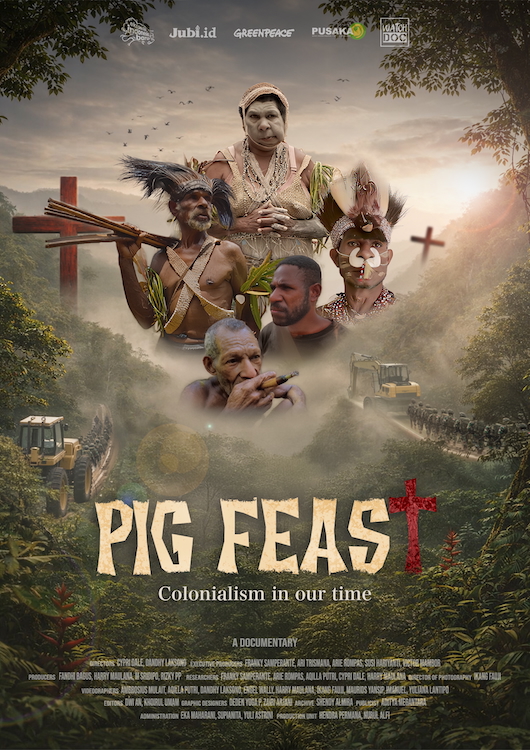
Cypri Jehan Paju Dale (cypri.jpd@gmail.com) is an anthropologist studying the politics of development, vernacular Christianities, and indigenous self-determination in West Papua. All photos are by the author. His film project, co-directed with Dandhy Laksono, titled Pesta Babi (Pig Feast: colonialism in our time), was released in March 2026.
An earlier version of this article was published in Bahasa Indonesia in Bulletin Kampung (Pusaka Bentala Rakyat) and Jubi Papua. I am grateful to Vincent Karowa, Frangky Woro, and Kasimilus Awe for their support during my fieldwork in 2024.