We, the Indigenous Peoples, are never alone.
When we stand on the land, we stand on living history. The land is not just a space for planting and building. The land, water, and all its riches are the bodies of our ancestors. It is a place of love, responsibility, and mandates passed down across generations. Indigenous territories are not property, not assets, not commodities. They are sacred living spaces that preserve relationships, cosmologies, and ways of life. We protect them not because of their economic value, but because they are the pulse of our shared life: a gift from our ancestors and the right of the younger generation and those who will be born in the future.
This is the song of the women who guard knowledge, tradition, and living practices. The nausus—whose knowledge and roles have long been marginalised. But it is precisely from the margins that they guard the earth, guard the world. The nausus do not just carry firewood and water. They carry history, devise strategies for survival, and stand on the front lines to defend a world that is being destroyed by greedy development.
Rituals are not relics of the past. They are not cultural decorations for tourism. They are political practices, strategies. They are a way of organising power, remembering origins, and connecting networks that cannot be measured by bureaucratic or legal parameters. Rituals cannot be captured in reports or development logic. But it is precisely because of this that they endure. They refuse to be rationalised, but they cannot be refuted. Because within them lies an agreement that is older than the state: an agreement with nature, with ancestors, with fellow human beings.
Time moves forward; many things change. Modernism and religions arrived with a mission of ‘purification,’ and severed the living connection with the world of our ancestors. New schools and legal systems forced us to forget our mother tongue, the names of our ancestors, customary laws, and history. The way of life, knowledge, and rituals of Indigenous Peoples are degraded as myths, as mystical, and their way of life is considered outdated. They are labelled ‘backward’, so that people may feel entitled to pursue progress and get rid of the Indigenous Peoples.
This is the clearest form of dispossession: that we are forced to relinquish our way of life, our relationship with the world, and our ancestors. We are not only dispossessed of our land, but also of our meaning, our language, and our way of caring for life. Our children are taught that printed maps are more valid than footsteps. That satellites know more than the sky we read every night.
The book discussed here is an attempt to seize and claim that space. To say: we are not silent. We are not extinct. We do not dwell in the romanticism of the past. The indigenous women in this book show that singing prayers is not a form of surrender, but a declaration of resistance. Offering sacrifices is not servitude, but an acknowledgement of a relationship with ancestors that cannot be nullified by laws or decrees. They revive and strengthen a channel of communication that has long been silenced: the channel between the body, the land, and memory.
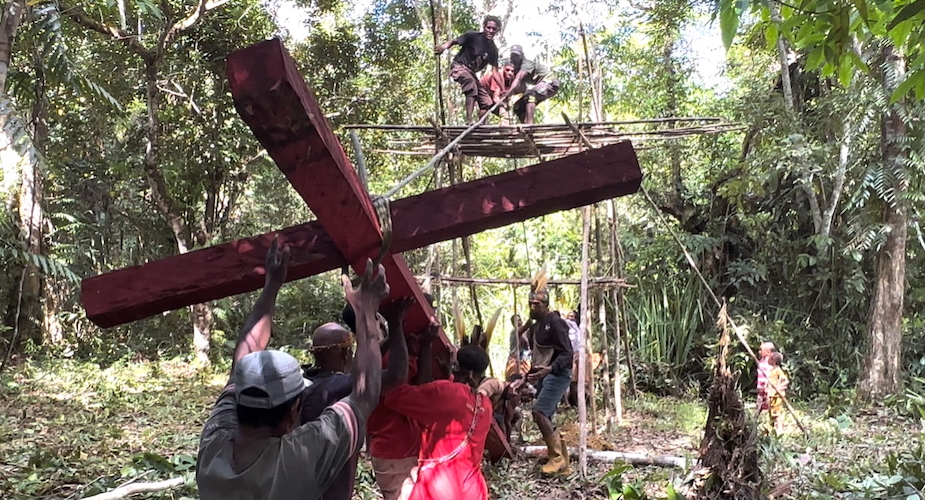
In Toraja, we believe that after death, we must be transported to Puya through a ritual. This is not merely a tradition. It is a living responsibility to those who have passed away. If the ritual is carried out sincerely, then our ancestors will remain with us—not as shadows of the past, but as guardians of our present lives. Therefore, children born after that must be introduced to their ancestors through rituals. Introduced to the guardians. That is the true meaning of rituals: to remember, to respect, to connect generations. Ancestors are not demons or devils, because every pulse and DNA we have comes from them. We are not descendants of demons!
The strengths of the nausus in this book do not come from a vacuum. They come from solid communities, from supportive networks, and from deep-rooted beliefs. Some were shaped by families that respect women's knowledge. Some grew up in religious groups or small communities that provided them with a starting point. However, their courage is not a gift or a privilege. It stems from their ability to break through barriers—barriers that, consciously or unconsciously, were put in place to restrict women.
These barriers come in many forms—doctrines that sever communication with ancestors, school curricula that distance our children from the history of their villages, even a culture of silence that forces women to bow their heads even though they know the truth. But these women transcend all of that. They do not merely hang on in their own village. They travel to other villages, reviving rituals, replanting seeds of knowledge, and summoning the spirits of their forebears into the heart of the struggle.
They fight not because they have no choice, but because there is too much at stake. They supply food during deliberations, ignite the spirit of struggle, and determine strategy. When the men are hunted down, kidnapped, imprisoned—they take over. They look after the children, the elderly, the fields, the village and the spirit. They are not just the rear guard. They are the front line. In Sangihe, in Kendeng, in Mollo—they are the ‘last woman standing.’ They are the ones who, when others are defeated, remain standing. They do not give up.
As long as these women remain standing, as long as they believe that seeds must be passed on, that rituals must be performed—then Indigenous Peoples will win the struggle.
Ultimately, the book Senjata kami adalah upacara adat [‘Our weapons are traditional ceremonies’] is part of a grand effort to reconnect broken channels. To rearrange the sound waves so that ancestors and the living can hear each other. The women in this book show that rituals are not mere relics. They are strategies for the future. They are a way to survive in a world that wants to uproot us.
As long as the rituals are still practised,
As long as we still acknowledge their existence,
As long as we still honour our ancestors,
As long as we believe that this land does not belong to individuals,
We will never be defeated.
And we will never be alone.
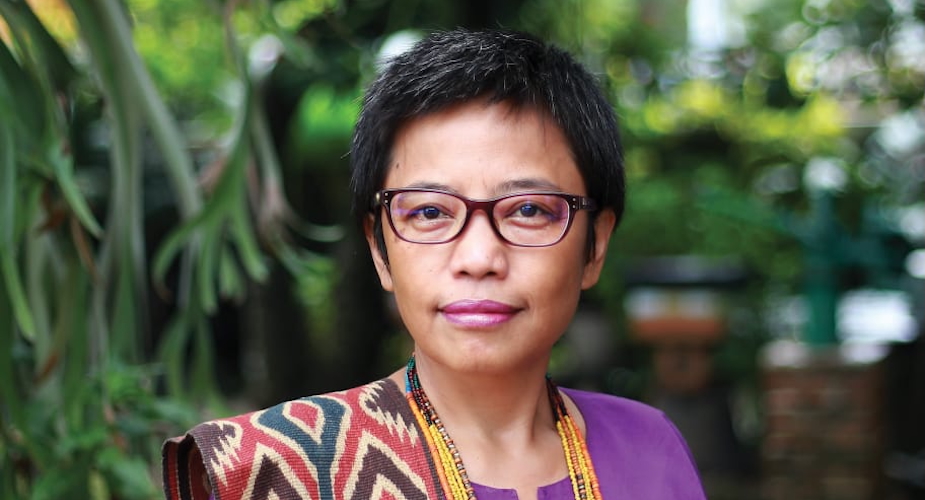
Rukka Sombolinggi is secretary-general of the Alliance of Indigenous People of the Archipelago (Aliansi Masyarakat Adat Nusantara, AMAN). She comes from Toraja, in Sulawesi.