A new way to write about mining and logging
Siti Maimunah in conversation with Gerry van Klinken
GvK: Mai, you finished your PhD dissertation at Passau University in Germany in 2022. It is about environmental protest at a logging and coal site in Central Kalimantan, and at a nickel mine in Sulawesi. You wrote it in a very unusual way – as a ‘life project,’ involving ‘auto-ethnography.’ This sounds like you yourself are part of the story, not standing outside looking in as in a ‘normal’ social science thesis. Can you tell us about this approach to writing about logging and mining? How did you come up with this idea?
SM: I used the term ‘life project’ because research cannot be separated from the activist life. In the late 1990s I studied agriculture at Jember University in East Java. I was astonished to discover that it takes 300-1000 years for nature to make just one centimetre of fertile soil. Mining washes that away for short-term profit, without thinking of nature. I joined the university Nature Lovers club (Mapensa). I learned and practised how to protect nature. We started protesting against plans by tycoon Jusuf Merukh to open a gold mine in the Meru Betiri National Park, quite close to Jember. This was the home of the last Javan Tigers.
My father was a small-time gold trader on the streets in Jember. For us as a Madurese family, gold had high symbolic value. At the Idul Fitri feast, it said ‘welfare;’ even if we had no money, we at least had our jewellery. But now I learned to look at gold in a different way.
Yusuf Merukh is also involved with the gigantic Batu Hijau gold mine in Sumbawa. It flushes over 100,000 tons of tailing waste into the ocean every day.
I started to learn about ‘extractivism.’ This draws the net much wider than just how not to run a particular mine. Extractivism is the wholesale removal of natural resources for export, with minimal processing. This connection between a mine in one place with global capitalism forced me to ask very big ethical questions, about how we as humans live with nature.
After graduating I joined Jatam, the Indonesian Mining Advocacy Network. I travelled all over Indonesia to learn from the communities affected by mining. I visited Jusuf Merukh’s gold mines: the Batu Hijau in Sumbawa, and the Minahasa Raya in northern Sulawesi. Both use Submarine Tailings Disposal. People were divided, some were pro- and others anti-mining. But the impact of these mines exceeded my imagination. Women and children bore the heaviest burden. For me, by now, ‘research’ meant ethically engaged activism.
Extractivism
By the time I arrived in Passau 20 years later, I already had the basic ideas. My supervisors – Professors Martina Padmanabhan and Rebecca Elmhirst - helped me develop them further. Subjectivity can definitely enter into our research; indeed, it must!
My WEGO-ITN scholarship fund already specified that the research would be about feminist political ecology and extractivism – coal-mining and the landscape in Central Kalimantan. I had to learn to read the landscape. What has happened here over time? And aren’t the people living there part of the landscape too? They are Indonesian citizens; the social relations make extractivism possible by their labour.
Extractivism takes a very broad view. It connects the landscape with the human bodies there. There are zones where capitalism expands, not only into nature but also into human bodies. I learned that the same landscape in Central Kalimantan had been worked over in the past by no less than four coal mines and nine logging companies.
These were all puzzles to me, but the pieces were gradually falling into place.
GvK: Was it a long process of growing awareness?
SM: It was. The plan at first was never to become a scholar, never to do a master’s and then a PhD.
After Jatam I became coordinator of an initiative called Civil Society Forum for Climate Justice (Forum Masyarakat Sipil untuk Keadilan Iklim). That’s when I learned about the connection between climate and the children who were drowning in abandoned coal-mining pits, especially in East Kalimantan. To study this, I enrolled in a master’s at the University of Indonesia and did my thesis in Samarinda, the capital of East Kalimantan.
I found that the children’s deaths never led to any legal action. People just kept statistics – the latest death is number such-and-such, like a never-ending ritual leading nowhere. Where previously I had just focused on the mine itself, I now began to ask about the wider politics. In 1967 President Suharto had forced through a series of extractivist laws – the Foreign Investment Act, the Forestry Act, the Mining Act, and in 1968 the National Investment Act.
And the politics went further. In 1972 he introduced the Family Welfare Development Program, and in 1974 the Marriage Act. These had the ultimate consequences of disciplining women in the domestic space, and strengthened the husband as the head of the household. Being a woman meant being subordinate and facing a double workload. To me, this explained why there was no legal action when children drown in abandoned pits – the mothers could plead for justice, but they simply did not count.
I became friends with Ibu Rahma in Samarinda. I still think of her a lot. On Mother’s Day, the 22d of December 2015, her boy Reyhan, 10 years old, drowned in a coal pit. Her husband’s family blamed her for not being able to look after the boy; the police refused to give her the autopsy report. This made me think: She is the one who gave birth to this boy, but she does not have an identity that convinces the police to act. The loss of their son hurt both her and her husband, but her suffering was different and deep.
However, I learned that she had agency. She visited Reyhan’s school and called on students to stay away from the mine pits. She started contacting other women who had lost children the same way. She visited them. Eventually, with Jatam East Kalimantan’s help, she came to Jakarta, along with her husband whom she encouraged to join. They met the Minister of Environment and Forest Protection, and presented a petition with 10,000 signatures on it. Their loss had led to active resistance.
Mollo
GvK: So was there one particular moment that made you think: Yes, this is a new insight? Or was it a gradual awakening?
SM: Gradual. But there was a significant moment. And it happened long before even Samarinda. It came in Mollo, in the hills of West Timor, when I got to know Aleta Baun. It was 2001 and 2002. She was about to give birth to her second child. I was still with Jatam. She is introduced elsewhere in this edition of Inside Indonesia. It was she who taught me their philosophy: The body of nature and the body of humans are inextricably connected. ‘When we damage nature’s body, we damage our body,’ the people of Mollo say.
This also means they refused to commodify nature. Their mantra says: ‘We only sell what we can make. We do not sell what we cannot make. We cannot make land. We cannot make water. We cannot make stone.’
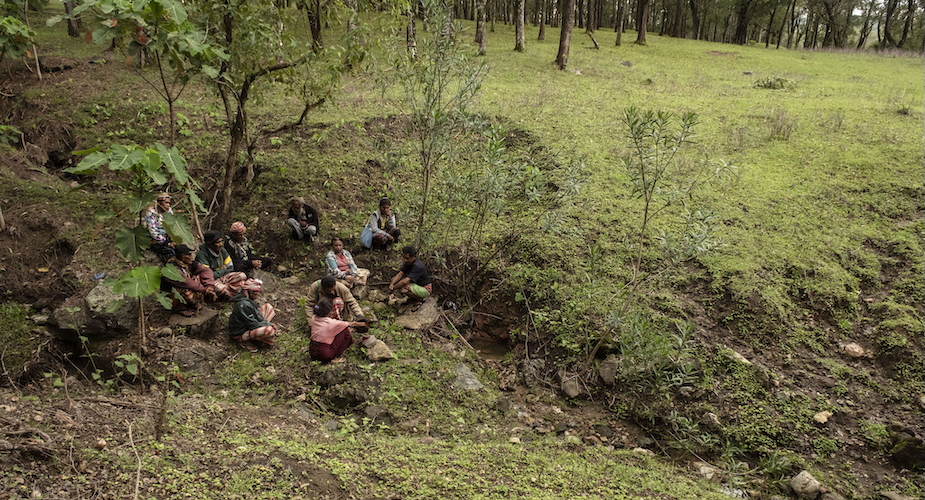
After that I went to Mollo nearly every year. I ended up writing two books. ‘Mollo, Development and Climate Change,’ published by Kompas in 2013, was about how their philosophy of tradition (adat) opposed the ideology of Development, and how that offered an answer to the climate crisis. ‘The Guardian of Identity’ (Teras Mitra, 2017) was about weaving as Mollo identity.
That was the birth of my awareness. Life in their kampung provided the first pieces of the puzzle, which later came together with other pieces such as the coal-mining stories in Samarinda and the nickel mine in Sorowako, Sulawesi.
In Mollo they have a ritual they call Naketi. They hold it every time they need to stop and think for a moment, when it looks as if the road ahead is blocked. A personal or collective reflection to reconcile with ourselves and with nature. The idea is to stop and reflect, to look failures in the face, to look at the community. They might slaughter a chicken and ask for a mantra. I now held my own personal Naketi, in a more moderate form, to try to understand what I should do. I realised doing a PhD overseas would be very hard. But it would create the space I needed to work all this out.
And I did find that space in Germany. I was able to gather up my experiences. What really helped me was the ‘auto-ethnography’ method. Bang Oji - Noer Fauzi Rachman, co-editor of the book about all this discussed in this edition of Inside Indonesia - had told me about it before, but it now fell into place. This is where I learned that in the coal-mining landscape of Murung Raya in Central Kalimantan, the human body and the territory are connected, just as in the past gold was connected with my body in Jember.
My body is not solid; it is not an independent entity. Rather, it is connected with nature in every possible way. I wrote in the thesis: ‘It is impossible to cut apart and isolate the individual body from the collective body, the human body from the territory and landscape.’ Realising this radically changes the way we live our lives.
Germany led not only to the thesis. I started an online ecofeminism school in Indonesia from there, called Ecofeminism school of Ruang Baca Puan. It was covid, there were lots of restrictions in Germany, so plenty of spare time. We read Vandana Shiva and Maria Mies together, and followed the speeches of Chimamanda Adichie. We are running the school for the seventh time soon.
And the ‘life project’ approach became the basis for the Mama Aleta Fund that I now lead in Jakarta. It too is a bridge between activism and academia. We aim to reconnect young people with their home village. This is where we produced the book discussed in this edition of the magazine.
GvK: Thank you. I hope the thesis will soon appear as an Indonesian book?
SM: I hope so too – I am working on it.
Maimunah, Siti. 2022. ‘Reclaiming Tubuh-Tanah Air: a life project on doing feminist political ecology at the capitalist frontier.’ PhD dissertation, University of Passau.
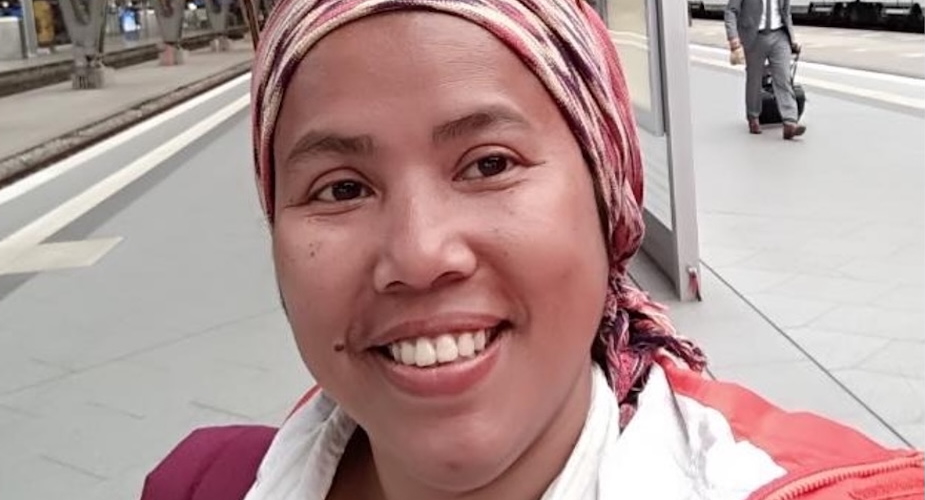
Siti Maimunah, known to her friends as Mai, is director of Mama Aleta Fund. She previously spoke with Inside Indonesia about ‘body’ and ‘territory’.