Name stone resistance
‘Rocks’, ‘trees’, and ‘water’ are names. We Timorese have a name and we don't destroy the name ‘stone’, the name ‘water’, and the name ‘tree’. We love nature very much, because stones are not just empty stones, they are filled with ‘clans’. Because the clans of the Timorese come from stone, all the clans of the Timorese come from water, all the clans of the Timorese come from wood. So, it is called ‘Faut Kanaf’, ‘Oe Kanaf’, and ‘Haut Kanaf’.
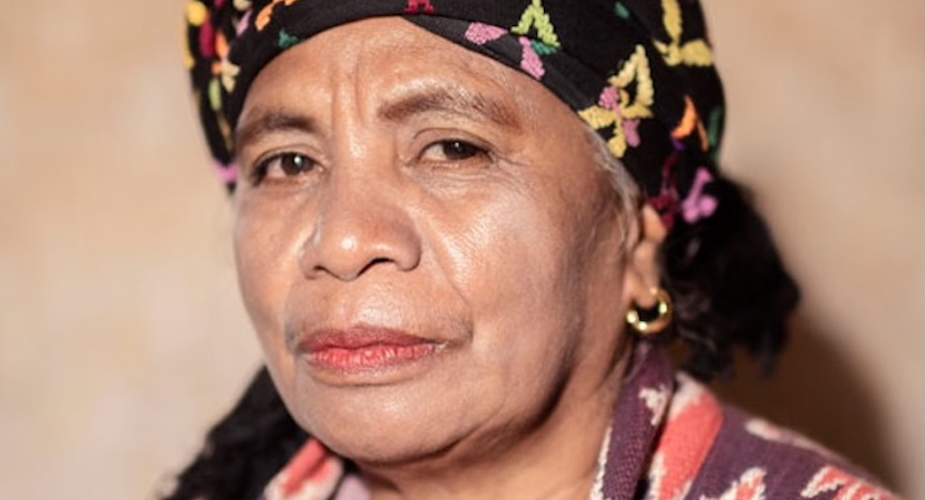
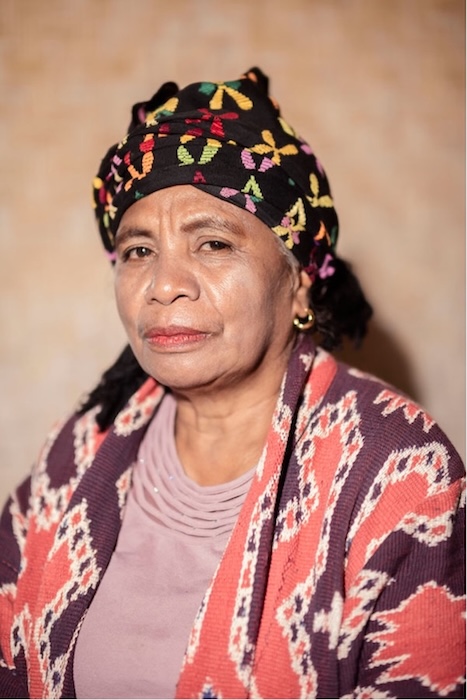
The ‘name stone’ represents the identity of the Mollo people. Aleta Cornelia Baun, commonly known as Mama Aleta, is an indigenous Mollo woman who has been at the forefront of the struggle to protect Nausus, their name stone, since 1986. It has been attacked by mining companies with government approval to obtain large quantities of marble, to be exported to foreign countries.
Nausus is the name of a stone located in the village of Fatukoto, in the hills of Indonesian West Timor, north of the town of Soe. Fatukoto is adjacent to Aleta's home in the village of Lelobatan.
The term ‘Nausus’ translates to ‘the stone that nurses (the other stone)’, and it holds sacred significance. It lies at the far right end of two other stones, Nanjaf and Anjaf. The Mollo people refer to these stones as 'name stones' because their clan names stem from the experiences and activities associated with living in proximity to them. In 1986, the government issued mining licences to PT Timor Indah Marble, PT KAA, PT Soe Indah Marble, and several other mining companies, allowing them to exploit the rocky mountains in the Mollo region, which spans a total area of 600,000 hectares. Among these, the Nausus quarry is one of the largest. Activity in this quarry has resulted in considerable environmental damage and adverse effects on the local community. Such damage is the reason Aleta actively opposes the government, the mining companies, and their supporters.
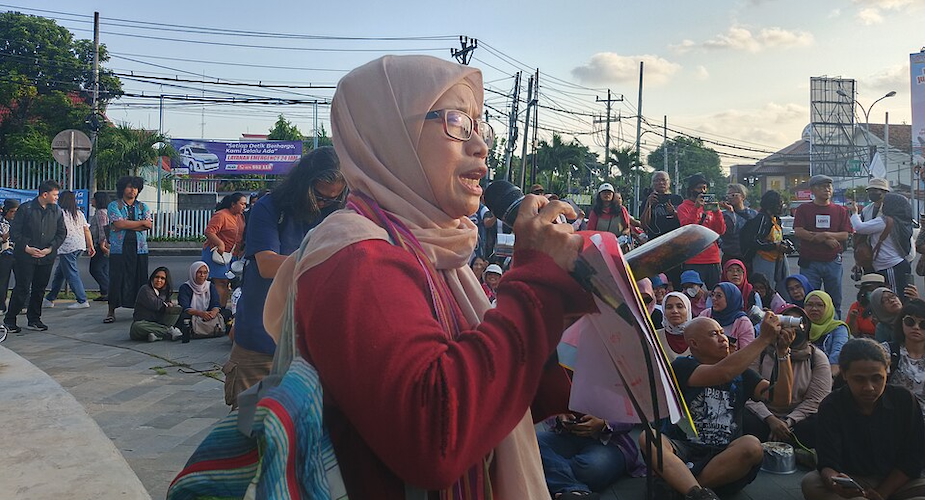
She spearheaded a renowned peaceful resistance, alongside the women of Mollo, by weaving at the mining sites. As a result of their determined efforts, four mining companies in Mollo were halted in late 2011, enabling the communities of the two villages, Tune and Bon’leo, to reclaim control over their ancestral lands.
Amaf family
Aleta is a diligent worker, enriched by a wealth of life experiences. She has held various roles, including maid, nanny, NGO worker, and village organiser, and she has even found herself on the police’s wanted list. She has also been a farmer, entrepreneur, lawyer, wife, housewife, and a member of the East Nusa Tenggara provincial parliament. Aleta's life may have taken a different course had she not chosen to become a defender of the Nausus.
Aleta was born 59 years ago in Lelobatan, Mollo, into a family of Netpala office-bearers.
Her father held the title of Amaf, which today would be called a people’s representative. However, it is important not to assume that the daughter of an official enjoys the material wealth that is typically associated with such positions today. Aleta experienced a strict upbringing, particularly under the authority of her grandfather, who was not hesitant to impose harsh punishments, such as tying her mouth with a rope if she failed to attend school.
Within the family, Aleta was known as the little rebel. Aleta Baun was familiar with rebellion, having been regarded as the troublemaker since childhood. Her stepmother once accused her of stealing a cucumber, to which Aleta vehemently protested. She was given a special nickname, ‘the head of the wind’, which describes her tendency to disregard advice and wilfully pursue her desires. She was also seen as disrespectful for failing to show proper etiquette when meeting royal officials, including the traditional king. As a result of her defiance and for repeatedly breaking family rules, Aleta often faced severe corporal punishments during her childhood, including being tied to a banana tree and left overnight.
Nature
As a child, Aleta loved to play in the woods with her friends, which is why she holds a deep appreciation for nature. The Mollo ancestral territory is renowned for its natural riches, including mountains, forests, and springs, all of which are considered sacred. The Mollo people believe that the natural world mirrors the human body. This philosophy is ingrained in Aleta's mind; the land represents flesh, the water signifies blood, the forest is akin to hair or veins, and the stones are likened to bones. Consequently, Aleta asserts, ‘When we damage nature’s body, we damage our body,’ a view that encapsulates the Mollo people's understanding of the interconnectedness between nature and humanity.
Aleta Baun spearheaded the campaign to protect the Nausus stone alongside the traditional leaders of the Mollo people who remain devoted to their customs. Besides her successful campaign to halt mining activities, wherein she led Mollo women in peaceful activism such as occupying the mine while weaving, she revitalised the customary symbolic speech that emphasises the importance of the land, stones, trees, and water, all of which possess clan names. For instance, stone is referred to as ‘kanaf stone’ (name stone) and water as ‘oekanaf’ (name water), the use of the attribution ‘name’ recognizes the ‘personality’ of these natural companions and highlights the profound spiritual connection between nature and the community.
Aleta led significant actions and embodied the evolving role of women within social movements, challenging the confines that have traditionally restricted women to domestic spaces. Her approach integrates what Nancy Fraser (1998) terms the politics of recognition with the politics of redistribution. In her paper ‘Social Justice in the Age of Identity Politics: Redistribution, Recognition, Participation’, Fraser writes that in today’s world, ‘claims for social justice seem to divide into two types: claims for the redistribution of resources and claims for the recognition of cultural difference.’ In this case, that would mean a campaign to save the Nausus mountain is either made on the basis that it is an unfair distribution of resources, or that it has cultural significance to a particular group, but not both. Instead, Fraser asserts that ‘...we try to encompass redistribution and recognition in a single framework.’ This framework primarily explores the interplay between class and status, as well as the relationship between injustice and denial in contemporary society. A comprehensive approach must acknowledge the full complexity of these interrelationships, including the distinction between class and status and the causal interactions between them. Furthermore, it must consider both the irreducible nature of injustice and denial and their practical interconnections.
Women
The traditional practices and rituals of the Mollo people successfully halted mining in the Mollo region, including the extraction of the already-mined Naitapan stone. Aleta’s lived experience illustrates that the struggle for land rights is deeply intertwined with the recognition of women's existence and their respect for their ancestors and the natural world. Ecofeminists, who also draw upon cultural wisdom, share this perspective. In contrast to white ecofeminists, Carol Adams' 1993 anthology, Ecofeminism and the Sacred, highlights cultural and religious diversity as a significant reality that can serve as a transformative force in societies with a history of colonisation. The essence of her argument is that the relationship between women and nature differs across cultures, and despite their differences, these manifold struggles underscore the effectiveness of employing symbols from a society's traditions in the course of their struggle.
In 2005, Aleta Baun, alongside other indigenous leaders, established the Attaimamus Organisation (OAT) to defend the indigenous territories of Mollo, Amanuban, and Amanatun. This organisation provided Aleta with an opportunity to broaden her efforts to conserve and restore nature. Between 2009 and 2014, she ventured into politics and became a member of the East Nusa Tenggara Regional House of Representatives (DPRD). As a leader in the Indigenous Peoples Alliance of the Archipelago (AMAN), Aleta successfully encouraged fellow AMAN leaders to join political parties and secure positions in parliament. She demonstrated that women could not only work outside the home but could also advocate for the rights of indigenous women and peoples within the parliamentary arena. This role afforded her a more robust platform to promote agricultural and environmental issues, particularly concerning natural resource management in East Nusa Tenggara (NTT).
Within the local parliament, Aleta advocates for more environmentally friendly policies and champions the rights of indigenous peoples to their land. She remains steadfast in opposing the expansion of the mining and plantation industries, which are harmful to both the ecosystem and the lives of the region's indigenous communities. Her political career encompasses not only environmental advocacy but also the fight for women's rights and the empowerment of local communities.
Aleta Baun's efforts and commitment to combating environmental destruction have garnered her recognition and accolades, including the Saparinah Sadli Award (2007), the Goldman Environmental Prize (2013), the Flobamora Award (2014), the Yap Thiam Hien Award (2016), and a Lifetime Achievement Award from President Prabowo Subianto (2024).
New challenges
The threat of mining remains a pressing concern in the Mollo region, but another significant challenge lies in ensuring that ancestral lands are retained under the ownership of the Mollo people. In response to this challenge, Aleta and her community have initiated the process of mapping their traditional forest territory. This initiative establishes territorial boundaries in the service of protecting indigenous lands and safeguarding natural resources from the accelerating pace of exploitation and environmental degradation.
Mama Aleta has collaborated with the indigenous community to safeguard sites that have been sacrificed to mining and to re-establish the women's and men's advocacy groups, ultimately aiming to defend the village. Their efforts include planting trees and creating traditional weavings, as ways to illustrate the integral connection between nature and women's lives. This struggle presents its own set of challenges.
Leaders
One of the most perplexing issues for Aleta is the regeneration of women's leadership. ‘How will leadership continue based on what I've done? It won't necessarily be 100% transferred to someone else, but I wonder how someone can emerge as a leader who can carry on?’ Aleta asked.
Aleta recognises that there are two distinct types of leaders. The first type consists of individuals who are born with an innate gift or charisma for leadership; these leaders often emerge spontaneously, particularly during crises. The second type comprises those who develop into leaders through a process of learning, being driven, guided, and shaped by their experiences. This latter type typically requires more time and support before they are fully prepared to assume leadership roles.
But what about women? Many women lack the space and opportunities to become leaders. Domestic responsibilities often consume their time, hindering their ability to learn collaboratively and develop leadership skills and knowhow. Aleta suggests a deliberate and structured approach to prepare women for leadership roles.
‘It must be undertaken with consent and awareness. The aspiring leader should dedicate time to learn from those who have experience in leadership, like myself. She must follow my lead. Through conversation and interaction with others, I can acquire my knowledge. Every encounter represents a learning opportunity, as there is always a moment to grasp. When she begins to grasp the concepts on her own, then I can guide her. However, if she only seeks my guidance when it is convenient for her, I will ultimately fail to teach her,’ Aleta stated.