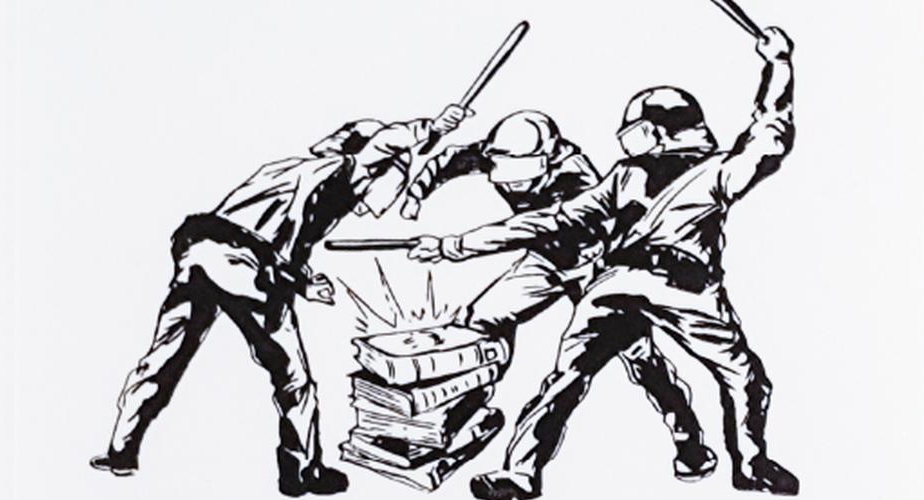
The struggle for democracy has slowed because ‘opposition’ leaders, all of them schooled under Suharto, are afraid of the people.
Arief Budiman
Suharto is corrupt. He killed a lot of people, just like Pinochet. He built an unstable political system. But he did more. He ran a school that produced politicians, including opposition politicians, who cannot change the system.
If the opposition could just unite, total transformation would be easy. If the students in May ’98 had been given wholehearted support by Gus Dur, Megawati and Amien Rais (the so-called Ciganjur group), Habibie would never have survived as president, and Abri would not have dared shoot more students in November.
In the real world, Gus Dur on 17 December accused the students on Radio Netherlands of accepting $300,000 from the CIA. While students were demanding Suharto be put on trial, Gus Dur went to meet him to suggest national reconciliation. How could this happen?
First, because the Ciganjur group all obtained their leadership role ‘from above’. They are not activists who rose up through the ranks. Gus Dur and Mega got it through their families. Amien Rais is an academic used to working with the government, who became an oppositionist only after the government threw him out.
The students are totally different. They grew up with playground battles, and now proudly fight the military, ‘to reform the nation and the state’. (This is not unusual – the historical boundary between the criminal and the revolutionary hero is often vague, also in the history of our own revolution).
Second, the Ciganjur group learned their politics in a strong repressive system, where someone could become a major ‘oppositionist’ just by criticising the government. By contrast, when Sri Bintang Pamungkas set up his Pudi party and announced its purpose was to replace the government, he ended up in gaol together with the PRD.
The Ciganjur leaders, who now have the historic task of leading the nation, would never have done that. Suharto taught them that opposition (the word was banned in those days) just means polite criticism. Never say ‘change the government’, because that is revolt and subversion. These were the lessons of the New Order school.
The students never went to the New Order school. They see things quite simply. If the government is wrong, change it. Full stop. The proof is there. This government with its parliament is the result of an election fraudulent in every way. Most of its personnel, including the president, are tainted with corruption. What are we waiting for?
The New Order school has done its work well. Its graduates, including the Ciganjur leaders, still hold fast to their text book lessons. Yet ironically the room to manoeuvre they now enjoy was largely created for them by the students, who even now carry on the struggle, unsupported by the Ciganjur leaders. If the students are successful in creating a more democratic system, it is the Ciganjur group, and not the students, who will benefit most.
When Megawati’s PDI headquarters were attacked in 1996, it was the PRD who most energetically defended her. The PRD leaders are still in gaol today. Megawati and her other PDI leaders have never visited them in gaol or even said thank you. This too is a New Order lesson, never to deal with radical groups, let alone with ‘commies’.
Now the students know they have to reposition themselves. They are pioneers and they have played that role well. But now they realise that having cleared the ground, the ‘garrison troops’ who need to carry their struggle to completion are not there. Now they have a dilemma. If they carry on pioneering, they will get tired. Their role as moral force is based on the assumption that other players will (to change the metaphor) pick up the ball and run it to the goal. Yet they cannot turn themselves into garrison troops, because that would mean becoming a professional political party with money.
That is why we are here now. Our graduates from the New Order school feel more at home working with the government than with the masses below. That is the success of Suharto. ii
Arief Budiman is professor of Indonesian studies at the University of Melbourne, Australia. Abridged from an article in Tempo, 4 January 1999.
Inside Indonesia 58: Apr-Jun 1999
Indonesians will vote in June. Can they escape from the dead hand of past elections?
Jim Schiller
Indonesian newspapers say 1999 is the year that will decide Indonesia’s future, but that the coming elections have the potential for national disaster. As I write, the remnant national assembly (DPR) has just completed negotiating rules for the June elections (see box). A legislature stacked with people from the Suharto regime, now called the Corruption, Collusion and Nepotism Order, had the task of reforming the system which put them in office. Initial comments on the reforms have been mixed. Will the laws be widely accepted? If they are, will the elections implemented under them be seen as fair enough to give the elected government a chance to govern?
To consider those questions we need to consider what elections are supposed to do, and then what they have been expected to do in Indonesia.
Democratic theory sees elections as opportunities for the people to have their say. It imagines equal, independent and enlightened citizens. Votes are conceived as calculated decisions about who should govern, based on candidates’ policies and records. Government is made accountable to citizens who are empowered at the ballot box.
Even in the most homogenous and prosperous democracies, these assumptions are not fully realised. Election campaigns are not necessarily informative. Many voters do not make calculated decisions about their votes. Voters may be equal in the voting station, but they are far from equal in their wealth or capacity to influence the results. Many citizens of liberal democracies do not feel empowered by election process.
More recently, the authors of The politics of elections in Southeast Asia have focused on more mundane uses of elections. Elections, they say, may help Third World governments to appear democratic and therefore qualify for aid, investment and preferential trade from fellow ‘democracies’. Elections may also help to pacify the population. If people believe the election system is ‘fair’ they may be willing to wait for their turn to win. If citizens believe that they have had a voice and that the winning parties have received a mandate from the people they may be more willing to obey authority and to refrain from street politics.
Engineered
The Suharto government never intended to empower people. It wanted elections that pacified the population and justified foreign aid. Its elections, called ‘festivals of democracy’ aimed to generate enthusiastic participation without risking power. The two political parties were meant to be supporting cast in the victory of the government party. To create the appearance of choice at a ritual without choice, the Suharto government put in place one of the most comprehensively engineered electoral processes in the world.
It began by reducing the stakes. The presidency was not filled through popular elections. Instead, the president was ‘elected’ by a mainly appointed super-parliament (MPR). The MPR consisted of 500 representatives from the national assembly (DPR), of whom 75 were military appointed by the president, plus an additional 500 presidential appointees. The voters’ choice was limited to 42.5% of the body that elects the president, and 85% of the seats in a rubber-stamp national assembly.
Since 1977 only three parties have been permitted to contest elections. They are the state party, Golkar, which had unparalleled access to private donations, and to the resources of the state, and two government-manipulated, cash-strapped, badly divided political parties, PDI (the Indonesian Democratic Party) and PPP (the United Development Party).
The government allowed only a brief campaign period. Parties found it difficult to organise outside the campaign period. Government officials, also Golkar cadre, were able to influence voters before the campaign, or during the ‘quiet week’ before the poll. The government restricted popular campaign symbols, screened prospective candidates, and banned critical campaigners. It intervened frequently to remove outspoken politicians. It also detained or threatened those who proposed an election boycott.
The most important reason for the government’s success at achieving a high turnout and Golkar victory was its control of an administrative structure which stretched from Jakarta down to the village. Local officials controlled development funds that could be used to reward the loyal. They also issue documents that are crucial in the everyday life of most Indonesians. Anyone who wants to send their children to school, sell land, or open a business must obtain the signatures of their local and village officials. This control over sanctions and rewards makes state officials powerful patrons everywhere in Indonesia, but especially in poor, isolated areas outside Java. Patronage was reinforced through intimidation by local officials, military and sometimes gangs.
Local state and village officials were required to join the government party and were given quotas for Golkar membership and votes. Retired army officers and government officials managed the Golkar campaign. Officials and family members were candidates for local assemblies. These officials also headed the committees that policed the campaign, voting and vote-counting.
The vote counting and tallying process provided little opportunity for independent scrutiny. The election ritual closed with a coerced declaration of acceptance of the results, signed by regional and national party leaders.
1997
State Secretary Moerdiono said that ‘the [1997] election should take place quietly, full of anticipation and full of enthusiasm. ‘ The government’s aim was to carry out elections that generated enough public participation and enthusiasm to give it some domestic legitimacy and international credibility without demonstrating the regime’s need to resort to repression or fraud.
It did not succeed. The election ended up looking more like a sham than a festival of democracy. In 1997 there was more resistance to the government’s effort, more violence by and against government supporters, more negative images of the election, and more visible opposition to the election.
More than one hundred were killed in one incident in Banjarmasin. A larger number were killed in daily campaign violence scattered across the archipelago. In Madura, crowds, disgusted with alleged vote fraud, burned down voting stations and government buildings. Elsewhere in East Java unrest continued for weeks after the election.
The resistance and violence had several sources. One source was the anger and alienation that resulted from the removal of Megawati Sukarnoputri as leader of the PDI, and the government-supported, violent attack on her supporters at PDI headquarters in 1996. Thousands of her supporters saw the election as fraudulent and were ready to challenge Golkar and ‘official’ PDI campaign efforts. Thousands more joined with the Islamic party PPP and helped radicalise its campaign.
Another source was the intensity of the government election effort. In 1992 the government vote had declined 5%. In 1997 the government wanted to more than recoup its 5% vote decline in 1992. Bureaucrats were mobilised to go all out for a victory. Weekly estimates of the Golkar vote using vote count declarations, rewards for delivering 95% or 100% Golkar victories, incentive programs to win the support of Muslim leaders, and huge mass rallies in PPP strongholds were all part of that effort.
Money politics was extensive. It included incentive payments to officials, provision of cattle to villages voting 100% Golkar, and cash payments to voters. Alleged government intimidation of party supporters was widely reported. This included sending a dog’s head to a Solo PPP leader, the beating of the PPP chairman in Wonosobo, and attacks on PPP supporters returning from a rally in Jepara. The government’s overbearing effort, which included efforts to restrict mass rallies, provoked thousands of angered citizens to ignore restrictions and, sometimes, to engage in violence.
Interestingly, negative news of the intimidation, violence, vote fraud, and vote buying was widely reported. The widespread availability of internet election stories may have made journalists more daring. The monitoring of the election and related human rights abuses by the national human rights commission (Komnasham) and the new independent election monitoring committee (Kipp) allowed the Indonesian press to report anger and frustration.
Legacy
The New Order set out to use an election to engineer consent. Instead it got violence and anger. So what is the legacy of 1997 and the Suharto election system? Four features stand out: a widespread suspicion of elections, a high level of campaign intimidation and violence, a suspect civil service in charge of the election, and the use of money politics.
In 1997, vote declarations appeared weeks before election day, vote counts at the village level changed at the next level, and in North Sumatra Golkar transferred votes to the pro-government PDI. The fraud helped to generate a deep mistrust of authority. This increases the likelihood of future election violence, and the risk that losers will claim foul play. In the present economic and social climate, the risks of rejection and violence are high.
The use of intimidation and violence by government supporters and opponents was a major feature of the 1997 campaign. The cost of intimidation, in lives and in the poor image of the election was high. Many party supporters became more militant. Government mobilisation of crowds was matched by the PPP and by Megawati supporters. Instructions restricting public rallies were largely ignored and crowds were frequently provoked to violence. In 1999 it is hard to imagine that crowds of a million or more could remain non-violent.
As the 1997 Jepara Golkar chairman, also the head of local government, stated in a post-election booklet: ‘as we all know the election is designed for a Golkar victory’. To do this the civil service was firmly enlisted in support of the government party through payments, opportunities for promotion and job threats if they did not deliver a Golkar victory. Local officials are now used to being part of a political machine. They will go into 1999 dispirited, with less patronage, and with a more critical society than ever before. Still, if the government party can deliver some local patronage that could sway the election outcome, especially in isolated places like Southeast Sulawesi where Golkar obtained 98% of the vote in 1997. Depending on how the election laws and civil service regulations are interpreted, bureaucrats might ally themselves with Golkar or other political parties. Officials taking sides could have a devastating impact.
Money politics was important in 1997, and is likely to be more important in the current depression. Money to buy the support of local patrons or to pay people for their vote has been a major feature of ‘democratic’ elections in Thailand and the Philippines. In 1999 it is unclear which Indonesian parties will have money to spend, or how much patron and vote buying there will be. It is certain that ‘money politics’ will be an issue in determining the election’s credibility.
Against these legacies of Suharto, all of which make it more difficult to hold a successful election, is the inventiveness and courage of Indonesia’s reformers and citizens. Reforms like the decision by Central Java university heads to turn the obligatory university student fieldwork into an extensive election monitoring program will make it harder for anyone trying to continue the practices of the Suharto period. The election laws and the ‘reform’ mood within society mean that this election will be closely scrutinised. Trying to engineer the results would be disastrous.
Jim Schiller lectures in the Department of Asian Studies and Languages at Flinders University in Adelaide. He has written on the 1997 elections for the University of Victoria, Canada, Centre for Asia Pacific Initiatives series.
On East Timor's rugged mountains, hospitable farmers, hidden guerrillas and Indonesian soldiers live uneasily together.
Mike Davis
My two weeks in East Timor at the end of October 1998 followed a previous visit in 1996, when I had been writing a BA dissertation on clandestine resistance to the Indonesian occupation. The purpose of my return was primarily to have a holiday and to explore parts of Timor which were new to me, but also to indulge a strong sense of curiosity about how things might have changed in two years.
I was keen to visit the most mountainous parts of East Timor. After brief stays in Dili and Maubisse I travelled to Hato Builico, a village near the summit of Mount Ramelau. Located 40km due south of Dili, this is at nearly 3000m the highest peak in Timor. Hato Builico has no accommodation for tourists. I was told I should stay with the Indonesian soldiers stationed in the grounds of the old Portuguese rest house. Here I was greeted by a longhaired, tracksuited figure, clutching a bloodied meat cleaver in one hand and part of a dead animal in the other. He turned out to be one of fifteen or so soldiers posted in Hato Builico, all of them from South Sumatra.
The soldiers were surprisingly laid back. During three days in Hato Builico I only once saw any of them wearing full military uniform, and even then the two who did remained unarmed. On my arrival one soldier immediately insisted on acting as my guide. He took me around the village, and then to a hamlet across the valley, where an animist festival was taking place. I was amused by the rather paternalistic interest the twenty four-year-old squaddie from Palembang took in the festival. My impression was that he associated such (as I suspected he saw them) quaint rituals exclusively with East Timor, and he seemed slightly disconcerted when I told him that I had seen similar events in parts of Kalimantan and Nusa Tenggara.
I climbed Mount Ramelau on my first night in Hato Builico, hoping to watch the dawn breaking from the summit. As soon as the sun rose the cloud descended, but at seven o'clock it lifted very suddenly, offering spectacular views of rugged countryside stretching from coast to coast. Walking back down the mountain I fell into step with a man bearing a selection of plastic jerrycans. After initially trying to convince me that he had climbed the mountain to water potato plants, the man said that he had actually been carrying water to a group of Falintil (East Timorese resistance) guerrillas camped near the summit. He told me that the soldiers in Hato Builico were well aware that local people took water to Falintil, but did not harass them for fear of receiving an unwelcome visitation from the guerrillas.
After descending the mountain I made my way back to the animist festival. When accompanied by the soldier the previous day, they had treated me with considerable suspicion. The same people now behaved completely differently towards me. Behind closed doors their attitude to the Indonesian soldiers proved to be entirely one of contempt rather than of fear. They spoke with great enthusiasm of 'reformasi', of Xanana Gusmao, and of the student dialogue planned for Hato Builico the next week. One student present suggested that I return for the dialogue and then accompany him on a visit to the local Falintil unit. However, sensing that he had misplaced hopes of me publicising such a meeting after my departure from Timor, I declined the offer.
After returning to Dili I travelled east to Veni Lale and Baucau, and then on to Baguia. Mindful of the fact that this village had been effectively off limits to tourists when I came to East Timor in 1996, the warmth of the welcome I received struck me. Within a couple of hours of arriving I had been given lunch by one family and offered a place to stay by another. My hosts for the night turned out to be the family of an uncle of Falintil guerrilla commander Taur Matan Ruak. He was the 'raja' of several small villages near Baguia.
Despite their friendliness, people in Baguia seemed more diffident than those I met in Hato Builico, and there was the tangible sense of an ongoing conflict in the way they spoke about the Indonesian armed forces Abri, and about East Timorese working for 'Intel' (Indonesian military intelligence). One group of people I met wanted to take me to see Falintil. Although tempted, I felt uncomfortable about the possible ramifications of such a visit coming to light and decided not to go.
Matebian My main purpose for going to Baguia was to climb Mount Matebian, which I duly did, in the company of a cousin of the raja. Matebian, which means 'Mountain of the Dead', was the final piece of territory to fall to the Indonesians in the last days of 1978. It had provided sanctuary to many thousands of East Timorese during the final months of Abri's so-called 'Encirclement and Annihilation' campaign. It was eventually captured after weeks of aerial bombardment and massive civilian casualties.
The mountain's bulk had dominated the landscape for much of my three-hour journey from Baucau. Closer, it revealed itself as an awe-inspiring tangle of cliffs, crags, gullies and ridges. The impression of sheer wildness was compounded by the extraordinary rock formations covering Matebian's upper slopes. Thousands of huge stones resembling broken teeth cluster along the ridges leading up to the summit. In places they are set so close together as to be practically impenetrable.
Before making the climb we were told by people in Baguia that near the summit we might encounter either Falintil guerrillas or Timorese Intel agents, and I had been puzzled by the notion of these two groups being camped in such close proximity to one another. Upon seeing the terrain high up on the mountain, however, it became clear how easily potential aggressors might be evaded in such an environment, and how futile hunting for small groups of guerrillas over the endless folds of boulder-encrusted land would surely be. As it happened we saw not a soul.
Coming back down Matebian we lost our way and ended up in Quelicai district. Making for the nearest sign of human habitation we came upon a village of only about a dozen inhabited houses and five or six traditional adat houses on stilts. The adat houses were beautifully constructed, and in some cases decorated with pictures and small wooden figures. Most appeared relatively new. At least one commemorated those who died in the late 1970s. The people in the village, obviously very poor, were extraordinarily hospitable. On our arrival they insisted that we stay to have a meal. They invited us to stay overnight, but I was keen to get back to Baguia, which we finally reached the next morning after an overnight stop at another tiny village on the slopes of Matebian.
I spent my last few days in East Timor in Baucau, Lospalos and Tutuala, all places I visited in 1996. During my brief stay in Tutuala I walked to the easternmost point of Timor, a beach facing Jaco Island, and on my way met Bishop Belo returning after a stroll along the shore. According to people in Tutuala the bishop was convalescing after a recent bout of malaria.
I made a foolish attempt to swim to Jaco, but thankfully was given a lift from about half way across by a group of local fisherman. On the beach on the island they had assembled a huge stinking pile of pieces of dead cuscus, which they unsuccessfully pressed me to sample. Later, as we motored back across the channel we encountered a boat from the neighbouring Indonesian island of Alor, and a brisk trade was done in cigarettes and freshly caught squid. While the East Timorese fishermen expressed a hatred of Abri, they said that they saw these men from Alor as their friends.
Most people I met during my two-week stay were daring to hope that East Timor might finally be on the brink of peace. It was so refreshing to find people free to speak their minds without fear. Yet I could not help feeling that expectations were dangerously high, and the scope for disappointment very considerable. From my perspective as a visitor the atmosphere of mounting optimism had its advantages. The superficial calm allowed me to concentrate on enjoying the beauty of the countryside and the generosity of the East Timorese people. These are aspects of East Timor that one hopes will not be permanently obscured by its tragic conflict.
Mike Davis <mikedavis@bigpond.com.kh> lives and works in Phnom Penh, Cambodia.
Indigenous Australians and Indonesians celebrate a shared story across the Arafura Sea.
Alan Whykes interviews Andrish Saint-Clare.
What have sea slugs, Yolngu Aboriginal people and Indonesian maritime power have in common? Quite a lot, which is exactly why the history of Macassan trepang voyages to northern Australia deserves to be widely recognised. Andrish Saint-Clare is an arts worker specialising in indigenous and intercultural performance. He has spent almost five years putting together a multi-dimensional project that is reaffirming these links. While the last trepang voyage in 1907 brought direct contact to a halt, the stories and cultural memories were lovingly preserved in the respective Yolngu and Macassan traditions. Now, across the Arafura Sea, the two peoples are working together to bring their fascinating relationship to a wider audience.
What prompted you to try to reconnect the Yolngu and Macassan cultures?
I was interested in the potential to create something contemporary from the mix of the historic and cultural elements, without surrendering the fundamental integrity and dignity of the people as they see themselves. It gave me the opportunity to integrate my interests in art form and intercultural studies, and also to perhaps contribute toward the expression of indigenous aspirations and pride. From the wider national perspective, I wanted to find out what insights might emerge from indigenous experience of precolonial contact with outsiders.
What materials did you have to work with?
In my initial field work, and from reading books such as Voyage to Marege, I found that the Aboriginal people had a considerable number of stories, songs and dances about this contact history with Macassans. As a whole the songs about the Macassan era can be seen as a preliterate encyclopaedia of commodities and practices introduced by the Macassans. I was also surprised and amazed to notice various Islamic influences, which I didn't know had made their way to Australia.
I was even more unprepared for the great emotional attachment to these stories among the two peoples, stories laced with broken family ties and lost friendships. It has never been acknowledged that the banning of the trepang visits was a tragic blow to the identity and indeed welfare of the coastal peoples.
To call it just 'history' is perhaps to sell the record short. Sometimes I think we forget that the medium of ceremonial record-keeping in preliterate times had something that writing has almost killed: the communal sharing of text through performance.
On the Macassan side, where contemporary conceptions of ceremony are morekin to ideas of performing arts, they were also keen to present their maritime history of voyages to Australia through a performance project. In Sulawesi the joint performance was also viewed as a breakthrough model for cultural tourism.
At the grass roots level in the villages around the Makassarese coast, such as Galesong, people still tell their stories of the time when many a crew and captain were lost never to be heard of again. It was in the villages that the Yolngu were also most curious, as it was in these places that descendants and graves of some trepanger families could still be found.
So how did the artistic cooperation unfold?
The central process was one of continual translation. Not only did we work with at least four languages, but the differences in culture and concepts made it inevitable that we would have to come up with a whole new genre of presentation. From the Aboriginal side there was very little notion of rehearsal and practice or of the roles taken for granted in mainstream performing arts. Functions such as writer, director and producer were quite alien and had to be constantly negotiated. Moreover, indigenous protocols and scruples on both sides of how people wished to portray their own identity, had to be carefully dealt with.
For example, the now more strictly Muslim Macassans were initially reluctant to address issues like their introduction of gambling and drinking to Yolngu, while the representation of the abduction of and occasional marriage to Yolngu women that had occurred during many of the trepang expeditions required a delicate and careful approach.
There were also strengths that kicked the project along such as musical ability, facility for songwriting, love for rituals and a general gusto for performing. The Yolngu have a highly developed sense of ensemble movement which was difficult for the Macassans to match. However they were able to respond with their own form of operetta and farce which stands in stark contrast to the high seriousness of Yolngu stage presence.
What arts events have taken place under Trepang Project?
The ground-work required extensive consultation with clan leaders and the community at Elcho Island. This paved the way for a series of workshops at Galiwinku culminating in a visit by a group of five Macassan performers in 1996. The workshops focussed on cultural maintenance from a community perspective. They included mutual exploration of loanwords, set design and construction, drama improvisation and Macassan music and dance. At the end of a month a large community event was staged which featured joint performance and gift exchange. The focal point of this event was a sand and bamboo sculpture of a Macassan perahu (padewakang) complete with tripod mast and working sail.
A year later we were invited by the regent of Gowa to participate in the Gowa Foundation Day celebrations and present a commemorative performance. The five week visit by 16 Yolngu cultural practitioners and a small support team involved school visits, television recordings, festival appearances, family visits and further development of the collaborative performance. The circumstances allowed for intensive rehearsals and melding of the discrete cultural items into a coherent narrative. The underlying story was of the journey of a Macassan perahu to Marege and the ensuing encounters with Aboriginal people.
Through this framework we used traditional performance elements that express the essence of the interaction between the two cultures. The resulting stage production called Trepang is of about 70 minutes duration and may be described as an indigenous opera. Trepang not only brings alive a fascinating period in the history of this part of the world, but also represents a break-through in presenting traditional culture to the contemporary public.
How did the audiences in Gowa and Ujung Pandang respond to this story and the way it was told?
The major performance was greeted with great enthusiasm and delight. Although our intent was mainly educational, the event obviously struck a chord with Macassans who are proud of their sailing achievements and their links with the Yolngu. There is no tradition of drama in eastern Indonesia, so the format of the performance generated excitement about a new way, accessible and enjoyable, of representing their history.
The governor of South Sulawesi, who cancelled other appointments to watch the entire performance, remarked that the Trepang Project initiative would help to establish the kind of dialogue and interaction that would consolidate friendship into the future not only between Macassan and Yolngu peoples but at the wider Australia-Indonesia level. News of the performance was widely featured in the Indonesian media, unlike Australia where it has been difficult to generate appropriate coverage. Despite Australia's supposed interest in being part of Asia, various government agencies have given only superficial recognition to the project. This has caused problems in raising the funds required to document the achievements so far and to extend the project in new directions including major public performance in Australia.
I understand you have been trying to compile a CD-ROM about Trepang Project and the associated cultural material. Is that suffering from this lack of funds?
Yes. A prototype CD-ROM was completed late last year and relied heavily as usual on in-kind support from the artists involved. The aims are to prepare an invaluable curriculum tool for Australia about an aspect of our history that is currently under-represented, and also to map out a cultural resource management program for the community. It may be surprising to some people that after 200 years, the wealth and beauty of indigenous cultural heritage remains largely unknown for the majority of the population. The neglect is catastrophic in many ways. This culture is fast disappearing and is deserving of our best efforts to preserve and record where we can, especially through modern means such as multimedia.
Then there's the issue of regional funding in the Northern Territory. It just so happens that the 'region' of the Northern Territory includes the neighbouring areas of Southeast Asia which makes it even more important to have transparent processes that allow for a serious and useful cultural development agenda. Trepang Project is one of very few to be working on creative, innovative and perhaps profitable concepts of cooperation and collaboration. Yet it has proved almost impossible to access and maintain government support, despite the increase in funding for regional development.
Where is Trepang Project heading now?
We would still like to put on a Yolngu-Macassan performance at a major festival in Australia. I have been approached by arts practitioners and academics from Europe, the USA and various cities in Australia who have indicated that Trepang represents a major new work. There is considerable interest from indigenous organisations as well. However we are facing high costs because we are working with performers from remote areas and overseas. As a result this enthusiasm has not translated into sufficient funding for a viable future based on live performance.
Glossary
Macassan – Aboriginals still refer to all people who came on trepang voyages that generally originated from Makassar, including Bugis, Bajo and other ethnic groups, as Macassans.
Yolngu - an inclusive name for the various clans and language groups who inhabit the northeast coast of Arnhem Land and nearby islands.
Gowa - a Makassarese kingdom established in the 14th century in what is now South Sulawesi. Gowa was for centuries one of the powers behind the trade in trepang, or dried sea slug.
Contact Andrish Saint-Clare at email daripa@octa4.net.au. Web: www.qantmnt.com/trepang.
Alan Whykes also lives in Darwin and is the Australian correspondent for Indonesia’s Republika newspaper.
Small enterprise relishes the 'economic crisis'.
Lea Jellinek
Before leaving for Jakarta to do research on the impact of the economic crisis on the urban and rural poor, people warned me of the dangers I would confront. The international media screamed about crime and violence. Friends phoned to say I would be lucky to come back alive. Economists described a crash of the rupiah, massive unemployment, dire poverty, dramatic hikes in the price of basic foods, a drop in incomes, malnutrition and starvation, with half the population dropping below the poverty line by 1999. The images were of impending chaos.
Expecting to be robbed as my taxi took me into Jakarta from Sukarno-Hatta airport, I carefully hid my money, Visa card and travellers cheques in all sorts of places. The city looked grey, with a sense of foreboding. An expatriate friend told me at which police station to buy a chili spray gun and pistol.
However, by the time I reached Central Java, instead of discovering crisis, I found an economic boom. Small enterprises such as blacksmithing, bird selling, services and repairs, petty trade, traditional markets and trishaw driving were thriving in a way they had not done for 30 years. With my research team, I travelled from Semarang to Blora, to Yogyakarta, Wonosari, and Gunung Kidul in Central Java, and to Pacitan in East Java. Wherever we went we saw the same dynamic small scale economic activities. We called it 'communal capitalism'.
Why is the outside world getting such a distorted picture of what is happening in Indonesia? Why the focus on violence, poverty and desperation when what we are seeing in most parts of Indonesia is little people beavering away, admittedly against great odds, to create a better future for themselves? What caused this homegrown economic boom? Why aren't the press, government, international agencies and economists reporting it? Why are they placing such stress on dire poverty and the 'social safety net' (a social welfare system which is supposed to provide rice, work and education for the poor) when most of the poorest people are not getting this assistance but are mainly helping themselves?
Cottage industry True, in urban areas prices have risen three fold, and an estimated 20 million people have lost their jobs in factories, offices, hotels, shops and supermarkets. Yet in rural areas there seem to be plenty of opportunities. Kinship and neighbourhood ties in the village provide social security when the going gets tough in the cities. Sons and daughters returning home from jobs in the city have been rapidly absorbed into rural society. They are learning traditional agricultural, house building, cottage industry and small trade skills from their parents. Cottage industries, destroyed during the economic boom years of Suharto's New Order, are reviving.
In Gunung Kidul for example, the dry area east of Yogyakarta, blacksmiths between 1975 and 1997 had a bad time competing against mass-produced agricultural tools imported from China. But with the economic crash, the imports have stopped. The blacksmiths now struggle to fulfil the many orders for agricultural tools from all over Indonesia. Clusters of blacksmiths in the same village pool resources to buy the iron they need. Much of it comes from railway tracks, dug up and stolen in the bankrupt industrial districts of Cilegon near Jakarta. Other metal comes from the urban riots and violence, the wrecked buildings, burnt out cars, shops, and supermarkets. A new industry - collecting scrap metal - is flourishing.
Blacksmiths work in groups to satisfy the demand for spare parts for cars and other machinery, now that imports are so expensive. They also have to meet a demand for gamelan (the Javanese musical instruments) from America, Holland and Australia. Sons and daughter help their parents. Neighbours pitch together to help meet the supply. The blacksmiths have developed community micro-credit systems of borrowing and lending. These enable their enterprises to thrive, yet have no relationship with the formal economy. Without any government assistance, the people are creating their own enterprises, while providing all the necessary skills, capital and markets.
Semarang, on the north coast of Java, is Indonesia's fifth largest town. One road in the city centre has been taken over by people buying and selling birds. Bamboo cages containing tropical birds of all shapes, colours and sounds are piled under trees in the middle of the busy street. Buyers and sellers mingle among them. Bird keeping has become popular during the economic crisis, especially among the urban middle classes who have turned from their more expensive hobbies of buying imported goods. It is said to be good for the psyche in times of crisis. For years, city authorities used to clear the bird market away to make room for traffic, but now it has virtually taken over the street. Cage making and bird food production are booming with it.
Many traditional markets in the towns and villages of Central Java, often displaced during the New Order boom years, have come back. A vibrancy, renewed energy and life pervade them. Peasant women, with only a few items to sell from their home gardens, sit in rows on the ground in strategic locations at the entry to the markets. They told us happily how they could now find a space from which to trade. Only two years earlier they could find none. Thugs linked with government authorities controlled the markets and used to charge extortionists fees to all who operated in them. Little people without resources could not afford a place to trade.
Trishaws Trishaw (becak) drivers were under the New Order driven out of most towns and cities in Java. People with little income, often labourers or poorer peasants, drove trishaws in the agricultural off-season when there was no work in ploughing, planting, weeding or harvesting. The trishaws were appropriate - most towns are flat, the vehicles were non-polluting and provided a reasonable livelihood when there was nothing else to do. They provided flexibility for the drivers, who could pedal part-time in the city and cultivate part-time in the village. Now the trishaws have been allowed to return. The high cost of petrol and spare parts has affected the capital intensive and mechanised forms of transport such as private cars, buses, mini-buses and taxis. Small enterprises building and repairing trishaw have gained a new lease on life.
Small-scale repairs, services and recycling is experiencing a boom. Whatever can be fixed - fans, batteries, televisions, radios, motor-bikes, bicycles, household utensils, shoes - is being repaired. Everything is reused, nothing is thrown away. It is as I remember Indonesia in the early 1970s, when everybody seemed to be a fixer. Nothing was beyond repair. The consumerism of the 1970s, 80s and 90s has been replaced by a collect, recycle, repair and reuse society.
The boom in small-scale activities can be partly explained by the devaluation of the rupiah and the consequent cut in foreign imports. A virtual tariff barrier has been set up around Indonesia, and it is one that seems to suit agriculturists and small-scale entrepreneurs, especially in rural areas. It does not suit the international experts, bankers and capitalists. Indonesians themselves are providing goods for their own 200 million people, and so locals rather than foreigners are reaping the benefits.
Because of their cheap price, many Indonesian products are in demand from abroad. Commercial products such as coffee, pepper, copra, tea, sugar, vanilla, fish and timber are selling well. Most farmers on the islands outside Java are benefiting, with much higher incomes than they had during the Suharto years. Even if they have to pay more for rice and other basic necessities, they are receiving more - up to three times - for their produce. In Central Java, cattle and teak are selling for three times their normal price. Teak furniture is being exported abroad. They are highly visible on Melbourne streets, which throughout our summer advertised cheap, durable, outdoor teak furniture for sale.
Hopefully many of these small businesses will continue to provide a livelihood for many Indonesians when large scale investment returns to Indonesia. Small enterprises have gained a breather through the collapse of big business.
Bambang Rustanto, who is a research anthropologist in Jakarta, contributed to this article. Lea Jellinek is a freelance development consultant who lives in Melbourne.
Two Aussie girls are cycling around Australia to raise awareness, and money, for Indonesians in poverty. But the project raises some questions too.
Helena Spyrou
On 28 February 1999, two young Australians, Fiona Collins and Mia Hoogenboom, left Sydney for a 16,455km cycle journey around the perimeter of mainland Australia to raise funds for the OzIndo Project, a short-term relief program to address 'a critical need for staple foods in Indonesia'.
Isn't it inspiring that some Australians can be so moved by the plight of their Indonesian neighbours, to take direct action? This is how I was introduced to the project.
However, the more information I gathered, the more I was beset with questions about the purpose and motivation of fundraising and direct aid. Who decides who needs money and how it will be used? How valid is short-term relief compared with long-term sustainable development? What motivates people who believe 'they have' to support people they perceive 'have not'?
Mia and Fiona met while studying in the Acicis program in Yogyakarta during 1997/98. (Acicis exposes over a hundred Australian university students to Indonesia every year). Their year in Yogyakarta coincided with the collapse of the rupiah and the ensuing riots that led to the resignation of President Suharto. 'Watching the effects of crisis spiralling out of control and watching how our Indonesian friends were being affected, we felt helpless', says Fiona. 'One afternoon in May '98, I took a siesta and had a dream. I dreamt that Mia and I were cycling along a dusty road in the middle of Central Australia, with people behind us supporting in some way. I told Mia about my dream, and since we both felt a responsibility to help Indonesia, we began investigating how two individuals could cycle around Australia requesting donations.'
'We approached over 35 NGOs (non-government organisations) in Australia, but decided to go with the AusAid-accredited Unity and International Mission in order to collect tax deductible donations. They respected our idea of two individuals wanting to make a difference. They didn't want to make it their project.'
Generosity The OzIndo team in Australia aims to raise awareness about the current humanitarian crisis in Indonesia and to promote cross-cultural understanding. Their Mobile Education Unit carries books, magazines, music, photographs, current affairs reports. A small support team accompanies Fiona and Mia, including Jan Lingard, the Australian coordinator, and Timur Nugroho, the Indonesian representative. 'It was important to have an Indonesian with us, we didn't want to speak on behalf of Indonesians, and a guy with a guitar is more interesting than two cyclists', says Fiona.
Timur met Fiona and Mia in Yogyakarta. 'We became friends', says Timur. 'They told me about their idea and asked my help … I saw poverty in my neighbourhood. Now I speak to Australian people about Indonesia, their struggle, their culture, and sometimes I sing Indonesian songs.'
The OzIndo team was by late May well on their way to Perth. I spent a day with them on the road from Melbourne to Geelong. As with every leg of their journey, they were joined by local cyclists supporting their cause.
Anecdotes in the OzIndo newsletters reflect the warm welcome and generosity of Australian people. Schools, Rotary, the Uniting Church, and Soroptomist International, have all billeted the team and organised fundraising activities on their behalf. 'Perhaps the highlight of highlights', comments the team, was an 'amazing day' at Mallacoota P-12 College on 19 March 1999. Students and staff were dressed in Indonesian type clothing. The Indonesian teacher had set up a fundraising activity in the form of a market where students purchased goods using vouchers representing Rupiah currency.
The OzIndo Project also aims to raise $500,000 to provide immediate assistance to Indonesians in need. The original idea was to implement a one-off subsidised food market (pasar murah), in eleven different Indonesian provinces. This is an established model of food subsidy in Indonesia, where local and mobile food subsidisation centres are set up so that Indonesian people can purchase staple foods at greatly discounted rates.
The short and the long Recently, I spoke with Damien Locke, at the time the Indonesia coordinator for OzIndo, based in Yogyakarta. He outlined the complex process of organising a 3-4 week pasar murah. Its advantage is that money collected in Australia is given directly to the people of Indonesia. There are no 'middle men', says Damien. Planning began months before by teeing up a local and reliable NGO to work with. The first pasar murah in Yogyakarta was done together with the large NGO Bina Swadaya. After extensive research they identified the village of Planjan in the dry mountains south of Yogyakarta as having the greatest need.
However, the experience of the first pasar murah raised questions about the validity of such short-term relief. Although successful as an exercise in cross-cultural awareness (Australian songs were heard at the market!), Damien believes the process was fraught with problems. Bina Swadaya have since turned down the invitation to continue OzIndo's pasar murah in Planjan because they are not able to supply the overhead costs. Damien urged OzIndo to look at moving towards longer-term sustainable community development models for Planjan, seeing a huge potential for farming, water and other technology.
Pasar murah for all the 1603 families of Planjan village cost AU$4,462. Of that, $962 was recouped after each family purchased a $2.78 food parcel of rice, sugar and cooking oil for only 60 cents. I asked Australian Volunteers International (formerly the Overseas Service Bureau) what development projects could be implemented for a similar amount of money. Their Indonesia officer Maree Keating told me $2000 would enable a project to make and market smokeless stoves for their community; $2000 would enable a community to develop an eco-tourism promotion centre; $1000 would buy a village seeds to plant alternatives to rice; $200 would pay for sanitation pipes for one village; and $600 would buy a buffalo to plow the fields of an entire village. For $3600, six buffaloes would keep 6 villages plowing their land for 30 years.
OzIndo said at the end of May they were open to suggestions and wanted to revise their strategy in Indonesia. They said they had abandoned the pasar murah concept in favour of school-based relief for children. However, OzIndo apparently remains committed to short term relief. 'We can't do anything except provide short term relief and do our damn best to raise Australia's awareness especially in schools. It's our personal response to take action. We are totally conscious that there are limitations,' says Fiona.
The pasar murah strategy grew out of reports at the time that Indonesians were starving. More recent reports on poverty induced by the economic crisis have suggested a less stark, more complex picture of great diversity. More importantly, the strategy ignored Indonesian requests for longer-term help. Vanessa Johanson, in Inside Indonesia January-March 1999, cited this comment from a villager: 'We have already been given this and that, [including] basic foodstuffs from you. But what about the future? We all know that children here need to go to school. Can't you help us finish building the school? We use it already, but the walls leak.'
The OzIndo team, in particular Fiona and Mia, must be commended for their courage and heartfelt action. They are having enormous success in raising awareness in Australian about the current humanitarian crisis in Indonesia. Now is the time for OzIndo to give a lead in reflecting on how the money they raise is spent. Like many other organisations involved in relief work, they need to address the issue of short term versus long term assistance. More importantly, Indonesian NGOs need to be given more independence to make decisions about what's most appropriate for their country.
Helena Spyrou is the promotions officer for Inside Indonesia. Email: admin@insideindonesia.org. Contact Ozindo at email OzIndo_News@hotmail.com.
[BOX:]
Our inspiration
The financial crisis has become the absolute focus for so many people's lives in Indonesia. You can't go anywhere without seeing its effects. Old women and homeless children beg for money in the streets. Men sit around in front of shops, hopeless, as their employers can no longer afford to pay their wages. I have friends who were forced to give up their studies at university and return home to their villages, because their families could no longer support them. Prices have skyrocketed by 400% and people simply can't afford to buy basic necessities. There is a tangible atmosphere of desolation, you can see it in people's faces and feel it in the air.'
Mia Hoogenboom
'The turning point for me came when a chicken farmer who lived in my neighbourhood could no longer afford to buy chicken feed. Rather than watching his chickens starve to death, in desperation he put all 20 of them into a cage and burnt the cage to the ground. Left with no source of income and no means to support his family, he was forced to leave the city and return to his village. This was just one of many striking instances that made me realise that I could not simply return to Australia and resume my normal life. In the face of such suffering, I had to do something to help. During my time here, people with so little have shown such generosity of spirit. I feel it is now time to give something back.'
Fiona Collins
Children are lured to brothels in remote places by slimy operators. International pressure can help free them.
Ahmad Sofian
Trafficking in underage girls for prostitution is a growing problem in North Sumatra. The children do not understand the risk of early pregnancy or of sexually transmitted diseases. They are usually sold to the government-licensed prostitution areas (lokalisasi) at Sicanang Island or Bandar Baru near Medan, and as far as Batam Island near Singapore. About 200-300 girls are employed in the Bandar Baru lokalisasi alone. The industry is driven by growing market demand, especially for girls aged 14-18 years, who are considered free of disease. The high price a virgin fetches makes the search for them a highly profitable business. Organised trafficking syndicates present themselves as employment agencies who also offer the opportunity of enjoyable travel.
'Collectors' usually operate in crowded places such as a shopping mall. Trained to recognise soft targets, they begin by simply befriending a girl making it difficult for police to act against them. Parents, too, report the problem only after the child has gone. The typical candidate is a teenager from a lower to middle class suburban family. The children seldom refuse an invitation to visit a luxurious place, where they are brought to a madame. Here the collector gets a tip of Rp 100-200,000 (AU$20-40), depending on the beauty and virginity of the victim.
Girls who refuse to satisfy the passion of their clients invite the anger of the madame. One girl had her head smashed into a wall so that she suffered concussion and later went insane. If the guard should catch them trying to escape he will beat them up. The madame, meanwhile, routinely cuts the money the girls earn by up to 50%.
The cruelty child prostitutes suffer was exposed recently in the case of two girls who managed to escape from remote Tanjung Balai Karimun after their parents bought their freedom in February 1998. The parents took the case to the police, resulting in some prosecutions. In September 1998 police from West Java succeeded in saving another 100 children or more from the same place.
Dewi (16), who ran away from a brothel in Tanjung Balai Karimun, explained how she escaped with the help of her mother (see box). Consumers paid her Rp 150,000 (AU$30) a time, but half of that was taken by the madame. The other half was hers only in the form of vouchers, which could be exchanged for cash after working for four months. In the meantime, Dewi practically had no money. She paid for her meals, clothes and medical checks out of extra tips her customers occasionally gave her.
Similarly Fitriani (16), a beautiful girl with white skin from Sujono Street in Medan, was lured to Bandar Baru with an offer of a highly paid job in a restaurant. She did not know that Bandar Baru was a brothel lokalisasi. After asking permission from her parents she went there with her friends Afrida (15), and Kiki and Florida (both 16). Arriving in Bandar Baru she felt suspicious because she was put into an all-girl house. She wanted to go home, but was unable to leave. That first night she was forced to surrender her virginity to a man of Chinese descent. For a month she was used by guests who queued up to book her. She made Rp 2 million (AU$400). She was released after her friend Florida fell pregnant and developed a craving for martabak, the spicy Medan pancake. When the madame permitted Florida to go to Medan, she contacted her parents and the police, who prosecuted the madame.
Stress The arbitrary harassment child prostitutes suffer as the weak partner in a highly unequal relationship often leaves them with post-traumatic stress that can last throughout their lives. They are part of a unique work system ungoverned by any law. The government only half recognises their work and considers they are acting at their own risk. They do not understand the high danger of HIV/ AIDS infection to which they are exposed. Nor do their guests, who do not use a condom because they think the prostituted children are healthy.
In the West, adult men who have sexual intercourse with underage girls (even when they are in love), are considered criminals and can be punished. Indonesia has no such law. Child prostitution cannot be prosecuted as such. Even those laws (such as unlawful detention) that do exist are poorly implemented due to official collusion. It will require the cooperation of many parties to eradicate the problem of child prostitution. International support to put pressure on the Indonesian government in this matter can be very effective.
Ahmad Sofian is executive secretary of the Study Centre for Child Protection (Pusat Kajian & Perlindungan Anak, PKPA) in Medan, North Sumatra. Contact: Jl Mustafa no. 30, Medan 20238, North Sumatra, Indonesia, tel +62-61-611943, email pkpa@medan.wasantara.net.id. Names of girls are fictional to protect their identity.
BOX:
'Aunt Merry is a devil' My name is Dewi. I am now 16, but this happened to me when I was 15. I am the oldest in my family, and have three brothers, all still at primary school. I only finished grade five and do not go to school anymore, because I was lazy and wanted money. My father died in 1993. My mother has no work. We are a poor family. I went to Tanjung Balai Karimun because a friend of my mother's, Aunt Meta, offered me work in a restaurant with a high wage. She said she was a close friend of Aunt Merry. She sold me to Merry. I heard later that every girl Aunt Meta sold to Aunt Merry got her Rp 850,000 (AU$170). Aunt Meta said I would get Rp 200,000 (AU$40) every day. My mother, of course hoping I could help the family, agreed.
I travelled there with two friends, Opi and Melisa. It is located on a remote island near Singapore. When we arrived we went into Golden Million Hotel, and were welcomed by some beautiful young girls. 'Why do you want to work here?', they asked us. 'If you can, run away. Here you will become a prisoner!'. This surprised me. Opi and Melisa even cried. But what could we do? At last I was brough to see Merry by her guard, Sitepu. We were all asked to sign a four-month contract. Then we were employed as whores. Every girl was given a breast number. Mine was 20.
In Golden Million, Merry and her people never called anyone by name. If they wanted me, they would just call: 'Hey, twenty…'. There were about 300 people working there, all with a breast number. We worked from 9pm till early morning. We were kept in a plain room under the direct supervision of two men we called Daddy, and a Mummy. A guest would first speak with Daddy and Mummy, who would then call us.
Working in Golden Million was hell. If anyone made a mistake, Merry's people kicked them. The lightest punishment was 'charge'. That meant paying a fine. If we were sick, we had to pay for medicine ourselves. If a girl fell pregnant, the fine was Rp 500,000 (AU$100). If we menstruated suddenly while serving a guest, the fine was Rp 75,000. A doctor came to give us an injection each week that cost us Rp 200,000 each time. Golden Million provided a room for us to take a rest. Our room was for 12 to 15 people. It was very small and hot. It had no window, and no ventilation. Our meals were supplied by Aunt Merry. Every meal was crowded and rushed. Every girl owed money to Aunt Merry. She pretended to be a good woman but she was very bad. She is a devil.
Throughout the time I was at Tanjung Balai Karimun I never sent money to my mother. When she came to see how I was she had to pawn the tape recorder to our neighbour to get travel money. As soon as my mother saw my condition she wanted to take me home to Medan. But Aunt Merry said my contract still had two months to run and would not let me go. Then my mother went back to Medan without me. Two months later she came back for me. It was about April last year. I do not know how or where she got the money for her bus fare. Aunt Merry promised my mother to cash my vouchers, but she kept delaying, and my mother became scared that Merry's people would kill us.
At last we chose to run away and just forget about the money owing to me, Rp 5 million (AU$1000). The important thing was to get away from Aunt Merry. As it happened I had Rp 300,000. It was not enough for the whole trip home, so on the way I sold my necklace for Rp 60,000.
Now I am back home, with my family. I never want to go to Golden Million again. If I have the money I would like to sell rice or fried noodles from my house. If God blesses me, I want to get married to a good man who loves me and my family. I heard that Aunt Merry was arrested. I was pleased to hear it, but I would like her people to be arrested as well Daddy, Mummy, and the gangsters who protected her. I also want the money I earned there returned to me. And I want all of my friends working there to be set free as well. I pity them.
The Ambon crisis produced tens of thousands of Muslim refugees. They desperately need help.
Elizabeth Fuller Collins
Mr Laode Kamaluddin calls them the ‘forgotten refugees.’ According to local government figures compiled by the Bupati (Regent) of Buton, Mr H Sahiruddin Udu, 37,000 refugees from Ambon fled to Buton, an island off the southeast arm of Sulawesi, 600 kilometres west-southwest across the Banda Sea from Ambon.
Frustrated that the central government had not provided any assistance to these refugees, Mr Laode Kamaluddin, Inspector General of Development for Backward Regions, decided to personally lead an expedition of reporters from Jakarta to Buton at the end of March. He wanted people elsewhere in Indonesia to know about the problem and provide assistance or pressure the central government to take action. At the last minute, one reporter was unable to join the team of observers, and I was invited to be a foreign representative.
On the afternoon of our arrival in Bau-Bau, the capital of Buton, the bupati presented us with the data he had collected on the exodus from Ambon, detailing the number of families that had sought refuge in villages throughout the region. That night we visited the refugee centre in Bau-Bau city. It was an open market next to a sports field. Between five hundred and a thousand refugees were crowded under the roof on a cement platform. It was difficult to see how they all found space to lie down at night.
The refugees in this centre were those who knew that some time in the distant past their ancestors had migrated from Buton to Ambon. But they no longer knew which village they had come from in Buton, or even whether distant relatives might still live there, so they had nowhere to go. Many were women with small children, who had no way to earn money. Their children crowded around them, and their babies sleeping on the floor looked exhausted and poorly fed. Several older women crouched over gas burners making snacks that could be sold the next day, but most people seemed to have no energy and no idea how they would manage.
The terror
The people I talked to had been traumatised by the violence that they had witnessed. They spoke of ‘the terror.’ They told us that their families had lived in Ambon for generations. It had been their home. They could not comprehend what had happened. One young man, the youngest of seven children, had been a driver in Ambon. Last January 20th he returned home to find the bodies of his parents and all his brothers and sisters cut to pieces. In Bau-Bau he earned a bit of money when he could as a becak (trishaw) driver. In this way he was able to supplement the meagre supply of rice that was available to the refugees. He was hoping he might find relatives somewhere.
Heavy rains have now flooded out the people in this refugee centre. The tarpaulins that we bought to keep out the rain were not enough. These refugees have probably been moved to the already crowded centres into an orphanage next to a mosque, and into a state Islamic institute (STAIN) dormitory near Bau-Bau, which we also visited. The refugees in these camps were somewhat better off because, although most slept on the cement floor, they were protected from the weather. However, the refugees complained that they did not have enough food.
They had not eaten rice for some time, nor were they given any protein. At noon that day they had been given noodle soup, all the food that was distributed that day. We saw a listless baby suffering from malnutrition. Another child had a high fever. Seven children have already died of diarrhoea.
The bupati and his wife have done the best they could to organise help for the refugees, but their resources are limited. The bupati explained that it would take several tons of rice a day to feed all the refugees. All he could do was provide some boiled rice and milk for pregnant women and babies. There was also a shortage of medicine and doctors.
Over the next two days we visited five villages, each with between 700 and 1,500 refugees. Most of these refugees lived on the ground under houses owned by relatives. Village resources were strained to breaking point. The teacher at a village primary school reported that formerly he had been responsible for just over one hundred pupils. Now he had over two hundred, and many of the refugee children had no books and no change of clothes. They were hungry and traumatised.
There will be no simple solution to the problem of the refugees from Ambon, as there is no simple solution for the problem of the (equally Muslim) Madurese refugees from West Kalimantan. Some are farmers who need land, and Buton is a harsh and rocky landscape with no empty land. Fishermen are better off, but they need boats and nets. We bought small ‘koli-koli’ canoes for the refugees in several of the villages we visited, but we knew that more than twenty families would have to share each of these boats.
The merchants whose shops in the city of Ambon had been burned have lost everything, even the deed to their property and the cash they had kept to do business. Yet many of these refugees said that they would return to Ambon if peace returned, but they needed help to start over again. One woman demanded to know what the government would do to help them. University students wondered if they would be able to finish their education now that their families had lost everything and they could not return to take their exams.
We met with the governor in Kendari, the capital of Southeast Sulawesi province, after returning from Buton, and learned that he had directed aid be sent to the region. He said that just before our visit to him he had learned that the aid had not arrived. (Later we learned that the money was used to buy land, said to be for the refugees.) The central government has yet to establish any program to help the refugees of Buton. The bureaucracy seems to be paralysed.
Ordinary citizens
The beginning of a solution to the problem of the Butonese refugees lies in civil society, in the actions of ordinary citizens channeled through non-governmental organisations (NGOs). While in Buton, the team I travelled with collected funds among themselves and from friends in Jakarta to buy tarpaulins, small koli-koli fishing canoes and nets, and to build portable toilets. Since returning to Jakarta they have established the ‘Foundation for an Enlightened World’, Yayasan Nurani Dunia, with the motto ‘People to People Aid.’ I will serve as an advisor to the foundation.
As a result of publicity by reporters on our expedition, the refugees of Buton are beginning to receive some limited help. Dompet Duafa, a non-governmental agency associated with the newspaper Republika, has established a post in Buton for emergency relief and to collect more data on the refugees. They report that there are now more than 50,000 refugees, and more continue to arrive as conflict spreads to other areas in Eastern Indonesia. The refugees are still in dire need of food, mattresses, access to clean drinking water, clothes, tarpaulins, toilets, school books, small boats, and fishing nets.
Nurani Dunia is now working with Dompet Duafa to raise funds for emergency aid to refugees in Buton. In this way there will be no administrative costs. Reporters will continue to report on the situation in Buton to ensure that the aid goes directly to the refugees.
I have a particular reason for wanting to be part of the effort to help the refugees in Buton. Over and over again, I have been asked by friends in Indonesia why it is that people in the West always seem ready to help when Christians are the innocent victims of violence, but not when the victims are Muslim. Every university student I talk to seems to have read or at least heard of the Huntington thesis that the future enemy of the West will be Islam. They wonder if Western governments are trying to weaken Islamic nations by ignoring the plight of refugees and the poor in a time of economic crisis. Just as I remind students in the US that there is no such thing as monolithic Islam, I try to explain to people here that scholars in America and elsewhere vehemently criticise Huntington’s arguments. I would also like people in Indonesia to know that Americans are ready to help refugees, whatever their religion.
The twentieth century has been a century of refugees. We are becoming numb to the seemingly endless campaigns of ‘ethnic cleansing’- in Europe, Africa, South Asia, and now Southeast Asia - and to the streams of traumatised, poverty-stricken people who flee from violence. But we cannot afford to ignore the problem of refugees. Refugee groups that are not helped to start life anew in one way or another are fodder for extremist political movements. They are angry and powerless. Their emotions can be easily manipulated so that they seek revenge. And the plight of refugee groups can become the excuse for another violent episode and another exodus of refugees.
A small (one man) koli-koli fishing boat and nets cost about US$100. Emergency assistance to mothers of US$25 per child will buy food (especially milk), clothes, and school books. All assistance will be most welcome. Temporarily (until I can set up a matching non-profit organisation in the States), Gene Ammarell has agreed to help collect funds for the Buton refugees. Contact him at: Dept of Sociology and Anthropology, Ohio University, Athens, OH 45701, USA, tel+1-740-592 9697, email ammarell@ohiou.edu. Or cheques may be sent to Nurani Dunia, c/o Imam B. Prasodjo, PhD, Dept of Sociology, Fac. of Social and Political Sciences, Univ. of Indon. (home: Jl Proklamasi 37, Jakarta 10320, Indonesia, tel/fax +62-21-391 3768).
Dr Elizabeth Collins is Director of the Southeast Asian Studies Program at Ohio University.
East Timor's global crusader sees the finish line before his eyes.
Conan Elphicke
'We have to do a lot of work to avoid violence,' says José Ramos-Horta. 'People are becoming increasingly frustrated. Indonesia is arming [the civilian militias], as the South Africans did during the apartheid regime, to sow violence, to justify their presence there. I have been sending messages to Timor saying 'no violence, no violence'. I don't want to see one Indonesian or one collaborator harmed. An overwhelming majority of the people will vote for independence.' Ramos-Horta grew up under the comparatively benign rule of the Portuguese who had colonised East Timor four centuries previously. He was born on 26th December 1949, the son of a local woman and a Portuguese naval gunner exiled to the colony in 1937 for his part in a failed attempt to seize two frigates with which to fight the fascists in Spain. José received his basic education at a remote Soibada Catholic mission where he excelled and so became one of the few East Timorese to be sent to the high school in Dili.
Upon graduation, Ramos-Horta became a journalist, spending his spare time reading widely and brooding over the possibility of an end to colonial rule. It wasn't long, however, before the secret police got wind of his dissenting views and exiled him to Portugese Mozambique for two years.
When he returned to Timor in early 1974 Ramos-Horta found sufficient like-minded individuals to co-found the Social Democratic Association of Timor (ASDT) in early 1974. The following year it became the popular pro-independence party Fretilin.
'My ideological influence at the time was Swedish social democracy, Willy Brandt and so on. But as the days and weeks evolved there was tremendous pressure from the Timorese university students in Portugal, who were all Maoist. By September 1974 we changed into Fretilin Revolutionary Front for an Independent East Timor. And idiots like myself were totally pushed aside by the hard-liners. [If Indonesia hadn't invaded] I would not have lasted long in the party. I was of accused of being an agent of Australian imperialism (those were the actual words), an agent of the CIA. But I had retained a lot of support from within Fretilin, from the military side. People knew me, and they liked me; they knew my work. It was only that that saved me [from expulsion].'
Following the 1974 coup that toppled its fascist dictatorship, Portugal decided to hastily abandon its costly empire. As part of a token gesture at decolonising East Timor, it held elections there in March 1975. The three parties involved were Fretilin, which favoured complete independence; the UDT, which advocated continued ties with Portugal; and the Jakarta-backed Apodeti, which sought integration with Indonesia. Fretilin embarked on a nationwide health and literacy campaign that endeared it to the people of the interior and brought it 55 per cent of the vote on election day. Most of the remaining votes went to the UDT. However, in August Fretilin's claim to power was challenged by the outbreak of civil war, most likely initiated by UDT. After three weeks of fighting in which an estimated 1500 people died, Fretilin emerged victorious.
Minister Ramos-Horta was studying at the ANU in Canberra at the time of the civil war, returning to be made Fretilin's Minister for Communications and External Affairs. As a result, he became the main contact point for foreign journalists, including an Australian film crew whom he drove to the town of Balibo to film Indonesian border incursions. Ramos-Horta left the town just hours before the Balibo Five were captured and executed by the Indonesian military. As the Portuguese withdrew, Indonesia was making no secret of its intention to invade its increasingly defenceless neighbour. In desperation, East Timor declared independence on 28th November 1975 in the hope that Indonesia would be less inclined to invade a sovereign state. Of course, it made no difference at all. On 4th December, with the invasion imminent, Ramos-Horta was among three people selected by Fretilin's central committee to immediately leave Timor and bring the country's plight to the attention of the world.
At the airport, one of his sisters rushed up and handed him a letter to their aunt in Lisbon. Says Ramos-Horta in his book Funu (War): 'Fear was in her eyes; she knew the Indonesians were coming any day. In the letter, she expressed her hope that "José will get the United Nations to help us. He is going to talk to big powers. This is our only hope".'
When he arrived in New York three days later, the invasion began. The Indonesians showed extraordinary callousness, killing thousands of civilians on the first day alone. Within hours of the invasion, hundreds of Dili residents were lined up on the jetty and shot one at a time, their bodies dumped into the surf. However, in his novel Redundancy of courage, Timothy Mo points out: 'I think in the light of [Ramos-Horta's] later career as [Fretilin] torch-bearer and thorn in the [Indonesian] side where it mattered abroad they'd have traded each and every life they took on the water-front for his alone.'
Ramos-Horta based himself in a cheap, cockroach-infested apartment in the Bronx. At 25 he was probably the youngest foreign minister in the world, and the most cash-strapped. For the next ten years he would plod down to the UN every day in a persistent attempt to keep the issue of East Timor from vanishing into oblivion.
'It involved meeting with as many diplomatic missions as I could, from different regions of the world, particularly Africans and Latin Americans. The primary task is to show yourself, to be visible. By being visible you remind them of the existence of East Timor. Secondly, to provide them with information [which] was very, very hard to come by. People were more sympathetic to me than to the cause itself, in a sense. Because by then they knew me and they liked me. They were prepared to put up with me, listen to me, but I don't think they believed much in the cause itself, in the sense that for them it was a lost cause. A lot of them would vote with the resolutions because of me, not because they believed in the issue.'
Ramos-Horta was heavily involved in the passing of a dozen UN resolutions on East Timor. Indonesia has not heeded one of them. In 1985, Ramos-Horta commented, 'It may not mean much to win enough votes for a resolution, but it would be an enormous setback if we didn't'. To get the resolutions passed Ramos-Horta had to face not only widespread indifference but forms of corruption that ranged from individual delegates selling their vote for a few hundred dollars to the systematic application of pressure by powerful nations on lesser ones. Indeed many western countries strongly supported the invasion. Apart from wanting to appease a significant trading partner, the West shared Indonesia's concerns about Fretilin's left-wing leanings. The ongoing conflict also provided a market for arms. Ninety per cent of the weapons and equipment that the Indonesians use are American, including the low flying jets that blew apart Ramos-Horta's sister before his mother's eyes, and broke the back of the resistance army Falintil in the late 70s.
Australia 'The UN is not the problem,' says Ramos-Horta. 'The problem is the countries that make the UN ineffective. Australia was one of them. Australian diplomats at the UN were really so unkind, so pro-Indonesia, such apologists of Indonesia, I tell you I never saw diplomats that actively lobbied against us. Australians were the only ones who went out of their way, individually, to [do so].' Why? 'To appease the Indonesians. It's a bit like a school kid; you do things to curry favour with the older one, the bully. No real sense of independence; of dignity.' Australia is the only country in the world to have fully recognised Indonesian sovereignty over East Timor. In the mid-eighties Ramos-Horta began spending more time away from the UN, lobbying governments and NGOs directly and raising awareness in whatever way presented itself. In the early nineties, he formulated a three-phase peace plan that became the template for further UN negotiations with Indonesia.
In 1996 he was awarded the Nobel Peace Prize jointly with the Catholic Bishop of Dili, Carlos Belo. Ramos-Horta describes the Nobel Prize as 'a blessing from God' and was quick to take advantage of the abundant diplomatic opportunities that came with it. Nowadays, Ramos-Horta bases himself in Lisbon and Sydney (despite being banned from Australia throughout the incumbency of the Fraser Government). He works extraordinary hours and, though he hates to do so, travels constantly.
'Yes, sometimes I feel like quitting, getting married, making lots of money, going to the Bahamas or Noosa Heads,' he chuckles. 'I want to be a private citizen, a writer. I want to write novels. Maybe I'll write a novel, the title of which would be Bill and Monica,' he says, laughing. 'I don't want to write too serious books that only a few people would buy. I want to be able to write and sell like Stephen King.'
However, this year, with the possibility of Timorese independence growing more distinct, he is busier than ever. 'I hope it will be free, democratic, tolerant. Free of corruption. The international community will be very generous towards East Timor as long as we are a model of non-corruption. It will not be easy because Indonesia does not only kill people there, it has introduced a culture of corruption, of violence, of cheating … It's a nightmare. It's going to be a monumental task to heal the wounds.'
Conan Elphicke (Conan.Elphicke@mail.ccsu.nsw.gov.au) is a Sydney-based freelance journalist.
A small but growing Indonesian movement supports self-determination in East Timor, for the sake of Indonesian democracy.
James Goodman
In a fashionable Jakarta restaurant two hundred people are listening to the editor of Tempo news weekly talk about East Timor. Over half are university students, the rest are journalists and some activists. They are attending the launch of a web site on East Timor issues organised by the Jakarta-based Solidamor, or Solidarity for Timor Leste Peace Settlement. Solidamor organiser Gustaf Dupe is very pleased with the turnout, more than double what he expected. He says there is a growing interest in East Timor issues in Jakarta. Many in the democracy movement have begun to see the East Timorese right to self-determination as first and foremost a democratic issue. Solidamor gets the message across through the language of reconciliation - East Timorese and Indonesians have a common aspiration, and to achieve this they must overcome past hostilities and work together for the future.
Since they began arriving in the 1980s, East Timorese students living in Indonesia have been trying to get the issue of East Timor onto the agenda for Indonesian democrats. Renetil, the National Resistance of East Timorese Students, found early support within the student solidarity movement from Infight, a sister organisation of the radical environmentalist group Skephi. Pijar followed, a progressive student organisation whose founders were involved in the student-peasant protests of the late 1980s, and which now has strong links with Solidamor. Smid, Student Solidarity for Democracy in Indonesia, which later founded the radical party PRD, was another source of support.
Indonesian-East Timorese solidarity groups sprang up in several university towns, including Denpasar, where Renetil was born. Fernando d'Araujo, Renetil's general secretary, recalls how the objective was to create pressure from within Indonesia, to internalise international principles of democracy and human rights, and thereby to redefine Indonesian national identity.
Joint action After the 1991 Dili massacre, Indonesian and East Timorese students began staging joint actions. Indonesians said the occupation of East Timor was in breach of Indonesia's founding principles specifically of the 1945 constitutional preamble, which states that 'independence is the right of all peoples'. Protests were held in Jakarta and Bandung, and many were arrested. This led to impassioned speeches at subsequent court appearances, notably from d'Araujo, who called on the Indonesian people to assert their own political principles. Subsequently, Indonesians such as the editor of the student activist newspaper Kabar dari Pijar, who is now active in Solidamor, and Wilson, who was arrested for PRD activities in 1996, made similar appeals in their court appearances.
The 1991 arrests led to the emergence of Jakarta's first solidarity group, the Joint Committee in Defence of East Timorese. The committee was set up by concerned Indonesians and brought together Jakarta-based legal centres and church bodies. The initial purpose was to support students who had been arrested at the Jakarta protests. It later provided some support for East Timorese students affected by military operations in East Timor.
East Timorese student networks began distributing an Indonesian translation of Xanana Gusmao's 1992 defence plea, as well as an analysis of the social and environmental impact of Indonesia's occupation of East Timor. The latter was written by the academic George Aditjondro, from Satya Wacana University in Central Java, who in 1992 became one of the few academics willing to publicly support the East Timorese right to self-determination. He was forced to leave Indonesia for Australia in 1995.
Jakarta's human rights agencies began employing East Timorese from the mid-1980s to focus on the humanitarian crisis in East Timor. By the mid-1990s the East Timor question was entering the Indonesian public realm as a human rights issue - although not yet as an issue of self-determination. East Timorese groups in Jakarta sought to widen the agenda, through cultural understanding. In 1994, for instance, Timorese students set up Oratim, a network of students linked to the church, which began meeting as a discussion group. In 1997 it began producing a quarterly newsletter on Timorese culture and history, distributed to senior members of the Suharto regime.
At the same time, more Indonesians began working together for East Timor in a loose organisation called Pokastim, the East Timor Communications Forum, which in some ways replaced the Joint Committee. This was dedicated to providing humanitarian assistance for East Timorese living in their occupied territory including education and health. It also aimed to provide a focus on East Timor for democracy and human rights organisations. It was the first to stage a public meeting in Jakarta on the question of self-determination in East Timor, held at a university in late 1997. Solidamor grew out of the Forum, as did another East Timor solidarity group, called Fortilos, Solidarity for the People of East Timor.
Fortilos pursues a different agenda from Solidamor in being more focused on direct solidarity for East Timor. The group draws on linkages established through the Joint Committee, and with feminist organisations and student cultural groups. Fortilos was set up in 1998 and provides medical aid for East Timorese. It explicitly backs self-determination. In April 1999 for instance, with the Jakarta-based journalist group Isai, Fortilos published the first translation of James Dunn's account of the 1975 Balibo incident in which several Australian journalists died. They were asked (but refused) to withdraw the booklet, so as not to offend the Information Minister, who is directly implicated in the Balibo incident.
Fay, a Fortilos organiser, argues that change in Indonesia will only come from below, from those who organise under the most difficult of circumstances. It is in East Timor that the true nature of the Indonesian state is exposed. It is here too that communities are constructing an alternative future. Similar alternatives are emerging in West Kalimantan and Irian Jaya, where indigenous Dayaks and West Papuans contest domination by resource companies.
This form of solidarity differs from Solidamor's reconciliation approach, and also from the PRD's approach of constructing parallel Indonesian-Timorese struggles. It deliberately prioritises East Timorese self-determination over broader Indonesian concerns, without distancing East Timor issues from those concerns. In the first instance it is solidarity 'for' rather than solidarity 'with' the East Timorese.
These three strands of the Indonesian solidarity movement, and their East Timorese counterparts in Jakarta, have helped to force the issue of East Timorese self-determination onto the agenda. In the post-Suharto era the East Timor issue has become a national question as much as a human rights one. In the widening democracy agenda, the question of self-determination in East Timor becomes inseparable from the question of democracy in Indonesia.
Amien Rais In early 1999 Amien Rais' PAN became the second political party to support self-determination. Although Megawati's PDI remained opposed, the pressure was mounting there too. Fernando d'Araujo says that Megawati's rejection of self-determination for East Timor creates a major problem if she wants to maintain her image. 'As a good fighter for democracy, she must support the East Timorese struggle', he says.
Many non-government organisations (NGOs) now also increasingly see East Timor in self-determination terms. At the Jakarta Legal Aid Institute (LBH) last April, two days after the Liquica massacres, I found myself in the midst of a passionate pro-Xanana demonstration. Students and activists were singing East Timorese national songs in the grounds of the Institute, while the military filmed them from outside. Jakarta lawyers represent Xanana, and the protest coincided with a press conference at the Institute to announce changes in CNRT strategy. Last November even more soldiers surrounded the Institute as the first public and legal commemoration of the 1991 Dili massacre took place in Jakarta. In April the Institute allowed students from the Timorese Socialist Party to stage a hunger strike in its grounds, in protest at the militarisation of East Timorese politics.
As a result of this widening support, Indonesian solidarity groups are gaining greater confidence. In April 1999 the Indonesian military, no longer named Abri but recently renamed TNI after the police split off, were hosting 150 pro-integration militia. They had come from Dili to hunt down East Timorese campaigners in Jakarta. Solidarity groups helped East Timorese find 'safe houses'. Several Jakarta women's groups organised a women-only demonstration outside the Kopassus (elite commandos) headquarters where the militia were staying. The aim was to pose a symbolic challenge that could not be dismissed by the wider society as a 'minority' East Timorese concern.
Solidarity groups are in effect attempting to turn Indonesian nationalism against the pro-integrationists. They accuse the violent militia groups of insulting the Indonesian people by claiming to act in their name, and say they are defaming the Indonesian flag. This is a bold step for the solidarity movement. It reflects widespread community outrage at the pro-integration violence in East Timor.
The Indonesian solidarity movement is starting to play a critical role in challenging the occupation of East Timor. This stems from many years of pressure from East Timorese students, as well as from the wider political context. Indonesians are feeling the necessity, and the ability, to act for East Timorese self-determination. The demand for self-determination is no longer an 'external' pressure. Increasingly it is coming from the heart of Indonesia's political culture.
James Goodman (james.goodman@uts.edu.au) is a researcher at University of Technology Sydney and was recently in Jakarta. Many thanks to George J. Aditjondro for extensive comments. The Solidamor web site is at www.solidamor.org.
Even after his death, YB Mangunwijaya speaks still with the voice of Indonesia's democratic independence fighters.
Nico Schulte Nordholt
Romo Mangun's voice is silent. Just now, when the situation in Indonesia is so grim, we miss his wise words and his courage. Fortunately he illuminated the political transformation process of recent years with incisive commentary through numerous articles, written with a boundless energy. Many of them are collected in a book entitled Menuju Indonesia serba baru 'Towards a completely new Indonesia' [Gramedia, 1998]. This is part of his heritage to a younger generation of Indonesians. To influence, to inspire that younger generation, that was Mangun's chief purpose in all his political action and writing.
In this book Romo Mangun appears to be fascinated by the differences and similarities between the struggle for independence in the 1940s and the current struggle for democracy. In those days, the new Indonesia had to be built up after colonial exploitation and fascist occupation. Today young people face the task, after seven years of oppression under Sukarno and another 33 years under Suharto, once more to give shape to a nation that has been wounded to the bone.
That task is if anything even more difficult today. The earlier struggle was led by a democratic leadership, with figures such as Sutan Syahrir, Mohammad Hatta and so many other founders of the republic, who gave meaning and direction to that process of nation-building. The indoctrination of the last forty years has made the possibility of democratic leadership at least in the short term virtually zero.
Mangun rather feared that the post-Suharto period could well be even more repressive. He resisted that danger, and worked for a genuine democracy, literally to his last breath of life. He saw it as his mission to convey the democratic values of the revolutionary period to a younger generation, who grew up in an Indonesia where for 40 years those values have been suppressed.
As a lad he fought in the student battalion, the Tentara Pelajar Indonesia, TPI. Since he had had a basic technical education, he became a driver-mechanic. He drove for the former Sultan of Yogyakarta, and also regularly came into contact with Commander Suharto, who later became president.
Student-soldier
This period was decisive for the remainder of his life. Three individuals played an immense role for him. They were Major Isman, the commander of TPI; Monsignor Sugyapranoto, who as bishop of Semarang unconditionally chose the side of the republic against the colonial Dutch and was later honoured as national hero by Sukarno; and Sutan Syahrir, the republic's first prime minister, whose inspiring, democratic attitude during the independence struggle made a great impression on the young soldier Mangun.
As a result of a speech made by Major Isman during a TPI reunion in Malang in the early 1950s, the 22-year old Mangun decided to dedicate the rest of his life to the cause of the wong cilik, the 'little people', the weakest members of society. Major Isman had pointed out that the true heroes of the revolution were not they, the young student-soldiers, but the villagers who had suffered so much. In order to repay his debt to them, Mangun henceforth devoted himself to the weak and the oppressed.
Under the influence of Mgr Sugyapranoto he then entered seminary to become a priest. The same monsignor later sent Mangun to Aken in Germany to obtain a degree in architecture.
It is the social democratic ideas from the writings of Sutan Syahrir that continually reappear in Mangun's politically coloured articles. He saw Syahrir as someone who devoted himself completely to the independence cause, but who understood at the same time that a narrowly nationalistic, merely political independence would not be sufficient to really improve the lot of the 'little people'. That requires in the first place social liberation, coupled with education on a massive scale, but also, and especially, international solidarity.
The technically gifted Mangun brought his political ethics, rooted in a religious social democratic thought world, into practice in such a way that for him the word and the deed became one. He acquired a virtually unique place among Indonesia's political activists. But perhaps Romo Mangun's especial characteristic is that he never let himself be put into one particular box. He knew how to break through every dividing wall. He could do that at least partly because of his multifaceted talents, among which lay a great sense of humour, and which makes it really impossible to regard him only in one dimension, namely as political activist.
He first became nationally known as an activist when he declared himself, in word and deed, in solidarity with the slum dwellers of the Code River in Yogyakarta. But he had by then already acquired fame through his novel 'The Weaverbirds' (Burung-burung Manyar, 1981). The novel won him a literary prize. Narrowly nationalistic interests initially contested the award and accused Mangunwijaya of having detracted from the heroic struggle for independence. However, because of his own role in that struggle, indeed under the command of Suharto, who had since become president, Mangun seemed to be immune from such reproach.
In his action on behalf of the Code River residents he also made skilful use of his old job as driver for the former Sultan of Yogyakarta. He never hesitated to make the fullest use of contacts built up over a rich and varied life, in service of the wong cilik.
Mangun adopted the same approach in the second big socio-political action into which he threw himself, on behalf of farmers displaced from their homes in a Central Java valley by the building of the huge Kedung Ombo dam. Without hesitating he contacted his campus friend from his Aken period, Rudy Habibie, at the time minister for research and technology, and asked him in an open letter for his help. Yet even more important than the letter was another aspect of his approach to action.
No dividing wall
As a priest he knew he was vulnerable to the allegation that he was hunting for converts through his social action, especially after he began a basic education project for the children in the Kedung Ombo dam environs. For that reason he made a close ally out of his friend Kiai Hamam Dja'far of Magelang, who has also since died. Not out of the tactical consideration that he needed someone to cover his back but, as he said to me, in the full awareness that in an action such as this every hint of conversion fanaticism must be avoided. He was convinced that only by working together hand in hand, in praxis, to improve the lives of the oppressed was it possible to break through the religious dividing walls. In that respect Romo Mangun's life as an activist has become a role model for all socio-political activists in Indonesia, indeed by no means only in Indonesia.
Now we must mention two further themes in the 'Mangun as political activist' narrative. First is a deep involvement in the cause of the East Timorese. He had already adopted a stance against the grave injustice of the occupation, though in a veiled way, in his novel Ikan-ikan Hiu, Ido, Homa of 1983. Here he drew an allegorical parallel between the bloody massacres of the inhabitants of Banda Island by the seventeenth century Dutch VOC, and the Indonesian occupation of East Timor in 1975.
Soon thereafter, arguing both out of his historical insight that the founders of the republic had fought only for the freedom of the territory of the former Netherlands India, and out of his great feeling for justice and a revulsion against any kind of human rights abuse, Romo Mangun became one of the first Indonesians to speak publicly in favour of a just solution to this bloody conflict.
Besides his good friend Abdurrahman Wahid, the colourful chairman of Nahdatul Ulama, Mangunwijaya was the only other Indonesian to be personally invited by Bishop Belo to attend the Nobel Peace Prize ceremony in Oslo on 10 December 1996. For political reasons, Wahid allowed the invitation to pass, but Romo Mangun was there. This is one of the differences between the NU leader, who has since then developed into a practising politician, and Mangun the political activist, who was always indebted only to his own principles.
In the second theme, however, Mangun came much closer to the area of practical politics. Over the last twelve months he became a very vocal defender of the federative idea within the political arena. Precisely because he thought of himself as a fighter for independence, he saw that the future of the entire island nation could only be saved as the Republic of Indonesia by working towards a federative state.
I would like to end with a mention of what was no doubt the pinnacle experience of Romo Mangun's role as political activist. On 26 May 1998 he was one of the main speakers at a mass rally in Yogyakarta to commemorate the death of the student Moses Gatutkaca. I tend to think it must be more than mere coincidence that it had to be someone with such a symbolically laden name who became the victim in Yogyakarta's otherwise rather peaceful month of May 1998: Moses, the liberator in the Judaeo-Christian tradition, and Gatutkaca, the purest hero within the Javanese mythology.
But I want to point to the speech that Romo Mangun delivered on that occasion. It was undoubtedly one of his most political speeches, but it was above all highly visionary and, to my mind, of the same quality as the Manifest Politik nomor 1 of November 1945, which Romo Mangun quoted so frequently. This document, written by Sutan Syahrir in the time of kegelisahan, of chaos, significantly determined the meaning and direction of the struggle for independence.
Mangunwijaya in his speech of 26 May 1998 especially addresses the youth, and calls on them incisively yet patiently to carry on the struggle 'towards a completely new Indonesia'. He envisaged in the first place the year 2028, a hundred years after the 'birth' of the first generation of democratic leaders, who proclaimed independence in 1945. And then, eventually, the year 2045 when, a hundred years after that proclamation, a truly democratic Indonesia has taken shape.
Like the prophet Moses, Mangun spoke of a promised land that he knew he would never enter. But with a rock solid faith in the power and impetuousness of youth he was convinced that that vision would become a reality. Abdurrahman Wahid expressed the same faith in an obituary for his friend Mangun when he wrote of his conviction that we would surely be enriched by successors to Mangun, who would dedicate themselves as wholeheartedly to his ideals.
Nico Schulte Nordholt (n.g.schultenordholt@tdg.utwente.nl) teaches at the University of Twente, Enschede, Netherlands. Extracted from a eulogy delivered at a memorial service for YB Mangunwijaya on 6 May 1999. Mangun died on 10 February 1999 aged 69 (see Inside Indonesia no.58, April-June 1999).
Reformasi came to a Javanese country town almost like a revolution.
Anton Lucas
In Tegal, a town of nearly 400,000 people on Java's north coast, the sun is searing. It even burns your toes in the becak. There are lots more becaks (trishaws) nowadays than in 1975, my last research visit. At night the drivers lower their hoods and pedal at high speed along the city's straight flat roads. Instead of bicycle bells, they have those metal clangers suspended under the seats which, when struck with another piece of metal, resonate wonderfully around the streets in the evenings. I'd forgotten the taste of the strong sweet black tea called teh poci (served hot) and the sate gambing (goat sate), both specialities of the city.
Thanks to the Indonesian newspapers now posted on the internet, I had read about the events here in mid-June 1998, when shops and bank windows 'that could not escape the frustration of the angry masses' were smashed (but not looted or set on fire). The angry crowd also set vehicles on fire, but no one was killed and Chinese traders were not physically threatened. Many now have the words 'Pro Reformasi' painted in large letters on their shop fronts.
Suharto's resignation had a big impact on the local student-led reform movement. It was first and foremost directed at Tegal's mayor, HM Zakir, a retired army colonel, one time intelligence officer and a former commander of the local military garrison.. After Suharto left the stage, the local political and religious elite quickly joined the protest against HM Zakir for the same reasons, namely collusion, corruption and nepotism, or KKN.
'A carbon copy of Suharto's arrogance'. This was how the mayor of Tegal was described in one press interview. I discovered while in Tegal recently that he was much more than arrogant. He was also a heavy weight corrupter, making huge amounts on commissions, levies, manipulation of local taxes, and extra-legal payments for building permits on a grand scale (rather like Dutch officials of the VOC did in the eighteenth century).
One student banner which appeared during the protests of last year depicted HM Zakir sitting on a red bag of money beside a pile of logs with his fingers in his ears. This poster portrayed his links with a local Chinese businessman named Ponco Dianto, who between 1991-96 was selling tropical timber, stolen from Kalimantan and smuggled into Central Java via the port of Tegal. To do this the businessman had to pay off the local bureaucracy, consisting of the harbour master, the police, the military and the local head of the Justice Department. Not to mention the regional and provincial military commands as well.
'How much did HM Zakir get paid?', I asked one of Tegal's leading Indonesian Chinese developers. He made some rough calculations. Ponco Dianto was smuggling into Tegal between 5-10,000 cubic metres of stolen Kalimantan hardwood timber every month, for six years. He sold this timber for between Rp 300,000-500,000 per cubic metre. Ponco paid the mayor a flat commission of Rp 30,000 per cubic metre. All this means he was making at least Rp 150 million a month, before the Indonesian monetary crisis! At the old exchange rate to the Australian dollar (about Rp 1,500), we worked out that the mayor raked in at least AU$9 million commission on the sale of smuggled timber in Tegal during his time in office. Ponco Dianto went to jail after the government cracked down on timber smuggling everywhere, but many are dubious that HM Zakir will be charged, for lack of evidence that will stand up in court.
No receipts Mayor HM Zakir tried to make money on just about everything in Tegal. On taking office he stopped the local market redevelopment so that his own contractor could build a similar department store on another site (the old bus terminal), in return for free shares in the company. The old market site has now been empty for seven years. After the elections, the originally planned five-storey department store will be built at a cost of AU$40 million.
The mayor levied compulsory payments for street cleaning on electricity bills, then contracted out the street sweeping to a private company, who employed women at rates below the regional minimum wage. He charged doctors one million rupiah for a licence to practice (young doctors couldn't afford to open a general practice). He charged banks Rp 25 million for permission to build a branch. He got all these fees paid to him in cash in his mayoral office. No cheques thank you (he sent one back), and no receipts of course.
On 20 May 1998, the day before Suharto resigned, students from the local Panca Sakti University initiated a sit in at the local municipal assembly (DPRD). Cultural expressions of dissent in Tegal, through poetry and plays, had actually begun years before. The May event cleared the way for most of the local political elite to change sides and support the students. Even a majority of the DPRD supported a resolution, read out publicly on 26 June 1998, that Mayor Zakir must resign.
A delegation went to the Ministry of Home Affairs in Jakarta to ask for his dismissal. There was no response. Then during the 17 August national independence day celebrations last year, several groups left the ceremony in protest rather than have to march past and salute the mayor. Ki Entus Susmono, the activist local dalang (shadow play puppeteer) and a new ally of the students, took the microphone to calm the crowd. The mayor was finally forced to resign two weeks later, on 5 September 1998.
To celebrate the mayor's departure a shadow play was held. Dalang Ki Entus Susmono modified the story of the popular clown Gareng, who challenges the moral authority of King Prabu Duryadana for cheating his cousins and taking their kingdom. In the Tegal version, a familiar figure (Kumbakarna) was used to play a new character called Prabu Kala Muzakar, whom the delighted audience knew immediately was Zakir the Mayor. This character came from a kingdom called Bahari (Tegal Bahari is the New Order government's name for the municipality in the national Clean City competitions). Right at the end of the performance a puppet in the exact likeness of the mayor appeared, and fell down a well, presumably to his death. The 70,000 crowd was delighted, and went home satisfied that, ritually at least, HM Zakir was now gone for good. The bupati (regent) of Tegal was also later replaced for nepotism, but less dramatically.
Two revolutions? The changing of local officials in 1998 was not as dramatic or as far reaching as in 1945, when all of Tegal's district and subdistrict heads (wedanas and camats), the mayor and the bupati, as well as most village headmen had to flee for their lives. These 1945 officials were targets of the people's anger because of the way they had been compelled to organise compulsory rice deliveries to the Japanese occupation army, and also because of corruption in the distribution of scarce cloth, rice and kerosene rations. Corruption on a smaller scale than today perhaps, but just as widespread in those days, and easier to prove.
In 1998 it is much harder to remove corrupt officials. Cultural expressions of change are also different today, but still played an equally important role. Bahasa Indonesia is no longer the exciting new language that village people were learning to speak in 1945, but cultural activists, poets, playwrights, and of course the dalang, now use the local Tegal dialect of Javanese (bahasa Tegalan) through protest poetry, local radio, and literary magazines. As well there are now three monthly local newspapers (in Indonesian), all attacking corruption and promoting political change and a more open society.
I was given a photo taken last year that showed a group of youthful village protesters. All were armed with the same sharpened bamboo spears (bambu runcing) that provided the leitmotiv of the pemuda revolution in Java in 1945. Except now motor bike helmets and baseball caps have replaced young coconut leaves (janur kuning), which back then gave the freedom fighters invulnerability.
Just as fundamental social structures proved difficult to change in 1945, so today money politics is still around. One of the mayoral candidates to replace Zakir distributed mobile phones to his supporters. Everyone expects more changes in the future, just as they did in 1945.
On Sunday 18 April 1999, Tegal city was a sea of navy blue and white. Twice the number of people than was expected by the organisers, perhaps 100,000, turned up to hear Muslim reformist leader Amien Rais speak at a mass rally in the city square. In Tegal city it will be a struggle between Amien Rais, who heads the Partai Amanat Nasional, and PDI Perjuangan. In the 1955 elections Sukarno's old PNI, not unlike Megawati's PDI today, won in Tegal.
The surrounding countryside will be hotly contested too. Conflict is emerging within the Islamic community in neighbouring Pemalang. PPP is making an issue of the fact that PKB has as its party principle the Indonesian state philosophy, the Five Principles - Pancasila - rather than Islam. They want to try and stop the Muslim leaders (kiai) from leaving PPP to join Gus Dur's PKB (Partai Kebangkitan Bangsa). Tegal regency is more devoutly Muslim than it was 30 or 50 years ago.
There is plenty of local government as well as party supervision of the electoral process. Dozens of new village headmen chosen since last year (in Tegal city over three quarters of headmen are new) won't have the same authority to force a Golkar victory, even if they are paid to do so as in the past. In Tegal there is cautious optimism for a democratic outcome.
Anton Lucas teaches at Flinders University, Adelaide. He wrote this while on a research visit to Indonesia.
After the victories of '98, why did '99 not become another glorious year for student demonstrators?
Dave McRae
Indonesian student activists started 1998 without a national network, and with little consensus about tactics. The same remains true today. In that respect little has changed. Yet 1998 will long be remembered as the year students toppled Suharto. Nothing underlined the special position students assumed better than the attention given to the deaths of four students at Trisakti University in May, and perhaps thirteen at the Semanggi overpass in November, in a year when hundreds, even thousands more non-students met innocent and futile deaths.
Activists had great success mobilising in 1998. Only two weeks into the campaign, a demonstration at Gajah Mada University in Yogyakarta on 11 March was already the largest in twenty years. Big years of mobilisation are landmarks in the student movement's history. Before 1998 came 1978, 1974, and 1966. Today's activists are acutely aware of this history. They have appropriated an even longer tradition of dissent dating to the turn of the century.
Yet in certain key respects they were determined in 1998 not to emulate their forerunners. First, they did not want a small group of prominent central leaders to emerge. Many felt that previous movements had been co-opted by the government after their leaders were first compromised. Not all agreed with this new trend. Some later said that the lack of new leaders was one reason why the student movement 'failed' to become a popular revolution.
Second, they were determined not to forge any alliance with more powerful partners. The armed forces, Abri, in particular were taboo. In 1966 a military-manipulated student movement helped hand power to Suharto. In 1974 students became pawns in a conflict between two generals. Student claims last year that Abri was 'returning to the people' were merely rhetorical.
When Suharto resigned on 21 May, mobilisation had lasted for about 13 weeks. It ended several days later. Its first peak was on 11 March - the final day of the parliamentary session (MPR) that installed Suharto for a seventh successive term. It then continued unabated until late April. In the last week of April and the early weeks of May violence escalated. News emerged that several missing activists had been abducted and tortured by soldiers. The campaign now entered its final stage. In the week before 21 May the number and size of demonstrations actually decreased, as all awaited the rumoured national day of protest on 20 May, Education Day.
Initially, activists affiliated to existing student organisations formed new organisations more suited to mobilisation. Their very success ensured that many activists, and the majority of protestors, had never participated in the much smaller demonstrations of previous years. It also created a certain diversity among the demonstrators, though most were students.
Many of the organisations behind the demonstrations were loose alliances involving activists from varying backgrounds. This blurred but did not destroy ideological divides between them. The strength of these new organisations is often exaggerated. Student fronts that claimed to encompass dozens of campuses usually had only limited representation at each university. In fairness however, the fronts became so numerous precisely because they proved effective in mobilising large numbers of students.
The mobilisation at times saw hundreds of thousands gather. But its success cannot be explained only by the activists' energy. After years of silence, the chance to criticise and even mock Suharto from the anonymity of a large crowd was a potent drawcard. The new organisations with unfamiliar names allowed students to join demonstrations without taking on the historical baggage of past activities. The intensity of mobilisation in itself was also an asset, as it prevented protestors from dividing according to their various convictions. It was not uncommon for non-Muslim students to attend the most overtly Islamic demonstrations.
Violence
Clashes were often due to Abri brutality, but certain activists deliberately provoked violence to increase the size and impact of demonstrations. Abri's attacks on demonstrations in fact injured only a small percentage of participants. The thousands of protesters who remained unhurt saw Abri as impotent. Even the injured usually returned to demonstrate again. Onlookers, meanwhile, were often outraged by Abri's cruelty.
Demands before 21 May were by no means uniform, but even calls for lower prices were usually considered an implicit reference to Suharto. Some demands were unequivocal, such as appeals to 'Reject', 'Overthrow', 'Prosecute', and finally 'Hang' Suharto. Suharto's name proved a potent symbol to arouse anger. The concept 'reformasi' was in reality quite vague. But the name meant that many demands in the end devolved into one simple demand: overthrow Suharto. The focus on Suharto made it easier for the elite to finally move against him. They had less to lose than if they had had to deal with wide-ranging demands for reform. But once Suharto was gone it also meant that mass support for activists who wanted to continue the protest evaporated.
Student mobilisation virtually halted for several months after Suharto resigned. Most students disagreed with those activists who asserted that the struggle was far from over. Habibie's presidency was a reality, and many preferred to give him a chance. Demonstrations had also lost their novelty. Having learned from their experience before Suharto's fall, the military usually attended demonstrations only in small numbers, or not at all. This removed the hint of danger from demonstrations, and helped undermine activists' ability to garner mass support.
However it would be incorrect to depict Habibie's early days as a period when activists tried but failed to organise mass demonstrations. Several organisations turned their attention to consolidation or political education. Others continued to demonstrate but relied solely on their core group. This avoided the embarrassment of a demonstration where no one turned up, but did expose the actual weakness of many organisations.
No consensus
It is often said that mobilisation also declined because the agenda had become fragmented. After Suharto fell there was no common enemy, and no consensus about the next target. While essentially correct, this view needs some important qualifications. Long-standing conflicts between activists, obscured by the huge demonstrations, reemerged. In addition, although there was a common platform - almost every demonstration protested Abri's role in politics this could not create the same unity as the dissent against Suharto.
Many conflicts related not to demands but to tactics. Forkot, the largest student front in Jakarta prior to Suharto's resignation, splintered mainly through disagreement over whether or not weapons should be carried at demonstrations, although mutual distrust was also influential. Whether or not students should use violence remained one of the most contentious issues in the movement, even after Semanggi.
Large protests did not completely disappear after May 1998. Two big demonstrations occurred in early September: one in Jakarta and then two days later in Surabaya. Both were violent. The phenomenon of 'red date protests' also grew in prominence. This describes demonstrations organised on significant dates, such as Abri Day (5 October) and Youth Day (28 October), marked in red on Indonesian calendars. However, the simultaneous demonstrations in many cities on these dates merely revealed how obvious these occasions were for a demonstration, rather than any coordinated planning. In truth, red date protests were also common before Suharto fell, but their influence was hidden by the sheer frequency of demonstrations.
One event in the second half of 1998 did loom as a focus for dissent, namely the special session of the super-parliament MPR in November. Mobilisation succeeded in Jakarta, with thousands, and then tens of thousands protesting every day for a week. When protesters were slaughtered on 13 November at Semanggi (as well as the previous night), the shooting triggered a national mobilisation for about a week. Indeed, demonstrations continued in Jakarta until the Islamic fast began one month later. However, even here the mobilisation outside Jakarta did not remove disquiet among many activists over the tactics employed in Jakarta. They feared the focus on the special session would be counterproductive, allowing the government to depict students as extremists.
Student demands often did permit misunderstanding. Some activists themselves were unsure whether 'Reject the special session of the MPR' was a catch-cry or a political target. The government insisted it was the latter. Complex issues such as Suharto's trial, a transitional government, and Abri's dual function were addressed only with one line slogans, making it difficult to determine whether or not student demands had been met. Rhetorical devices were also misinterpreted. Activists switched from 'reformasi' to 'revolusi' because they felt reformasi had become a meaningless word. Yet their core aims remained the same.
In the run-up to the 1999 election, students found it harder to manage demonstrations because political parties were mobilising so many other large groups. Somewhat less significant was the new 'freedom of expression' legislation. Activated in December 1998, it has been used to arrest many activists. But the penalties imposed are not harsh enough for it to become the focus of further solidarity.
The greatest obstacle however, was the students' inability to offer a viable alternative to the election. Their demands for a transitional government never gained acceptance, nor were they well formulated. While some groups were demanding outright rejection of the poll, other students became involved in Unfrel, the student body to monitor the election. Students played a central and admirable role in making the election possible. Ironically, the very system activists have struggled for may have proved their undoing.
Dave McRae is an undergraduate at the Australian National University.
Inside Indonesia 59: Jul-Sep 1999
Two huge, undemocratic states face economic crisis. Each starts on the road to democracy. For Russia and Indonesia, where will it end?
Anders Uhlin
Having paid close attention to Indonesia for about a decade I recently switched my research focus to Russia and other post-communist societies. I find it fruitful to compare the USSR with New Order Indonesia, and Post-Soviet Russia with Post-Suharto Indonesia.
An obvious similarity is that both countries are very large multinational states. The USSR had the third and Indonesia the fifth largest population in the world. This contributed to their international status - the USSR as a super power and Indonesia as a regional power. Ethnic diversity with one dominating group - the Javanese in Indonesia and to an even larger extent the Russians in the USSR - led to a strong centralisation of power in both countries. There was little regional or local autonomy in the Soviet Union and New Order Indonesia.
Both political regimes were based on a state ideology: communism in the USSR and anti-communism/ Pancasila in Suharto’s Indonesia. Although ideological counter-poles, there were striking similarities between the two highly undemocratic regimes. Power was concentrated with a strong leader - the Party General Secretary in the USSR and the President of Indonesia. Both had totalitarian ambitions. The people should be controlled and no powerful dissenting voices were tolerated.
There was an extensive surveillance apparatus on national, regional and local levels. In the USSR the communist party was responsible for the surveillance. In New Order Indonesia it was the military. However, Suharto’s Indonesia was far less successful in implementing its totalitarian ambitions than was the Soviet Union. The reason for that, I would argue, has more to do with bureaucratic incompetence in Indonesia than any ideological differences.
We should also not forget some fundamental differences. Power was much more institutionalised in the USSR, where the party ruled. In New Order Indonesia power rested mainly with President Suharto and his clients.
Another basic difference, of course, is that the USSR had a planned economy, whereas New Order Indonesia was built on a capitalist economy. This means that Russia and the other Post-Soviet states have to manage a double transition of both political and economic systems, whereas Indonesia at least does not have to face a transition to a new economic system. So one would expect Indonesia’s transition to be smoother and easier.
However, if we take the basic thesis of modernisation theory seriously, the higher level of socio-economic development in the USSR should be a democratic advantage compared to Indonesia. The Soviet Union in many respects was an industrialised country, whereas Indonesia experienced a later and more limited process of industrialisation, and the degree of poverty and illiteracy is much higher in Indonesia.
The regime transition which took place in the USSR in the late 1980s and early 1990s had an impact on developments in Indonesia. The fall of communist regimes made the New Order ideology of anti-communism obsolete. Western governments were less interested in supporting authoritarian regimes like Indonesia’s after the end of the cold war. Indonesia experienced its own version of glasnost - keterbukaan - a few years later.
Economic problems were one of the major triggering causes behind the breakdown of both authoritarian regimes. Mikhail Gorbachev realised that the stagnating economy had to be revitalised and the burden of defence expenditure lessened. He therefore initiated economic and political reforms (perestroika and glasnost) aiming at a reformed socialist system and more cooperative and peaceful international relations. It turned out reform was not possible. Instead the whole system collapsed, paving the way for a transition to a capitalist economy and a political system that (at least on the surface) shows some similarities with Western democracies.
In the case of Indonesia, the 1997 currency crisis put an end to the economic growth which had given the Suharto regime some legitimacy. With growing popular protests, regime elites realised they had to sacrifice Suharto and implement some reforms in order to save their own positions and some aspects of the authoritarian regime.
Old elites
In both cases the transition was characterised by strong popular pressure, but it was still mainly controlled by old elites. Sections of civil society (although weak and repressed in both the USSR and New Order Indonesia) played an important role in the collapse of the authoritarian regimes. In Post-Soviet Russia, however, politics soon turned into a struggle of a few persons, around whom political parties were founded. Social movements and other civil society groups were marginalised once more. In Indonesia we can witness a similar process today.
Political parties in Russia exist only for the sake of elections. With the exception of the communist party, which used to rule the country, they have no institutional structures and few if any grassroots connections. It remains to be seen whether the new political parties in Indonesia will base their policies on collective interests, succeed in institutionalising themselves and develop a popular base, or if they will become personalised election vehicles like the new Russian political parties.
The authoritarian rulers’ party Golkar is the most well organised party with branches down to village level in all provinces. Although thoroughly delegitimised after the fall of Suharto, it is not unlikely that Golkar will gain a substantial share of the votes due to its organisational and economic resources. By promising economic development and stability ‘like in the good old days’ of the New Order the party may also win votes, in the same way as the communist party of Russia has managed to remain the strongest party in the Russian parliament due to socio-economic grievances and political nostalgia. Golkar is unlikely to keep its dominant position if the June elections are reasonably free and fair. But if a new reform government does not succeed in improving conditions, a slightly reformed Golkar party could well make a comeback in the next election.
The weakening of central power has led to an increase in open centre-periphery conflicts in both Russia and Indonesia. The wars in Chechnya and East Timor are the most violent cases. But there are many other parts of the Russian federation where demands for more autonomy or self-determination are strong. In Indonesia the people of West Papua and Aceh are demanding their right to self-determination just as the East Timorese have done. Social conflict often takes the form of clashes between different ethnic and religious groups - more severe and violent in Indonesia than in Russia.
Being itself a federation with 89 subjects, Russia seems better prepared to handle demands from the regions than the still rather rigid unitary state of Indonesia. The idea of federalism, still widely associated with Dutch colonialism in Indonesia, has only started to reemerge in the public discourse after the fall of Suharto.
Negative growth
Since 1991 the Russian GNP has decreased more than 80%, and the average life expectancy for men has decreased 6 years. Indonesia after the currency crisis faces negative growth, enormous unemployment and a substantial increase in real poverty. This is not a favourable context for political democratisation.
The International Monetary Fund is playing a similar role in the two countries. Both are dependent on loans from the fund and subject to IMF dictates on economic policies - policies that tend to be the same irrespective of variations in the local context.
A major problem in both Russia and Indonesia is corruption. Widespread already in the Soviet Union, corruption has become even more common or at least more visible after the collapse of the communist regime. The way privatisation was implemented in Post-Soviet Russia led to an enormous concentration of economic resources to a few people who used to be part of the old nomenclature, and who seem to dominate the political scene in contemporary Russia. In Indonesia too it will be very difficult for a more democratic government to gain control of the enormous resources stolen by the Suharto family and clients.
Finally, I would like to stress some important differences. Russia has no historical experience of democracy, whereas Indonesia had a democratic political system in the 1950s. It might be an asset to build on, although the way New Order propaganda has constructed the democratic period as a chaotic unstable one may still contribute to delegitimising democracy.
Another important difference has to do with religion. The potential political impact of Islam in Indonesia is stronger than the impact of the Russian Orthodox Church. The Orthodox Church was accused of cooperating with the communist dictatorship during the Soviet period, just like the major Muslim organisations in Indonesia were accommodative towards the authoritarian regime. Since the fall of the communist regime there has been a religious revival. Leading politicians, including President Yeltsin, have sought support from the church. But the political impact of religion is not as strong there as in Indonesia, where several of the leading politicians are Muslim figures and many political parties are either directly based on Islam or more or less closely related to Muslim organisations.
The role of the military also differs between the two countries. In Russia there is civilian control of a weak and disillusioned military, whereas in Indonesia the military is still strong and independent, although losing legitimacy.
So what can we learn from this kind of comparison? Compared to Russia, Indonesia has some advantages which point to an easier process of democratisation. It has a less totalitarian heritage; democratic experiences from the 1950s; and the absence of a double transition. But there are more factors indicating worse prospects for democracy in Indonesia than in Russia. Among them are a lower level of industrialisation and modernisation; more severe conflicts between different ethnic and religious groups; a rejection of federalism; religious based politics; and last but not least a politically strong military opposing democratic reforms.
Anders Uhlin is assistant professor in political science at Södertörns högskola, (University College) in Stockholm. He is the author of ‘Indonesia and the Third Wave of Democratization’ (1997).
Inside Indonesia 59: Jul-Sep 1999
Indonesians in the resource-rich outer regions no longer accept the heavy hand of Jakarta.
Anne Booth
On 17 August 1998, the leading news magazine Forum Keadilan devoted its National Day edition to a discussion of national unity. According to a poll it conducted, over 90 per cent of respondents were worried about the danger of the country falling apart, over 80 per cent thought the emergence of political parties based on ethnicity and religion would increase the dangers of disintegration, and over 85 per cent thought the control of the economy by minorities increased these dangers.
The fact that a widely read magazine could openly conduct a poll about such a sensitive issue, and publish the results, indicated the extent to which press freedom had blossomed in the three months since Suharto's resignation. But the results of the poll could hardly have been gratifying to the new government of President Habibie. They were a clear indication of the extent of concern among middle class Indonesians about the fragility of their country.
In addition the poll reflected a widespread conviction that the regions must be given greater political and financial autonomy. In effect, the message of the poll seemed to be that the resource-rich regions would have to be permitted to keep a much higher proportion of the profits from resource exploitation. At the same time the electorate would have to have the power to vote in, and vote out, key provincial and local officials such as governors, regents, and mayors.
In the latter part of 1998 and early 1999 there were many manifestations of regional unrest. Some were violent and tragic, such as the events in Ambon and West Kalimantan. Some, such as student demonstrations in Caltex facilities in Riau, obviously intended to make a political point to both the national and the international media. The Habibie government's apparent promise, made at the end of January, of self-determination for the troubled province of East Timor, immediately provoked predictions of a domino effect in other parts of the archipelago, from Aceh to Irian Jaya.
By the end of April, press reports suggested there was a strong military backlash against any promise of ultimate independence for Timor, based in large part on the conviction that, once the Pandora's Box had been opened, several other provinces would want to escape as well. Increasingly, newspaper pundits in various parts of the world began to talk about 'another Yugoslavia' in Southeast Asia. To many, the world's fourth most populous country appeared to be unravelling in much the same way as the former USSR in the early 1990s.
To a number of observers of the Indonesian scene (myself included) it had seemed obvious for some years that the highly centralised system of government which Suharto and his key advisers had put in place in the 1970s was, by the 1990s, both politically unacceptable and, from an economic viewpoint, inefficient and inequitable. (My own views were expressed in a lecture I gave at SOAS in 1992: 'Can Indonesia survive as a unitary state?', Indonesia Circle no.58, June 1992.)
Oil
In the early 1970s, the establishment of firm central government control over revenues from natural resources (mainly of course oil) had seemed essential if the government was to provide infrastructure and improve the quality of life for populations in all parts of the country. After all, much of the oil was in fact located in two rather small and isolated provinces, both of which seemed to lack any strong sense of regional identity. Given the development needs in other parts of the country, it would have been very difficult to make a case in the 1970s for handing over a significant part of the oil revenues to either Riau or East Kalimantan.
When huge gas reserves were located in Aceh, a province which did have a long tradition of rebellion against outside control, some observers predicted that there could be trouble, although I cannot recall anyone in the 1970s forecasting the tragic events of the latter part of the 1980s and early 1990s in that province.
But as rapid economic growth and industrialisation transformed both the urban and the rural landscape in Indonesia, and especially in Java, over the 1980s and early 1990s, the whole nature of the 'regional problem' in Indonesia changed. In the 1970s the central government could claim to be playing the role of a benevolent Robin Hood, robbing the rich few to pay for improved living standards for the poor millions, especially but not exclusively in Java. But by the mid-1990s, it was clear that the incidence of poverty in Java was in fact lower than in a number of provinces outside Java, including some such as Irian Jaya with abundant mineral wealth.
Even in those provinces such as East Kalimantan and Aceh where poverty was lower than the national average, there was growing resentment at the differences in living standards between the local populations and those of neighbouring Malaysia. Per capita GDP in East Kalimantan in 1993 was about the same as in the neighbouring Malaysian state of Sarawak, and higher than in Sabah, but poverty incidence was much higher in East Kalimantan. Given the porous nature of the land borders and the widespread movement of labour from Indonesian Kalimantan into East Malaysia by the early 1990s, it was inevitable that local populations would make comparisons between their own living standards and those in adjacent regions of the neighbouring country.
In addition, by the early 1990s, the combination of rapid economic growth and over two decades of administrative centralisation had produced a situation where government ministries in Jakarta were handling huge budgets for both routine administration and development projects in all parts of the far-flung archipelago. Given the absence of effective audit procedures, and the demonstration effect of growing nepotism in the first family, there was inevitably a sharp increase in the magnitude of official corruption throughout the central government apparatus. Even those government ministries and agencies which had been considered 'clean' in the 1970s became increasingly blatant in the way they creamed off funds for the personal use of senior staff, including lavish housing and cars, foreign travel and foreign education for their children. Regional and local government officials often followed suit.
That there is now, with greater freedom in both the print and the electronic media, an explosion of public outrage against such manifestations of bureaucratic abuse is hardly surprising. The Habibie government has not been slow to sense the public mood. On April 23, the parliament (the same body which slavishly approved the centralist policies of President Suharto) passed a new law on inter-governmental fiscal relations which allows for a considerable amount of revenue-sharing between centre and province, especially for revenues from oil, gas, other mining, forestry and fisheries. The issues are complex and it is, as yet, far from clear how the law will operate in practice (see John McBeth in Far Eastern Economic Review, May 13, 1999). It is also possible that the new parliament, to be elected in June, will press for even more sweeping changes.
Breakup?
There seems to be little doubt that what James Mackie once termed the 'powerful centralising and integrating forces' of the New Order era have been halted and indeed thrown into reverse. But how far will the reverse process proceed, and will it inevitably lead to the breakup of Indonesia?
On this question, I can only give a personal view, based on my own observations over nearly three decades of study. It does seem to me that, after more than fifty years of independence from Dutch colonialism, most inhabitants of this vast archipelago do wish to be part of some entity called Indonesia. Understandable demands for greater autonomy from a corrupt and predatory central government apparatus should not be confused with a desire for outright independence. Indeed it was the repeated failure of both Suharto and the armed forces to comprehend this distinction which led to so many human rights abuses in places like Aceh and Irian Jaya.
While the East Timor problem may only be resolved ultimately by independence, it ought still to be possible for other regions to remain within the Indonesian state, but with different conditions of membership from those which were laid down in the Suharto era. New conditions of membership in effect mean constitutional change. Accommodating growing demands for such change while at the same time trying to restore confidence in both the economic and the administrative system will severely test the skills of whatever government assumes control in Indonesia in the post-Suharto era.
But one thing is clear: Suharto's New Order has gone, and with it the highly centralised political and economic system which he fashioned. There will be a very powerful group of losers from the changes now in progress in the central bureaucracy (both civilian and military), and especially in its upper echelons.
The logic of the decentralisation measures introduced in April will be that provincial and local governments will assume more direct responsibility for sectors such as health, education, family planning, women's affairs and environmental protection. Much economic and social planning will have to be done in the regions rather than at the centre. Many officials will thus have to move to the regions or find alternative employment.
To the extent that they will be forced to leave central departments, they will also be cut off from the extensive patronage networks which developed at the centre; indeed these networks will themselves wither as they are deprived of resources. Senior bureaucrats were among the most privileged people in Suharto's New Order and they can hardly be happy about the inevitable attenuation of their power which a genuine process of decentralisation will entail. What, if anything, they can do about the situation remains to be seen.
Professor Anne Booth teaches at the School of Oriental and African Studies (SOAS), University of London. She has written numerous books and articles on the Indonesian economy.
Inside Indonesia 59: Jul-Sep 1999
Has Indonesia escaped from its authoritarian legacy?
Gerry van Klinken
People who write about transitions to democracy around the world often make it look so easy, but of course it never is. This election too has left so many questions unanswered that there has hardly been a moment to celebrate. Yet sometimes we who watch Indonesia have so trained ourselves to expect more of the same that we can’t recognise the big one for looking. The election did happen, and it was much freer than any in the lifetime of most Indonesians. The country is on the way to democracy.
An Australian friend in Bali described to me ‘a golden, crystalline feeling’ on 7 June in Ubud. People lined up peacefully for hours, silent and focussed on their vote. They were angered, and determined to right the wrongs of the past. Afterwards they were proud of what they had done in that booth.
It could all have happened so differently. Rioting could have engulfed the country until the election was postponed or cancelled. The military could have declared a state of emergency. Rivers of money could have so distorted the result that Golkar once more emerged with a major victory. But the campaign was mostly peaceful, and monitors at least in the heartlands of Java and Bali were pretty happy with what they saw. Some suspect the high Golkar vote in the less-monitored outer islands was due to traditional intimidation as much as respect for Habibie. But the army seems to have kept its promise to remain neutral during the campaign.
Just two years ago, most Indonesia watchers thought they knew the shape of Indonesia well into the 21st century: a military-backed government, a booming economy, and merely decorative elections. It was more important to study the next generation of generals than to observe political parties. Anyone who suggested the country would have a popular, civilian government by late 1999 was from another planet. Suddenly that has changed. At last the voters matter. Pre-election polling - a primitive science as Suharto never allowed it - told us they felt good about the ballot, and that many favoured Megawati’s PDI-Struggle party.
An electoral commission led by former Interior Minister Rudini vigorously resisted Suharto-era habits of government interference. It stopped most cabinet ministers from campaigning. It permitted the small People’s Democratic Party PRD, portrayed by the government as a dangerous communist party reborn, to participate. It stuck heroically to a schedule so tight it threatened to collapse under the weight of logistical problems.
Thousands of independent monitors from various organisations, some from overseas (including Jimmy Carter), fanned out across the archipelago to watch proceedings. This too was new - although KIPP had laid the groundwork with the 1997 election.
Today, just over a week after the election and with less than two thirds of the 100 million or so votes counted, the talk is not of military coups but of coalitions and party room intrigue - exactly the kind of talk one might hear in a multi-party democracy such as Italy.
As the polls predicted, PDI-Struggle came in streets ahead of its nearest rival. That rival was Golkar, thus confirming that this was really a two-horse race. Behind it came Abdurrahman Wahid’s liberal Islamic PKB, then the Suharto-era Islamic party PPP, followed by Amien Rais’ open reformist party PAN. These were the big five. Their strong showing put paid to fears - there were so many fears! - that the electoral process would be swamped by its 48 participants.
As it is, there will be coalitions, since not even PDI-Struggle has enough votes to rule alone, but they will probably not be unimaginably complex. This magazine will be at the printers before the final outcome is known. Most say a coalition will emerge around each of the two major contenders, one of which will then claim government. Megawati’s PDI-Struggle and Abdurrahman Wahid’s PKB have a history of working together. Some smaller secular nationalist parties will also join this group.
On the other side, Golkar will be joined by PPP and a number of smaller Islamic parties. Unfortunately this places most ‘political’ Islamic representatives on the conservative side. Already some of these party leaders are saying that religion forbids a woman president. The poor ‘political’ Islamic showing put to rest (yet more) fears that Indonesian politics remained mired in the religious debates of yesterday. But there is a danger of wounded anger from this side.
Amien Rais too has reason to be disappointed at his own poor showing, for different reasons. But, along with the army (which remains a power in parliament), his party PAN appears to hold the balance of power. In his oppositionist past he was close to Megawati and Abdurrahman Wahid, and many hope fervently he will join them now to form a government. Given Amien Rais’ Islamic connections it would help reduce the religious polarisation between government and opposition. A PDI-PKB-PAN coalition would have more right to call itself ‘reformist’ than a Golkar-led one, which Indonesians love to call ‘status quo’. Unfortunately, a number of PAN members may be thinking the unthinkable - they want the party to join Golkar if the offer is right.
Yet it is difficult to imagine that a public which voted so strongly for Megawati will accept a government in which she does not play the decisive role. ‘We have escaped from the evil genius Suharto’, said commentator Wim Witoelar. ‘Now we want Megawati to be our mother’. Megawati may not have led her people to victory against tyranny, as Cory Aquino did in the Philippines in February 1986, but she is an honest woman who will restore a sense of popular sovereignty.
Legacy
This election will see a lot of old faces exit left and new ones enter right stage. That kind of ‘elite circulation’ will shake up corrupt networks and introduce new ideas. It almost doesn’t matter what they are thinking. But of course it does matter, and the faces are not all new. The truth is that all the major parties and players - except PAN - are Suharto-era leftovers. There is a conservatism about them that cannot yet grasp the big changes happening in their own country.
Student radicals insist the agenda for fundamental change contains four items - prosecute Suharto, democratise the fascist 1945 Constitution, get the military out of politics, and do something to satisfy the regions outside Java. On none of those issues has PDI-Struggle distinguished itself from Golkar. Some suspect they may be quite happy to become the new Golkar with a feminine face.
A Brisbane student studying the electoral process, Lars Bjorge, thinks the ruling elite had stalled on the idea of elections until Megawati and three other opposition figures issued the so-called Ciganjur Declaration in November 1998. When they saw how mild opposition intentions were, a comforting awareness dawned on them - ‘we can work with these people’. From then on the election was back on track.
Any new government faces almost overwhelming problems – especially in the economy and in the regions. A coalition government will find it practically impossible to apply unpopular, authoritarian methods. The glow of Megawati’s popularity will not be sufficient if they are unwilling to embrace democracy wholeheartedly. And that means embracing the students’ agenda of radical change. For that we may need to wait till the next election.
Gerry van Klinken edits ‘Inside Indonesia’.
Inside Indonesia 59: Jul-Sep 1999
20 July 2026by YOKIE R ISJCHWANSYAH & AIRLANGGA JULIO
Support Inside Indonesia
We are a volunteer-run, open access magazine. We rely on donations to ensure that we continue to deliver a diverse range of quality content. Donate today!
Subscribe
Receive Inside Indonesia's latest articles and quarterly editions in your inbox.