When I first arrived in Adelaide, Priyambudi Sulistiyanto was one of the people who welcomed me to the city. We often cycled together, and during those rides we talked about Indonesia, Australia, politics, migration and the people he had encountered during his many years living in South Australia.
For someone who had only recently arrived, these conversations offered me a particular way of getting to know Adelaide. Mas Budi, as I call him, rarely introduced the city to me simply through landmarks or places. More often, he introduced it through people. People who had arrived from elsewhere, built lives here, joined communities, disappeared, returned, or simply crossed his path, even for a while.
Those conversations also encouraged me to become more involved in Adelaide's Indonesian community. They eventually contributed to my decision to volunteer in Indonesian community radio at 5EBI, where I began having similar conversations with people whose lives had moved across cities, countries and professions.
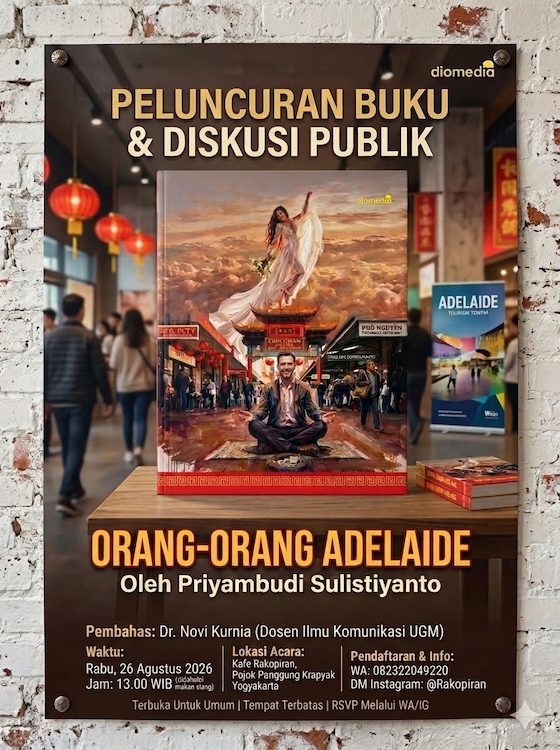
Reading Priyambudi's latest collection, Orang-Orang Adelaide, I recognised something familiar. The book, too, introduces Adelaide through its people.
The collection brings together six stories centred on Sri Mulyaningrum, Leonardo Bugatti, Tom Bowring, Brahim Al Marocco, Helena Yeoh and Carmen Tanaka. Priyambudi is explicit that these are fictional characters, yet he also explains that the stories grew out of more than three decades of listening to migrants whose lives had intersected with his own in Adelaide. His preferred form, he writes, is mendongeng - a form of storytelling that brings together history, politics, culture, food and tragedy.
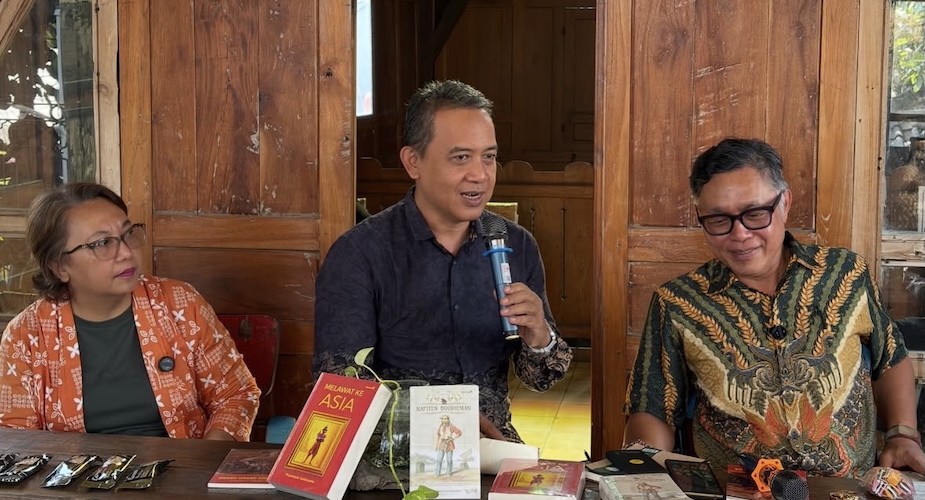
Priyambudi's earlier Melawat ke Asia approached places through movement, everyday encounters and historical connections. Orang-Orang Adelaide reverses that movement. If Melawat ke Asia followed the traveller across the region, here the wider world seems to travel into one city through its migrants. Adelaide becomes the meeting point.
A city made by movement
One of the most interesting features of the collection is that Adelaide is rarely the beginning of anyone's story.
Sri Mulyaningrum's story begins in Tulungagung and moves through education, Australia and the political upheavals of Indonesia in the 1960s. After studying in Adelaide, Sri returns to Indonesia with the conviction that she should contribute to the country. Instead, she encounters a society transformed by political violence. Friends from her student years have disappeared, and their fate remains unresolved. She eventually returns to Adelaide carrying questions that the story never fully answers.
Brahim's route begins in Tangier, Morocco. The narrator meets him at Orange Lane, a weekend market described as an ‘oasis’ for Adelaide's multicultural community, where Indonesian noodles, Moroccan goods and other foods circulate side by side. Both men are small traders, and the narrator later describes the market as the place where they could ‘saling mengadu nasib sebagai imigran di Adelaide’ - share their fortunes as immigrants in Adelaide.
Carmen Tanaka's journey extends this geography further. Her family history links Japan and Peru before her own life brings her to Adelaide. Once there, the professional identity she had developed as a journalist cannot simply be transferred. She studies English, retrains in nursing and begins again professionally.
Seen together, these stories complicate the apparently simple title Orang-Orang Adelaide. Who exactly counts as an ‘Adelaide person’? Someone born here? Someone who has remained for decades? Someone who arrived as a student, refugee, worker or spouse? The collection never answers this directly. Instead, its characters suggest that connection to a city can be made gradually, through work, relationships, habits, memories and repeated encounters.
History, memory and ordinary lives
Priyambudi's background as a scholar of politics and Asian studies is visible throughout the collection. Personal stories repeatedly open into larger histories. For example, the Colombo Plan and Indonesia's political violence in Sri's story, post-war European migration in Leonardo's, Chinese migration and humanitarian activism in Helena's, and Japanese-Peruvian history in Carmen's.
At its best, this historical layering shows that migration is never simply an individual decision. People arrive in Adelaide carrying histories shaped by war, political crises, labour markets, education and family obligations. Their journeys began long before they reached Australia.
At other moments, however, Priyambudi's impulse to explain history can overwhelm the fictional scene. Characters occasionally recede while historical exposition takes over. There is also a tension in a work that moves so freely between fiction and historical reconstruction: because recognisable institutions and chronologies carry so much narrative weight, historical precision matters. For example, Sri is described as studying veterinary medicine at the University of Adelaide in the 1960s, although the university's veterinary program was introduced only in 2008. Such slips do not undo the collection's broader exploration of migration, but they matter precisely because history is so central to its storytelling.
More compelling to me is what happens when the book turns from large historical events to the fragility of personal memory. People disappear from one another's lives. After Orange Lane closes, the narrator loses contact with Brahim and later searches Adelaide's weekend markets without finding him. Sri never learns what happened to several old friends. Helena's disappearance is different: when the narrator meets her again in an aged-care home, dementia has erased the shared memories that once connected them.
In this sense, Orang-Orang Adelaide is not only a book about migration. It is also a book about remembering. People arrive, become important, share meals, work, talk and travel, and then sometimes disappear. What remains are fragments, such as conversations, places, gestures and stories. The act of telling begins to resemble an informal archive.
Where do we belong?
The question of belonging stayed with me beyond the book. During a recent conversation on Indonesian community radio in Adelaide, I asked a guest who has lived in different places and worked in different professions, what ‘home’ meant to her. One part of her answer stayed with me: ‘My home is not bounded by place.’ She explained that she feels at home when she finds joy in helping others and that is where she belongs.
Her response offers another way of reading the title Orang-Orang Adelaide. Belonging is not necessarily something inherited through birthplace. Nor does it always mean replacing one home with another. It may emerge through relationships, work, care, participation and the recognition that one has become part of other people's lives.
This resonates with Carmen, who leaves Peru, retrains, works in aged care and builds a family life in Adelaide while continuing to carry Peru inside her. Her past has not disappeared, yet Adelaide is no less home because of it. Belonging may not require a single answer to the question, ‘Where are you from?’ Sometimes the more revealing question is: what makes somewhere home?
When I arrived, I initially understood Adelaide spatially: through the university, the buses and trains, the suburbs, the beaches and the roads connecting them. Over time, my map of the city has become increasingly populated by people. Some met through university, others through the Indonesian community or radio, or work related, and some only briefly.
That is perhaps what Orang-Orang Adelaide captures most effectively. Multiculturalism here is not primarily an official policy or demographic category. It appears as a social process where people arrive with different histories, meeting one another, building routines, helping each other, becoming friends and sometimes losing contact again.
The ‘people of Adelaide’ are not necessarily people who come from Adelaide. They are people who arrive from elsewhere, bringing histories with them, making relationships, working, caring, remembering and being remembered. And sometimes, without being able to identify exactly when it happened, they realise they are already home.
Priyambudi Sulistiyanto, Orang-Orang Adelaide, Diomedia, 2026.
Jusuf Ariz Wahyuono (jusufariz.wahyuono@flinders.edu.au) is a PhD candidate at Flinders University and a lecturer in Communication Science at Universitas Gadjah Mada, Indonesia.