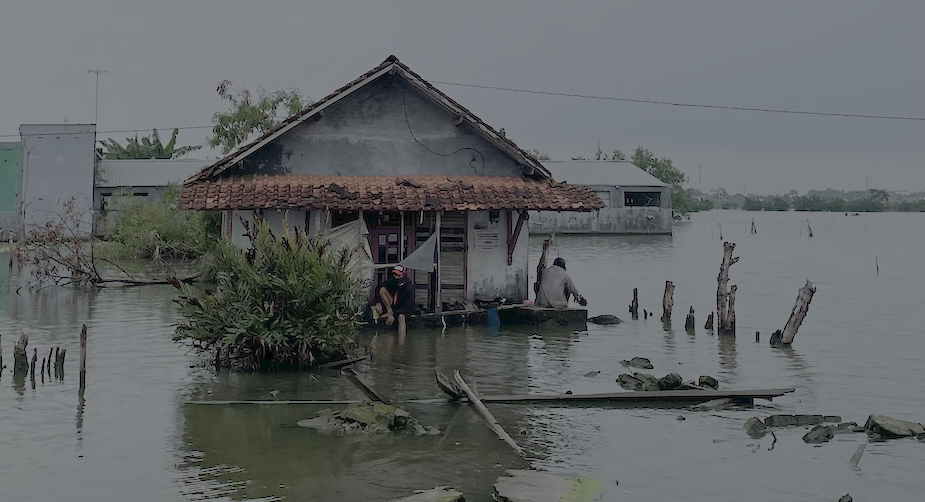
After years of tidal flooding, the livelihoods and living spaces of Pantura's residents have already been eroded
Java’s North Coast, known as Pantura (pantai utara), is a corridor stretching 1316 kilometres from Cilegon at its western end to Banyuwangi in the east that carries a significant burden. Home to one of the country’s key logistical, transport and industrial networks, the region is a major source of employment and is expected to contribute trillions of rupiah to the economy. Meanwhile the land beneath the massive ports, roads and factories along the coastline is slowly sinking into the sea and the people who have lived in Pantura for generations are bearing the consequences of decisions they never made.
For decades, Pantura has been regarded as a backbone of Indonesia’s economy. In 2025, the region contributed more than 70 per cent of Java’s total GDP and in support of its continued economic growth the government has built toll roads, widened highways, increased energy supplies, and expanded industrial areas along this corridor.
For the 50 million people living in this region, Pantura cities are home: a living space and source of their livelihoods, a place to raise families and build communities.
As a young person born and raised in one of these cities, I grew up watching fishing boats return with their catch, enabling them to provide for families waiting at home. Today, the memory of a life sustained by nature is slowly being eroded by economic ambitions, embodied in concrete infrastructure racing against the ever-rising seawater.
An increasingly absurd race
This literal race against the tide is also a gamble that has seeped into our everyday life. While young people in other cities may be thinking about paying off their first home, in Pantura we are busy calculating how many more centimetres we will need to raise the floors of our houses in order to keep them from being submerged. We watch as our yards gradually turn into ponds and our roads are repeatedly raised. Windows and doors that once appeared high above us are now barely a handspan above our heads. Football fields that once bustled with activity have become lakes.
Tidal flooding disrupts our education. Sometimes schools are forced to close, other times we study in classrooms with our feet submerged in water. For us, tidal flooding is no longer an extraordinary event to mitigate against, but an inescapable certainty.
The impacts of climate change are not only about what can be seen physically. There is something much harder to measure: our sense of security and how we imagine our future. For young people growing up in Pantura cities, questions about the future are no longer as simple as where we want to work or when we might be able to buy our first home. Instead, we ask: should we stay and fight for the land where we were born, or should we give up and become climate refugees in another city? Will our childhood homes still be habitable places when we become adults?
Some of us may have the option to leave and rebuild our lives elsewhere, but the decision to leave our hometown is not simply a matter. It affects our work, education, families, and everyday life.
Others do not have the luxury of leaving. Even as each year the water rises higher than the ground beneath our feet, they must stay. The stark irony is that this is happening in a region that contributes 23 per cent of Indonesia’s GDP. So, the question becomes for whom is Pantura being built, if the people who live here are forced to choose between leaving or staying and managing an uncertain future?
The cost of a 'safer' coast
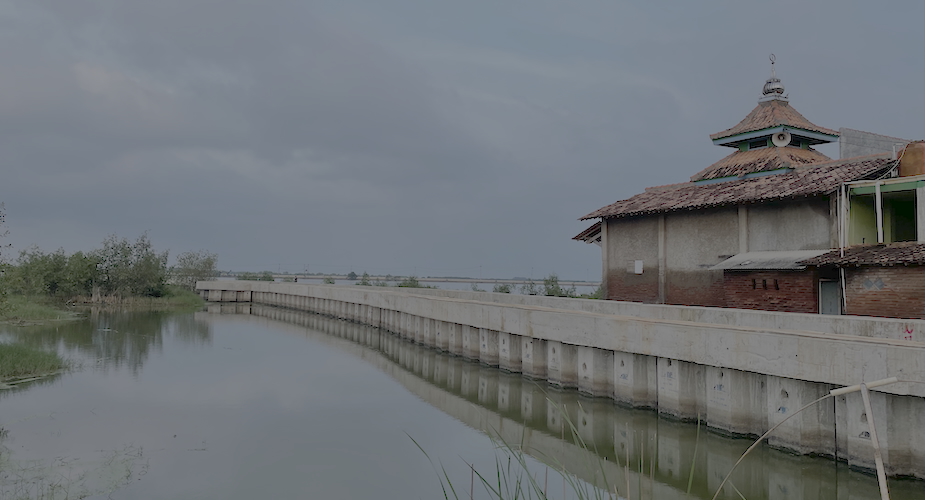
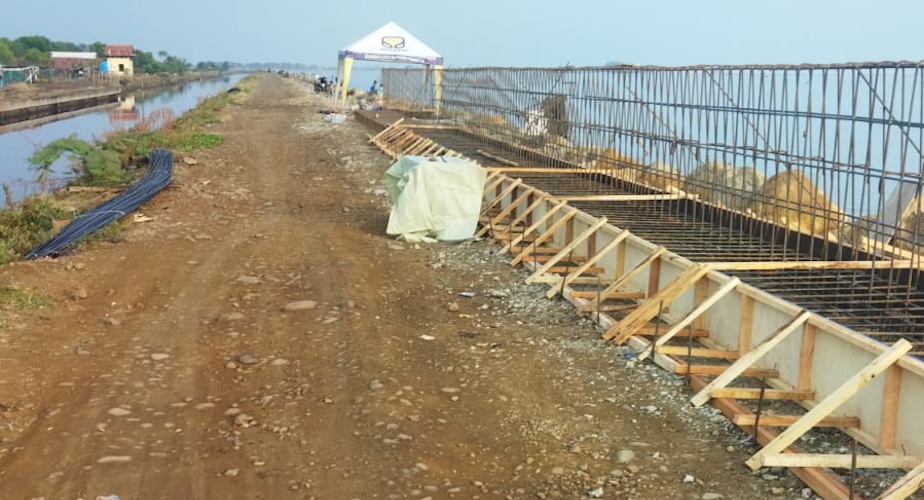
Central and local governments have made various efforts to mitigate losses and hold back the water, ranging from the construction of seawalls, road elevation, drainage systems, embankment, dyke, and flood-control infrastructure to programs for adapting to environmental change. Most recently, the government has planned the 575-kilometre Giant Sea Wall as part of the National Strategic Project (Proyek Strategis Nasional, PSN) stretching from Serang to Gresik. The Giant Sea Wall is expected to protect Java’s northern coast from tidal flooding.
Smaller-scale projects in Pantura cities, from Jakarta and Pekalongan to Semarang, have shown us that this amounts to a ridiculous race between rising water levels and concrete. These projects provide only temporary relief without addressing the roots of a much more complex climate crisis. Nor can they restore our environments and homes.
In my hometown, Pekalongan City, I witnessed firsthand how seawalls and river embankments, have created a dilemma for coastal fish-farmers. Although the infrastructure can protect fishponds (tambak) from tidal flooding, it also obstructs the flow of brackish water into the ponds. This technology treats seawater as an absolute threat while forgetting that, at the right level and at the right time, it also sustains livelihoods.
A different situation is unfolding in Batang. To avoid large coal-carrying barges serving one of Indonesia’s largest power plants fishers now must travel farther out to sea. As a result, their incomes continue to decline because the costs of going to sea are increasing. Plans to develop a dry port and a special economic zone have added to their anxiety, as this will likely make their fishing grounds increasingly crowded with large cargo ships and therefore access to fishing areas limited and potentially dangerous.
Meanwhile in Demak, the local government lacks fiscal capacity to tackle the problems the city is facing and so can only hope that residential areas affected by tidal flooding will be taken over by surrounding industrial areas, allowing residents to receive compensation in the form of relocation to other places.
The cost of endless adaptation
These three stories reveal the same irony: development that appears to bring protection and hope can instead create new forms of vulnerability. For young people growing up in Pantura the question is much bigger than simply how to adapt. If their cities continue to be forced to change according to the demands of development without regard for the environment’s capacity to sustain them, what kind of future is actually being prepared for them?
Endless adaptation is not a measure of success. If every generation must expend more energy, time, and money simply to maintain the same way of life, perhaps we need to ask whose interests are being served by all these seawalls, dykes, roads and concrete.
Perhaps it is also time to move beyond the debate on how to protect Pantura from water. Even if one day we succeed in holding back the water with seawalls, pumps, or new kinds of technology, that does not mean people’s lives will automatically improve. After years of tidal flooding, Pantura’s residents’ livelihoods and living spaces have already been eroded. We have been so preoccupied with keeping the water out that we have not talked enough about how to rebuild people’s lives once the water recedes.
Because ultimately, Pantura is not only an economic corridor of Java. It is home. And a home should not merely be protected so that it continues to stand; it should also be cared for so that it remains a place where its inhabitants can build a future.
Faris Abqori Ramadhan (farisabqq@gmail.com) is an Urban and Regional Planning student at Universitas Sebelas Maret. Originally from Pekalongan, he is interested in exploring the intersection of urban development, environmental issues, and youth participation, with a particular interest in translating complex urban issues into accessible narratives for wider audiences.
This essay is part of a mini-series focused on the stories of young people reimagining urban life in Indonesia today.