How volunteers in a North Jakarta kampung care for the dead
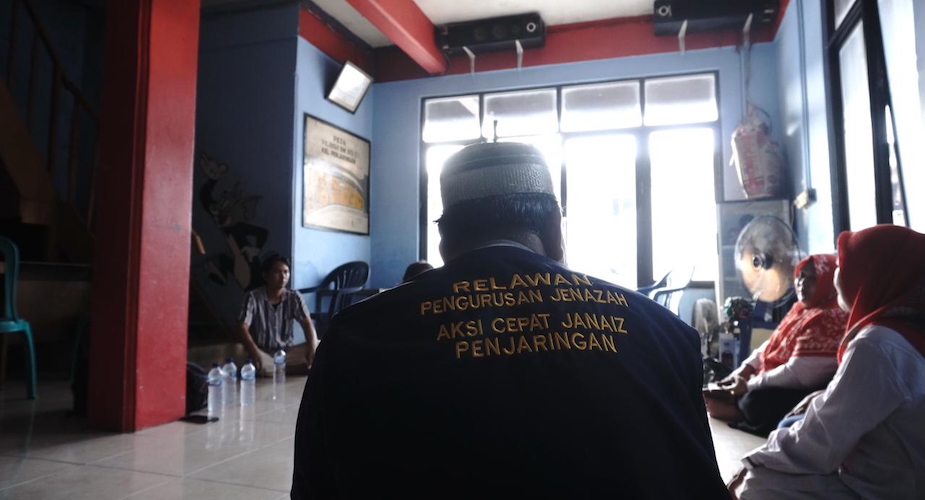
The first time I met Bu Nurbani was not at a funeral. We met at the office of the residents’ association or RW (rukun warga) in Penjaringan, North Jakarta. Like many neighbourhood offices across Indonesia, it was a place where residents came to discuss community affairs, attend meetings, organise social activities, or seek administrative assistance. But one corner of the room served another purpose.
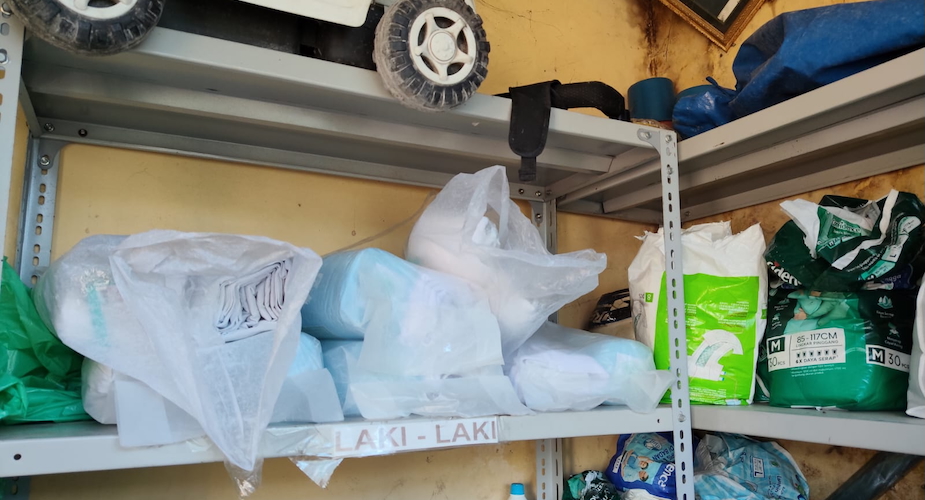
Stacked neatly inside a cabinet were rolls of white kafan cloth, bottles of perfume, gloves, cotton, ropes, and other equipment needed to prepare a Muslim body for burial. ‘This is where we keep everything’, Bu Nurbani told me.
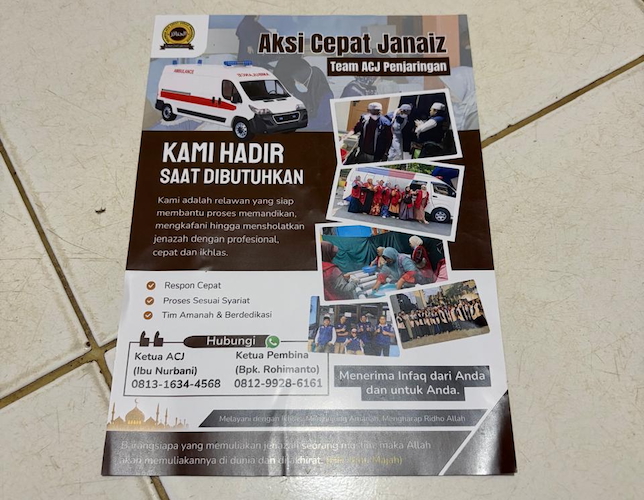
Bu Nurbani leads Janaiz, a neighbourhood volunteer group responsible for washing, shrouding and preparing the dead for burial in RW 13. Such community involvement in caring for the dead is not unusual in Indonesian urban kampungs, where funeral arrangements are often coordinated through RT or RW neighbourhood associations and funded through residents’ contributions, while some families register with local foundations that provide funeral services. Janaiz, however, is distinctive because of its commitment to caring for those who cannot afford such arrangements.
Its volunteers provide funeral care entirely free of charge, particularly for the urban poor, as well as for those who die without family members to claim or care for their bodies. Whenever news of a death reaches the neighbourhood, members of the group collect the equipment from the RW office before making their way to the family's home. The cabinet, tucked quietly into a room usually associated with neighbourhood administration, is a reminder that in RW 13, caring for the dead is also part of everyday community life.
Over several conversations, I became interested in one phrase that Bu Nurbani and other Janaiz members repeated whenever I asked why they devoted so much time to this work; ‘mencari qirot'. The expression refers to the act of seeking (mencari) the religious merit promised to those who accompany and care for the dead. At first, I understood it simply as another way of describing ‘pahala’ (meaning to gain merit for a good deed). But the more I listened to Bu Nurbani’s stories, the more I realised that ‘mencari qirot’ described something much larger than individual religious reward. It expressed an understanding that caring for the dead is also caring for the living, the grieving family, and the moral life of the neighbourhood itself.
Care after death
In global health, palliative care is normally discussed in relation to hospitals, pain management, and the final stages of illness. What I encountered in RW 13 suggested another dimension of end-of-life care. Here, care did not end when medical treatment ended, or even when breathing stopped. It continued through neighbours who washed the body, volunteers who organised funeral rites, mosque committees that prepared prayers, and residents who helped families navigate the practical demands that follow death.
Death, in other words, was not left to hospitals alone. It became neighbourhood work.
Watching Janaiz volunteers as they carried out their tasks made this particularly clear. Preparing a body involved technical knowledge, religious obligation and emotional sensitivity at the same time.
Volunteers washed the deceased carefully, wrapped the body in white cloth, prepared it for funeral prayer and accompanied it to burial. Just as importantly, they reassured family members, coordinated with the mosque, arranged transport, and helped manage the practical problems that emerged during a moment of grief.
Bu Nurbani rarely spoke about these activities as acts of sacrifice. Instead, she returned repeatedly to the importance of protecting the marwah jenazah – the dignity of the deceased. Death did not erase a person’s place within the community. The body remained someone’s mother, husband, neighbour or friend. Caring for the body was therefore a way of honouring the person who had lived among them.
Anthropologists have long argued that personhood is created through relationships rather than existing solely within the individual body. The work of Janaiz makes this insight tangible. Death does not immediately dissolve social personhood. Instead, responsibility for sustaining that personhood shifts to others. Volunteers preserve the dignity of someone who can no longer speak or act for themselves, while neighbours collectively ensure that the deceased’s final passage is marked by respect rather than abandonment.
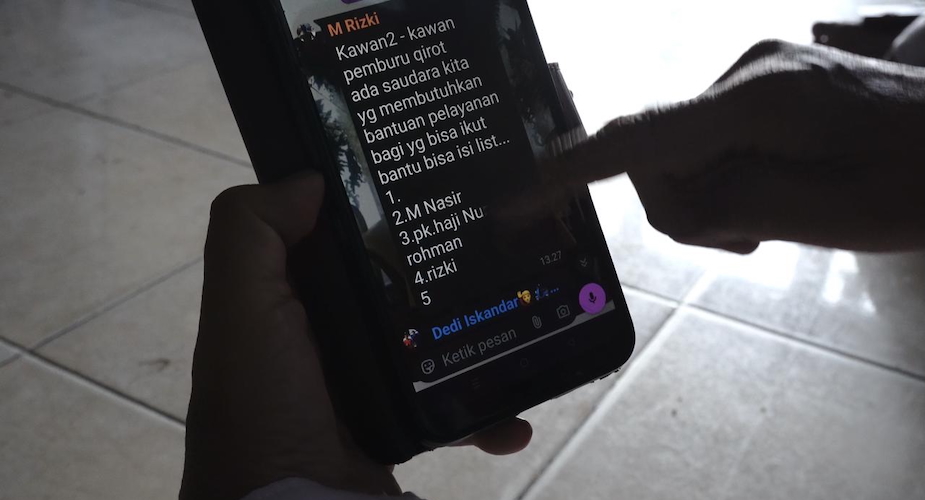
This is also why mencari qirot cannot be understood simply as pursuing personal religious reward. The merit that volunteers seek emerges through relationships—with the deceased, with grieving families, with fellow volunteers and with God. Their work resembles what anthropologist Tanya Jakimow describes as the moral formation of volunteers in Indonesia: unpaid labour through which people become particular kinds of ethical subjects. Yet Janaiz volunteers occupy a distinctive position. Rather than mediating between citizens and development programs, they accompany neighbours across the threshold between life and death.
Filling the gaps
The existence of Janaiz also reveals the limits of formal systems of care. Janaiz is not affiliated with a mosque or any particular religious organisation. Its volunteers are all Muslim, however, and their knowledge and skills are specific to Islamic practices of washing, shrouding and preparing the dead, so their services are limited to Muslim funerals. The group was initially organised by Bu Nurbani to serve residents of RW 13, but over time its network expanded as volunteers from neighbouring RWs joined and donors began contributing money and other forms of assistance to support its work. Its geographical reach expanded as well.
What began as a neighbourhood initiative serving Penjaringan now responds to requests from beyond the kelurahan, including cases as far away as Depok, a neighbouring city south of Jakarta. Families in RW 13 often face narrow alleys inaccessible to vehicles, financial constraints, administrative burdens and the practical challenges that accompany death in one of Jakarta's most densely populated neighbourhoods. Community volunteers respond not only because they are compassionate, but because someone must fill the gaps left by formal institutions.
For this reason, mencari qirot is more than a religious expression. It names a moral practice through which the neighbourhood collectively assumes responsibility for those who can no longer care for themselves. It reminds us that palliative care is not only about easing suffering before death. It is also about ensuring that dignity survives death itself through the hands, labour and commitments of others.
The cabinet in the RW office, quietly storing the materials needed for the next funeral, captures this ethic perfectly. It sits among files, chairs and neighbourhood records, waiting for the moment when it will once again be opened. In RW 13, death is not hidden from community life. It is one of the many ways the community continues to care for itself.
Hestu Prahara (hestuprahara@ui.ac.id) is a lecturer in Anthropology at Universitas Indonesia. His research interests include the anthropology of development, urban studies, and socio-cultural transformation. More recently, his work has focused on the governance of death in urban kampungs, examining how communities navigate and organise care, responsibility, and everyday practices surrounding death and dying in densely populated urban settings.