A community of women are re/claiming what it means to be janda
For Indonesians there are few labels that carry as much baggage as ‘janda’. According to the sixth edition of Kamus Besar Bahasa Indonesia, the word refers to a woman whose marriage has ended through divorce or the death of her husband. On identity documents and administrative forms it appears as a neutral category of classification. Yet ‘janda’ carries significant moral weight and certain assumptions about those whose lives do not fit into a narrative of ‘happily ever after’.
When I interviewed Mutiara some years ago she recounted how on her visit to the district office to renew her identity card following her divorce, the officials looked at her with a curiosity she found intrusive. They made half-joking remarks about how she had ended up there and about how young she was. Nothing was formally recorded beyond what was needed to complete the administrative process, yet the exchange made clear that ‘janda’, as a category, was doing more than just describing a biographical fact or legal status.
‘What’s wrong with being a janda? In fact, what’s wrong with “janda”? The word itself needs rescuing,’ Mutiara told me.
Stigma and struggle
What is so often dismissed as trivial, unpleasant encounters, through repetition become one of the ways inequalities are made. Mutiara lost a job when her client found out she was recently divorced. She felt that the meaning attached to her identity had suddenly changed. As she soon discovered, for women, the end of a marriage triggers suspicion tied to their sexuality and presumed dependency on men as providers. Another woman told me her male colleagues began making sexual advances after her divorce. There were assumptions that a woman without a husband must also be a woman looking for one. Their aloneness is often misrecognised as availability. For some the harassment becomes intolerable. Like Mutiara, some choose to leave their jobs rather than endure the constant insinuations. Others choose to stay and learn to negotiate unwanted attention as part of their daily working lives.
These stories are not exceptional. They belong to a wider narrative through which ‘janda’ is made to signify more than just a marital status. News articles, television dramas, songs, comedies, and social media content, have long rehearsed the same fabulation about the lives of janda, reducing them to tropes associated with sexual availability, incomplete womanhood, and failure. Although the term ‘janda’ is used for both widows and divorced women, some question whether widows are afforded greater respect and are less likely to be accused as failing wives or mothers compared to divorced women. A study by Mahy et al. published in Indonesia and the Malay World in 2016 found that such divergence does not extend to perceptions of sexuality with presumptions of sexual promiscuity attached to all janda regardless of their circumstances.
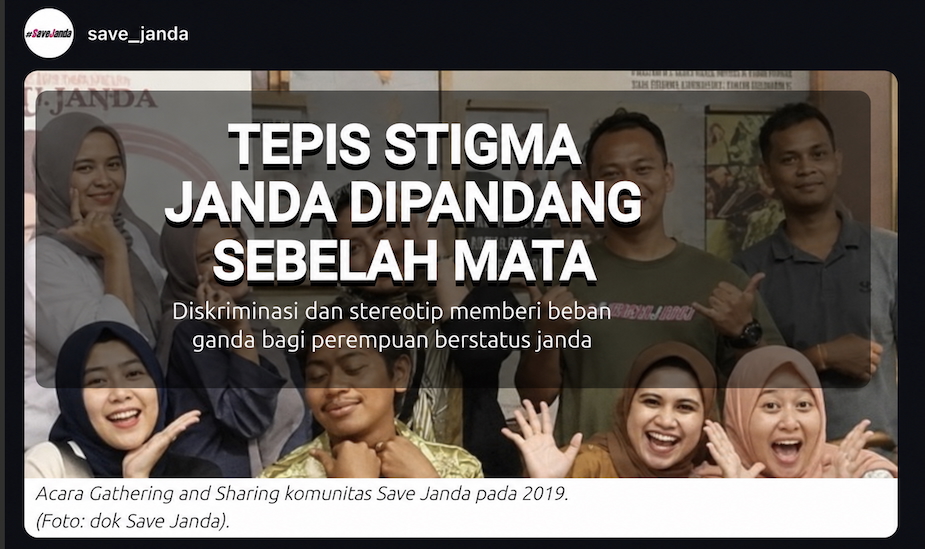
In 2016, Mutiara began posting about her experiences under the hashtag #SaveJanda. When Bertin, who later became a member of Save Janda, went through her divorce, she reached out to Mutiara. Others found her in much the same way. What began as one woman’s insistence on speaking her truth gradually became a conversation among many others who recognised themselves in stories that resembled their own. By the time I met Mutiara, the Save Janda WhatsApp group had around 100 members. Some stay briefly, seeking support during divorce proceedings or moments of grieving after their husbands passing. Others stay longer, finding a community where they feel that their worth is not measured by a label.
What’s in a name?
What Mutiara encountered was not simply prejudice directed at an individual. The word ‘janda’ has long carried assumptions about women in her situation. In a sense, she was already named before she could name herself. In Critically Queer (1993) Judith Butler offers an example of how people become recognisable through categories that already exist before them. ‘Queer’ became an insult not because of what it means literally, but because it was repeatedly used to shame, ridicule, and pathologise those it named. Each repetition used in an injurious way, echoed earlier acts of naming, reinforcing the norms that separated those who belonged from those who did not. Likewise, the word ‘janda’ signifies an already existing specter within a particular history, reproduced through its repetition in bureaucratic encounters, popular culture, and everyday conversations.
The meanings attached to such words can, however, be reworked. In Excitable Speech (1997) Butler points at how meanings can be resignified when those targeted reclaim the very words once used against them, as in the cases of ‘queer’ and ‘Black’. Through reiteration, a word used in discrimination and abuse can be subverted to mean differently, to perform differently. Save Janda focuses on tending to such linguistic injury by laying claim to the word and using it openly, to organise under its name and build a community around it. Much of its work centres on social media campaigns against stigma and sexual harassment. This includes calling out those who use the term to harass, harm or discriminate against women and in the process to sever the naming from the effect of shame.
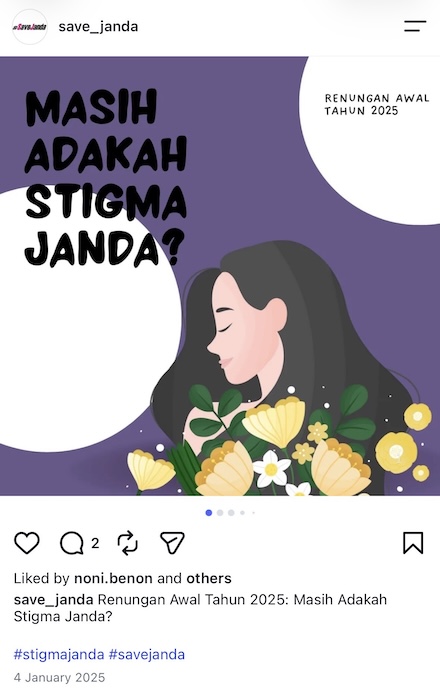
Another element valued by its members are its peer support networks. Its WhatsApp groups include dedicated channels where members can share their grievances, vent their frustrations, and seek advice, including about their intimate lives. These spaces help identify members’ needs and connect them with organisations that can provide specialised assistance, including legal advice, psychological counselling, and other forms of support. They also organise social events for members and their close ones, so that they can enjoy themselves in a space made safe for them. The members believe that their moments of hardship do not have to define their lives.
Who needs saving?
Save Janda is not the only social media-based initiative concerned with the welfare of widows and divorced women in Indonesia. There are several more groups with overlapping membership bases, including Spinmotion (Single Parents in Motion), Perdalisa (Perempuan Berdaya Peduli Bangsa, Empowered Women Care for the Nation), and PenTaS (Perempuan Tanpa Stigma, Women Without Stigma). These groups collectively organise under the hashtag Koalisi Ibu Bergerak (Women in Action Coalition, Kolibri), focusing on the welfare of single mothers and advocating for greater social protection for children following divorce. While Save Janda has expressed support for this effort and such issues resonate with many, not all janda are mothers and the roots of their exclusion may differ.
In the current political landscape, Save Janda may not be the largest or most politically visible among these initiatives, but their willingness to reclaim the word ‘janda’ distinguishes them from other organisations. Rather than abandoning a word long used to demean them, its members insist on inhabiting it differently. There is politics in that choice. It may not be in the forms of political action we have learned to recognise but it is political, nonetheless. It begins with their refusal to accept the terms through which janda has been made intelligible.
A woman does not become recognisable as a janda simply because her marriage has ended, but because society already possesses a cultural framework and discourse, through which that social fact is interpreted and given meaning. What they confront is not only the stigma associated with the label ‘janda’, but also the moral order that ties respectability to women's positions within the family. In reclaiming the word – janda – they seek to make possible another way of inhabiting the world, in which lives that appear oblique and strange within the grammar of the nuclear family can also be recognised as lives worth living. They expose the limits of a politics that only grants recognition to women who fit into the ideal of the respectable wife and mother.
If women’s worth continues to be measured by their place within marriage, those whose lives fall outside of it will continue to be seen as failures, lacking, or at best, exceptions. The struggle of Save Janda is not simply the struggle for inclusion. It is for a future world in which women no longer need to be wives or mothers to count as fully human.
Mirna Nadia (mirna.nadia@gmail.com) is a research fellow at Institute for Advanced Research, Universitas Katolik Indonesia Atma Jaya. She is interested in studies of citizenship, state power, and the politics of belonging.