A dialogue on haunting, journalism and anthropology
Tito Ambyo, in an apartment on the third floor in Kensington, Melbourne. Or Narrm — the name given by the Wurundjeri people, who lived here for more than forty thousand years before Europeans arrived, opened slaughterhouses to feed the growing city, and fouled the Maribyrnong River with the blood and entrails of pigs, sheep and cattle.
Titah AW, in a two-storey house on Bukit Bibis, Bangunjiwo, Yogyakarta. Around two hundred years ago, in the middle of the Java War, Prince Diponegoro built a secret headquarters in one of the caves at the foot of this hill. Together with hundreds of his soldiers, he planned his campaign against the Dutch colonial forces. At that time, the forests of southern Java were still home to the Javan tiger — king of the jungle, now known only through taxidermy, fossils, and legend.
They open their computers and connect through the internet, data packet by data packet, pixel by pixel, to talk about ghosts, journalism, and anthropology.
Haunted knowledge
Tito: The theme of our conversation: does journalism need to be haunted by anthropology, or does anthropology need to be haunted by journalism? Or maybe both need to be haunted more generally? Because we want to talk about ghosts not only as a topic, but also as witness, as partner in the search for knowledge, and as method.
But first — a question for you, Titah AW: when Indonesian mainstream media covers supernatural belief, what does that framing usually look like? And what do you do differently?
Titah: I first became drawn to reporting on ghosts with journalism through something I observed during a university assignment. The task was simple: buy a newspaper every day for seven days and study what's in it. And I found a pattern. There was always a small column on the front page — or somewhere near it — filled with funny little everyday stories. Ghost stories ended up there, alongside stories of pickpockets, people cheating on their partners, scandalous affairs. Things considered trivial.
Meanwhile, supernatural phenomena were reported as something absurd or framed as irrational. Media covered them as if asking: why, in this day and age, do people still believe things like this? But I was already familiar with a different way of shaping reality — that whenever a development project tried to change the physical landscape, especially on a large scale, there was almost always a supernatural response. These stories don’t make it into media reports or official documents, but they were experienced and passed from mouth to mouth among the people living in the affected landscape.
And the governmental regimes of the last twenty years have been obsessed with infrastructure development. In 2022, the Jalan Jalur Lintas Selatan road project in Gunung Kidul was covered only through the lens of economics, investment, progress. When I wrote about the ghosts of Gunung Kidul, what I did was open a wider window onto the situation, something more holistic. Infrastructure development isn't only about economics. There's also ecology. There's the cultural equilibrium that gets disturbed. The ghost stories reveal a more complete map of reality.
Tito: There's a large gap between how we live with ghosts every day and how the media tells stories about them. Growing up in Indonesia means growing up with ghosts. And these ghosts aren't always the kind you see in films — no jump scares, more of an existential dread. A motorbike stalling on a dark road, for example, has an immediate explanation that comes out of this feeling that we’re always haunted: ghostly frequencies killed the engine. We talk about this with each other.
So why the gap between how we narrate the world in everyday life and how we narrate it as journalists?
Titah: I think it connects to class. Journalism is associated with intellectualism — writing, analysis, data, facts. And in Indonesia, to be called educated is to be haunted by a colonial education system that is thoroughly rationalist. So ghost stories become lower-class topics; stories for those who are uneducated and irrational. Even now, journalists who specifically cover ghosts in Indonesia are almost nonexistent.
Tito: There used to be Majalah Misteri. I once bought a copy at a secondhand magazine stall, and the vendor said: 'Just Majalah Misteri, Mas? Usually people like you buy Misteri alongside Tempo'. He laughed. The implication was clear: educated-looking people buy the investigative journalism magazine, Tempo, to seem respectable, but what they actually want to read is Misteri.
Titah: Because our education system is still haunted by the colonial education system. When a ghost story appears, journalists immediately read it as logika mistika — occult logic, something to be avoided, unscientific, and therefore abandoned. But ghost stories are part of something much larger. Maybe they reveal something about the decolonisation of our knowledge. Maybe they hold the knowledge of our ancestors — a richer reality that has long been exploited and erased by colonialism.
Ghosts as witness
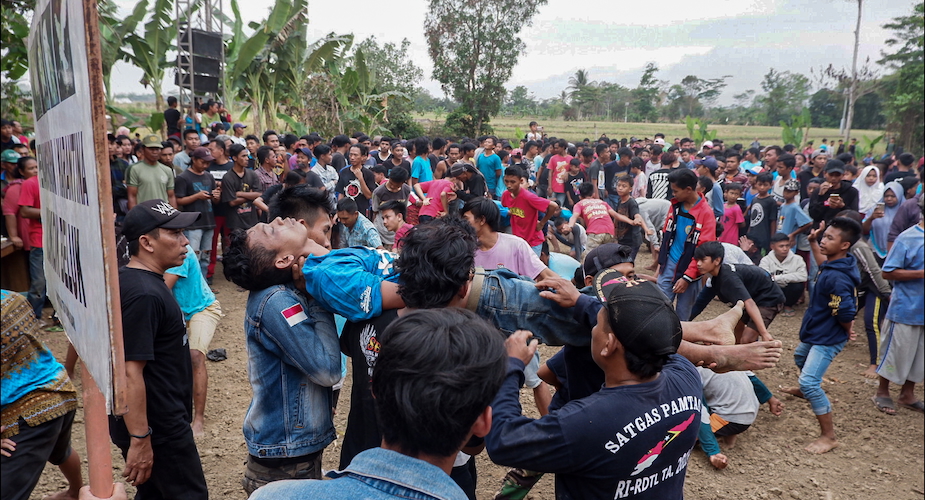
Titah: When I was reporting on ebeg in Banyumas, I stood in the middle of a field, fully conscious, while all around me people were entering kesurupan — spirit possession. And I realised: the question of whether this is real or not had become useless. This experience was being lived collectively, right in front of me, and I couldn't access it through my own senses. But the limitation of my senses didn't mean that the ghosts, and this inter-dimensional gathering, weren't real.
I asked the dukun — the ritual practitioner: 'What's here with us?' He said: 'If only you could see, Mbak — there's a tiger, there's a monkey, there are so many things.'
Tito: What struck me reading your piece was that I wasn't reading about possession. I was reading about young people in Banyumas doing something very similar to young people in Melbourne going to a nightclub. They were also seeking altered states. Liminality.
Titah: And it's social. Which spirit you manage to receive, how you enter possession — that determines your position in the social circle the next day at school. Your spiritual knowledge is your social currency.
But I've realised something I didn't think about during the reporting. The spirits that possessed them — tigers, monkeys — those are animals that used to live there. The Javan tiger is biologically extinct. But perhaps, with Danu entering possession by a tiger every week, Danu is keeping alive the memory of the ancient forest that once existed in Banyumas. The ghosts are the living memory of something that no longer exists.
Tito: This is what's interesting about the materiality of ghosts in Indonesia. European ghosts inhabit stone buildings — castles and fortresses hundreds of years old. But most Indonesian buildings in the past were made from materials less permanent than stone. Colonial and post-colonial violence destroyed much of what remained. Interestingly though, in cities like Bandung, the most well-known ghosts tend to be Dutch ghosts — and their stone houses are still standing.
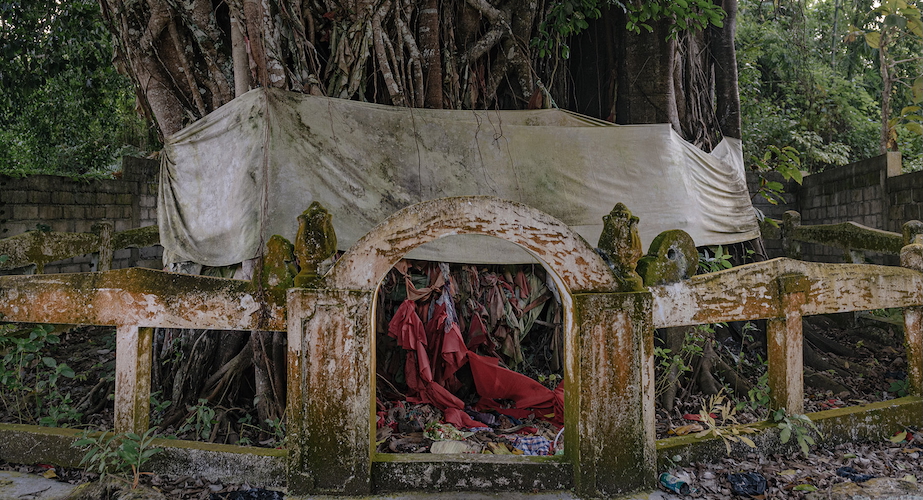
We have temples made of stone, too, of course. We have inscriptions on stones. But the ghosts in temples aren't everyday ghosts. What I’m interested in with my research is to ask: where is the home of our everyday ghosts? They are in forests, in old Dutch buildings, in places that carry spiritual significance — but also in trees, invited to possess our bodies, and in roads, bridges, and tunnels. This is perhaps a question about how the types of ecologies and landscapes we humans build become the homes that are available for our ghosts to inhabit. And what stories they tell.
In cities like Bandung or Jakarta, the pace of development — with little heritage protection — makes it difficult to imagine what these cities once looked like. But we have stories. Including ghost stories that become a way of connecting with history.
On Jalan Cipaganti in Bandung, for example, there's the ghost of a headless jawara — a local warrior said to have possessed the power of ajian Pancasona, an invincibility charm. The Dutch paid locals to cut off his head, but he still roams there, looking for his head. Which is why you should be careful riding your motorbike along that stretch. But with this story, you’re not just riding on the road, you're also riding through time — remembering, or imagining: there was once a fighter here who resisted the Dutch. And his spirit remains. The story may not be objectively real, but his story, this piece of data, becomes something you can feel.
Maybe ghosts are history for people who don’t study history. Although there is the example of Om Hao, who is both a historian and a practitioner of retrocognition. He has given presentations at Universitas Gajah Mada where he studied, I think partly because he is able to present history to a wider audience.
Titah: And it's not only human history. In my research for Tales of Belonging in Aceh, in the ecosystem of Leuser, I found that communities at the forest edge maintain maps of worlds beyond humans. They know the territory of each tiger, the routes that the elephants take, the way the river and the wind move. And tigers there are not just wild animals, but some of them are rimueng aulia — holy creatures, who often appear as tigers or as humans with tiger abilities.
Their sense of belonging with the landscape of Leuser is built through ongoing friendship and negotiation with the spirits of the forest. But state conservation practice — based on fortress conservation, which restricts human presence — cannot read that map at all.
Tito: And mapping is never neutral. The Ministry of Environment and the Ministry of Forestry will produce different maps of the same peatland, because one wants conservation and one wants to sell. What they're doing isn't mapping the world. They're mapping their own interests.
Titah: And if the ghosts of Gunung Kidul were never written, never mapped, we would never know there are sacred sites there. We would never know about a tree that couldn't be felled because the community had grown familiar with the spirit that inhabits it — knew its name, knew its habits. Ghosts as neighbours. When they wanted to cut the tree down, the spirit refused — and that is data. Data about the ecosystem, about cultural equilibrium, about what is lost when development is reported only through the lens of investment and economic growth.
Haunting as method
Tito: How do we, as journalists, anthropologists, writers, rebuild our relationship with ghosts?
Titah: First: openness of mind. Among the journalists I know, many are still haunted by Western knowledge systems — when a ghost story appears, they immediately read it as logika mistika, something unscientific and therefore to be abandoned. But as journalists we have to be willing to listen to whatever our sources tell us without rushing to judge whether it's true or not.
In Banyumas, or in Maluku when I was reporting on butterflies, I always came away with detailed and descriptive ghost stories — because of how I asked the questions. Every ghost speaks about something specific to its place and time. Spiritual knowledge is always bound to landscape. When the landscape changes, the stories change with it.
[Looking back at this moment in the conversation, we notice the jump — between Titah's forests in Leuser and Tito's laneways in Melbourne. In the conversation, we moved between them the way you move between rooms in a familiar house in the dark. But it might be worth putting a torchlight on the connecting thread: that the failure to take ghost knowledge seriously isn't an Indonesian problem, or an Australian problem. It's about what colonial rationalism does to every landscape it touches. It erases the maps — humans and more-than-humans — that were already there. What remains are the ghosts. And the journalists and anthropologists are now trying to learn, belatedly, how to read them.]
Tito: Journalists are often taught that emotions don't matter — you must be objective. But if you're speaking with First Nations people in Australia at sites where their ancestors were killed, our mapping of the world as journalists will be incomplete if we don't acknowledge that emotion matters in the way we relate to the world and each other. In Melbourne we often see ghost bikes — bicycles painted white at the sites where cyclists were killed. And there's the She Matters memorial, a mural in a laneway with photographs of women who were victims of violence. These are serious problems, and we need many different ways of telling stories to help us keep remembering.
Titah: And ghosts aren't only about history and wounds. I once had a conversation about kuntilanak — women who died in childbirth. Someone said: 'Maybe ghosts are proof that our love can go beyond time and space.' So beyond trauma, there is also love. Emotion that transcends dimensions.
Tito: Growing up in Bandung, hanging out with friends meant playing guitar, eating, drinking, and then it often ended up in ghost stories. And sometimes it led to a ritual. We'd go to an old school building to look for a Dutch girl's ghost, the Noni Belanda. Or to Taman Maluku to find the Headless Pastor. Or there was a large billboard advertising shampoo on a street corner with a photo of a model with long hair on it — they said if you went there at 2am, the model in the ad would transform into a kuntilanak. In a way, as high school students, my friends and I were doing historical research. But through feeling and story.
Titah: Almost every school I attended — kindergarten, primary, junior high, senior high — was a haunted place. And they were all former Dutch buildings. Our childhood ghostbusting was historical fieldwork.
Tito: Historical fieldwork that mattered.
Penutup
Tito: Later, from this interview, we'll make a transcript, shorten it, and become the ghosts that haunt it.
A dialogue with the versions of ourselves that no longer exist.
Titah: Who have become ghosts.
Titah AW is a freelance journalist and writer whose work moves between magical realism and ecology. She lives in Yogyakarta, Indonesia. Tito Ambyo (arsisto.ambyo@rmit.edu.au) is a media anthropologist, journalist, community organiser, a lecturer at RMIT University, Narrm, Australia and a member of the Board of Inside Indonesia.