In Indonesia’s digital realms, protests are lived and remembered through colours
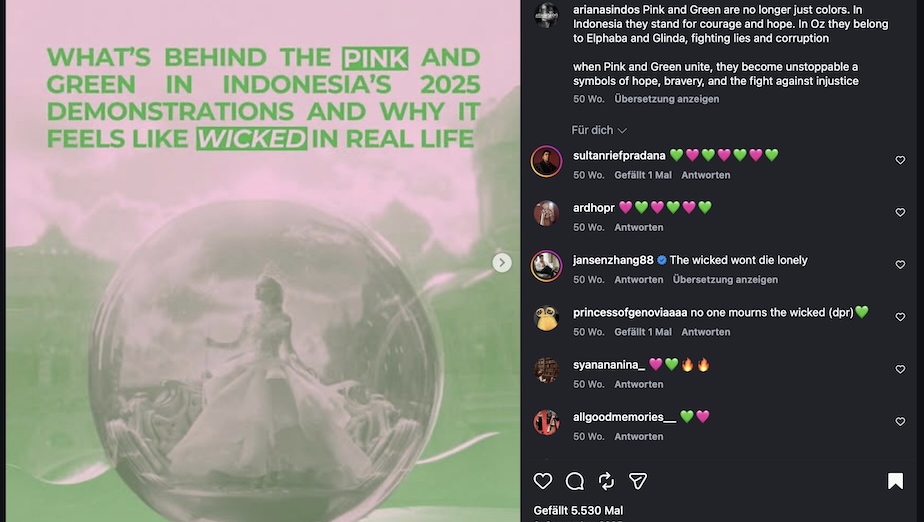
In early September 2025, a colour-coded meme caught my attention. It was an image of American singer Ariana Grande starring Glinda in the musical movie Wicked: For Good. A pink-and-green filter shaded the meme, referencing the colours of Wicked’s two main characters: a powerful sorceress and a wicked witch. I was intrigued by its serendipitous appearance on my Insta feed, almost a year after the movie’s release. All the more fascinating was its overlaying title, ‘What’s behind the pink and green in Indonesia’s 2025 demonstrations and why it feels like wicked in real life’.
It was the title image of an Instagram carrousel that drew parallels between ‘Indonesia’s politics’ and Wicked. This opened a poetic world, showcasing the fragmented yet creative practices that allow young Indonesians to master their increasingly difficult realities. Pop culture fantasy and real-life political events blended seamlessly in this memeified commentary. Its colours enabled a sense of connection to those arresting events in August 2025, poetically activating political imagination in ways that cannot be achieved through text alone. That is why colour-coded memes became an integral part of the August 2025 protests and its aftermath.
Memes for a wicked reality
In Indonesia’s digital realms, political campaigns enthral with costly, AI-generated images and stitched videos. Concurrently, Indonesia’s tech-savvy youth have become adept at using digital technologies to convey their aspirations – using smartphones equipped with high-speed internet connections, integrated cameras, image editing tools, and social media platforms that magnify the creation and circulation of protest imagery. For them, memes have become a central vehicle of political communication and participation.
Memes are powered by the entertaining visual features of popular culture and the ironic and witty characteristics of everyday talk about politics. A stunning feature is their layered intertextuality: they demand additional knowing from their audiences and invite viewers on a journey of deciphering visual cues. By engaging publics into a joint process of imagining political realities, memes share some characteristics with art that, in Indonesia, is well-known for its sophisticated political character. Ingrained in public commentary, some memes stick due to the awkward connections they trigger, often to expose political absurdity. Such was the case for memes accompanying the August 2025 protests.
Set off by the brash proposal of Rp 50,000,000 (AU$4000) monthly housing allowances for MPs on top of their already generous salaries, these protests were not an isolated event but part of a series and a subculture of protests that have been growing in size and intensity at least since the ‘Reform Corrupted’ protest in 2019. Memes were integral to successive waves of protest since. But those circulating since August 2025 struck a different chord – by means of colours.
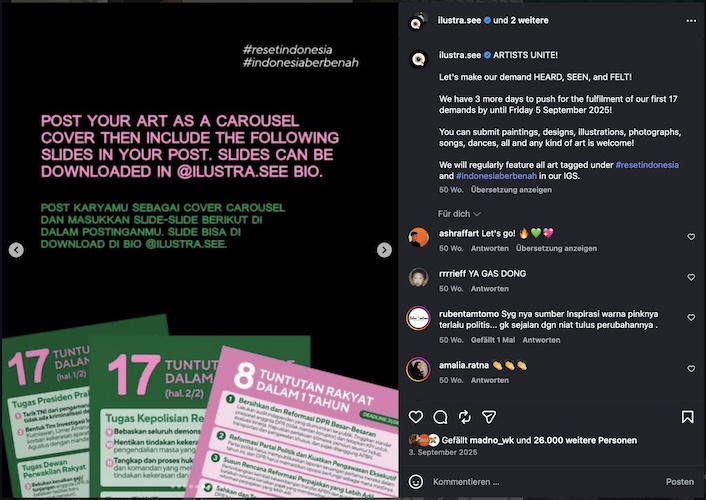
The unusual combination of pink and green captivated online publics only days after the August mass demonstrations. A group of influencers and content creators had made a list of political demands which they circulated widely as an attempt to translate people’s grievances into policy-related action points. On Instagram, however, they called for art. They invited users to join their campaign by reposting the list alongside their own pink-and-green artwork. By 5 September, the platform was flushed with pink and green imagery. Some social media users were quick to grasp the cinematic allusion: ‘Pink goes good with green!,’ they cited Wicked’s iconic line.
The two colours, however, derive their poetic grip from imagery born out of the chaos of the August demonstrations. In Indonesia, they now stand for courage and heroism – two personal qualities that seemed to follow naturally from chronic grievances over political and economic realities, which for many feel ‘like wicked’. This ‘wicked’ reality transpired through the unprompted and unruly digital mediation of two specific events during the August 2025 protests.
Colours of sacrifice, courage, and resistance
On the fourth day of the protest in Jakarta, a bystander accidentally filmed the fatal injury of Affan Kurniawan with her phone camera. An armoured vehicle, summoned to disperse the crowds, struck and, after a seconds’ pause, ran over the body of a young motorcycle taxi driver passing through the area. The footage showed several protesters rushing to help him, pushing, banging and swearing against the car. In the acoustic foreground, witnesses screamed in terror, not least the woman holding up her camera to catch the dramatic event.
In the next hours and days, the recording was viewed millions of times across various platforms. People were furious. Students took to the streets after classes. On the streets, more and more bright green jackets – representing the work attire of Grab and Gojek, the two ride-hailing companies Affan worked for – through the sea of black-attired protesters. Media recognised motorcycle taxi drivers as a ‘key group taking part in the protests’. In the span of just a few days, the death of Affan came to represent everything that is widely perceived as going wrong in the country – an economy and a judicial system that routinely fail ‘small people’ (rakyat kecil).
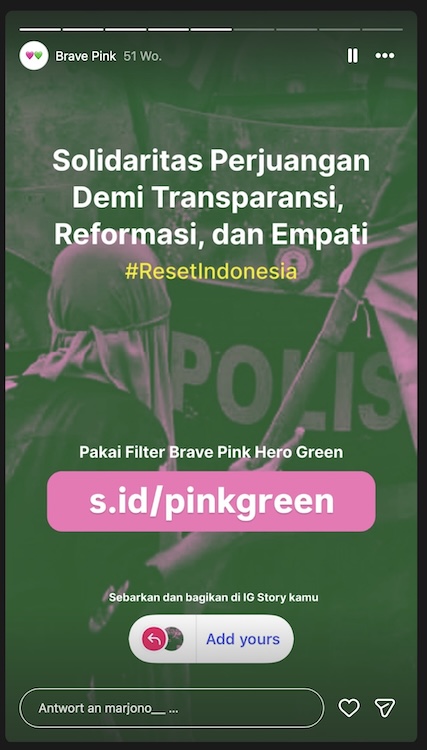
Amidst reports covering Affan’s death, another colour interrupted the bright green of motorcycle taxi drivers’ attire. It was the pink of a woman’s headscarf against the murky background of police shields, captured by AFP photographer Bay Ismoyo during the protests, only hours before the fatal collision. By the time the photograph appeared in media like The Jakarta Post, Ibu Ana – the middle-aged woman who, on that day, stood outside the central parliament building to join the protest, and attacked the police with a flagpole carrying the red-and-white – had become a symbol of women’s courage.
Images of the scene circulated on social media since that day. So did stories about the woman. One user dreaded, she was his mother who had not yet returned back home. Another claimed, the woman was his aunt who had lost her sanity. Others doubted her existence at all. Critical journalists quickly grasped the depriving effects of this guessing game. But while the controversy surrounding Ibu Ana’s identity ebbed, the colour of her scarf, and the image of people’s courage it referred to, sticked.
In the following days, thousands of netizens posted and commented on AI-generated images of Affan’s green helmet and Ibu Ana’s pink scarf. Equipped with colour codes and free online image generators, users quickly learned how to shade their own images in pink and green. As if to balance out the technical aspects, the colours came with memorable designations. Pink became ‘brave pink’ associated with the courage of a woman facing shielded policemen, while green advanced to ‘hero green’ that stood for the ‘sacrifice’ of the rakyat kecil. The colours unleashed an organic online movement that budded on ‘brave-pink-hero-green’ image generators, quickly spilling over onto the streets of Jakarta and elsewhere, where people gathered in solidarity and marched in demand for political reforms.
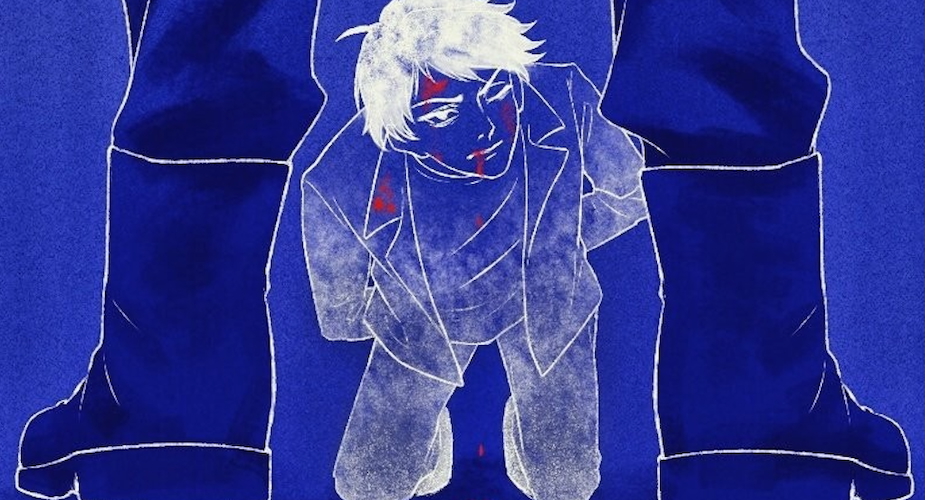
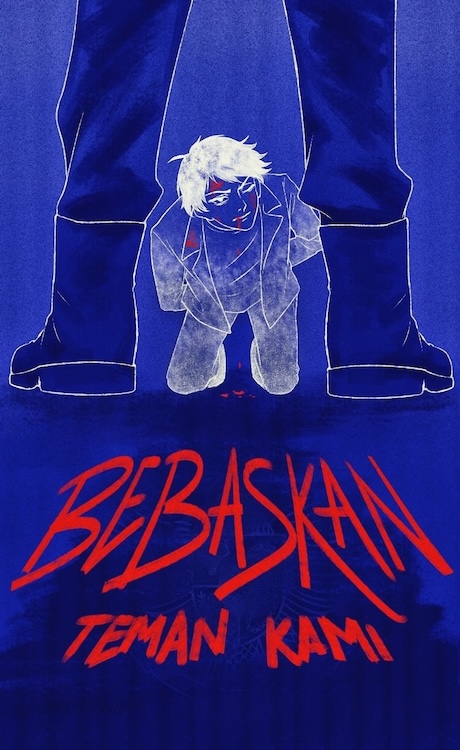
Soon, a third colour mingled among the pink-and-green amalgam. A year earlier, in August 2024, blue became the colour of another alerting protest against the consolidation of political dynasties: the parliament’s attempt to amend the Regional Elections Law, overruling an earlier decision of the Constitutional Court, to enable the candidacy of then president Joko Widodo’s son Kaesang Pangarep in the 2024 regional elections. The blue came from a posting by journalist Najwa Shihab which used a fragment from a locally-produced horror video – a fictive emergency warning broadcast on fictive television reminiscent of Suharto’s days. Emergency Warning (#PeringatanDarurat) became the name of the movement against the law’s revision. Varieties of slogans and symbolic images against a blue background circulated widely on social media and beyond. One year later, when pink and green started to shade social media images, blue returned to the scene – now becoming ‘resistance blue’.
Poetics of perseverance
Following the August 2025 protests, Indonesia saw one of the biggest crackdowns on protests since reformasi. In the first week alone, the Indonesian National Police reported more than 3000 detentions across the archipelago. This number grew as the police continued to arrest suspects – predominantly young people – throughout September, more than once referring to the ambiguous Electronic Information and Transactions Law. The use of colours could be considered a less dangerous option for those who sought to criticise the government online.
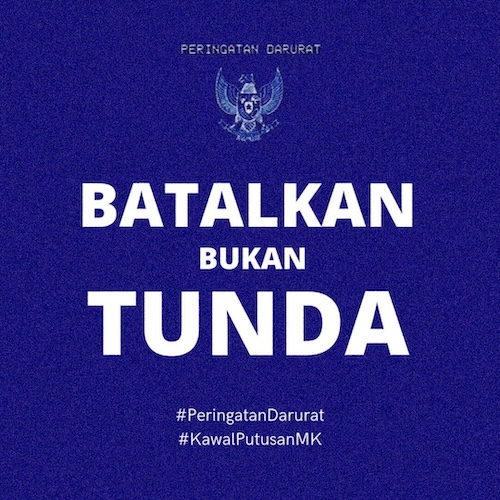
But the colours functioned not merely as safe cosmetics to prettify images. They shaded the posters of activists standing in front of police offices, demanding the release of their peers who had been arbitrarily taken into custody. They adorned popular hashtags – such as ‘#ResetIndonesia’, as the movement became known – daring acronyms such as ‘ACAB’ and demanding slogans, such as ‘Pak Polisi, stop stalking our social media’, held up at rallies by those refusing to see their demands as settled.
Retrospectively, #ResetIndonesia and #PeringatanDarurat seem to represent individual online campaigns in a series of protests that signal activists’ grievances over democratic regression. However, the colour spectrum that settled on protesters’ imagery shows that grievances accumulate. While street protests aim at generating acute pressure, the colours that continue to shade activists’ visual attributes today signal that such moments of climax, once passed, are not forgotten. They sternly oppose the common view that protests tend to be short-lived.
Some even described the colours as the people’s new ‘spectrum of hope’. Hope resides in the poetic grip of the colours that bestows power and courage upon the people, particularly on those who are regularly marginalised and excluded from formal political discourse. Dominating the visual surface of social media platforms, they generate a unifying effect.
Beyond the emotional momentum, the colour spectrum that pervades online and offline forms of political expression signals that Indonesians consult the digital archive for future orientation. The colours blue, pink and green might strike with aesthetic discordance, yet displayed on posters and banners in front of government buildings they build a distinct seriality that functions as a lineage, referencing past events that authorise and give meaning to present political calls, while opening poetic worlds beyond traditional forms of protest. Protests’ fragmented occurrence is made meaningful through colours that demand ‘naming’ and retelling their background and therefore the dire political conditions protesters address.
The role of poetic imagination
The social media world is messy. It is barely organised like the print and electronic media world, although there are regular attempts to control discourse, discredit information and make a clean sweep of undesirable users. TikTok disabled its live feature for four days after the August protests escalated. This ‘voluntary’ decision, as TikTok representatives and the Ministry of Communication and Digital Affairs emphasised, aimed to curb ‘the spread of provocative content’ and impede the uncontrolled broadcasting of riots erupting alongside the protests. A few years ago, in 2020, TikTok, along all other social media platforms in Indonesia, had to register with the Ministry of Communication, allowing state oversight and control over digital content. But while it is easy to structure, control, or divert online discourse, it is hard to curb the interpretative capacities of those enclosed in the communicative action.
Ever since September 2025, blue, pink and green keep reminding Indonesian publics and authorities of their disruptive origin and wittingly disturb by their allusion to that which is already, and painfully, known. They invite audiences to participate in imagining and testing political possibilities. In this process, memes – just like stories that are told and songs that are sung – become key platforms of affective remembering and collective crafting. As the colours adorn diverse imagery, from protest sites to cinematic allusions, they convey persistence in contexts of online action that is too often denounced as performative and low-risk only. But just as in a good performance, this online generated movement captivated audiences by giving them tools to present and see themselves through a colour-coded scheme born of their own political realities.
Dayana Lengauer (dayana.lengauer@oeaw.ac.at) is postdoctoral researcher at the Institute for Social Anthropology, Austrian Academy of Sciences. She explores activism among Indonesian youth, focusing on online forms of political enunciation, disruption, and ambiguity.