Tapang in the shadow of Kalimantan’s fires
For months, Indonesia’s forests and peatlands have burned. We often measure this ecological collapse, driven by predatory food and energy estates, timber and oil palm plantations, in hectares burned, carbon released, respiratory infection rates increased and biodiversity lost. These measurements tell us little about what disappears with particular trees, whose lives have become entangled with humans and other beings over generations. What happens to the histories, relationships and possibilities that have developed around a particular tree when its continued existence is threatened?
These questions emerged from conversations with former interlocutors in West Kalimantan who worried that the Tapang trees around their communities might also burn. Their worry brought us back to encounters with these trees during our ethnographic fieldwork in two communities in 2016.
What’s in a tree
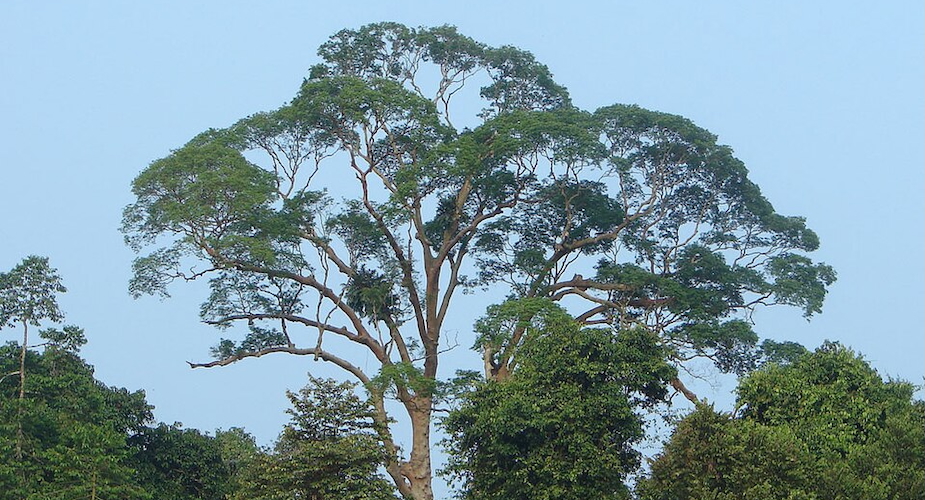
Even against the red skies of a burning landscape, Tapang (Koompassia excelsa) is difficult to overlook. Growing more than fifty metres tall (with conservationists recording 80 metre high trees), it towers above the surrounding forest canopy. Large buttress roots support its growth, but its crowning jewels are branches that provide nesting sites for giant honeybees and rhinoceros hornbills. In one rainforest plot in Brunei, just two Tapang accounted for more than five percent of the total basal area of living trees. Even where Tapang is relatively uncommon, a single tree can dominate the forest.
Tapang grows through changing seasons, droughts, and disturbances, sometimes enduring conditions that prove devastating to other trees. During the severe 2015 - 2016 El Niño drought, established Tapang in Malaysian Borneo showed comparatively little response to prolonged water stress, even as other species experienced reduced growth or increased mortality. Yet a mature tree's resilience offers no guarantee that another will grow in its place. Tapang seeds may germinate readily, but the survival of young seedlings depends on the conditions in which they take root. Drought tolerance also does not necessarily protect a tree from fire.
The tree’s extraordinary size and longevity also shape how people live with it. Its towering presence makes particular trees recognisable across a landscape, allowing people to remember origin stories, recount settlement histories, establish communal fruit gardens and negotiate social boundaries. Harvesting honey is a demanding process that requires technical skills, familiarity with the tree and its inhabitants and knowledge of customary rules governing when and how harvesting should take place. Over generations, Tapang also becomes entangled with ancestral histories, cosmological relationships and obligations that cannot be reduced to the monetary value of its honey or timber.
These relationships are not simply meanings that people attach to an otherwise passive tree. They develop through encounters where Tapang’s growth, physical presence and relationships with other organisms shape what people can do. Conversely human practices and histories shape what particular trees become. Inheriting a Tapang, for instance, can mean more than holding rights to its resources. It can mean knowing where the tree stands, how to approach it, who else has claims to it and what obligations accompany those claims.
Such relationships are neither uniform nor unchanging. Settlement histories, interethnic relations, religious transformation and plantation expansion have shaped different ways of living with Tapang across West Kalimantan. The disappearance of a tree does not necessarily erase the relationships that have developed around it. Memories may persist, customary claims may be contested, and obligations may take new forms. But losing a living tree can also foreclose possibilities that might otherwise have unfolded around it.
We explore these possibilities through two communities where Tapang has become part of everyday relationships with land, ancestry and more-than-human beings.
Ancestral trees and changing heirlooms
When the first author arrived in Gimba, a predominantly Dayak Desa community, several towering Tapang stood above the surrounding oil palm and fruit trees. Each had a name referring to ancestors whose relationships with particular trees were passed down through generations: Tapang Nek Musar, Tapang Nek Maro, Nek Rite and so on. Naming a Tapang has also helped people remember who belonged to whom. Families could trace their ancestry, with some recalling genealogies that extended over nine generations.
Knowing one’s Tapang meant knowing one’s place among others. Once, when Dom, a young man in the village, could not remember where his family’s Tapang Nek Rite was, his father became furious and turned the moment into an interrogation of his life choices. The news circulated among the wider kin network, with some interpreting his forgetfulness as a failure to appreciate his ancestors. Whether Dom understood it that way himself was less clear. The tree remained standing, but the knowledge through which one descendant maintained his relationship with it had become uncertain.
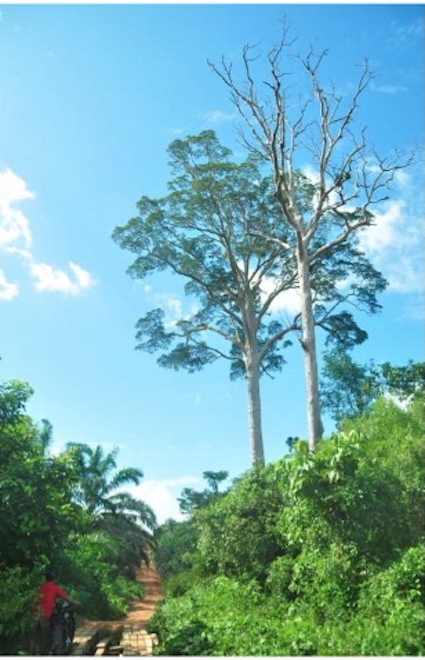
Customary prohibitions also sustain these relationships. Descendants inherited the right to climb the tree and harvest honey for medicine and sale, following an intricate song to gauge the bees’ attitude and soothe their anger on moonlit nights. Elders gather children to tell stories of the tree as a bridge that let the first Dayak Desa descend from the moon to earth, making it a keramat (sacred being). In practice, keramat status strictly limits the lineage that can access the tree’s timber, which is important for medicine and house construction.
Yet shared ancestry did not necessarily translate into shared authority over a tree’s future.
Consider Tapang Nek Musar, whose descendants make up the majority of Gimba. In 2015, one descendant sold the tree to a neighbour outside the kin group for Rp.2,000,000 (A$157-) without first consulting the wider kin group. When I asked why, he explained that it was no longer useful. His contracting work with an oil palm company had slowed, and he needed the money. For the purchasing family, the transaction carried a different possibility: their son’s late father-in-law had wanted to acquire a tree that could become a mark of his own lineage.
This transaction did not necessarily diminish the tree’s significance as something passed between generations. A shaman explained that customary systems had long provided mechanisms of valuing Tapang and other forest beings through measurements such as tael, pa, real, and amas. The prominence of Rupiah-based monetary exchange changed the circumstances in which different ways of valuing a tree could be brought together, negotiated and put to use. This included transacting with plantation companies that offered Rupiah payments to those who could claim authority over the tree, allowing them to clear the land on which Tapang stood.
Plantation expansion continued to reshape livelihoods and expectations in Gimba, but these changes cannot be understood as economic interests replacing ancestral obligations alone. The same Tapang could sustain different social aspirations, even among people who recognised its significance as an inheritance. The tree’s ability to outlive its present claimants allows both families to imagine it as an heirloom.
The trees that would not fall
In the village of Dawok, transacting a Tapang does not settle its future; it brought longstanding relationships among people, spirits and land into sharper relief. Dawok is a diverse community settlement where Malay settlers are the dominant inhabitants, followed by Chinese, Dayak, Javanese and Sundanese residents. A Malay clan owns the Tapang at the village centre and reveres it as a sacred heirloom.
The clan’s ownership began because the endemic tree grew naturally near where early Malay settlers practiced traditional farming (nugal) and established their fields (uma). A clan member actively cared for it and harvested its honey, establishing customary rights. Today, as inherited lands are divided, this towering tree acts as a physical boundary marker between individual family plots. Furthermore, it anchors collective memory and serves as a genealogical marker spanning six generations.
Historically, the tree was prized for its honey. Before allopathic medicine, honey was a primary medicine for ailments such as fevers, coughs and stomachaches; today, it is largely considered an alternative remedy. The clan shared the harvest freely with anyone who helped, regardless of community boundaries, and sold any surplus for Rupiah. However, harvesting required strict magical rituals to appease guardian spirits, including plunging a machete into the ground, reciting holy verses or mantras, and observing an absolute taboo against profane words.
The most immediate threat to this heirloom came not from fire, but from commercial privatisation. Driven by financial distress, an heir who had migrated to the city sold the Tapang to an outsider for logging, without consulting the wider clan. Relatives resisted by gossiping and cursing the decision behind his back, fearing that felling the sacred tree would bring disaster to the village.
The buyer's first logger, a native Dawok Malay who was also a descendant of the Tapang owner who was trying to justify the feeling and counter the villagers' fears, boldly dismissed the myths. He labelled those who still believed in the tree's curses as ‘Islam KTP’ (nominal Muslims) and accused them of syirik (idolatry).
‘Every villager that still believes in the curse is just like Islam KTP in Java. They are practicing syirik. I used to study in a modern Islamic boarding school in Pontianak, so I do not believe in the Tapang curse anymore,’ said the first logger.
Despite dismissing these concerns, he eventually withdrew from the logging attempt while also taking the money. Other loggers subsequently declined to fell the tree.
The repeated attempts to cut the tree down became entangled with the Malay understanding of Tanah Jahat (evil land), a place where relationships between humans and spirits make certain actions perilous. Felling a tree there was understood to invite misfortune, even death. Stories circulated about the buyer’s chainsaw inexplicably breaking down near the tree, experienced Dayak loggers refusing to proceed, and mysterious red stains appearing on its trunk. These encounters and retelling reinforced the uncertainty surrounding the tree’s future.
The Tapang’s continued life was bound up with relationships among people, spirits and the land on which it grew. Yet these relationships offered no guarantee of its survival. As fires increasingly threaten the landscapes surrounding Dawok, the tree’s possible disappearance raises another question: what becomes of these relationships when the living tree around which they developed is no longer there?
What disappears with a tree
In Gimba and Dawok, Tapang have survived constantly changing relationships that stretch across generations, but they remain precarious. Their disappearance could unsettle inherited land boundaries, disrupt honey-harvesting practices, and threaten alternative sources of medicine, construction materials, and supplementary income. They also interrupt a living history – of growth, relationships with other beings, and the changing relationships people have developed around it – that cannot be reproduced simply by planting another.
When our former interlocutors worry that their Tapang might burn, they confront the possibility that a living tree, whose future has remained open through generations of change, might no longer be there for generations to come. Fires sweeping through Borneo threaten these relationships and futures yet to unfold.
Atmaezer Hariara Simanjuntak (Ara) (axs4026@earth.miami.edu) is a postdoctoral fellow at the Department of Environmental Science and Policy at the University of Miami. Adrianus Venda Pratama Putra (vendapratama1@gmail.com) is a researcher at the Sunyata Lab, Indonesia.