
An encounter through community service brings a young person closer to the harsh realities of life for Banten villagers
From the beginning of my university studies, I was sceptical about the Community Service Program (Kuliah Kerja Nyata, KKN) that must be undertaken by all undergraduates. To me, KKN is merely a place for the university – in this case, Universitas Gadjah Mada (UGM) – to ‘wash its sins’ after having produced so many individuals who undermine our democracy, such as Pratikno and Joko Widodo. Throughout my time in university, this view became deeply rooted in me. The community service programs cannot change anything in 50 days (the duration of the KKN) so long as structural inequality persists.
Originally conceived in 1971 as a pioneering project by the then Rector of UGM, Koesnadi Hardjasoemantri, KKN became a distinctive feature of higher education in Indonesia during the New Order period. Students were engaged as technocratic agents in helping to advance the regime’s vision of developmentalism. KKN was designed with the intention that students would align themselves with the New Order’s modernisation vision. I would also argue that KKN replicates what the Indonesian Communist Party once did, namely connecting with the grassroots.
Whatever its historical origins and aims or my feelings about it, KKN today is an obligation and a requirement for graduation from the university. Consequently I also needed to complete the program.
On service
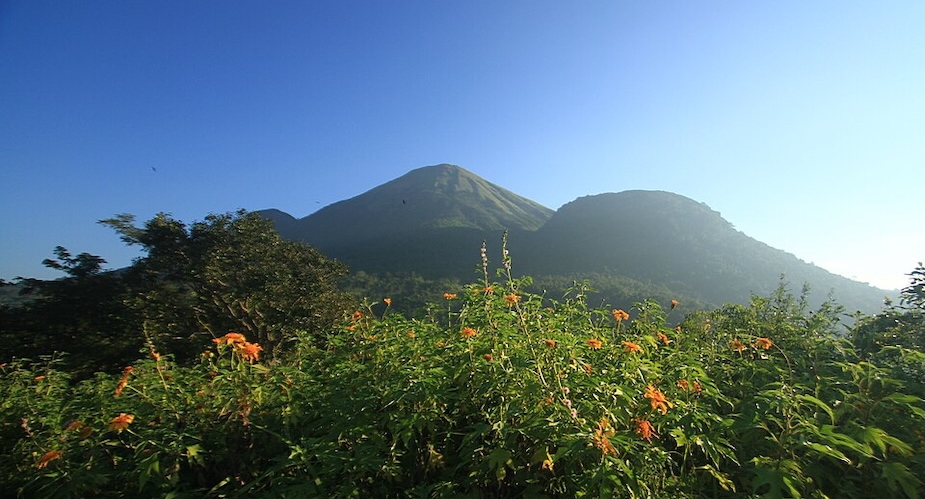
The university provided a range of options. I applied for and was accepted for KKN in Mancak Subdistrict, Ciwarna village, Banten. The journey began after the final examinations. Exhausted from ‘crossing’ Java, my friends and I arrived in Mancak, Ciwarna where we were greeted by the typical dry landscape of villages in this part of far west Java – scorched by the heat of the sun. Unlike the locals who are well acclimatised, sweat poured off me and I drank water beyond the threshold humans need. Thankfully, over time I began to adjust to the conditions.
In the early days of our stay we visited the Ciwarna village office. After exchanging pleasantries about Yogyakarta or Mancak, I asked the village head, ‘Are there any land-related problems here?’ Knowing that I was a student with a background in legal studies, the village head replied, ‘There are, in Kampung Pasir Peteuy. It concerns the Ministry of Forestry’s claim that the area above the village is forest land.’
I was not surprised to hear that. Most of the topography of Ciwarna village is covered by forest that directly borders residential settlements. It is possible for two parties to claim rights over both land and forest areas within the same territory.
I did not presume to be a hero who would solve the problems of such a conflict. This is precisely the kind of framing that I wanted to detach from – a student who is supposedly regarded as an agent of change. Instead, I wanted to accompany the people advocating for the case and learn from them.
After that, there was barely a day I did not spend standing, sitting or observing in the village, located two kilometres from our accommodation. On many of the quiet, dark nights we spent in Ciwarna, I sat with people who were part of the village administrative structure.
‘The land in this village is an inheritance passed down through generations. A father and mother raise their children and then entrust this customary land to them. We have been here since the generation of our great-grandparents,’ the local people explained. Living across generations in the same space—that is the key point. He then continued, ‘We have SPPTs for the land we occupy, although it has not yet been certified.’
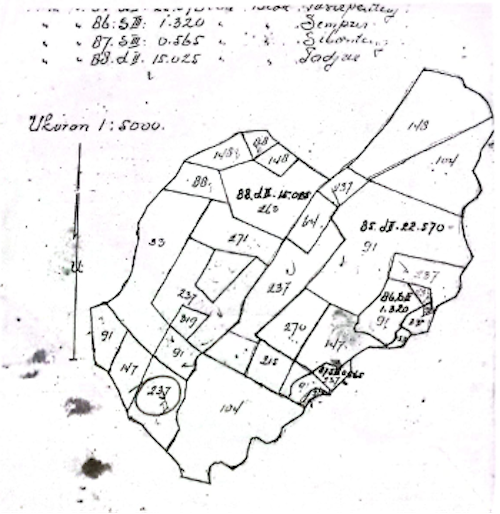
They told me how, quite suddenly in 2016, the Ministry of Forestry published a forestry area map that included Kampung Pasir Peteuy as a forestry area. The basis of the map referred to Forestry Area Decree No. 419/Kpts-II/1999.
All of this was done secretly by the state, which sought to erase the socio-cultural identity of the peoples who had long lived in Kampung Pasir Peteuy. The revised map was not even known to the kampung (village) officials until the 2020s. The responses of public officials appeared to oversimplify the issue. The Ministry of Forestry’s response to the villagers’ concerns was to describe the matter as merely a matter of ‘lines and boundaries’.
On mapping
Apart from the state's failure to read its own territorial area we may also ask, what is the problem with the map? What is most certain is that, inevitably, people who live within the area and aspire to certify their land will be unable to do so. This was acknowledged in 2024 by a National Land Agency (Badan Pertanahan Nasional, BPN) team that visited Kampung Pasir Peteuy for purposes of land registration. The BPN team said, as the people remember it, ‘We do not dare to help register this kampung's land if this area is still said to be a forest area.’
While speaking with the kampung people, some horrifying scenarios occurred to me. It is not impossible that the state could carry out land acquisition for extractive projects on the land of Kampung Pasir Peteuy on the grounds that ‘this land does not belong to the people’ or ‘this land is state forest.’ In other words, the state could arbitrarily evict the people.
I could never have imagined that the state could generate such uncertainty for the residents of a kampung of 135 families.
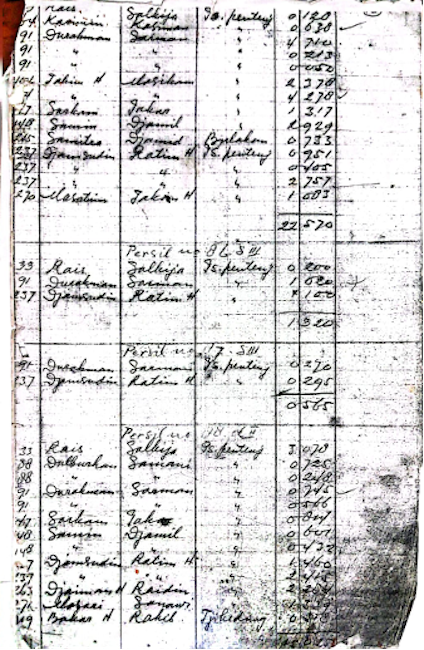
I arranged to meet with a former mantri (village secretary) who had a thorough understanding of the land situation in Ciwarna. ‘I can meet you at night, because during the day I am still working in the fields,’ he offered. When we met, he explained that the land on which I was sitting was the very land they were fighting for. It was still customary land that they were attempting to register through the state administration. In the middle of our conversation, he went into his house and brought out several sheets of paper.
‘These are records of the people’s control over the land, dating back to the 1960s,’ he explained.
I was speechless. The records dated back to when Sukarno was still in power. The villagers had carefully documented their control over customary land; who controlled which parcel of land was clearly noted.
I know those handwritten records are a form of informal administration of land, but I also see them from another angle. Perhaps, the records were kept as a safeguard in case the state later attempted to seize their land. These decades-old records serve as evidence that the land in Kampung Pasir Peteuy is not a forest area but has been farmed and lived on by these families for generations.
My conversation with the former mantri in mid-July 2026 took place a decade after this forest area map came into being. Since then, the peoples of Kampung Pasir Peteuy have experienced persistent vulnerability and precarity in relation to their homes and livelihoods.
Ten years is a relatively short time for a high-intensity struggle against the state forest regime and land rights. They know they are fighting the state, but so far the advocacy organised by village officials and the people of the kampung has been weak. There is no momentum. At most, whenever there is an opportunity there are hearings with the Provincial Forestry Agency. In 2023 the village officials issued a statement confirming that Kampung Pasir Peteuy was customary land and not a forest area.
When I spoke about this case with the kampung head he looked almost desperate. He realised that what they sought to reclaim from the machinery of state power was akin to a matter of life and death for the people of his kampung. His eyes lit up when I explained that I wanted to help to bring this case to completion. ‘We have been in this state of uncertainty for a long time, going back and forth to the city repeatedly to speak with agency officials without any result,’ he told me.
His comments made me reflect. Holding hearings or sitting and talking with government officials will never resolve such structural problems, which are rooted in the state’s broad approach toward natural resources. The state seeks to manipulate the customary tenure system within the framework of the state forest regime, including incorporating informal land into the land rights regime in accordance with the interests of the state and the market.
The 2016 forest area map reflects imperialist colonial logic. The state arbitrarily makes claims on the places people live while ignoring the history of land control and the people’s relationships with the land. Connecting the thread between the forest area map and colonialism is not an exaggeration. As someone working at the Forestry Agency told me, ‘The area map and the Forestry Area Decree are actually anomalies, because the determination of forest area boundaries contained in that map is no different from the forest area map that was once issued by the Dutch East Indies government.’
On struggles
My observations, findings, and notes yielded an analysis and policy recommendations about the land dispute. I brought these to a hearing with the relevant agency so that they could pass them on to the Ministry of Forestry. During the hearing I felt that my efforts were all in vain. After all, I was up against an advanced bureaucratic-political machine called the state.
Even so, it does not feel entirely futile. Such a hearing, or similar small actions that contribute to the resolution of this case, remain an effort to prolong the resistance.
When day 50 of my KKN arrived, I left Kampung Pasir Peteuy knowing that life there would continue as usual with farming and gardening, but its residents would also continue to live in a state of vulnerability. Until now, the state has paid no heed to the people's concerns, and yet the village officials continue exhaustively to fight their case. The BPN team is still reluctant to help with the land registration of that kampung. Everything continues to move within its own respective corridors.
This experience has revealed the naked face of the Indonesian state; one without cosmetics, without the packaging of political elite rhetoric that pretends to back genuine agrarian reform or recognition of customary communal rights. What was laid bare was the growing despair of the local people, the concerns of the village officials and ultimately the state’s abuse of power.
Alvino Kusumabrata (alvinokusumabrata2017@gmail.com) is a research fellow at Centre for Law and Social Justice (LSJ) in the Faculty of Law, Universitas Gadjah Mada, Yogyakarta, and a writer whose work has appeared in publications including Prisma, Harian Kompas, Project Multatuli. His research interests focus on the political economy of law, socio-legal studies and state power.