Review: Abidin Kusno examines trends in architectural design and urban planning in Jakarta
Julie Shackford-Bradley
In this book, Abidin Kusno examines trends in architectural design and urban planning in Jakarta over the 20th century that resulted in the 1998 riots. Kusno's objectives are to show how 'imagined community' takes concrete form and substance in the 'real' spaces of the city' in order to understand the ways in which postcolonial cities alter the space and form of the built environment for themselves, in the process, forming a dialog with their colonial past. As a representation of that dialog, Jakarta exposes its blind spots. Kusno argues that Jakarta's architects and urban planners have struggled with legacies of the colonial mind-set, particularly the 'tradition vs. modernity' construct used deceptively by both the Sukarno and New Order governments in their quest for power. The results have been disastrous for Jakarta's underclass.
Kusno contends that, while Sukarno promoted Jakarta's post-independence design in terms of 'modernist' nationalism, the downtown area was discreetly modelled on elements of aristocratic Javanese power and grandeur. Display models of the city's master plan simply ignored the kampung (lower class areas), as did Sukarno's urban policies.
Suharto's equation of nationalism and the 'traditional' was just as inconsistent. The New Order saw the emergence of an upper class with transnational dreams of 'First World' style housing developments and culture. Motivated by a fear of falling in status, this upper class elevated itself, literally, through the creation of fly-overs (elevated highways) that build up confidence leaving behind the 'lower' classes who are routed through the crowded street at ground level. Through transmigration, the becak (pedicab) removal program, and Petrus, (mysterious shootings), the urban street was further transformed into a site of disturbance and criminality. Now nationalism was linked with development and the mass media announced the birth of a new ideal middle class subject of the nation. Meanwhile, the underclass was degraded into a mass of 'undesirables'; excluded from the new nationalism, they had no overarching affiliation and nothing to lose in 1998.
These issues are familiar, but benefit from Kusno's analysis of their spatial aspects. The book also presents a discussion of tropical architecture, from both the colonial period (featuring the buildings of Thomas Karsten and Henri Post) and the present (Sumet Jumsei's 'water-based' cultures, and Ken Yeang's bioclimactic skyscrapers) that blend local/traditional and modernist elements. Through such examples, Kusno projects a hopeful vision for the future in which more Indonesian architects and urban designers can practice this type of fusion, once freed from the colonial mindset that still constrains them.
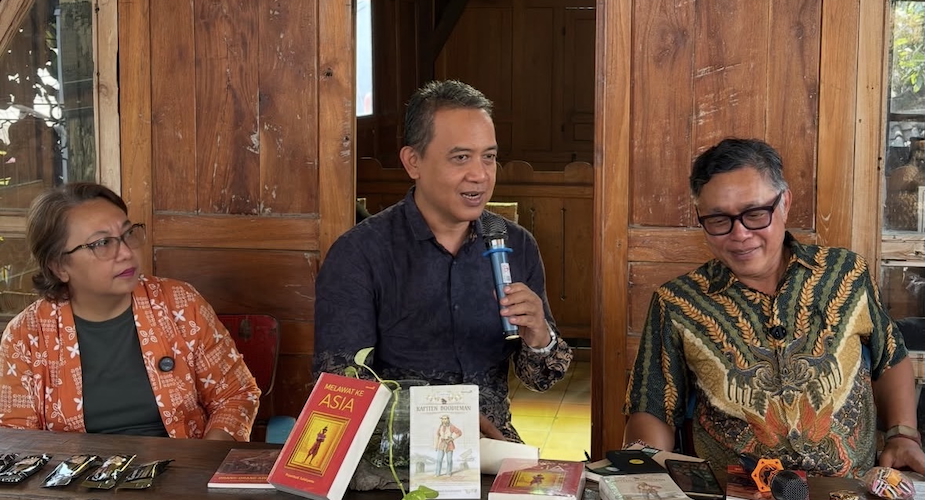
Abidin Kusno, Behind the Postcolonial: Architecture, Urban Space, and Political Cultures in Indonesia, London and New York: Routledge, 2000
Julie Shackford-Bradley (julie_shackford-bradley@csumb.edu)
Inside Indonesia 72: Oct - Dec 2002
Two directors resided in an intercultural realm
Ian Brown
Teguh Karya and Suyatna Anirun were each inspired by traditional and popular forms of theatre throughout Indonesia, as well as the Western forms of theatre they adapted for the stage. Their style of theatre resided in the realm of intercultural practices that all theatre artists in Indonesia now revere.
Perhaps better known in the Western world for his international standing in the realm of film, Teguh's career in the theatre spanned a period of twenty-five years from 1968 to 1993. Teguh, of Chinese ancestry, was born in Pandeglang, West Java, on 22 September 1937. His former name was Steve Lim, but assumed his current name when Suharto's New Order regime repressed the social presence and activities of the Chinese communities in the early days of his presidency.
Undeterred by repression, Teguh's Teater Populer was inaugurated on 14 October 1968 in the Bali Room of Jakarta's first modern international star-rated hotel, the Hotel Indonesia. Two short plays were performed to mark the occasion; they were adaptations of Western works, Antara Dua Perempuan (Between Two Women) by Alice Gerstenberg and Kammerherre Alving, Teguh's version of Hendrik Ibsen's Ghosts.
Two key elements of Teguh's theatre and films were naturalism and realism. These western influences derived from his studies at the Akademi Teater Nasional Indonesia (National Theatre Academy of Indonesia) in Jakarta, where he entered in 1961.
Teater Populer's core repertoire was adaptations of Western plays. Notable among them were The Marriage and The Inspector General by Nicolai Gogol, Tartuffe by Moliere, The Father by August Strindberg, The Glass Menagerie by Tennessee Williams, Bertolt Brecht's The Good Woman of Szechwan and Garcia Lorca's Blood Wedding. Teater Populer only performed two plays originally set in Indonesia, namely, Dag Dig Dug by Putu Wijaya and Jayaprana, a play based on the story of a legendary Balinese hero warrior, by the Dutch writer Jef Last.
Teguh continued to apply intercultural forms of stage presentation by adapting Sophocles' Antigone into the social and cultural environment of the Batak people of North Sumatra. The performance tradition of the Balinese dance dramas such as Barong, Gambuh and Arja influenced the style Teguh adopted for Jayaprana. This is the last recorded stage work performed by Teater Populer before it disbanded. Teguh Karya then dedicated himself fully to film and television sinetron. He had previously engaged with the medium of television for high quality play performances by Teater Populer since 1969.
Suyatna Anirun is rarely mentioned abroad, but in Indonesia itself his reputation as a great director and actor has impacted on the development of modern theatre throughout the archipelago. Born on 20 July 1936 in Bandung, West Java, in 1958 Suyatna, together with other artist colleagues, established Studiklub Teater Bandung (Study Club Theatre of Bandung), which became known simply as STB. Its first performance in March 1958 was Jayaprana. Suyatna had been educated not in a theatre arts institution, but through the Faculty of Fine Arts and Design at the renowned Institut Teknologi Bandung (Bandung Institute of Technology), ITB, where the former first president of Indonesia, Soekarno, had studied.
Suyatna directed plays in both the tradition of Western realism and through acculturation of performance traditions from the Sundanese region of West Java. Like Teater Populer, STB main repertoire was adaptations and translations of Western plays. Among the more notable Western playwrights were W. B. Yeats, Anton Chekhov, G. B. Shaw, Tennessee Williams, Pinero, Gogol, Ben Jonson, Shakespeare, Moliere, Brecht, Eugene Ionesco, Albert Camus, Jean Girradoux and Max Frisch.
STB also performed works by a number of Indonesian playwrights, such as Kirjomulyo, Utuy Tatang Sontani, Misbach Yusa Biran, Ajip Rosidi, Motinggo Busye and Saini K.M.. Their plays share a prime place of literary importance in the development of modern Indonesian theatre.
The performance genres of longser and masres from West Java were a fitting style for adaptations of plays such as Ben Jonson's political satire Volpone or The Fox for which Suyatna chose to use traditional masks in his version titled Karto Loewek. Costuming for this performance was the customary dress of the Sundanese, both formal attire and everyday street clothes were worn. A similar treatment was applied to the performance of The Matchmaker by Gogol adapted by Suyatna as Mak Comblang, but mixed with modern day dress.
Performance aesthetics were always paramount in Suyatna's theatre. He maintained that the theatre was primarily a source of entertainment despite the presence of its didactic. In many respects the essence of his theatre was Brechtian, a fact many Indonesian (and Western) critics and writers recognised when analysing the performance style of STB. Although well acquainted with the theatre of Bertolt Brecht, curiously Suyatna waited for twenty years before he directed Brecht's Caucasian Chalk Circle, which was performed in 1978 with the title Lingkaran Kapur Putih. Its success ensured performances in Jakarta at the arts centre, TIM, the nation's international showcase for the prime products of Indonesian art.
Perhaps the highest peak Suyatna reached was his production of Shakespeare's King Lear (Raja Lear) for STB. First performed in Bandung in April 1986, it was heralded by critics and the public alike for the virtuosity of Suyatna's performance in the role of King Lear. Prior to King Lear, Suyatna had directed Shakespeare's Romeo and Juliet (Romeo dan Yulia) in November 1993 followed by A Midsummer-Night's Dream (Impian Di Tengah Musim) in August and September I991.
The theatre performed by STB and directed by Suyatna was distinguished by its diversity of repertoire, its constant exploration of new forms through acculturation of performance traditions and its constant high standards of performance. STB itself also has the reputation of being the longest active group in the history of modern Indonesian theatre.
The theatre world of Indonesia has paid its last respects to these two visionary artists. Teguh died in Jakarta on 12 December 2001, Suyatna died in Bandung on 4 January 2002.
Ian Brown [darian@indosat.net.id] completed his PhD at NTU and is now an independent writer and theatre researcher in Bandung.
Inside Indonesia 72: Oct - Dec 2002
Two poets tour Australia
Marshall Clark and Giora Eliraz
It seems that the days of superstar poets - who bravely spoke up for the common people and criticised the Indonesian state, in front of large audiences in between being banned - have passed. When Rendra, who was Indonesia's leading poet throughout the New Order era, toured Yogyakarta several years ago, one writer in the letters page of Bernas suggested that Rendra had become like an old pillow - nostalgic and comfortable yes, useful and relevant no.
Since the fall of Suharto, Emha Ainun Nadjib, another of Indonesia's more oppositional cultural activists, has also kept out of the public spotlight. For several years, Emha hosted Gardu, a popular talk-show. However, TV audiences soon tired of the incredible over-abundance of talk shows following Suharto's resignation. When Emha himself grew tired of all the 'collusion' associated with organizing and rewarding guests, he pulled the plug.
Besides, Emha has never been able to shrug off his close association with Suharto. It is common knowledge that Emha, together with several other Muslim leaders, met with Suharto several times in the days before 20 May. It was at this point that Emha publicly transformed himself from an oppositional figure to something quite different. Some would say that his decline in popularity has mirrored Suharto's fall from grace. Long considered as one of Indonesia's foremost poets, these days Emha barely rates a mention.
It was as enjoyable as it was nostalgic, therefore, to see Emha reading poetry and dazzling audiences with his unique wit and political insight in Australia for several weeks in May and June. Invited by the Australia Indonesia Arts Alliance, and supported by the Australia Indonesia Institute and Garuda Indonesia, Emha gave lively poetry-readings in Sydney, Canberra and Melbourne. Like Rendra in the 1990s, Emha was able to draw enthusiastic audiences, consisting of as many Indonesians as Australians.
Accompanying Emha was another Indonesian poet, Fathyen Hamama Handry, also known as Fatin. Born in Padang in 1967, Fatin grew up in West Sumatra and has spent over a decade in Cairo, where she has studied theology at the Women's Faculty of al-Azhar University. Her poetry is not quite as sensational as Emha's, yet it contains its own fair share of social criticism. Fatin writes of riots and military violence in Semanggi and elsewhere in Jakarta, as well as the problems faced by Indonesian women, farmers fighting against poverty, women suffering in Aceh, and the struggles of the urban poor.
Like Emha, Fatin does not consider herself as one of Indonesia's more popular poets. In terms of literary figures, Fatin is no trendy Sitot Srengenge, nor a young and sensational Ayu Utami, or even a marketable 'woman poet' in the mould of Dorothea Rosa Herliany. Yet like Emha, in the midst of disappointment and frustration, Fatin continues to imagine a better Indonesia. It is for this reason that her poetry is worth examining, at the very least for the buffer it provides for the harsh coldness of Indonesia's post-New Order, and perhaps even post-reformasi, reality.
Fatin's latest collection, Papyrus (2002), exhibits the strong Islamic slant of her poetry. The opening poem, 'Al Fatihah', is the same name given to the opening sura or chapter of the Koran. Like the first chapter of the Koran, this poem is merely a few lines long: Segala puji bagi-Mu/ Tuhan/ lempangkan bagiku/ jalan/ amin [All praise to You/ God/ straighten out for me/ a path/ amen].
These poems - and their titles - are an indication of Fatin's position within a global Islamic historical consciousness. Her allusion to Islam is based on an effort to verbalise the thoughts and emotions arising from her deeply personal Islamic faith.
The distinctive Egyptian context of Fatin's poetry is also important. Many of the poems were written in Cairo, where Fatin leads the Cairo-based literary group, Komunitas Sastra Indonesia [Indonesian Literature Community]. Thus we see poems such as 'Samira dan Sariyem', a poignant tale of the sad life of an Eqyptian belly-dancer.
Fatin's poetry also includes many references to the pre-Islamic era of Egypt. The title of the collection Papyrus refers us back to another world, the world of ancient Egypt and the dawn of civilisation. Elsewhere, by arranging a set of poems under the title 'Cleopatra', Fatin alludes to a fascinating and defiant Egyptian woman and queen, who was, of course, from a non-Islamic context.
This engaging combination of the worlds of Indonesia, Egypt, Islam and pre-Islam makes Fatin's poetry fascinating and rich, speaking to us from both a global and local perspective. Besides placing Fatin's name on the map of Indonesian literary studies, Papyrus also suggests that Fatin's poetry can be seen as a representation of a deep pluralist view that has come to take hold amongst many contemporary Muslim intellectuals in Indonesia.
Marshall Clark (Marshall.Clark@anu.edu.au) is a lecturer at the Australian National University, on leave from University of Tasmania. Giora Eliraz (Giora.Eliraz@anu.edu.au) is a Visiting Fellow at the Southeast Asia Centre, Australian National University.
Inside Indonesia 72: Oct - Dec 2002
Unable to pay for formal lessons, many poor Indonesians have mastered English through radio, TV and film. Like Rizza of Surabaya.
Duncan Graham
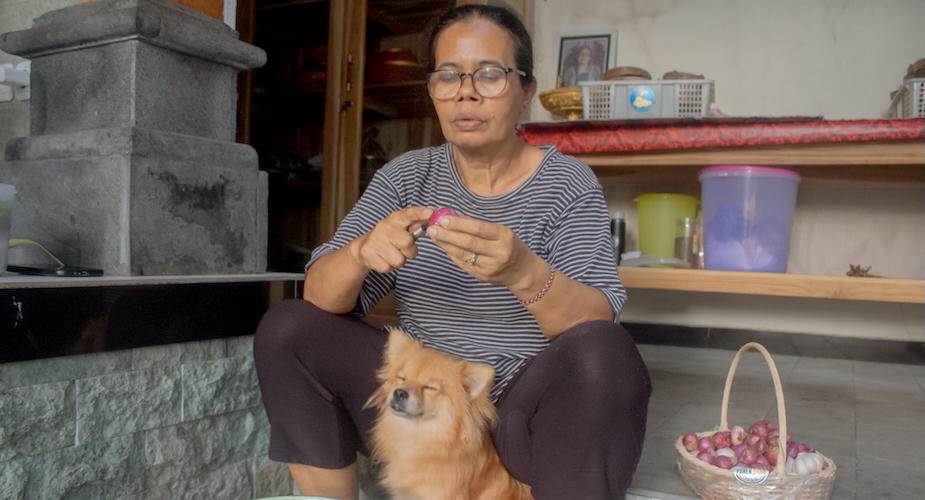
Half way along Jalan Joko Dolog, opposite a high fence shielding a building site, is a small shop. Well, really just a glass counter facing the dusty street and more often behind shutters than exposed. For few people now livein the area, and the lane has become a short cut, a speed track between Basuki Rakhmad and Pemuda, the two great bitumen rivers trisecting the centre of East Java's capital Surabaya.
Apart from the spray-painted number on a battered iron gate, there's only a small chromed dome squatting unhappily on the pavement to catch the eyes of the Grand Prix wannabees. Should the sun ever penetrate the smog this artefact might glitter and mesmerise like a spinning night-club globe.
Once Nyonya Rizza's shop sold domes to the faithful for their personal mushollas. Then came the monetary crisis, and demand tumbled along with the rupiah. Now she markets half litres of lamp oil decanted from backyard drums into stained plastic bottles; tiny packets of washing powder, needles, thread, batteries pulled from under the splintering shelves, single cigarettes.
Also on the counter is a dictionary and a monster exercise book buffed brown, rusting staples losing grip against a stuffing of clippings, brochures and postcards. Most show distant lands and cities shimmering in the gloss of sunrise, the promise of heavenly locations free of crime and grime.
'Of course I'll never visit these places,' Rizza sings in rapid and sometimes scrambled English. 'No money. What does it matter? I can see what they are like, and people tell me. I can imagine. It's my vision.'
There are also photos of tiny Rizza standing alongside hulking Australians, broad as their accents. Her face is always open and laughing, theirs bemused. Only their mouths smile. No pictures show plump white male arms around her slender and inviting olive shoulders, her fine 44 kilo frame.
Although a mother, grandmother and widow, Rizza gets angry when addressed as Ibu, the standard Indonesian honorific for women of her status. She is 56, and claims a unique name, though Germany has a Rizza ice cream, which she thinks a hoot. She has John Howard's eyebrows, wears no make up but dyes her manic hair in copper tones. Her dress is mainly a torn skirt and marquee-size T-shirt.
She could pass for 40 despite a doctor misdiagnosing a heart attack in 2001 and prescribing treatment which put her in hospital with a serious illness. Her appearance, a voice which could stir possums, and up-front approach make her a stand-out among conservative customers and coy neighbours.
But it is her skill with English which provides the extra dazzle, for the nimble-minded and effervescent Rizza is one of the numerically large, but proportionately small number of poor Indonesians who have taught themselves our complex tongue.
Born in Malang of Madurese parents, Rizza was the fifth of nine children. Like his daughter, her businessman father was clearly smart and different, covertly listening to broadcasts from Australia and Malaysia during the dark days of Sukarno, when such behaviour was suspect. Rizza loved the foreign voices, did well at school and left at 17 to work in a bookshop in Surabaya.
Even now many Indonesian bookstores are sad affairs. Dominated by religious texts, comics and dictionaries, most volumes are bound in plastic to stop browsing and keep covers clean. In the dangerous days of Suharto's rise, when even the mildest comment could be interpreted as radical dissent, bookshops must have been even more sterile.
Unable to make such comparisons, the teenage Rizza found herself in Aladdin's Cave. She didn't just dust the wares, she hoovered them whole, particularly those in English. The occasional foreign buyer was quickly sucked into conversation. Their requests were taken seriously. 'I remember everyone wanted The Happy Hooker-r-r,' she said rolling the final syllables like a Scot. 'Very nice book. I think the publisher Macmillan.'
The shop used her sparkling personality and lovely voice to spruik the wares. Customers were not the only ones seduced. At 18 she married the manager, and sadly her love affair with language came to a shuddering halt. 'He did not like me always talking to the customers,' Rizza recalled. 'He very jealous. One day he threw a book at me. For ten years I did not practice English.'
One daughter was born. Twenty years ago her husband died from 'post-power syndrome', Rizza's label for inactivity after retirement. Photos show a small, neat Javanese with regulation moustache nonplussed besides his volatile wife with wild hair and giant spectacles: 'Jacqueline Onassis, ya?'
'Of course I was not sad. He was a good man, but why should I be sad? If I am, I will lose myself.' So despite the many lustful overtures from Indonesians and foreigners drawn by her magnetic personality, Rizza is determined to stay single and independent.
'If I married again I become sad, difficult with life,' she says. 'I must honour husband, smile-smile. It is a must in Indonesia as a wife, or it is a sin.'
'It is easy to fall in love, I have to strive to be strong. I say to men: 'Don't touch me. I am afraid of myself. This is very heavy for me, it is a danger for me. I don't want someone pity for me. I am a strong woman.'
Twice a week she goes to the mosque wearing a bonnet or scarf. Conscious of Western hang-ups about Islam, she stresses 'pure religion - no ideology'. At other times she meditates, listens to short-wave, translates English into Indonesian and vice versa. 'I love English,' she says and means it. 'Writing in English is a beautiful and profound experience. If I have troubles I write them down in English. Then they get better.'
Occasionally she spots a foreigner and cheekily calls: 'Welcome to my country', a greeting which takes many aback, particularly those who anticipate a con artist though her motives are altruistic. 'I want harmony everywhere,' she says earnestly, 'between friends, families, nations. Otherwise we are finished.'
At times her enthusiasm and humour overtakes itself. After hearing a German tourist recite the many marvels of his country she asked with feigned naivety: 'And how is Mr Hitler?' As a conversation stopper you don't get much better than that.
For Rizza the idle gossip which fuels Indonesian life is a waste of time. 'I don't like talk meaningless,' she says, famished for facts to be transcribed into the Big Book. 'What is the point? There are so many things to learn. I want to know about other countries, everything.' In exchange she offers fierce condemnations of her nation's leaders and their penchant for corruption. She says she was equally fearless during the days of Suharto when criticism was equated with communism.
If so, then the authorities must have overlooked the transgressions, for Rizza behind bars would have been more of a headache than behind the counter.
There is no chance Rizza's skills with English will be put to good use. Her vocabulary is vast and her ear sharp. Conversationally she can out-run many university English teachers and out-wit the rest, but her grammar is a dog's breakfast.
Indonesian schools teach tense to the point where enthusiasm is anaesthetised, so a poor self-educated woman who is a wiz with words will never get the opportunity to galvanise the next generation with her unquenchable lust for language.
Which is Indonesia's great loss and no-one's gain.
Perth journalist Duncan Graham (wordstars@hotmail.com) slumps in awe of all self-taught linguists.
Inside Indonesia 72: Oct - Dec 2002
Highlighting the state's role may help stop the Poso conflict
Syamsul Alam Agus
The conflict in Poso was initially triggered by local elite political skirmishes. Over the last four years, however, it has transformed into a conflict between grass-roots communities. Hatred and suspicion have spread among a society that previously co-existed peacefully. The bloody conflict between the 'red group' (Christians) and the 'white group' (Muslims) remains a daily topic of conversation. A string of horror stories have graced the front pages of the local media, making it difficult to differentiate between information and rumour.
The Malino Declaration was a government initiative to initiate reconciliation in Poso. The ten-point accord, subsequently known as Malino 1 after a similar agreement was drafted for Ambon, was signed on 20 December 2001. Poso's inhabitants hoped that the declaration could be implemented successfully, to end the conflict that has resulted in riots on 25-30 December 1998, 16-19 April 2000, 23 May-10 June 2000, 26 November - 2 December 2001 and most recently 12 - 16 August 2002.
Sadly, the Malino Declaration now faces utter failure. Between the declaration's signing and 12 August 2002, there were 30 violations. These violations involved both parties to the conflict as well as incidents triggered by the security forces.
These incidents became increasingly common towards the end of the period set down by the accord for the restoration of security. They have included mysterious shootings, bomb blasts and inflammatory graffiti. These various incidents have rekindled trauma, mutual suspicion and sensitivity amongst society in Poso. The security forces have also contributed to the situation by making statements to the community that have implied that the end of the security restoration period would signal the end of security itself. Predictably, following the escalation of these incidents, the police and military have requested more operational funds from the Central Sulawesi government to restore security. The tension that had subsided is again rising and could lead to further large-scale conflict.
The failure of the Malino Declaration can be traced to several factors. The declaration is elitist, relies on quantitative measures of success, and is laden with opportunities for profitable 'projects'. For example, in the period to June 2002, the Poso Regency Working Group spent 2.2 billion rupiah (roughly A$450,000) just on disseminating information about the Malino Declaration. The accord also separates social rehabilitation, reconstruction of facilities and security, as if these three concerns were not related. As a result, facilities have been constructed without regard for the prevailing security situation or whether inhabitants feel safe, and social rehabilitation has not been supported by affirmative policies towards various flare-ups and incidents. Efforts to restore security, which have focused on placing large numbers of security personnel in Poso, have been easily undermined by disquieting acts of terror. Security has become the monopoly of the security forces, who treat it like a tradeable commodity.
At a community level, there is still a genuine desire to live peacefully. Behind the conflict, the community still remembers a time when living with different religious groups didn't mean living with war. However, the trauma caused by various conflicts has unfortunately created a fear of attempting any reconciliation or rehabilitation that might succeed where the government has failed. Nevertheless, an awareness has started to emerge in Poso that the community has the right to feel safe and have their socio-economic needs fulfilled things they have lost during the conflict. For instance, after an Omega bus was bombed on 12 July 2002, the Poso Pesisir Subdistrict Inter-religious Congregation Communication Forum issued a statement demanding that the security forces work harder to prove that they are trying to resolve the conflict. This statement is also an example of efforts to shift the perception of the conflict away from conflict between grass-roots communities to the role of the state. However, such efforts are still a minority in the midst of media statements by religious figures and political parties that simply blame the other side.
The severance of lines of communication at a grass-roots level has made the community more easily influenced by divisive statements by members of the elite. The media, with its focus on circulation, is more likely to publish these statements. When signatories of the Malino Declaration expressed their disappointment with the security forces for failing to take serious steps to follow up violations of the declaration, the press packaged the statement in such a way that it provoked a negative reaction from one religious community.
Terror after terror, issue after issue, statement after statement - this has been the pattern following the Malino Declaration. If society again takes the bait and participates in violence, this pattern could result in further large-scale conflict. As such, the awareness that has been developed thus far must be guarded and continually consolidated. A broader alliance with a common perception must be established at the most legitimate level, namely between the communities that have directly suffered from the conflict.
Of course this will not be easy. Society has several vulnerable points that will need to be monitored, so that they do not influence the community's capacity to keep each problem in proportion. In Poso, there can be no separation between rehabilitating these vulnerabilities and placing the conflict in the framework of state accountability. These two matters must be worked on together, with the aim to muster a critical force in society aware of its rights and the practices that are weakening its former capacity to manage conflict and difference.
Syamsul Alam Agus (duael@telkom.net) is an activist at the Institute for the Development of Legal Studies and Human Rights Advocacy, Central Sulawesi (LPS-HAM)
Inside Indonesia 72: Oct - Dec 2002
We are a volunteer-run, open access magazine. We rely on donations to ensure that we continue to deliver a diverse range of quality content. Donate today!
Subscribe
Receive Inside Indonesia's latest articles and quarterly editions in your inbox.