A collaboration on words
My first encounter with Pat Walsh was at an afternoon meeting that was tense, slightly deadlocked. It was 2013 – I can’t recall the month, perhaps mid‑year, perhaps August or September. I was a new assistant editor, not yet two years into the job. The difficult question on the table that afternoon was: how to prepare Chega! – the 3,000‑page report of Timor‑Leste’s Commission for Reception, Truth, and Reconciliation (CAVR), so that it could be printed in Jakarta and shipped to Dili within that same year?
What I remember from that meeting, apart from the heat and the impasse, was that Pat was a good listener. He leaned forward and tried to excavate the problems one by one.
After the meeting ended, we shared a taxi through Jakarta’s evening traffic to the hotel where colleagues from the Secretariado Técnico Pós‑CAVR (STP-CAVR) were staying, to sort out some administrative matters. It was in that taxi somewhere in a Jakarta gridlock I can no longer place on a map, that I had my first real conversation with Pat Walsh. Nothing about it stands out as especially memorable, except that he seemed a patient storyteller. Patient, especially, with my spoken English, which was considerably more limited then than it is now. When he mentioned having once studied at a seminary, something shifted in me: a somewhat primordial, possibly irrational sense of trust. At the same time, a quieter scepticism remained: Why would an Australian bule concern himself so persistently with Timor‑Leste (and Papua and Aceh)?
Pat and I were soon appointed the fresh new hands to carry out the mission. The workflow and schedule were arranged by counting backwards from the deadline that had been set. We didn’t argue, nor did we voice the kind of impossibility that hung in the air. From that near‑silence, a collaboration began - one that I did not expect to last, and did not expect to matter, and turned out to be both.
The year 2013 was before the artificial intelligence (AI) era, still before smartphones had fully settled into people’s palms. At our publishing house office, KPG, two ‘outsiders’ came regularly: Peter Carey, whose Indonesian translation of Power of Prophecy we had published the year before; and Pat Walsh, who not only visited but effectively took up residence for months - most intensively, almost every day during the final four months of 2013, watching over the last stages of Chega!
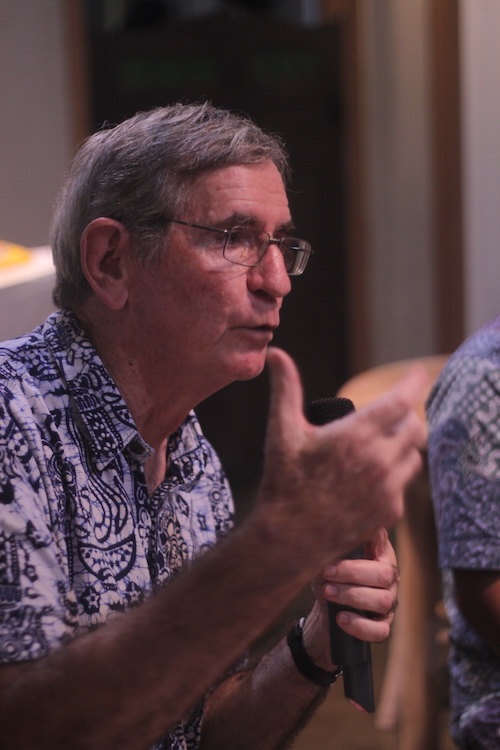
With today’s AI, we can ‘chat’ in different languages – one person speaking in English and the other replying in Indonesian – and both understand each other. But even before the AI era, I had already witnessed people communicating and exchanging information and stories in two different languages. That happened with both Peter Carey and Pat Walsh, when they were chatting with one or two of us during coffee breaks or lunch.
And during those months I noticed Pat’s small habits. He often wore a blue checked shirt. He arrived and departed at consistent hours, always carrying a cup of coffee from the café downstairs – Javaro, it was called then – and the staff behind the counter knew him by name.
One afternoon at lunch in the office canteen, a colleague asked Pat: ‘How, or why, do you keep working on human rights?’
I don’t remember his answer. I may not have fully understood it at the time. What I remember is a smile, and a pause – the kind a person takes when deciding how to translate something they feel too precisely to say simply. That smile reminded me, oddly, of a video rental shop attendant in Yogyakarta I had asked something similar almost a decade before: ‘How do you know the story of every single film?’
The attendant (I still remember the shop was called Universal), replied with a question of his own: ‘Have you ever fallen in love? And when you’re attracted to someone, don’t you find yourself wanting to know everything about them, from A to Z?’
I regret not being the type who diligently takes notes. Pat’s answer, whatever it was, got buried somewhere in the increasingly crowded archive of my brain.
But the question turned itself around, eventually, and came back to face me: Why was I – an Indonesian – seemingly not paying closer attention to these issues? Not that I was indifferent. In the years that followed, KPG and I would be involved, directly and indirectly, in publishing works about 1965, about Papua, about the lives of people for whom these histories were never abstract. The question didn’t disappear. It just took longer to arrive.
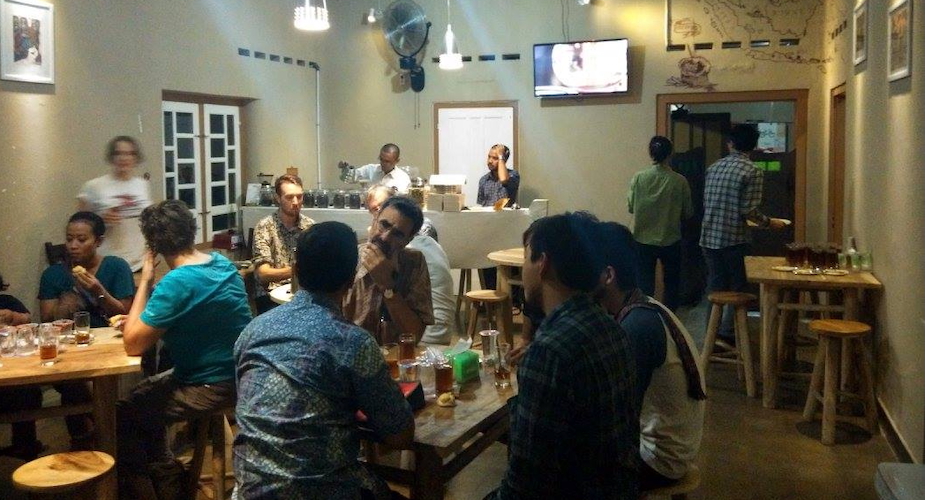
At the end of 2015, approaching thirty, I decided to change careers. I left KPG and opened a small coffee shop in Yogyakarta with some friends. Pat had just published Stormy with a Chance of Fried Rice: Twelve Months in Jakarta, and he supported the move – what I then called, in earnest, a ‘determination,’ and what I would now call an adventure – by holding a book discussion at the shop. His comment on what must have looked like an abrupt career change has stayed with me: ‘Running a coffee shop and editing books aren’t all that different, are they? Both are about selecting something for others – first books, then coffee.’
I understood that, conceptually. What I did not yet understand was the consequence. My taste in coffee turned out to be too eccentric – or, in a more forgiving phrase, slightly ahead of its time. I preferred black single‑origin coffee with a complicated brewing method. In literature, too, I was a minority within a minority: even the authors I loved – Haruki Murakami, Mieko Kawakami, Hiromi Kawakami – attracted only a somewhat niche readership, at least in the publishing market in Indonesia. The consequence I came to understand, somewhat belatedly, was that personal taste does not make a large market. For those reasons and many others, within less than two years I was back working with books. (Alongside the café, even then, I had been involved in entering the index for the Portuguese edition of Chega! – the work, it seems, was difficult to leave entirely).
February 2016 was the last time I saw Pat in person at my coffee shop in Yogyakarta. We did not know that then, of course. Over the next eight or nine years, we published at least five books together – his name as author, mine as editor on the colophon – without ever meeting in person, without a single phone call. Everything by email. A small miracle of modern life, or perhaps simply how trust sustains itself across distances, between Jakarta and Melbourne, once the foundation has been laid.
Among those books, the one that stayed with me most was A Window on Our Street: Sondering through Covid-19 in Northcote. It was through that book that I was introduced to the word ‘sonder’: the realisation that every random passer‑by is living a life as vivid and complex as your own… populated with their own ambitions, routines, worries, and inherited craziness. Pat had introduced this word in Stormy as well, but what I held onto from Stormy was a single essay: ‘Two Sharp Eyes.’
When he passed away last December, we wrote in an Instagram post: ‘Pak Pat, thank you for being a faithful guardian of Chega! - even though our work on human rights, especially now, is clearly harder than ever. Thank you for entrusting so many books to us. It was truly an honour and a joy. In particular, thank you for the ‘Two Sharp Eyes.’ I am not perfect but I am limited edition, which you noticed on a girl’s T‑shirt at Plaza Senayan, will always be a consolation for us editors who, no matter how sharp we try to keep our eyes, still miss things now and then.
Pat was not the kind of writer who typically needs an editor. Initially, I did not credit myself anywhere in his books. He insisted. Preparing his manuscripts was a quiet pleasure: he thought through everything from front cover to back, kept his files orderly, and had clear instructions on where and how each image should be placed. Working with him involved very little guesswork.
It’s all about Chega! and Timor-Leste. That, I suppose, is the knot of memory that ties me to Pat Walsh. Of course, memory is never precise.
When Jemma Purdey emailed and asked me to write a remembrance of Pat, I spontaneously wondered what had linked us for so long. I thought back to our last correspondence. Two events stood out.
I’m glad the old regime still reigns at KPG, I recall Pat writing in an email. It was around May 2025. Hugo Fernandes, Executive Director of the Centro Nacional Chega!, visited KPG. We discussed plans to publish Chega! in Tetum. A photo of the four of us (Hugo, Alpha, Candra, and me) made its way to Pat; the old regime he was referring to were Candra and me.
Another time, earlier, around September 2024, Ian Martin visited KPG. We met to celebrate the publication of the Indonesian and Tetum editions of his book, having lunch together at the Padang restaurant in front of our office, which turned out to be the number one culinary champion for rendang. Pat, the one who had done the most to bring us together, sadly couldn’t join and only followed the news through an email thread.
When I did check my email, it turned out that my last personal correspondence with Pat was on 5–6 May 2025. He enquired about the acronym for Kompas as komando pastor in the earlier days of the newspaper. And he said, ‘I'm writing a work memoir and am back in 1968 when I first came to Indonesia as a total innocent!’
In all our correspondences there was no sentence that felt like a message. No summing up. But going back through his earlier emails I keep finding the phrases like: ‘You should hammer your iron when it is glowing hot.’ And: ‘You have a lot on your plate.’ I had read those expressions at the time as something like sympathetic observations. The distance in our ages - Pat born in the 1940s, older than my own father; I in the 1980s - meant I sometimes understood things later than he had perhaps intended. Now I think: having a lot on one’s plate is both abundance and burden. And hot iron does not stay hot.
At the end of 2013, after what amounted to a months‑long editing marathon, Pat gave me an envelope. Inside was a plane ticket home for the Christmas holiday. The envelope was tucked inside a copy of his book Di Tempat Kejadian Perkara, which he had inscribed. The handwriting was a little hard to read: ‘You are hereby made an honorable member of the Order of Chega.’ On another page, he had noted that I should read his poem in the book - the one about the mangosteen. I remembered, then, that we had once discussed it over lunch: someone had asked his favourite fruit, and he had said: mangosteen.
I’m not entirely sure what he was trying to say with that. But it felt like a version of the Latin phrase I once encountered in a film: Fallaces sunt rerum species, appearances deceive. Things are not what they first look like. The Australian bule who turned out to be someone you could trust. The collaboration that lasted years without a single face‑to‑face meeting, conducted entirely through the patient medium of email. The editor who didn’t think he was really editing, and the writer who kept insisting that he was.
Ining Isaiyas is an editor at KPG (Kepustakaan Populer Gramedia) and is currently editing many translated fiction works, particularly those translated from Japanese into Indonesian. He received an honorable mention in the 2017 Jakarta Art Council Literary Criticism Competition.