Start with a flower, and end at a river…
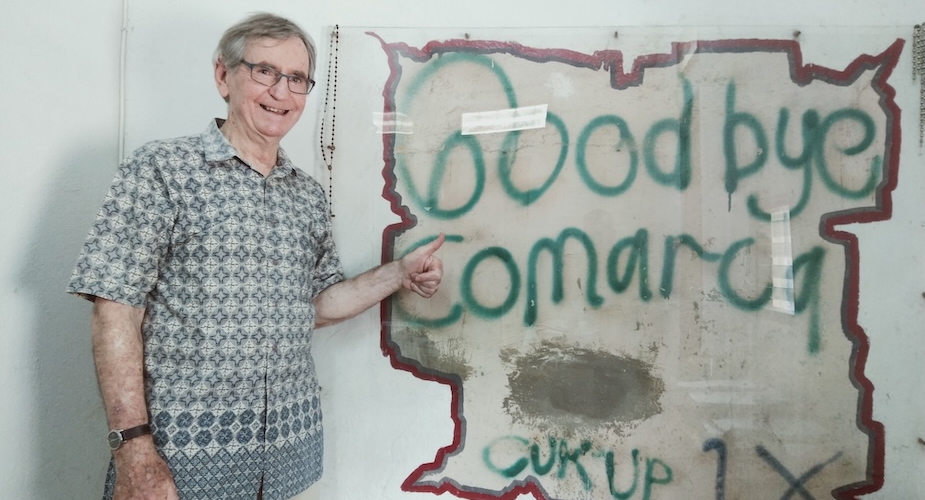
In the days leading up to the first public hearing of the Commission for Reception, Truth and Reconciliation in East Timor (CAVR: Comissão de Acolhimento, Verdade e Reconciliação de Timor Leste) in 2003—at the Comarca Balide, former torture centre—Pat was focused on transforming that physical place. For Pat, the Comarca had to become a symbol, a physical place representing the transformation that the people of Timor-Leste were creating at the time. The Comarca could not remain just a building with walls soaked in pain, etched with the writing of prisoners.
Pat was like a dog with a bone—focused, relentless, endearing (and frustrating!) at the same time. In those early days, while the rest of us juggled a hundred things –recruitment, training, designing the work of the CAVR, Pat took on the lion share of transforming this tired derelict building into a work-space for truth.
With Maun Jacinto Alves (Assepol, later commissioner), Pat pushed for the approvals for the building. Together with Patrick Burgess and the United Nations Human Rights Unit, they secured funding from the Japanese government, transforming the Comarca into the national office of the CAVR—housing some 70 staff in Dili, a gathering place for over 140 staff across the districts, and importantly, the site of our public hearings.
About a week before our first hearing on unlawful detention and torture, a flower garden was planted by a young woman named Maria José (Mize) who, as a four-year-old child, had been detained in that same place with her mother in 1976. That day as we walked to admire Mize’s newly planted garden Amu Domingus Maubere summarised it well: ‘We will show the world that we can grow flowers in prison’.
Pat loved those words. Not only because it was poetic—but because it was practical. It named exactly what he was trying to do. Take a place designed to break people, and make it serve truth. Take a site of fear and violence, and turn it into a place where survivors would speak, a nation can heal and lessons about how to rebuild a society can be learned.
That was Pat’s work: not abstract human rights (although of course he could also duel ideas), but grounded, stubborn, dogged transformation. And at the Comarca, he stayed…. Thus the name of our WAG ‘Comarca Forever’.
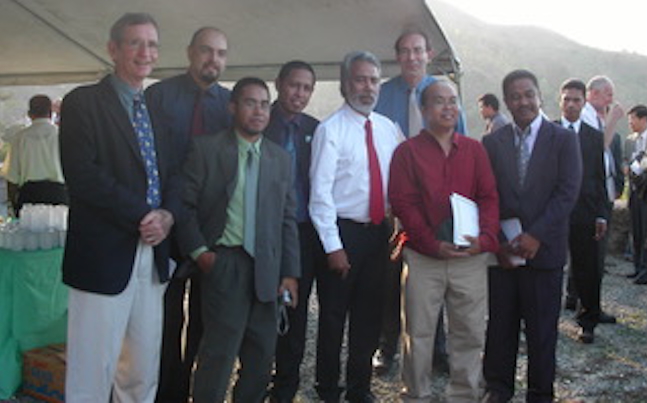
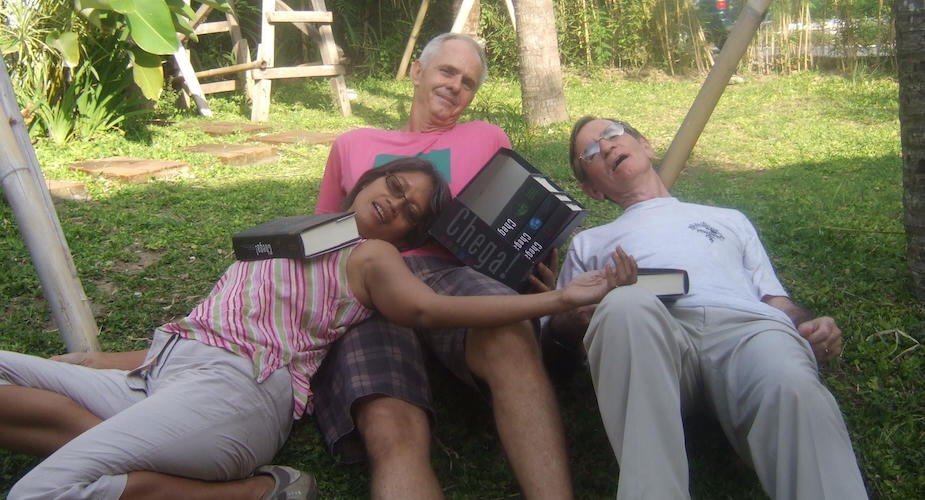
After the CAVR, when most of us had moved on to other things, Pat stayed with the Post CAVR Technical Secretariat (STP-CAVR) getting the Chega reports (English, Indonesian, Portuguese) and the Plain version (Tetun) finally printed, with an index! He then travelled with Asia Justice and Rights (AJAR) to ten cities in Indonesia to disseminate the report (another adventure story, too long to include here.)
With Jose Luis and Hugo we worked on the popular ‘comic’ version. Ever the optimist, in an email in 2018 (after looking at the proofs of the five volumes of the comic Chega!) he was already planning a talking book version and quipped— ‘what we really need is the Gone with the Wind film version’. Hmm, next project Pat.
Pat brought his moral doggedness and Aussie can-do spirit, mixed in with an unmoving faith for humanity and a dry sense of humour, plus a steadfast long-arc for truth.
In June 2003, Pat testified at a hearing on forced displacement and famine. For the first time, survivors spoke openly about bombardment, about the camps, about Atauro, about hunger as a weapon of war. Pat spoke about how relief was delayed, restricted, controlled. How aid came too late for many. How tens—hundreds—of thousands lost their lives.
Pat dedicated his testimony to all who died of hunger—and specifically to ‘the nameless girl from Laga’. The photograph of her wasted body was taken in October 1979 by Australian journalist Peter Rodgers. It travelled the world. It was shown at the United Nations in New York. It became an image of Timor-Leste’s suffering. But for Pat, she was not an image. She was a person. And he made a commitment—to find out whether she lived or died.
True to his promise, in November 2018, 15 years after he spoke at the CAVR hearing, Pat travelled to Laga. He brought copies of the photo, looking for her. He did not want victims to remain anonymous. He did not accept that time erased responsibility. And he left us with a list of unfinished business (including on the girl from Laga.)
And as always, Pat supported, cheered, cajoled AJAR in our work disseminating the Chega report in Indonesia. This includes looking for and finding now 200 stolen children (and reuniting 100 of them), supporting 455 survivors of rape and their children born of war as part of our Bukae program; and also opening the eyes of the next generation in Indonesia (and the region) about Timor-Leste’s story and progress.
At the end of his time at the Comarca, Pat worked with the team to get the Chega exhibition up and running. Near the entrance to the dark cells, he planted a reflection garden—adjacent to the flowers that Mize had planted. On the wall, he inscribed:
‘What did you do for human rights today?’
That question wasn’t just for the young visitors. It was for all of us. Pat believed that truth, once spoken, creates responsibility. That remembrance without action is not enough. That reconciliation is something you plant—slowly, collectively—like a garden.
In May 2024, Pat quoted Borja in an email to me, Hugo, and Zé—describing a full-circle moment that linked Herb Feith and Helen Hill, to CHART, and to Dewi Anwar’s then-pending visit to Timor. He concluded:
‘Streams flowing together become rivers.
When rivers unite, what can oppose them?’
Pat helped streams find each other. He helped truth to flow. And along its banks, he planted plenty of flowers—creating spaces where hearts and minds meet. Thank you, Pat, we are blessed to have called you a friend and a comrade.
Galuh Wandita began working on peace and conflict issues in 1996. In 2002-2005 she was appointed Deputy Director of Timor-Leste’s truth commission (CAVR) and drafted key chapters in Timor-Leste’s truth commission report, “Chega!” in 2005. In 2012, she co-founded Asia Justice and Rights (AJAR) and continues to lead the organisation as its Director.