On Stormy With a Chance of Fried Rice
Pat Walsh was a tall man. Very conspicuous in a place like Jakarta where people are, on average, much shorter. And he was more conspicuous because he liked to walk, in a mode that might be a combination of Walter Benjamin’s flâneur, Orwell’s plongeur and Jokowi’s blusukan, and altogether PatWalshian. Because unlike a flâneur, he put himself in the world, not looking at it only from a distance. Unlike Orwell, he wasn't slumming for the sake of a book. And unlike Jokowi’s carefully managed blusukan, his blusukan was based on care, repair and a smoldering, but gentle, anger that fueled him.
I always had a suspicion that Pat loved amusing himself. He was always so easily amused by his own joke, chuckling even before others understood and caught up with what he thought funny. He laughed at his own joke not because he was insecure, but because he saw himself as someone who was so equal with everyone else that surely everyone could see the world through his big-hearted jokes and laugh with him.
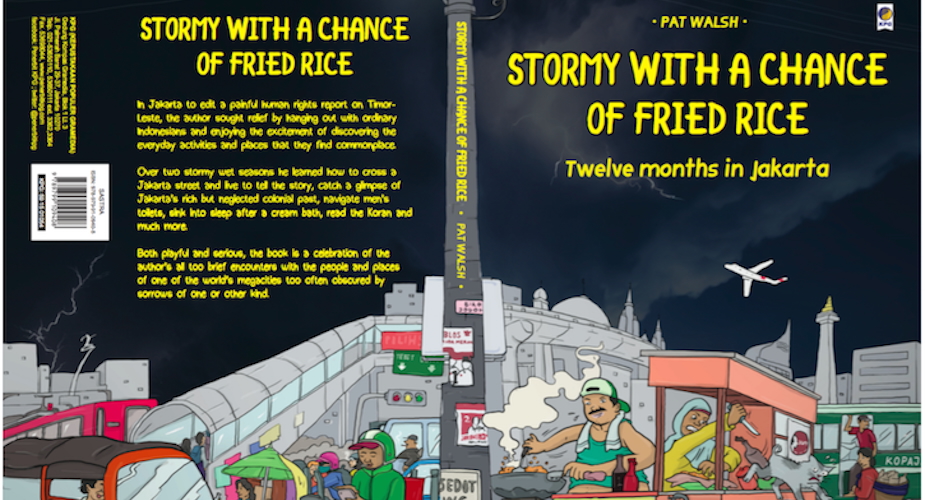
This is what Stormy With a Chance of Fried Rice is about. Pat walking and chuckling his way through a country where despair is often so in-your-face that humour and the camaraderie of walking together are two things that help us Indonesians survive despite our anger. Reading the book feels like walking with him as he walks a step in front or behind you, either to notice a small thing that you had not, or to slow down so he could see the bigger picture and conjure up a memory. This is a book that argues that attention is itself a form of activism and solidarity.
Fittingly, the book starts with a walk and a cheeky word play in the chapter Kissing in Public. ‘Walking one morning in a Jakarta slum, its houses leaning on each other like worn books on a shelf, I caught up to a family of four heading out of the narrow alleys toward the main road,’ he begins.
The comparison hints at the way Pat saw the world: every house and its occupants seem heavy with stories. And of course he approaches this family of four, talking with them, and somehow ends up in a flag ceremony where an old veteran kisses a flag and a flag ‘kisses’ a boy when it falls on him. In six pages, he walks us from the slum to the ceremony, to the history of the Battle of Surabaya, the politics of naming national heroes in Indonesia and all the way to Sydney University Labor Club. This is the central mode of the book: in each chapter, we get to see Pat noticing, following and listening to others and what they do as he traverses big histories and small moments that contain them.
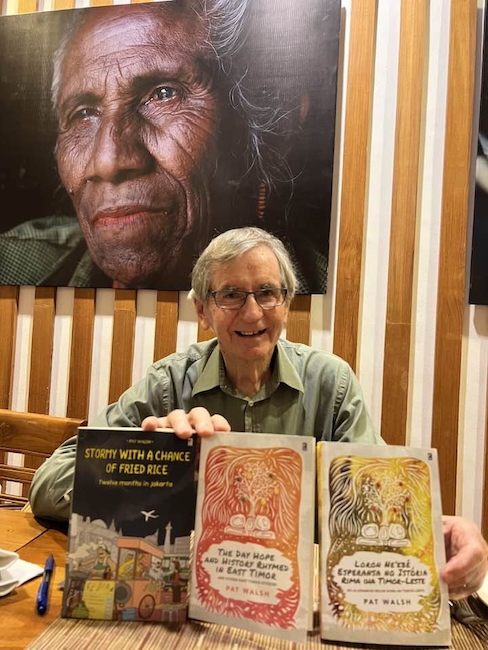
The book is set mostly in Jakarta, but also in the mind of a true cosmopolitan who sees an Australian outback dam in a soto ayam, a cricket ball in Indonesian nastar cookie, and the ritual of baptism in an Indonesian cream bath. Those who knew him could hear him chuckling after every comparison, after every faux surprise at seeing something that no one else sees with sparkling clarity and humour.
The warmest moments of the book come from his reminiscing about his childhood in Cobden. For example, as he orders from a superhero-themed menu in a cafe in Jakarta he detours to a memory of The Phantom ring he had as a kid. Or how ‘chuffed and amused’ he was to see the big toes of the former Irish president Mary Robinson ‘peeping out of her casual shoes’, just like his mother’s did. This is in a chapter called Indonesian Feet where he theorises the origin of the ‘Irish turned-up big toe’ and yearns for the return of the art of darning socks.
He namedrops. Prime ministers. Former presidents. Famous human rights activists. But these are put on the same stage as Pak Kumis, Nur, and Dewi. All ‘ordinary’ Indonesians he saw as extraordinary. Pak Kumis for his deft elegance (and generosity in his use of cooking oil) in cooking nasi goreng, Nur the rempeyek seller for her thoughts of home, and Dewi, an Indonesian maid, for her professionalism and attentiveness to her work. But he is always perfectly clear about who has the power, and who struggles. He does not romanticise Dewi’s work as a maid but puts it in conversation with his own position and history as a white man and a human rights activist.
His empathy also extends to the animals. There is, for example, Bandung, a black bull ant that keeps appearing where he works on a visit to a friend’s place. ‘We were a perfect match,’ Pat writes. ‘While he industriously fossicked for food, I hunted for words. And when, like the frivolous grasshopper, I got distracted and restless, the singleminded Bandung was there to remind me of the virtues of consistent effort and its handsome rewards.’
Across forty chapters, the book consistently documents an expression of a PatWalshian walk of noticing and care. It is full of hope. It is full of understanding that we should all be equal. He jokes freely, almost always at himself before anyone else. He jokes about his fear of heights and his less-than-stellar golf arms. He pokes fun at the absurdities of Jakarta. Yet, it never feels like he’s laughing at Jakarta or Jakartans.
It is a funny book. One that necessitated an apology from me to neighbouring studious readers in the quiet Dome Room of the State Library of Victoria as I blurted a belly laugh at Pat’s description of a children's ditty played by a toy train over and over, as he sits trying to edit a book in a shopping mall in Jakarta. I smiled as I imagined him in karaoke sessions or trying to hide from an enterprising Jakartan taxi driver.
The book also confirmed my suspicion that Pat Walsh was in fact also an angry man. But his anger was never toxic. It was gentle and focussed.
He was in Jakarta to edit the English version of Chega!, the human rights report on Timor-Leste. A report that is an important work and one among many that he has contributed to the world as a human rights activist in Indonesia, East Timor and Australia. In a chapter in the middle of the book, he describes what drove him: ‘anger smoldering below the surface like a fire in a coal mine at indifference to the report and the victims whose story it tells’.
Again, this is an anger that does not distract but rather, sharpens his questions, guides his walks and fuels his attentiveness to the world. The chapter where he criticises East Timorese and Indonesian leaders for failuring to take human rights abuses seriously, with words that befit the seriousness, is a must read for anyone working in activism. It is an anger that he keeps smoldering for others, not just for himself. This is an anger he keeps for Suryadi, whose father, a trade unionist, disappeared when he was only nine years old. For Pak Yasman, whose bajaj and livelihood were threatened by a new legislation, and for every character he names in the book who has been victimised by the inhumanity of Jakarta and its politics.
Throughout the book he also sees the warmth in this monster of a city. Partly because he has the attentiveness of someone in love with a world, holding on to hope that this life is worth living, by living. With others. By noticing others, asking their names, asking where they're going, and walking with them, even when the world is at its most disappointing, because, who knows, it might be stormy and dark, but there is always a chance of a good fried rice in the walking.
Thank you, Pat, for all your warmth, for teaching me to notice, and for the way you interspersed your chuckles and sparkling humour with the ugly noises of the world you knew and loved so well. Wherever you are, I hope the roads are long, the conversations generous, and that someone still remembers how to darn their socks.
Pat Walsh, Stormy with a Chance of Fried Rice: Twelve Months in Jakarta, Jakarta, Gramedia, 2015.
Tito Ambyo is a journalism lecturer and media anthropologist at RMIT University in Australia. He does not know how to darn socks but makes a decent fried rice.