Marginalised youth are hooked on the Internet, strategically and collectively overcoming barriers to connectivity
Since digital technology became part of daily life, a key concern is whether all social groups can access and benefit from it equally. Digital inequalities persist, especially among lower social classes who have fewer resources to access the internet and its benefits, which may reproduce or amplify existing inequalities. Yet, despite limited resources, being connected has become crucial even for marginalised youth in Jakarta’s slums. They use their creativity and collective resources to get and stay connected, strategically navigating internet access and benefiting from it.
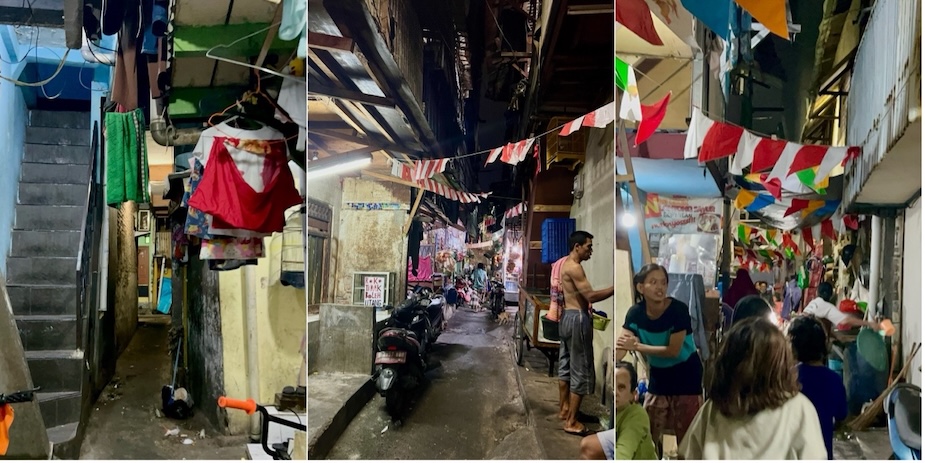
Walking deeper into a densely populated neighbourhood in Jakarta, known by the government as an urban slum (kampung kumuh kota), feels like entering a large communal house. Residents live side by side in dwellings of roughly three square meters, a space that serves as a living room during the day and a bedroom at night. The kitchen stove is usually located in front of the house, precisely on the side of the narrow alleys. Residents share a bathroom with others or pay for a public one. In some alleys, it is hard to tell day from night, as there is no space for sunlight to enter.
Digitalised slum
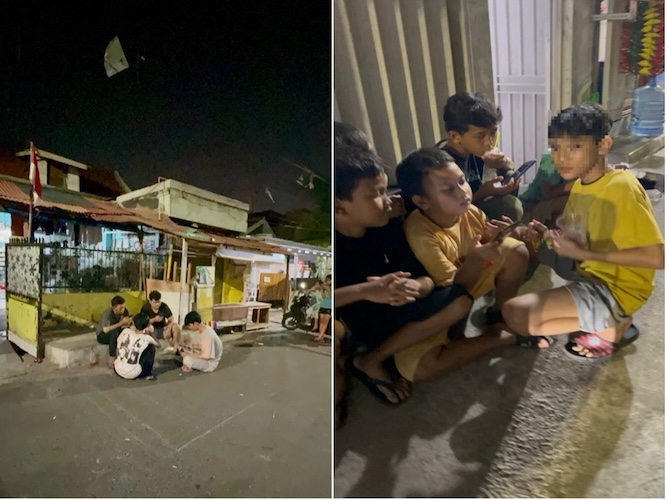
Despite their poor living conditions, a mobile phone and the internet connect residents to the rest of society. These devices have become integral to their daily lives – common, essential items rather than luxuries. Late afternoon is usually the busiest time of day; men, women, children, and young people crowd the narrow alleys. They are absorbed in their mobile phones, scrolling through social media, chatting on messaging apps, watching movies, or playing online games. Meanwhile, many women prepare dinner in front of their houses. The aroma of fried snacks and fried fish drifts through the neighbourhood, transforming the area into a large kitchen. Even for this mundane activity, many are connected to the internet. As Sinta (29 years old) says: ‘I use the internet to look for recipes for everyday cooking and earn money; I made a profit from selling rice burgers.’
Corners and nooks in houses along narrow alleys often hold special meaning, especially for young people and children. These areas act as digital social hubs where they gather to hang out, learn, connect with the outside world, and relax. Some spots offer internet access, either for free through government Wi-Fi introduced during the COVID-19 pandemic or, more commonly, for a small informal fee charged by neighbours with home Wi-Fi, as internet service providers have actively promoted their home Wi-Fi packages in slum neighbourhoods.
A source of happiness and hope
Young people living in this neighbourhood tell me the internet makes them feel happy. Their happiness stems from using the internet for leisure, chatting with friends, making new friends, discovering new information, and making life easier.
‘The internet makes me happier because I can explore many things’, says Sula (20), ‘even just knowing Jakarta’s traffic, playing games, and chatting with friends’. For Rudi (27), the internet allows him to explore his love of music: ‘I enjoy music; the internet makes me happy because I can listen to my favourite songs for free on YouTube or Spotify, despite ads.’ Moreover, it allows him to improve his own music: ‘I can play guitar but can’t adjust the sound, but online I can customise my guitar sound through an app.’ For young parents, as Sinta (29) shares, the internet makes her happier and ‘simplifies my life’, as it ‘helps me assist my son with his homework. Since I only graduated from secondary school, if he asks for help, I can look it up online’.
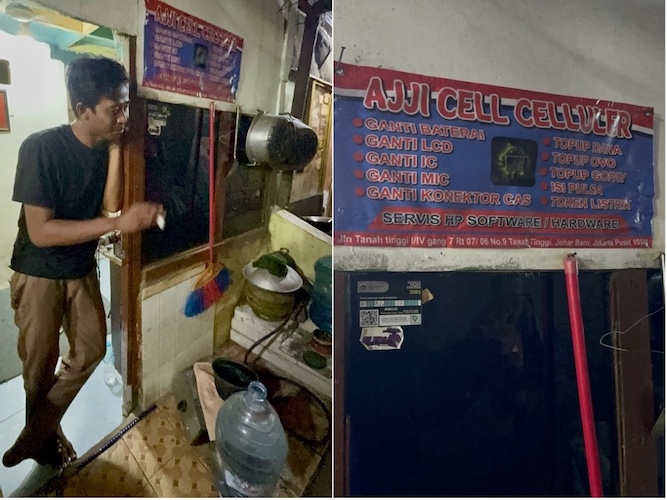
Through their mobile phones, many youths access a vast range of knowledge: ‘from not knowing to knowing many things’. They learn daily hacks like cleaning shoes, cooking recipes and fixing things. For example, Icul (22) is self-taught in digital tech, disassembling phones via online tutorials. ‘I can repair my and friends’ phones and have been learning and trying cryptocurrency.’ Some young people view the integration of digital technology into kampung life as a business opportunity and open a digital service centre. The services include hacks for circumventing lack of access, such as helping those without a bank account top up their e-wallet.
Jakarta’s kampung digital service centre
Eldi (27) shared that the most important impact of the internet is opening access to job vacancies. ‘I use social media and JobStreet to find jobs, making it easier to apply for jobs. I just email applications and wait. Going door-to-door is harder, needing transportation costs.’
Sometimes, knowledge offers insights that transcend social-class boundaries. For instance, Icul grew to enjoy the English language and reading English books after connecting to the internet: ‘I love watching TED Talks; I read Atomic Habits; now I’m reading How to Think Clearly.’ Without the internet, such opportunities were unimaginable for young people from lower-class families living in slums. In Indonesia, English is not part of slum culture, as it is seen as a sign of higher social status. He cannot afford lessons and has no family member to teach him, but online he learned and practiced with people worldwide. ‘Now I can speak English and have friends from different parts of the world, sis. I learn English from a Discord community,’ he said proudly.
Gaining new knowledge beyond their social boundaries is a great opportunity for marginalised youth, as it opens alternative pathways. Youth in slums often see the slum as both their roots and their future, believing their lives will mirror their parents, marked by dropout, insecure jobs, youth fights, or illegal activities. Indonesian schools often fail to inspire hope, reinforcing social class boundaries rather than dismantling them, which leads many to drop out. However, access to new information influences how they see their lives and future.
Icul found inspiration and information online to help plan his future, information that was hard to find elsewhere. ‘Because of the internet, we have ideas about life, enabling us to plan. We learn from others’ successes and struggles, forming future goals.’ Now, he says, ‘I want to continue university studies while working during the day and taking night courses.’ Marginalised youth can learn and reflect independently, but without internet access, they rarely reach resources beyond their immediate surroundings.
Neither connected nor disconnected
For youth living in the slum, connectivity follows its own rhythm. Despite their hopes for great opportunities from the Internet, connectivity is not a given. Whenever I have trouble contacting them, they later reply: ‘Sorry, sis, my mobile phone was empty,’ or ‘Sorry sis, yesterday I didn’t have the internet package.’ Sometimes I also get scolded for my slow responses: ‘Please respond soon, sis, I’m in a place with free Wi-Fi!’
I got used to saving many numbers for one person (Agus 1, Agus 2, Agus 2026) or changing their number frequently. Sometimes I receive a message after a long time of lost contact: ‘I changed my number, sis,’ or ‘This is my friend’s number, sis; I just borrowed it for a while.’ This meant their number had expired because they could not top up their internet balance before the package ended, or they encountered a problem and needed to change their number.
The rhythm of their connection depends on their day-to-day economic conditions. Unlike the expectation of being constantly online, marginalised youth’s digital access is about timing, continuity, and synchronisation of connection. Timing enables them to connect. They are online when they have money to buy packages. Continuity is about how long they can stay connected, which is often unpredictable. One week, they may have full internet access, but the next week it is still in doubt.
Synchronisation is about aligning their connectivity with social world expectations. It matters because being connected at the wrong moments can mean missing opportunities. For instance, when applying for jobs, they focus on keeping the internet package active, lest they miss job vacancies, invitations, or important information. Conversely, they use the internet based on the availability of internet packages. Meri (26) explains, ‘What I access depends on the internet quota I have at that time.’ Her internet use is strategic and dependent on available resources.
Improvised strategies
The intermittent, irregular, and uncertain nature of the digital present creates a rhythm rather than a problem of lacking a static connection. The rhythm reflects marginalised youth’s ability to adapt and negotiate limited resources with a quota consciousness. They can stay connected via second-hand devices or affordable Chinese Android brands (costing less than Rp 2,000,000). Internet providers offer daily or weekly plans for Rp 2,500 - Rp 12,000, helping manage costs.
Switching providers whenever there is a promotion is also a strategy, although it comes at the cost of changing numbers. Sharing devices and home Wi-Fi subscriptions are also ways to improve access. Yumi (28), a scavenger living among used mattresses by train tracks, saved Rp 60.000 for a second-hand mobile phone and now buys weekly or daily internet, so her daughter can learn and have fun. She shares the phone with her husband and daughter.
Marginalised youth’s connectivity shows digital access is not just about being connected or disconnected. It is a negotiable, temporary condition, in which limitations and precarious conditions also foster creativity. Access involves everyday tactics by regularly calculating, prioritising, and negotiating based on data availability.
However, although internet connection helps to expand their knowledge and social networks, their connectivity stays unstable and requires more effort from marginalised youth. Connectivity can enable them to temporarily break through social class boundaries, but these boundaries persist. Their rhythm of connectivity is both a symptom of digital inequality and a mechanism for overcoming it.
Daisy Indira Yasmine (d.i.yasmine@vu.nl) is a PhD candidate at the Department of Social and Cultural Anthropology, Vrije Universiteit Amsterdam, and a lecturer in the Department of Sociology at the University of Indonesia. Her research examines digital inequality among marginalised urban youth in Indonesia.