A gift for making boundary-busting things happen
Pat had an enormous influence on my life. He filled me with boundless admiration. Yet in some ways I hardly knew him. That strange disjunction initially held me back from writing about him in this edition. Then I realised that this hesitancy actually revealed something important about Pat. He reached out to people he didn’t know and invited them into the exciting things he was doing.
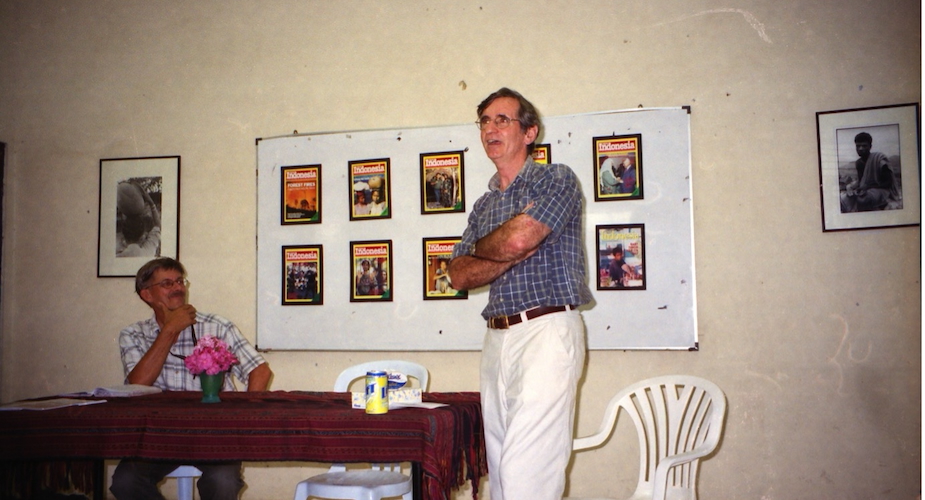
The first person to describe Pat to me must have been Herb Feith. I was a Brisbane lad teaching physics at a little university in provincial Indonesia. Herb had stayed with us in Salatiga a couple of times – he was visiting some of his ex-PhD students after long being banned from the country - and he told us about Inside Indonesia. (I later learned he was himself one of its benefactors). Evidently this little magazine belonged to a circle of progressive activists in inner city Melbourne. Pat Walsh was their avatar.
East Timor
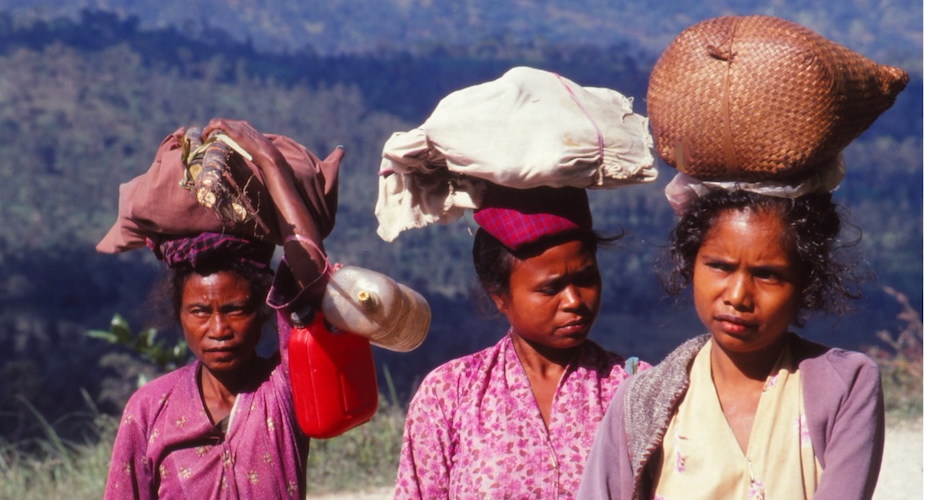
The first article I published in Inside Indonesia must have passed through Pat’s hands. My photo of two East Timorese women featured on the cover of the October 1989 edition. Inside, was an anonymous illustrated travelogue of a visit to East Timor my wife Helene van Klinken and I had just made together with my dad, Arie. We were among the first foreigners to enter since the invasion in 1975. East Timorese students in Salatiga had arranged contacts through their clandestine resistance network. Helene later wrote several pieces too.
Herb asked me what I was going to do after my time at Salatiga ended. He offered to write me a good recommendation if I wanted to drop physics and study to become an ‘Indonesianist’ like him. So, by 1991, back in Brisbane, I was once more a student, knowing nothing and feeling uncertain.
In early 1992, I visited Melbourne – a 24-hour Greyhound bus trip through the back blocks of New South Wales – and met Pat for the first time. It was an Inside Indonesia café meal in Lygon Street. A happy crowd of activists and Monash University intellectuals were there – all witty, lefty, opinionated, and changing the world. I knew nothing like that in Brisbane.
But here’s the thing. Pat had this gift of reaching across boundaries, offering trust and humour. His Melbourne circle of committed Timor activists had every reason to hate Indonesia; while I practically considered myself Indonesian after living there for so many years. Most Australian academics considered the annexation of East Timor a fait accompli – Herb Feith being the shining exception.
But Pat reached out to people who loved Indonesia, inviting them to care for East Timor too. He radiated faith in human goodness regardless of nationality. Inside Indonesia was a ‘people-to-people’ bridge over the abyss of Indonesian militarism and Australian pragmatism that would divide us.
Inside Indonesia
Those visits to inner city Melbourne led to an offer from Pat early in 1996. Having finished my PhD, would I take over from him as part-time editor of Inside Indonesia? With a salary starting at 75 per cent full-time? Herb Feith was also chipping in. My answer: Would I what!
As all hell broke out in Indonesia following 21 May 1998: Suharto out, newspapers wanting op-eds, democratisation calling for research, the monies available to sustain a salaried editor also declined. Within a decade the magazine had gone online only, and the entire operation was run by volunteers, as it is until the present day under Jemma Purdey’s leadership.
Far more important than any money I earned as editor: Inside Indonesia made me part of a progressive, post-nationalist community I had never known existed. For my first edition, March 1996, I got to know the gay rights activist Dede Oetomo, human rights campaigner Marzuki Darusman, child labour protester Arist Merdeka Sirait, and the people who interviewed them for the magazine: Sharon Bessell, Krishna Sen, and Wendy Miller. Jill Elliott of the Kimberley Indonesia Friendship Association wrote about Indonesians caught fishing in Australian waters. And so it went on, edition after exciting edition, all lived out via faxes and emails that ran through Melinda Venticich in the office in Pat’s and Annie’s Northcote home.
Truth-telling
That was the first time Pat changed my life. The second was in 2002, when he asked if I would join the East Timorese Truth Commission (Comissão de Acolhimento, Verdade e Reconciliação de Timor Leste, CAVR), in which he was playing a significant role. I didn’t hesitate. Whatever Pat did was worthwhile. For the first time, this pushed my nose into the real flesh and blood of crimes against humanity. Hitherto, war had been for me a story of suffering and defiance on the printed page. Now it became the stuff of real human lives and deaths, played out over many years below the achingly beautiful mountains of this brave little country.
Pat’s friendship with Xanana Gusmao had surely opened the door to this huge venture. He put heart into his relationships. He once told me he smuggled casks of wine into East Timor around ballot time in 1999, intended for Falintil! The whisky he also brought, may have fallen into the hands of the militias.
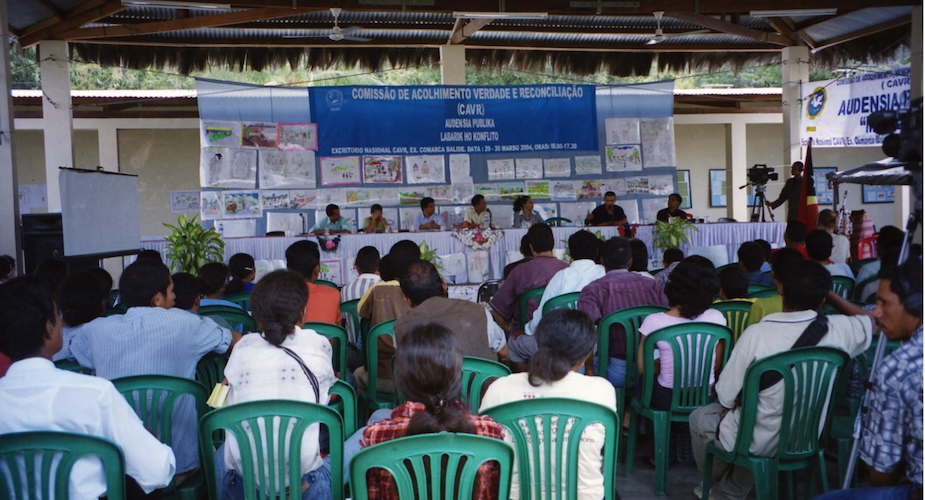
The old Comarca prison became the commission’s head office. This notorious torture centre now became a place of acceptance, truth-telling, and reconciliation. I will never forget watching Pat ambling around the complex in the late afternoon, a bunch of keys on his belt, just looking at the flower beds, checking the state of preservation of prisoners’ graffiti on an old cell wall, or perusing a new display of historical resistance posters.
By this time, I was attached to a research institute in the Netherlands and working on the unexpected outbursts of ethnic and religious violence in Indonesia’s outer islands. The institute agreed to let me join CAVR (agreed to rent me out to them might be the more accurate term, I am a little ashamed to say), for three months each year over three years to support the research team.
My brother-in-law Rob Williams bought us a motorbike and I travelled all over the country, sometimes with Helene, to see the places calling out for truth-telling after decades of war behind closed borders. Helene later wrote her PhD on material she gathered about children taken from East Timor to Indonesia.
Pat persuaded foreign donors to pay for an ambitious survey to record the names and dates on every gravestone in the country. The Human Rights Data Analysis Group (HRDAG) used this data to estimate the number of people who died of famine during the Indonesian occupation: 104,000, and possibly as many as 183,000.
Poetry
And yet so much remained unknown to me about Pat. The poetry. The books he self-published later in life. Much of Annie’s and Pat’s girls growing up. Most of the Catholicism – though to me he always remained the priest he once was, who continued to bring people together for a greater good.
The Irish wake after his funeral on 13 January 2026 seemed to be full of folk like me. People drawn into something visionary by Pat’s charisma, only partly aware of the full implications, but grateful to be welcomed into a community living for a better tomorrow.
Gerry van Klinken (gvanklinken@gmail.com) is a former editor and current member of the board of Inside Indonesia magazine.