Manuscripts have opinions
Somewhere between Jambi and Jakarta, a storm in the sky forced me to confront the spirits in the pages of the manuscripts I study. It was by no means the most remarkable manuscript we had seen that day, neither was it strictly speaking a manuscript at all, but the photocopy of one, written in Arab Melayu, perhaps fifty or so pages unceremoniously stapled together on the side. I had the privilege of accompanying a group of scholars from the University of Jambi and Lancang Kuning University in Pekanbaru to the Museum Siginjei in Jambi to digitise some of their manuscripts, including inscribed bamboo poles and buffalo horns in the Incung script, as well as beautifully illuminated handwritten copies of the Qur’an.
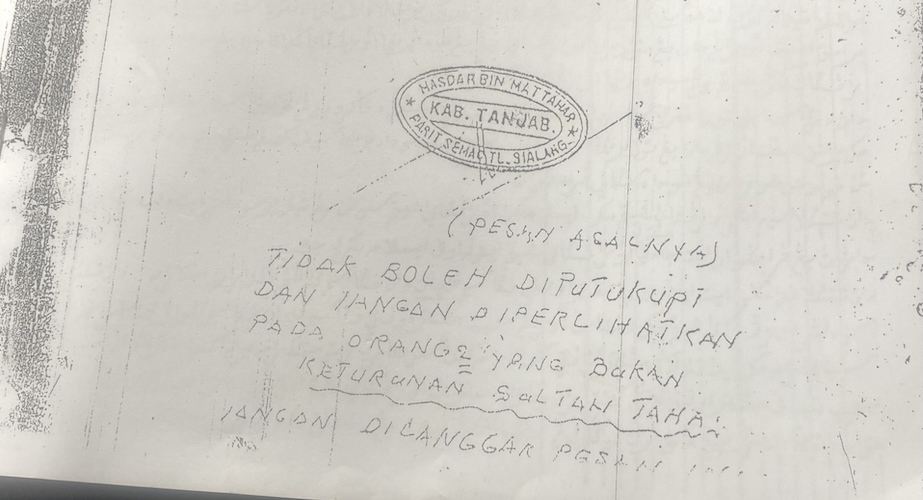
In this impressive collection, one—although no more special than the others—made us pause. This particular piece had a handwritten note on the cover, right under the stamp marking it as the property of the District of Tanjung Jabung Barat (Tanjab) in Jambi, Sumatra. Written in Indonesian the note said: 'May not be photocopied, and do not show to people who are not descendants of Sultan Taha. Do not ignore this message.'
I could not help but laugh when I read the note. Too great was the irony that a) the original had obviously already been photocopied, since the photocopy was right in front of us, none of whom were descendants of Sultan Taha; and b) we were about to digitise this photocopy to make it accessible to even more people who are likewise not descendants. I had no part in making any decisions about what would be digitised. I was there as an ethnographer, observing — a bit astonished, perhaps — how my friends were comfortable digitising something that apparently wasn’t meant to be accessed by us at all. But when I texted a picture of this inscription to a friend who also studies manuscripts, he told me (in not quite so many words) that I was screwed.
A question of agency
When it comes to the question of whether or not to digitise formerly restricted manuscripts in Indonesia, we are navigating contested grounds, as the value of free and open access and the democratisation of knowledge seems to run counter to the fact that access to information, in traditional Southeast Asia, was never free of social figuration. What is more, manuscripts may be more than passive objects in these negotiations. Some of them have an agency of their own, a claim to a certain kind of treatment, and even the capacity to fight back when they are not treated properly. Those who deal with them without having the knowledge or authority to do so may go crazy, or suddenly die in a car crash, or encounter some other sort of misfortune. But if my friends were not worried, should I be?

This question has broader relevance than it may first appear. Given the complex history of textuality in Southeast Asia, should I be worried that more and more manuscripts in the special collections of my own university in Leiden are being digitised, a process that is never free from concerns that it perpetuates epistemic violence by defining a manuscript as a text rather than a living agent with powers of their own?
A few days later I was on a plane back to Jakarta. It was the rainy season, but the weather was calm when we took off in Jambi. As we approached Jakarta, the trip became increasingly turbulent. I was clutching my armrests during our very bumpy final descent when suddenly the plane turned and ascended again. There was no announcement from the pilot. We weren’t landing. We were retreating. Fifteen minutes later we were nearly back over Sumatra when finally the pilot came on. The weather in Jakarta had been too severe to land. We would turn south again in a moment and try again. Another forty minutes later, we were descending once more into the same storm — except this time it felt even angrier. The bins rattled and my stomach dropped. I just stopped myself in time from grabbing the hand of stranger beside me. We made it further than the previous time, far enough that I could already see the ground through the bottommost layer of dark clouds — but again we turned. Another retreat north. We would not land in Jakarta until the weather had cleared up. We were diverting to Palembang, almost back to where we had started, to wait out the storm. Hours later, on the third try, we landed.
Dramatic as the experience felt at the time, the following day I was already joking about it with a Javanese friend, a fellow ethnographer. Having discussed the hazards of travel during rainy season, he asked me about my time in Sumatra. Before too long, I was showing him the photo of the manuscript. 'You know,' he said, simultaneously amused and pensive, 'you should talk to an expert about this.' He shared with me how during his own fieldwork he had had a dream where he was riding a crocodile, which was interpreted by a juru kunci as a sign that he was allowed to continue with his research. He suggested that perhaps my experience — not being able to to leave Sumatra immediately, being called back to Palembang — also had some deeper meaning, as though a verdict had yet to be spoken as to whether the digitisation initiative was legitimate. Of course, one may object that this interpretation is reading too much into what was just bad weather in Jakarta, something completely commonplace during rainy season. But I think we do well to listen to my Javanese friend, who cautioned me to consider the possibility of a ghost in the machine — and urged me to think about what this might mean.
Deliberating before digitising
Digitising manuscripts and making them accessible is welcomed by many Indonesians, including many who understand them and the traditions from which they emerge much better than I do. My colleagues from Sumatra, like many other experts, know that digitisation is often the only way to safeguard vulnerable manuscripts. They also resist the idea that the stewardship of manuscripts today needs to follow social configurations of the past, with all their hierarchies and mechanisms of exclusion intact. At the same time, we cannot deny that the creation of digital copies also disrupts indigenous understandings of texts and of the social order of which these texts are a part. If manuscripts have an agency, they may resist these transformations, reminding us that they are no passive objects but forces that one should not mess with.
In my current research project, I am trying to make sense of this dilemma and think of a way out or through. In this context, my encounter with the spirited pages from Jambi gave me the idea that the two — the embrace of digitisation with all its benefits, and the acknowledgement of the agency of some manuscripts — may not be mutually exclusive. I’d like to think that this spirit called me back to make clear who is the boss, but then let me go because once this was acknowledged, digitisation was not such a bad thing. Perhaps this interpretation is just my own anxieties and desires speaking, but aren’t ghosts always reduced to that by whose who don’t believe they exist? One day, I hope to return to Jambi and to consult with an expert, as my friend recommended. But for now, I take this to be a reminder to keep listening to spirits in the pages, and take seriously the agency of the manuscripts themselves. They, too, may have opinions about their treatment and preservation.
Verena Meyer (v.h.meyer@hum.leidenuniv.nl) is an Assistant Professor (Universitair Docent) of Islam in South and Southeast Asia at the Leiden University Institute for Area Studies.