A tribute based on a personal reflection delivered at Pat's wake
Many thanks to Annie and the family for the privilege of contributing a few words on this most sadly unwelcome but turning-point moment, in their lives and those of many others, including me.
Pat was clearly blessed with many gifts, and today, from other speakers, I have learned so much more of their manifestation over his far-too-short 84 years. Humour, wisdom, knowledge, irony, passion, rationality, determination, empathy, doggedness are qualities which come immediately to mind from my work and play with him for over fifty years.
And then there's the gifts of oratory and being able to write – books, research papers, appeals to the better angels of not-so-angelic political players, and poetry – even though, jokingly, I felt at times he strayed too far into the metaphoric. His sensitively written and then movingly spoken eulogies for late family, friends, colleagues were legendary. So good were they that I have long-carried the now-dashed hope that I would die before Pat so that he might deliver one for me. Alas.
All the people present here that I know personally, I also know shared with Pat a lifetime commitment to trying the make our world a better place. Not just for our own, but for everyone – whatever the limits of our individual capabilities.
We have heard today of the many arenas in which Pat contributed his outstanding abilities. For my purposes today, I wish to limit myself to the Timor sphere - the area of work in which he and I collaborated closely from the late 1970s and know best – and indeed limit my thoughts to his early Timor activity years.
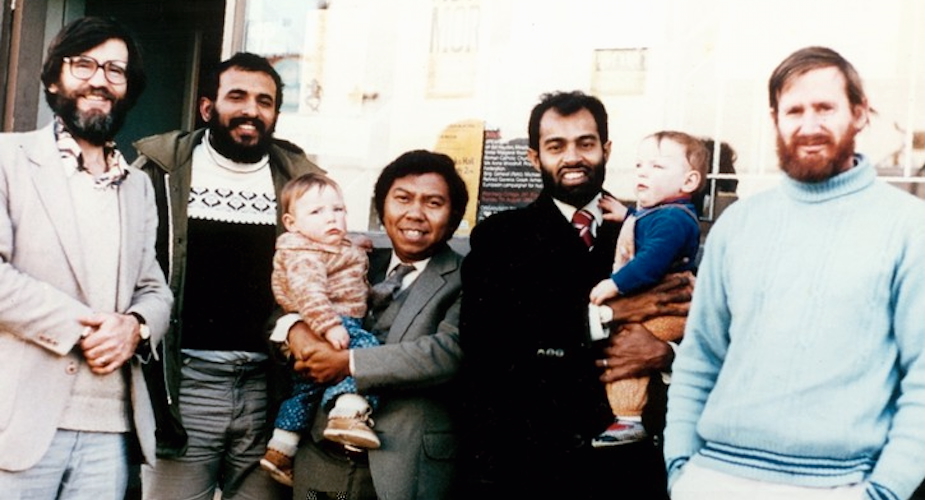
As Chaplain to the Young Christian Student organisation, in 1976 Pat published a single issue of the YCS newsletter, comprehensively updating members on the evolving Timor tragedy. In 1978 he became more directly engaged on Timor by joining the committee of the Australia East Timor Association. Sometime in the second half of 1978, I remember him coming to my small attic office in Fitzroy where with other volunteers I had been operating the Timor Information Service (TIS) since late 1975.
The key message I got from Pat that day was that he believed the current methods of Timor activism were failing. He felt the activists were mainly talking to one another and becoming increasingly marginalised. He wanted to do something that brought Timor into what he called the ‘mainstream’ and he was looking for ideas and allies to achieve this.
In retrospect, I probably felt something similar at the time but couldn’t articulate it and had absolutely no idea how to change things. I think I said something grumpily about the ‘mainstream’ having abandoned the Timorese years ago but I ‘wished him luck’ with his mission.
Luckily, he took no notice of my surly pessimism and went from my attic up the stairs to the offices of Action for World Development (my attic landlord) to speak to its national coordinator, Bill Armstrong. Bill listened, agreed with Pat’s views and in a short time came up with a proposal which ultimately set Pat’s mission rolling.
Bill Armstrong convened a meeting with me and Pat, asking us to prepare two reports for AWD – one on the current state of the East Timorese refugee and family reunion program and one on the humanitarian situation inside Indonesian-occupied East Timor. I agreed to do the first, Pat was to do the second.
Within two or three weeks I had submitted my draft report which, with some adjustments was published in the name of AWD and received some immediate mainstream media coverage. Modest success! Pat expressing some surprise at the rapidity of my work and using one of his favourite mock-Latin phrases, said he supposed he’d better ‘extractum digitum’ or get to work.
We waited. And waited. I had completed my report by simply drawing on the documentation I had at hand in the burgeoning TIS filing cabinets. That was not Pat’s way. Over the next months and into the new year Bill started hearing reports from colleagues in other aid and development agencies about this impressive person who’d been visiting them and pressing them for information and documentation about humanitarian needs in Timor.
Finally, in about May 1979, Pat produced his draft paper and together we tested it with one or two wise individuals before he handed it to Bill Armstrong who published it, again in the name of AWD. It also received good media coverage, especially after the report was adopted and re-published by the Australian Council for Overseas Aid (ACFOA), the peak-body for aid and development organisations.
The innocuously titled report, Aid and East Timor, concluded there were signs pointing to a drastic humanitarian disaster occurring in Timor, not least because of Jakarta’s continuing exclusion of external humanitarian organisations and the limited and ineffective aid programs managed by Indonesian Red Cross. Pat had carefully pieced together fragments of data from a range of public sources and private interviews with knowledgeable persons to draw this stark conclusion.
The accuracy of Pat’s work was absolutely confirmed shortly after with the release of an International Red Cross report which found conditions in parts of Timor ‘as bad as Biafra’ and with the potential to be ‘worse than Kampuchea’. This confirmation was dramatically illustrated in late October 1979 by the Fairfax Media publication of former diplomat and now-journalist Peter Rodgers’ images of skeletal, starving East Timorese children. Pat’s authority was on the rise.
By the end of 1979, Pat had been co-opted on to ACFOA’s East Timor Sub-committee and was coordinating a humanitarian aid appeal by Australian aid agencies. 1980 saw the emergence of a range of activities by Pat under the ACFOA umbrella, including a comprehensive dossier on East Timor Today and a round-the-world trip to meet other activist and mainstream organisation advocates for Timor. He returned from that trip, walking straight into an ACFOA-convened meeting of aid agencies and Department of Foreign Affairs officers and delivered a wide-ranging report, including the latest news from Timor picked up in Jakarta. Pat’s declared ‘mission to the mainstream’ was well and truly launched – and he never looked back.
Many things followed in short order, bearing Pat’s organisational and strategic thinking: a strengthened Labor Party policy on Timor, a Senate Inquiry on East Timor, the campaign to Reunite the Families of Timor (RAFT), Christians in Solidarity with East Timor (CISET) and not least, Inside Indonesia magazine.
While some of these activities fell outside the direct ACFOA ambit for which Pat eventually became employed, they amplified the overall outcomes of his work. Australia’s foremost establishment authority on Timor, Jim Dunn, concluded in his 1983 book that, as a result of this work, the Timor issue ‘has not been allowed to die in Australia’.
Pat continued with Timor and other human rights work within ACFOA until 2000 before committing to a decade and more of his life working in newly independent Timor-Leste. There are many stories yet to be told. Pat earned justifiable fame and authority within the Timorese and Timor-phile communities world-wide, but I will always recall those very early days of his meteoric rise to such status.
We know that Pat was writing a personal memoir before his death. He was definitely owed a miracle or two ‘from on high’ when his mortal illness emerged, but that was not to come. We are told he had finished Chapter 7. Of Volume 1! There was much to write about.
The documentary record of his life and work will live on in his extensive and very rich archives, but his many-faceted stories will need to be written by others.
I would like to conclude with a few personal thoughts.
Pat was one of the most significant characters in my life and I count it a great blessing to have known and worked with him. (I won’t talk here about the day in 1980 when he ruthlessly wiped me off a tennis court.)
His work ethic was unmatchable, an awe-full inspiration to me, as was his determination to always dig deeper and then follow-up. And follow up again.
In his last days his daughter Mayra helped him deliver a few whispery words over the phone to me – then in Perth: he was fading fast, sending his love, and agreeing with Mayra’s statement about our long-time connection by describing me ‘as like a brother’. Even in extremis, the perfect word. His gift.
For those of you who, like me, wept at the recitation of Auden’s poem Funeral Blues in the movie Four Weddings and a Funeral, Pat’s death is like a slow dawning ‘stop the clocks’ moment. He was not ‘my North, my South etc’, but as time goes on, I feel increasingly unhinged in the simplest of day-to-day ways.
To whom do I turn now to share today’s best cartoon or joke or new development in Timor or Australian politics? Who else will contact me often to remind him of a date or an event or find something in his archive or, indeed, on his own website or on the internet? Who else will give me immediate, even sometimes acerbic, commentary on an idea or a piece of writing.
There are others who can do some of these things, but his daily absence now is an irreplaceable loss.
Pat Walsh was an extraordinary person by any measure. For his family, friends, colleagues. And me.
Farewell, Brother.
John Waddingham co-founded the Timor Information Service (1975-1984) and, with Pat Walsh, Inside Indonesia magazine (1983). John is the archivist/manager of Clearing House for Archival Records on Timor (CHART) Inc; co-founded with Pat Walsh in 1999/2000.