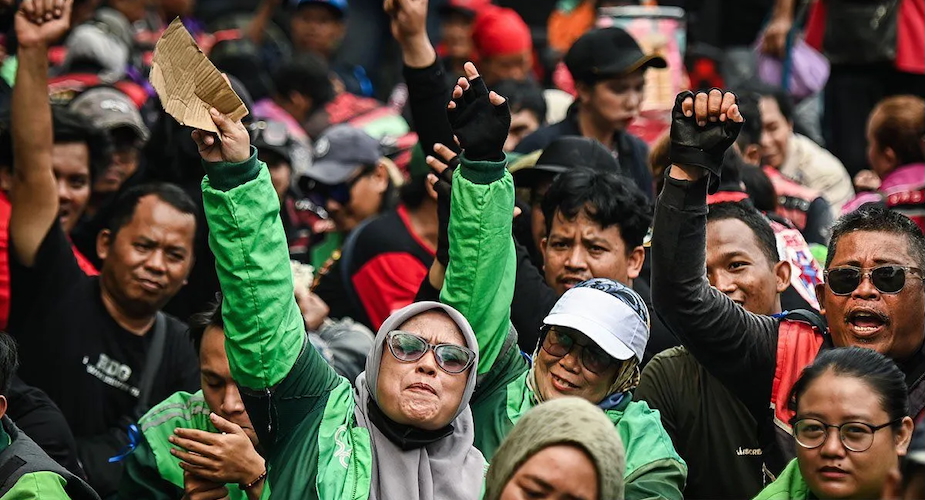
Precarious ride-hailing drivers take to TikTok to voice their grievances but fight an unequal battle
Baca versi Bh Indonesia
App-enabled ride-hailing drivers, or ‘ojol’ (short for ‘ojek online’), are no stranger to social media. While waiting for orders they are often seen scrolling social media on their smartphone. Some use their waiting time – which is not truly time off, as they must remain available and attentive to incoming orders – to earn additional income as content creators, especially on TikTok, one of the fastest-growing apps in Indonesia. Moreover, many ojol drivers take to TikTok to voice grievances about their precarious labour conditions.
Throughout the month of Ramadhan (mid-February to March 2026), the issue of ojol’s religious holiday allowances and bonuses – THR (Tunjangan Hari Raya) and BHR (Bonus Hari Raya) – went viral on TikTok. One post, for instance, showing an ojol driver’s exhilarated response to receiving this bonus from their employer, received more than 3,800 likes. But the caption carried an undertone of irony: ‘Don’t look at the amount just consider it a form of appreciation.’ Others commented directly on the gap between official promises and drivers’ actual experience: ‘They promised 20 per cent, but in the end, it was only Rp 50.000. How pathetic.’ This comment prompted similar responses from other drivers: ‘True, Grab is not like Gojek. Those who were active for a full year received Rp 100.000–250.000. Grab only gave Rp 50.000.’ Another simply wrote, ‘We are being lied to, again.’
TikTok thus becomes a vital space for digitally-mediated contestation over ojol drivers’ religious holiday allowances and bonuses. Since 2024, debates around this issue have circulated across social media, government circulars, platform responses and street protests. Beyond holiday payments, the debates reveal a broader struggle over workers’ rights. For ojol drivers, their ‘freelance’ status as ‘partners’ of the companies they work for, rather than employees, complicates this struggle. Social media platforms like TikTok enable drivers to expose the precarity of these labour conditions. However, TikTok posts have done little to address the structural injustice of this arrangement.
Struggles for labour rights
The contestation over ojol drivers’ holiday allowances and bonuses cannot be understood only as a recent dispute over platform regulation. It belongs to a longer history of labour struggles over welfare in Indonesia. As early as 1914, workers at the Dutch East Indies’ newspaper Java Bode, many of them Chinese, demanded that their Chinese New Year allowance be increased from 14 days’ pay to a full month’s wage. After independence, SOBSI, a labour union affiliated with the Indonesian Communist Party, pushed for holiday allowances to be extended beyond civil servants. Over time, these struggles transformed holiday allowance from discretionary payment into labour entitlement, later codified in Indonesian labour regulations. Since 1994, all employees of either private companies or government institutions in Indonesia are entitled to religious holiday allowances (THR).
This history matters because THR emerged as a claim to workers’ rights, regardless of technical employment status. Yet in today’s platform economy, this older rights struggle has reappeared through a narrower legal question. In 2024, the Director General of Industrial Relations and Social Security declared that ojol drivers could be considered fixed-term contract workers entitled to THR, partly in response to long-running driver unrest. But this framing was quickly contested by the ride-hailing companies Gojek and Grab, who found an ally in former Minister of Manpower Muhammad Hanif Dhakiri.
In 2025, THR for ojol drivers was reframed as BHR (Bonus Hari Raya): discretionary support rather than enforceable entitlement. This shift from THR to BHR is crucial: while THR locates the claim within labour rights, which all workers are entitled to, BHR relocates it within voluntary corporate assistance, implying employee generosity. In this sense, BHR becomes a compromise: recognising ojol drivers’ grievances but refusing to recognise them as workers entitled to a set of rights.
In Indonesia’s ‘gig economy’, app-enabled ride-hailing drivers lack formal employment status, serving instead as freelance ‘partners’ of the platform companies they work for. While many ojol drivers embrace this ‘partnership’ model for its promise of work flexibility, it allows those companies and the state to deny them employment-based rights. The language of partnership itself is not politically neutral. It echoes Indonesia’s longer tradition of harmonious industrial relations – institutionalised during Suharto’s New Order regime – imagining workers as cooperative partners of employers and the state, while organised labour was tightly controlled and repressed. However, a growing number of ojol drivers insist that they are being misclassified as ‘partners’ and should be recognised as workers entitled to labour rights.
Fragmented views on TikTok
TikTok has become one of the spaces where the THR-turned-BHR compromise was contested. But TikTok debates around this issue also made visible long-standing fragmentation among ojol drivers; it sharpened differences between those embracing the ‘free partner’ status and those demanding labour rights. The THR/BHR debates compounded this fragmentation by narrowing the struggle for rights to the question of employment status, excluding those who do not identify – or are not recognised – as workers under the law.
Some drivers mocked those demanding THR. As one driver insinuated on TikTok, they had all chosen this work as ‘partners’, and if they wished such benefits as THR they should just change jobs and become employees. However, this view does not account for the fact that most ojol drivers end up doing this work for failing to find regular employment in Indonesia’s precarious labour market.
At the same time, many ojol drivers on TikTok linked grievances over BHR to other platform practices that impact their income. One post, for example, criticised a promotional mechanism that requires drivers to complete discounted orders before receiving prioritised orders, which systematically reduces their income.
Such posts illustrate that the problem is not only whether drivers receive an annual bonus, but how platform algorithms, commissions, incentives and promotions continually reorganise drivers’ income and risk. When posted on TikTok and discussed with other drivers, these complaints make such structural problems more visible, revealing the underpinnings of ojol drivers’ precarity often obscured by the language of partnership.
Uneven visibility
Although TikTok increases the visibility of ojol grievances and its structural underpinning, the visibility is distributed unevenly. Many posts commenting on the BHR program are spread through personal accounts with low engagement and follower counts, thus receiving little exposure. Even when they express similar grievances, they often circulate within isolated clusters shaped by users’ viewing histories, interactions, networks and algorithmic recommendations. This means that similar complaints do not necessarily aggregate into a shared public claim. They may appear intensely visible to some users and nearly invisible to most others. As a result, grievances remain fragmented.
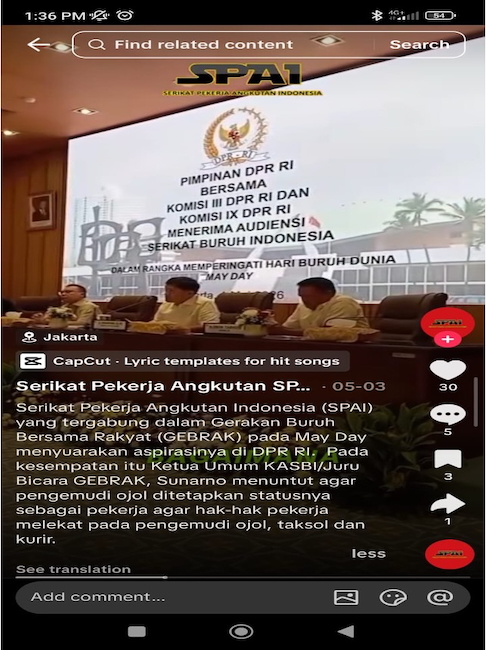
Ojol drivers’ organisations experience similar limits. The Indonesian Transport Workers Union (SPAI) has actively used the THR/BHR debates on TikTok to advocate for ojol drivers to be recognised as workers entitled to workers’ rights. In one post, SPAI highlights how BHR harms ojol drivers, because it is merely a voluntary appeal to platform companies, not a binding obligation. However, accounts like SPAI, which grow organically, remain relatively small, often with only a few hundred followers, as many ojol drivers remain outside union representation. They receive low engagement and have limited ability to counter dominant narratives.
For organisations like SPAI, online advocacy is not detached from offline mobilisation. In May 2025, for example, SPAI and other unions organised street protests demanding better working conditions and fulfilment of drivers’ rights. Posts of these street protests circulated on social media. Yet on TikTok, protest-related posts have received limited attention compared to celebratory narratives around BHR. Narratives depicting BHR as a successful programme are spread by accounts with larger followings, often reaching tens of thousands of users. These accounts are often associated with companies, government actors, political actors, or media affiliates. Because accounts with wider reach are more likely to generate interactions – likes, shares, and reposts – their narratives are further amplified, spurred by TikTok’s personalised algorithmic systems that prioritise content based on patterns of past engagement and predicted relevance. Thus, on TikTok, ojol’s grievances are not only fragmented across different audience clusters, but also rearticulated into narratives of policy success, individual effort, and institutional care.
Unruly digital practices and its limits
TikTok helps ojol drivers connect personal disappointment to wider collective issues. Occasionally, such grievances align with broader public anger, as seen in the August 2025 protests, when the death of an ojol driver intensified wider distrust toward political elites. Reaching a critical mass, ojol drivers’ posts of protest went viral at that time. This is what we call precarious workers’ digitally-mediated unruly practices: forms of resistance to domination that operate outside institutionalised democratic channels.
Yet, grievances voiced on TikTok do not automatically become consolidated political claims. TikTok enables ojol drivers to make visible their discontent with precarious work and life. But digital visibility is structured by unequal power, which fragments precarious workers’ grievances and enables their rearticulation by dominant institutions and actors.
The digital mediation of THR/BHR struggles among ojol drivers is imbued with contradictions. TikTok provides a space for precarious workers to narrate everyday injustice, connect with others and challenge dominant framings. Yet, as part of platform capitalism, where visibility itself can be monetised, TikTok structures visibility unevenly and enables more powerful actors to repackage grievances as evidence of policy success. Taken together, ojol drivers’ digitally-mediated unruly practices reveal a struggle over rights under conditions of denied legal status, algorithmically managed work and collective voice that is both unevenly amplified and algorithmically fragmented.
Anastasia Yuni Widyaningrum is assistant professor at Universitas Katolik Widya Mandala Surabaya; Fadhila Isniana is researcher at Lembaga Informasi Perburuhan Sedane; Diatyka Widya Permata Yasih is assistant professor at Universitas Indonesia. This article is part of the project ‘Precarious Labour and Authoritarian Resurgence: Potentials and Challenges of Working-Class Struggles in Indonesia and Thailand’, a collaboration between the Asia Research Centre, Universitas Indonesia (ARC UI), Lembaga Informasi Perburuhan Sedane (LIPS) and Just Economy and Labour Institute (JELI).