
Live-commerce work and youth precarity in Bandung
After working for seven months as a live-stream host for a bag brand in Bandung, Santi finally decided to quit. She was exhausted. And the pay she received for the work was far from ideal. She earned Rp 20,000 per hour (about AU$1.60), plus a Rp 2,000 bonus for every transaction. She worked six hours a day, divided into two three-hour sessions.
For Santi, one of the most physically and emotionally exhausting aspects of being a livestream host was having to keep talking about the products she was selling, even when nobody was watching. She was not allowed to stop because, she was told, a pause of more than a few seconds could be considered a violation of TikTok’s rules and potentially lead to penalties for the account. TikTok Shop’s official guidance on ‘non-interactive content’ encourages hosts to keep speaking even when briefly stepping away from a livestream. For breaks longer than two minutes, it recommends using the pause button, which allows hosts to pause for up to five minutes. Failure to follow these guidelines may be treated by TikTok as a violation.
Working as a live-stream hosts on platforms such as TikTok, selling a wide range of products, from fashion to skincare, is increasingly becoming popular for young Indonesians. Like Santi, many of them do not stay in the job for long. Heavy workloads, intense pressure, and inadequate pay are among the main reasons.
Amid limited job opportunities, many young people are actively developing strategies and turning to digital work, such as livestream hosting, while continuing to explore other employment opportunities. Even securing a job as a livestream host is not always easy. Santi shared that she had to submit more than 200 applications before finding a livestreaming job that suited her pay expectations and schedule. Her experience also challenges the perception promoted by some that young people are merely passive consumers of entertainment content on TikTok. They use various social media platforms, including TikTok and Instagram, to keep navigating economic uncertainty.
Income and working conditions
Amel, a fresh graduate from a university in Bandung, shared a similar experience. She had worked as a live-stream host for several skincare and fashion brands in the city. She described live-stream hosting as essentially being an online salesperson, working under particular targets and pressures.
The income of live-stream hosts often depends on the popularity of the brand they represent and the value of the transactions they generate. Amel knew a live-stream host working for a major fashion brand in Bandung who could earn more than ten million rupiah a month, including a basic salary and bonuses. The income was high because the host was often able to generate hundreds of millions of rupiah in sales during a single streaming session.
But cases like this are rare.
Amel herself once worked full-time as a live-stream host for a skincare brand, earning a basic salary of Rp3 million per month. Even this could be considered relatively good. At another company, full-time live-stream hosts were paid only Rp 1.2 million per month.
Like Santi, Amel said that working as a live-stream host was physically and emotionally exhausting. She had to speak continuously for three hours. If she needed to use the toilet, the live stream could be paused for only five minutes. In that short period, she had to rush to the toilet and return quickly, even though the toilet was not always close to the studio.
Apart from having to talk continuously, the job sometimes required her to remain standing, particularly when she was selling fashion products. For the entire three-hour session, she was also exposed to studio lights positioned close to her body, which could become uncomfortably hot.
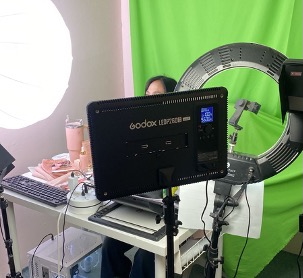
Appearing in front of the camera also meant that she could not show up casually. She had to dress and wear makeup according to the demands of the job. She was expected to maintain a professional appearance even when she was physically and emotionally exhausted, or even when she was in pain.
‘During one live session, my acid reflux flared up and it was painful. But I couldn’t stop talking, and I couldn’t show that I was in pain.’
Some live-stream operations run from morning until late at night, while others operate twenty-four hours a day. Companies usually divide the schedule into several shifts. Amel herself had worked the night shift, from 9pm until midnight.
This situation made her uneasy.
‘At night, the office area was very quiet. There were three of us, all women, working as live-stream hosts. The security guard was stationed near the warehouse, which was far from the studio.’
Despite working until midnight, Amel did not receive any additional allowance or overtime pay for working at night. The hourly rate remained the same. She once raised the issue with management, but nothing was done. Eventually, she decided to leave and look for another job.
Searching for decent work
Working as a live-stream host often becomes an alternative to navigate the increasingly competitive jobs market. Adi, for example, explained how he eventually ended up working in the live-streaming business despite the very limited income it offered.
Three years after graduating from university, Adi still had not found the kind of job he wanted. He had always hoped to work in human resources or general administration. He had sent out dozens of applications, but none had been successful.
‘I keep updating my CV every month. Sometimes even every week. At one point, I was desperate.’
While waiting for the job he wanted, Adi took whatever work he could find. He worked as a freelance teacher at a school, helped a friend with a digital printing business, and eventually found a job at a small clothing business that sold its products online.
But working for an online shop meant that he was expected to ‘do everything.’ His official responsibilities included managing the warehouse, supervising the live-stream hosts, and being the live stream host.
He worked from Monday to Saturday, twelve hours a day, earning only Rp 1.5 million per month (AU$119). This was less than half of Bandung’s minimum wage of Rp 4.7 million (AU$375). Adi’s workplace itself was a relatively small fashion business. On an average day, the shop recorded only around twenty to thirty transactions.
As someone with a bachelor’s degree, he found the low pay difficult to accept. But, as he put it, ‘In this economy, we have no choice. As long as it is halal, I will just do it.’ To make ends meet, he also started a small wedding planning business with his friends. He works at an online shop from Monday to Saturday and spends his weekends organising weddings at various locations.
Young people like Adi, Amel, and Santi are part of a well-educated, hard worker, and media-savvy generation. They understand how digital platforms operate and have the skills to work with them. They do not fit the stereotype of the ‘strawberry generation’; young people supposedly lacking resilience and being overly selective about jobs. The problem lies less in this generation’s mentality than in the messy and uneven realities of the digital economy and the broader economy. Digital platforms may have expanded the range of work available to young people, but they have also created forms of employment in which flexibility and accessibility coexist with low wages, insecurity, and demanding working conditions.
Three months after our first interview, I met with Amel again, although this time it was an online meeting. She was happy to share that she had just secured a job as a content planner at a social media agency in Bandung. Her new position offered better pay and better working conditions.
Amel has come a long way to reach her current position. She began working early in her university years, modelling for brands selling their products online. She then worked as a livestream host for several fashion and beauty brands before eventually moving into her current role.
Career paths in the digital economy are often far from straightforward. These young people have to navigate a succession of jobs before finding decent work.
Acep Muslim (acepmuslim@gmail.com) is a PhD researcher in the School of Media and Communication at RMIT University. His research examines digital cultural production in West Java.