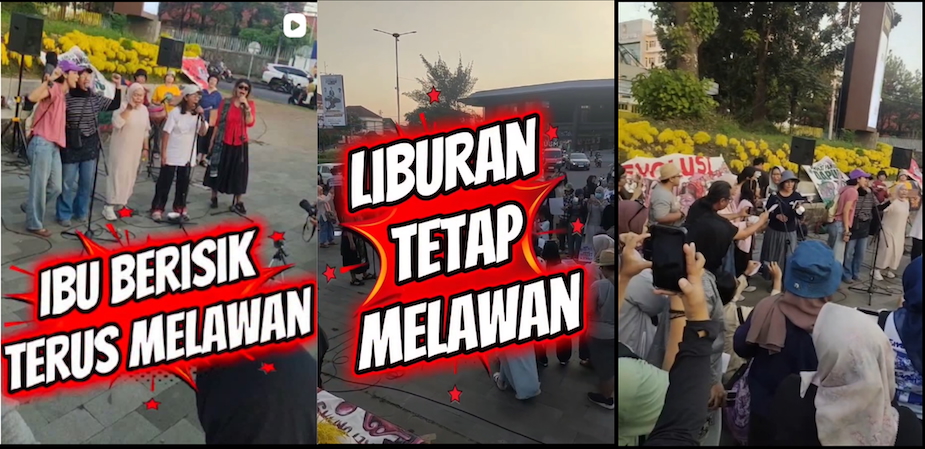
The digital content of the Ibu Berisik (noisy mothers) collective is embedded in daily life
Baca version Bh Indonesia
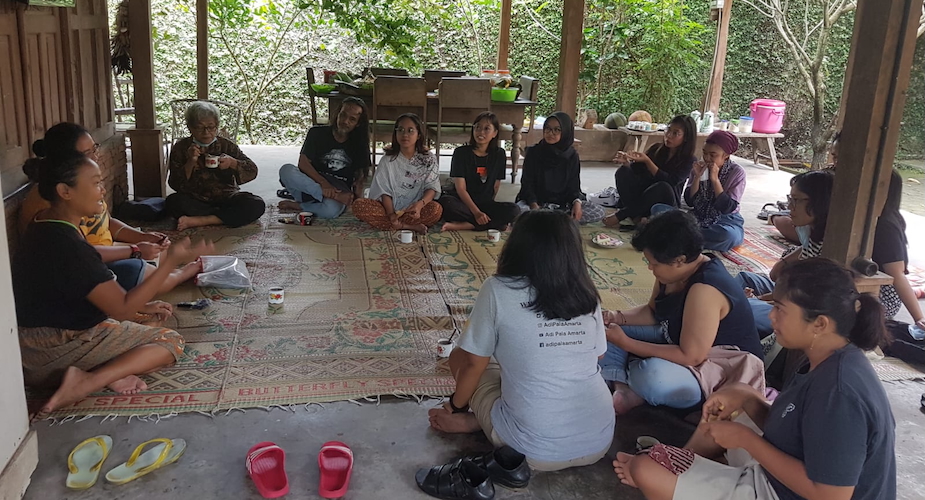
During the month of Ramadan – a week before the 2025 Eid al-Fitr holiday – a group of women in Yogyakarta staged a demonstration to oppose the revision of the Indonesian Armed Forces (Tentara Nasional Indonesia, TNI) Law, which was being fast-tracked at the time. As one of the organisers, I (the first author) managed the flow of the event, including coordinating the women who would deliver short speeches (orasi). A fellow organiser suggested that I give a speaking slot to one of the women, who I later learned was a member of a collective called Ibu Berisik (IBBRX) or ‘Noisy Mothers’. She wore a large sign on her chest that read ‘Parenting is political’. I found out that the IBBRX collective produce content on Instagram under the handle @Ibu.berisik. Their bio includes the invitation: ‘Let’s make some noise together, moms!’, with the hashtags #IbuBerisik, #ParentingItuPolitik and #BerisikMinority (noisy minority).
Since its inception in February 2025, the IBBRX collective has actively used Instagram to voice its members’ concerns and spread awareness on contentious issues. Their online ‘noise’ spreads rapidly, resonating with ‘mothers’ across the country and compelling them to also share their concerns. For the women of IBBRX, however, producing digital content is not about political expression alone. Their digital content and interactions are deeply embedded in their daily life.
From street snacks to Instagram
Gernata, one of the founders of IBBRX, explained to me that the collective focuses on ‘educational content’ via Instagram. The decision to launch the Instagram account stemmed from the widespread ‘Indonesia Gelap’ (Dark Indonesia) protests that took place across the country in February 2025. A group of long-time friends joined the student demonstrations in Yogyakarta; they were deeply concerned about the state of the nation but felt unsure of what concrete action they could take.
Wanting to contribute in some way, they pooled their money to buy traditional street snacks to distribute for free to fellow protesters, many of whom likely had not had a chance to eat before the demonstration. One of the members of IBBRX shared with me the sense of awkwardness they experienced during the protest. ‘When we offered traditional snacks, no one wanted to take any. Some protesters even asked, how much are these, ma’am?’ They assumed these women were food vendors, not participants who had joined the protest out of genuine concern.
Following that event – and recognising that they could not always join street protests amidst their busy lives, taking care of the family while some run small businesses too – the group of women decided to become part of a movement critical of the regime by producing educational content on Instagram. They chose Instagram because all of them were already active on this social media platform. Thus, emerging as an organic extension of their existing digital engagements, IBBRX came to be centred on their roles as parents.
Everyday banter on serious issues
The first post from IBBRX appeared in late February 2025, garnering 45 likes, 10 comments, and 24 reposts. It featured a picture of a refrigerator’s contents, with an overlaying pink sticker: ‘Hello, middle-class Ibu-Ibu who are worried and anxious. Is your kitchen still in an acceptable state (aman)? Is your gas still secure?’ By the time of writing this article (September 2026), the account had reached 39,800 followers and produced more than 400 posts. Widya, another initiator of IBBRX, explains that much of the content revolves around the daily grievances of mothers, linking them to poor state policies. Their posts frequently address the rising price of rice and other basic commodities and the hardships this caused for mothers.
In addition, the women do not shy away from addressing broader societal issues. For instance, IBBRX shared a post on the importance of raising boys not to become perpetrators of sexual violence, thus shifting the focus away from merely telling girls to dress modestly. This particular post received 197,000 likes; it was created in the context of a sexual harassment case involving a law student at the University of Indonesia. Other posts condemn repression of government critics.

The content often takes the form of ‘gojek kere’: self-deprecating, humorous banter among friends, and usually among those struggling financially. Literally, ‘gojek’ (a Javanese word) refers to joking with or poking fun at each other among friends, while ‘kere’ means poor; hence, it means making fun among friends about their own hardships. This form is combined with ‘sambat’, which is essentially sharing complaints, including grievances and anger towards the state, also among friend. Through these everyday forms of banter and complaints, IBBRX’s content resonates deeply with its followers. The experiences, the sambat shared by the IBBRX team are felt and then echoed by mothers all across Indonesia.
Between digital and everyday life
For IBBRX, the digital space is not primarily about driving traffic, gaining followers, or generating revenue; rather, it serves as a platform for the initiators’ political activism, rooted entirely in voluntary participation. Consistency in posting is also not a primary objective, as content production follows the rhythm of the mothers’ daily lives. When members have just given birth, are caring for a sick child, are busy tending to a small shop, or are overwhelmed with orders for Lebaran (Eid) cookies, the act of posting ‘sambatan’ or grievances must be put on hold. Once the daily chaos subsides, the ‘sambatan’ can resume.
While the digital content produced by IBBRX frequently addresses government policies, their posts remain deeply intertwined with daily life. Consequently, the team members – as citizens who are themselves frustrated with the regime – experience an iterative process between content creation and their own personal emotions. For instance, in a post titled ‘A Letter to Sri Mulyani’ (the then-Minister of Finance), one slide featured an illustration of mothers repeatedly pawning their wedding rings just to survive. The post garnered 59,000 likes and drew a flood of comments and direct messages.
The team members shared with me that reading these comments and messages left them feeling both saddened and angry. These reactions became a major topic of discussion within their private Signal group. The conversation expanded to encompass the sense of insecurity they were personally experiencing and grappling with.
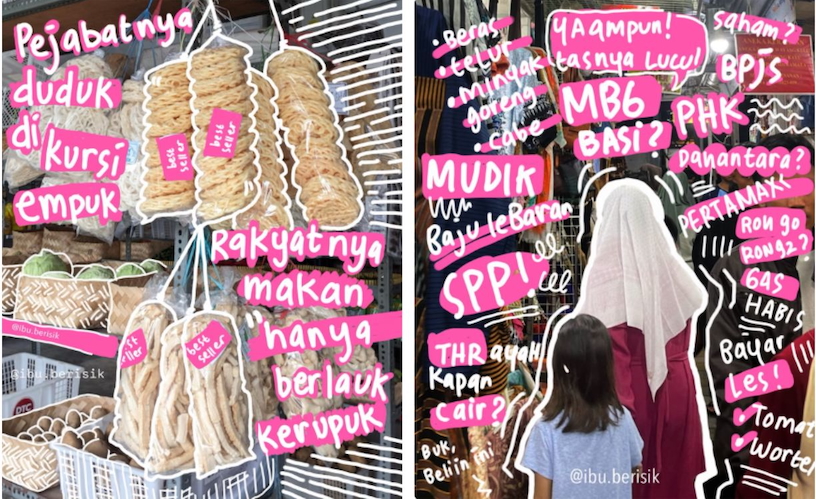
This illustrates how digital space is experienced, practiced and embodied within everyday life. When I requested input for this article from the IBBRX team via a WhatsApp voice note, one member’s reply included the sound of a baby in the background; the recording had to be paused and only continued once the situation with the baby was resolved.
There is a common assumption that digital content becomes autonomous once posted, effectively ‘detaching’ itself from its creator. It is often believed that the tastes of followers alone determine the fate of a piece of content, whether it gains popularity or sparks a flurry of comments. However, the experiences of the IBBRX team reveal a different pattern: the content they design and post does not truly exist independently of its creators. Instead, it creates a feedback loop that directly impacts the team.
The members of IBBRX often feel the weight of the stress shared by their followers, who frequently open up about the economic hardships they face. This occurs because the digital content produced by IBBRX is an extension of their participation as citizens and as mothers – lives fundamentally shaped by political policy. This illustrates that digital life is deeply embedded in the everyday existence of content creators, resulting in processes that are often non-standard or irregular. This is what it means for digital life to be intrinsically woven into the fabric of daily life.
Amalinda Savirani (savirani@ugm.ac.id) is a Professor of Human Society, Urban Politics and Political Science at the Gadjah Mada University in Yogyakarta. IBBRX (Ibu Berisik) can be followed on Instagram: @ibu.berisik.