Feminist Instagram accounts help transform women’s anxiety into action
Baca versi Bh Indonesia
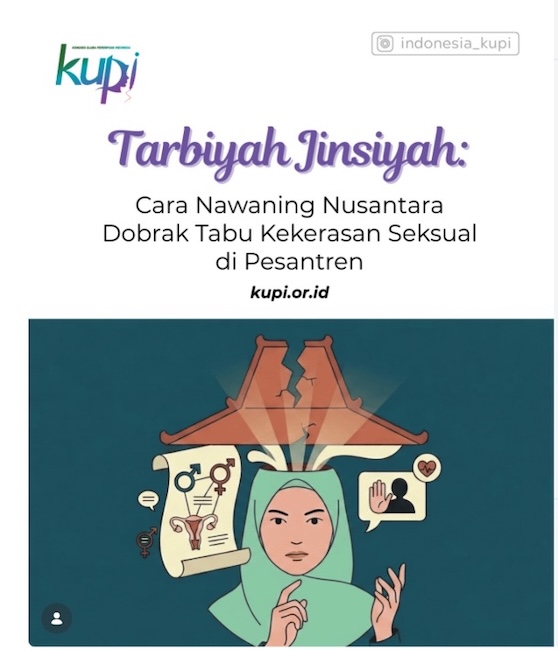
Desi is a school counsellor and a devout Muslim woman from Papua. She is also an avid follower of Indonesian feminist Instagram accounts that discuss gender equality and Islamic interpretations of women’s rights. ‘I had always thought that many feminist issues conflicted with religious teachings,’ she told me. ‘However, through @KUPI’ – one of the accounts she follows, from the Indonesian Congress of Women Ulama – ‘I discovered that Islam has actually carried a mission of equality all along.’ She adjusted her posture, her voice rising with quiet conviction: ‘That realisation helped me see that what I had been experiencing all this time was, in fact, inequality.’
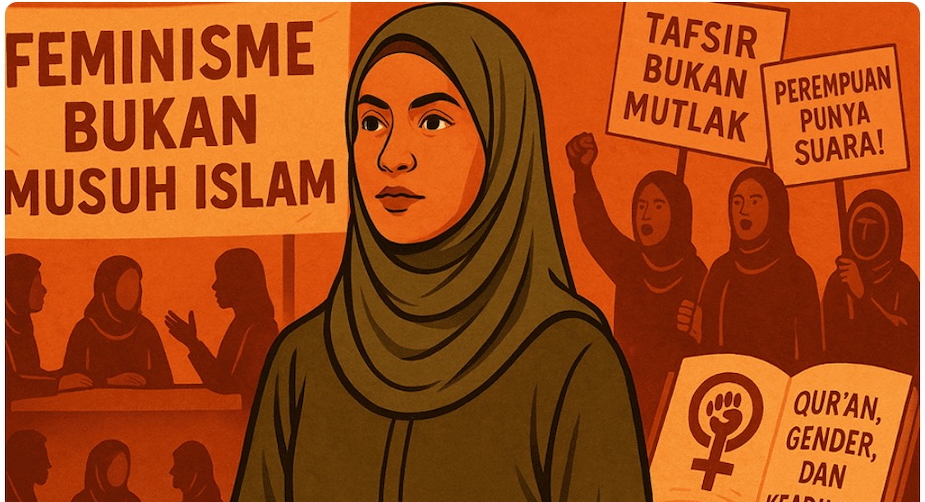
In modern Indonesia, the word feminism may no longer carry the heavy stigma it once did – at least not on Instagram. Over the past decade, dozens of feminist accounts have gathered tens of thousands of followers, offering a new entryway into conversations about gender. While some of these digital spaces proudly fly the feminist flag in their bios, many more choose to tread a subtler path, weaving progressive ideas into everyday posts or religious teachings without ever using the word itself.
Among their most active followers are the twenty-four women in their late twenties and early thirties I interviewed. Unlike older generations, who had to hunt for rare feminist texts in specialised bookstores because schools and mass media kept those ideas out of the mainstream, these young women enjoy the effortless, daily exposure to radical ideas on gender equity right on their phone screens. Yet, despite these modern tools, what connects Desi and her peers to the women who came before them is a shared cultural shadow. Both generations grew up under the enduring legacy of what Julia Suryakusuma calls ‘State Ibuism’. The state dictates that a woman’s primary purpose is to serve her husband, nurture her children, and anchor the domestic sphere above all else.
The fall of Suharto’s regime in 1998 and the dawn of Reformasi did not magically erase this deep-seated dogma. Growing up in rural towns and traditional households, to many of these women , ‘feminism’ initially sounded like an alien, Western concept. Few had ever heard that housework could be shared equally or that a woman’s worth existed independently of her marital status. Yet, they developed an intuitive, gut-level sense that the objectification, silence and domestic burdens placed upon them were wrong. When social media brought them into contact with Muslim feminist thinkers, they found a name for their unspoken disquiet. These digital spaces transformed quiet, isolated women into bold feminist micropoliticians in their own right.
From anxiety to awakening
The young women I interviewed are among the growing number of Indonesian women who have completed higher education. But while female bachelor’s degree holders outnumber men in certain cities, they still constitute a minority nationwide. They repeatedly pointed to a shared feeling of ‘kegelisahan’, an inner anxiety and systemic uneasiness when asked what drew them to feminist discourse online. This feeling stemmed from having to navigate social and religious norms they no longer identify with, which frame marriage and motherhood as a woman’s true destiny, casting education as a secondary pursuit.
Ulfa, who was raised in a devout Muslim family, recounted her disquiet when an examiner for her undergraduate thesis openly promoted pro-polygamy views during her defence. She highlighted the broader ideological pressure facing young Indonesian women: ‘There is something deeply unsettling about how polygamy is framed, like how anti-dating discourses insist that early marriage or polygamy is preferable to committing adultery.’ By the time Ulfa learned about Islamic feminism through Instagram she attained recognition and emotional peace.
Nina, a young woman from Java, felt ‘finally seen and heard’ when encountering feminist content online. Years earlier, back in school, she was harassed by a classmate who happened to be the headmaster’s son. When she mustered the courage to tell a female teacher, the response was a shrug, ‘It’s just normal boy behaviour, you need to get over it.’ Deep down, she knew her teacher was wrong. It was not until she stumbled into digital feminist circles years later that the missing pieces clicked. She found a name for what happened: sexual harassment; and the invisible force: ‘patriarchy’.
These accounts helped them realise that the heavy, uncomfortable experiences they had been carrying alone were not private failings. For many, scrolling through these pages felt genuinely therapeutic.
Moreover, engagement with feminism can encourage women to actively challenge gender norms and invert the stigma. Jacinta, a content creator in her late twenties, proudly identifies as a ‘rebel.’ She pursues higher education, remains unmarried and routinely highlights gender issues on her Instagram. Jacinta’s persistence gradually transformed their family expectations. ‘My mother used to pray for me to find a devout husband, believing every household should mirror her own life of submission to my father,’ Jacinta shared. Over time and through countless conversations, Jacinta’s mother came to realise that wives don’t all have to follow her model of obedience. She now understands that times have changed. ‘And the way she served my father isn’t the only way to live today.’
Similarly, Intan – a young politician in Padang – a city known for its matrilineal yet socially conservative Minangkabau traditions – turns her feminist agency into a carefully curated public persona on Instagram. She regularly posts photos of her career achievements alongside activities traditionally coded as masculine, like riding a heavy motorcycle. This digital branding filters out patriarchal suitors before they ever reach Intan’s inbox. ‘Many men still think women should stay at home, I don’t want to waste time explaining the fundamentals of feminism to someone.’ By showcasing her achievements, she added, ‘a man who does not align with my values will automatically feel that I’m not the right match for him.’
Nevertheless, by embracing feminism, these young women may appear ‘less Muslim’ to their surroundings, and hence risk social ostracisation. In a culture that emphasises female modesty and compliance, claiming a feminist identity invites the dangerous label of being a ‘disobedient Muslimah’ (perempuan durhaka) or a rebellious daughter. Alya recounts: ‘Once someone is known to be a feminist, people believe you are inherently defiant toward your husband or your father.’ The risk of stigmatisation is not something these women take lightly. Yet, they manage this threat through a bold, transformative move: reclaiming and renewing their own religious understanding.
Synthesising Islam and feminism
One prominent Islamic account that frequently promotes gender equality is @mubadalah, an extension of the online magazine Mubadalah.id, established by Fahmina Institute. One of the institute’s co-founders, Kyai Fakihuddin Abdul Kodir, pioneered the concept of ‘mubadalah’, which emphasises reciprocity (kesalingan) between men and women.
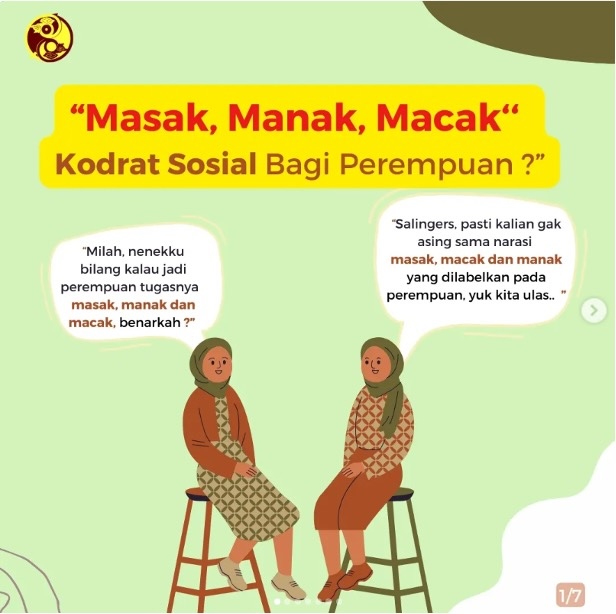
@mubadalah regularly challenges the common belief that women’s and men’s roles are dictated by ‘kodrat’ – a term often misconstrued in Indonesian society as biologically predetermined and unchangeable gender mandates. The account reframes gender relations, asserting that domestic and social responsibilities are not biologically fixed but negotiable and reciprocal duties shared by both sexes.
Halimah, a pesantren (Islamic boarding school) heiress and businesswoman from East Java, articulated this synthesis clearly: ‘What Muslim feminists and Islamic teachings are fighting for is essentially the same: equality (kesetaraan), not identical sameness (kesamaan) between men and women. What we advocate today is the exact same cause that both Prophet Muhammad and Kartini’ – the Javanese heroine who championed women’s rights during Dutch colonial rule – ‘advocated in their own times.’
Alya refers to posts by @mubadalah and @KUPI as a ‘breath of fresh air’, because they render her feminine anxieties intelligible. Raised in a conservative religious family in a Javanese village, Alya attended a pesantren, where she encountered several ustadz (male teachers) whose sermons demeaned women. One sermon insisted that even if a wife is ill, she must still fulfil her husband’s sexual desires. These words stayed with her. ‘I could not understand why women in Islam were positioned in such a low and disadvantageous way.’ She also noticed that women were always placed second in the pesantren’s leadership structure. ‘Women could become administrators, but they were always subordinate to men.’
After discovering @mubādalah and @KUPI, Alya realised that ‘Islam does not position women as inferior or secondary. Islam does not place women that low.’ These platforms offered her the clarity she needed. While she retained her faith in Islam, she could no longer accept the patriarchal interpretations promoted by some ‘inauthentic, twisted Islamic believers and preachers’, she said.
For Desi, this critical shift was a revelation. ‘For me, religion is an exegesis,’ she explained, highlighting that human interpretation is never beyond question. Criticising an Islamic text, she said, ‘does not mean criticising the Qur’an or the sacred verses themselves, but criticising how humans have interpreted them.’ Rather than pulling her away from her faith, stepping into feminist thought deepened her spiritual autonomy. ‘Because I became a feminist while remaining a Muslim, I finally gained critical power.’
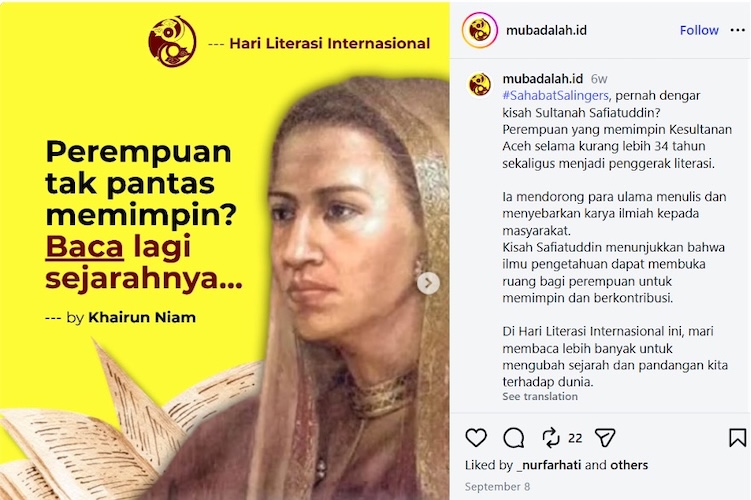
Moving seamlessly from digital feeds and scholarly texts into the intimate realm of real-world courtship and marriage, mubadalah also becomes a blueprint for daily household balance and a non-negotiable standard for choosing a life partner. Alya shared how she and her husband explicitly agreed on mubadalah prior to their marriage as a framework to divide domestic labour. Carli, a teacher in Central Java, shows me a widely shared post from a popular Islamic da’wa account, titled ‘Tutorial to Find a Spouse.’ The post cites traditional hadith detailing the four reasons a woman is sought for marriage: her wealth, her lineage, her beauty, and her piety. In conservative discourse, this text is used to instruct men on how to evaluate prospective wives, reducing women to objects of male selection. But Carli uses the logic of mubadalah to flip the script. ‘If a man is entitled to seek specific qualities in a wife, a Muslim woman has the equal spiritual and social right to apply those same standards to a prospective husband.’
Sunnah and safe feminism
While stepping into the role of a ‘feminist Muslimah’ might feel empowering in private life, the online world remains a paradoxical and perilous arena. Feminist accounts intend their posts to go viral, reaching as many women as possible to spark real awareness. However, high visibility invites anti-feminist backlash and occasionally intense hostility, ranging from coordinated comment section harassment to damning accusations of heresy and moral decay. To navigate this tightrope, creators rely on a strategy of ‘sunnah and safe feminism’ – a pragmatic method that transforms digital activism into both a spiritual duty and an exercise in personal safety.
Halimah began producing online content tailored to her community and students at the pesantren, using materials they already engage with. When a high-profile celebrity infidelity scandal dominated national headlines, she capitalised on the trend to educate her audience, posting a video dissecting the scandal through a gender lens. The video went viral, generating widespread engagement across feeds that would otherwise ignore feminist critique. For Halimah, turning Instagram into a public classroom is a spiritual commitment. In Islam, she explained, actions are categorised wajib (obligatory), sunnah (recommended), or makruh (discouraged). ‘Posting random photos with plain captions feels like makruh, a missed opportunity to do good. But if the content carries real educational value and helps people, it becomes sunnah. It adds genuine spiritual merit.’
Bella, a housewife-turned-influencer from East Java with thousands of followers across Instagram and TikTok, relies on mubadalah as an ideological shield. ‘In my content, I always try to highlight the importance of fighting patriarchy above all else,’ Bella shared, ‘more than, say, identifying as a feminist or pushing feminist labels,’ acknowledging that the word ‘feminist’ can still provoke negative reactions. ‘But so many women have gone through these exact same patriarchal experiences, which makes focusing on those shared struggles far more relatable and deeply resonant for them.’
For Halimah and Bella, adopting concepts like mubadalah over explicit ‘feminism’ is more than a tactical retreat. It allows them to challenge entrenched patriarchal norms while remaining firmly anchored within Islamic tradition – all while anticipating and deflecting backlash.
Engaging with mubadalah and digital feminism on Instagram is more than a personal panacea for gendered anxieties. It transforms young women into a new generation of Muslim feminist micropoliticians. Through every post, curated bio, and intentional comment, gender equality evolves from an isolated struggle into a vibrant, connective concern. Yet, as empowering as these digital spaces have become, the ultimate test lies ahead. We can only hope that this ‘safe and sunnah’ feminism will extend beyond individual coping mechanisms and private domestic negotiations.
Gilang Desti Parahita is Assistant Professor at the Department of Communication Science, Universitas Gadjah Mada. Her research interests span media sociology, journalism, and digital culture, with a particular focus on gender, feminist communication and the politics of digital media.