
For the generation of Indonesian language and studies educators who, like myself, began their teaching careers in the 1960s and 70s, this lively collection of informative essays and personal reflections tells a truly remarkable story. In the decades leading up to the early 1990s, the idea that students at Australian universities might have access to a formal program of study at an Indonesian university or institute as part of their Australian degree programs belonged in the realm of ‘impossible dreams’. It was an ideal that seemed so far out of reach that it was hardly worth thinking about, let alone devoting time, resources and personal careers to.
For decades, students of Indonesian language and studies in Australia had been travelling to Indonesia during their summer vacations, developing their language skills, learning about Indonesia through personal experience, and forming sometimes life-changing friendships and connections with Indonesian people. Only very rarely did these students have access to realistic options for formal study in Indonesia itself.
The intensive program of Indonesian language and culture courses (PIBBI) at Salatiga’s Universitas Kristen Satya Wacana (UKSW), pioneered and nurtured over many years by the legendary George Quinn, gave hundreds – if not thousands – of students and teachers the opportunity for intensive in-country study of Indonesia during the Australian summer. A small number of students studied for longer periods of in-country study at Indonesian higher education institutes under the Indonesian government’s Darmasiswa program, which provided modest financial support and, more importantly, a pathway through the bureaucratic challenges of securing a student visa and enrolment at an Indonesian university or institute. Some Australian universities set up study options for their own students with partner institutions in Indonesia, while others devised more informal ways of exposing their students to firsthand experience of ‘the real’ Indonesia. But the complex challenges posed by immigration regulations and educational bureaucracies in Indonesia, and the accreditation and funding of degree programs in Australia, seemed destined to entrench in-country studies as a piecemeal and restricted part of Indonesian studies at most Australian universities.
In 1994, a far-sighted initiative by David Hill of Murdoch University began a years-long effort that led to a complete transformation of these limited options. Drawing on the collegiate nature of the Australian Indonesian studies community, but underpinned by their own high level diplomatic skills, their capacity for hard work and their unflagging commitment, Hill and his colleagues – both Australian and Indonesian – achieved what had always been the impossible ideal, a structure that made in-country study a realistic option for all undergraduate students of Indonesian studies at Australian universities.
The steps towards the realisation of this ideal, its current operations and its prospects for the future, are explored in detail in this collection, a comprehensive survey of the 30-year history of Acicis (the Australian Consortium for In-Country Indonesian Studies). It is a story of hard-won success, a list of achievements that, in the words of Liam Prince, the consortium’s current director, ‘has seeded a critical mass of Indonesia-literate Australians into almost every domain of Australian public life.’ As it enters its fourth decade, Acicis’s nearly 5,000 alumni are now spread ‘across government, academia, media and the private sector.’ Some have even taken over the reins of Acicis itself, as the consortium’s first generation is succeeded by a second generation of administrators and care providers who demonstrate the same commitment to ensuring the quality and sustainability of Acicis’s programs as their predecessors.
All in all, it is hard to avoid the impression that in both its original conception and its present-day operations, Acicis illustrates the very best of the Australia-Indonesia relationship, a history of people-to-people contact and interaction that has its roots in the days of Australian support for the Indonesian national revolution.
The ‘people-to-people’ dimension of Australia-Indonesia relations emerges in the preoccupation with non-classroom learning that has always been at the core of Acicis’s operations. In their contribution to the collection, Jacqui Baker and Annie Pohlman point out that a ‘deeply ethnographic, people-focused, learning-by-doing understanding of fieldwork’ was ‘an integral part of the Acicis design from the beginning.’ In the early years of the consortium’s operations, students commonly began their in-country program with a semester of intensive language study at Universitas Gajah Mada (UGM) in Yogyakarta, before moving on to a semester of field study at Universitas Muhammadiyah Malang (UMM) in East Java. Here, the consortium’s foundational in-country director, Paul Stange of Murdoch University, oversaw individual fieldwork projects that were designed to immerse Acicis students in Indonesian society and culture. The effect of these projects was often transformative. As an Indonesian studies educator back in Australia, I still vividly remember the striking level of understanding and personal commitment that many Acicis alumni of this time brought to their studies and future careers on their return home. Their fascination with all things Indonesian was now underpinned by experience-based knowledge and empathetic understanding of the Indonesian ‘other’.
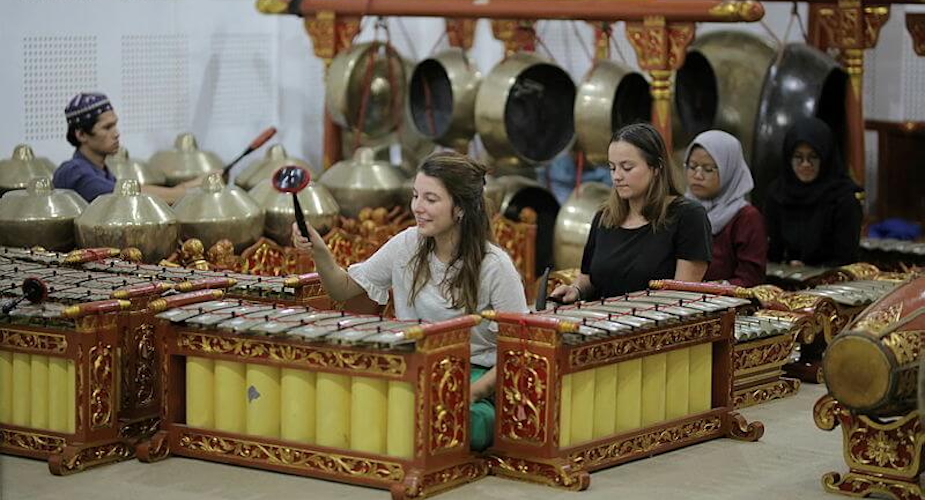
In more recent times, this original Acicis model has undergone significant change. Baker and Pohlman note that in the period between 2017 and 2022 only three students undertook the Malang program, and while intensive fieldwork opportunities are still offered through the West Java Field Study program, most of these options are undertaken in English, reducing the immersive aspect of the earlier Acicis experience. However, people-to-people connections are still embedded in Acicis’s programs. Beginning with the Journalism Professional Practicum in 2002, as Angela Romano recounts in her contribution, university-based training and professional internships in areas as diverse as public health and agriculture, sustainable tourism, law and human rights, and creative arts now offer Acicis students the opportunity to establish one-on-one relationships with their Indonesian counterparts in a wide variety of professional fields.
At the organisational level, the partnership ideal inherent in the people-to-people ethos emerges in the growing participation of Indonesian institutions in the consortium, not as passive recipients of Acicis students, but active and equal initiators of the design, implementation and goals of Acicis programs and study options. As Phillip King describes in his account of in-country developments during Acicis’s second decade, this process was facilitated by the deregulation and internationalisation of the university sector in early twenty-first century Indonesia. Active Indonesian participation in Acicis soon acquired its own momentum, and was evident at the personal, as well as institutional level.
The many ‘personal reflections’ by Indonesian members of Acicis’s in-country staff, and especially Aldo Nugroho’s touching account of his experience and aspirations as an Acicis ‘buddy’, pepper this collection with a sense of Indonesian ‘ownership’ of Acicis and investment in its continued success. At the institutional level, Adrian Budiman’s reflection on his experience as Acicis’s first Indonesian Resident Director again places the personal dimension at the core of Acicis’s mission. Budiman’s own experience teaches him, he says, ‘that the best way to genuinely engage with and understand a country is through personal, lived experience.’
On the Australian side, Acicis’s later development and current operations have benefited greatly from the launch of the federal government’s New Colombo Plan (NCP) by then-Foreign Minister Julie Bishop in 2014. Many contributors point to the centrality of the NCP as both a funding mechanism and an official endorsement of importance of in-country study at a time of increasing stringency and corporatisation in the Australian tertiary education sector. Interestingly, however, Elena Williams’s survey of the attitudes and opinions of Acicis alumni and their Indonesian hosts, a fitting conclusion to the collection, shows that the NCP’s emphasis on creating ‘young ambassadors’ for Australia in the Indo-Pacific undergoes a significant shift in the Acicis setting. In her research, Williams found that ‘many students and hosts […] did not identify with this language of “ambassadorship” or “public diplomacy”.’ Rather, for these Indonesians and Australians, the important thing was not ‘diplomacy’ but the ‘small acts’ involved in just ‘being themselves’, building personal relationships and friendships and sharing experiences and stories, the people-to-people contacts that have sustained the official Australia-Indonesia relationship since its very beginning.
Experiencing Indonesia is one of those rare collections that is likely to maintain readers’ interest and enjoyment from beginning to end. It is also well sign-posted so that those looking to ‘read around’ in it will have no trouble tracking down the parts of the story of particular relevance to their own interests and experience. Either way, it is not to be missed. It is published by ANU Press, and the good news is that it can be downloaded without charge (see the link below).
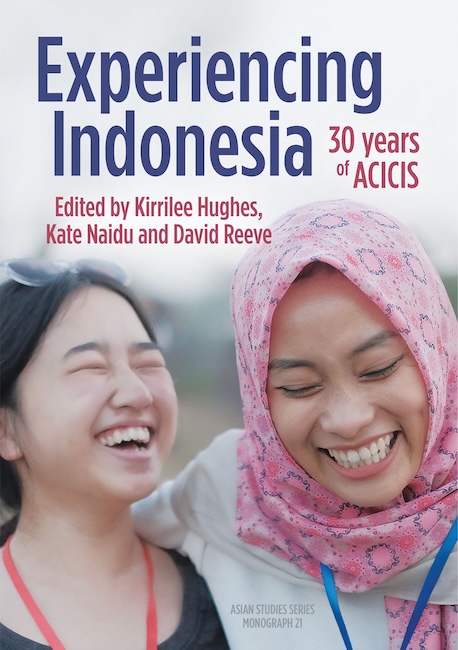
Experiencing Indonesia: Thirty Years of Acicis. Kirrilee Hughes, Kate Naidu and David Reeve (eds), ANU Press, Asian Studies Series Monograph 21, 2026.
Keith Foulcher (foulcher@bigpond.net.au) taught Indonesian language and studies at Monash University, Flinders University and the University of Sydney.