Accommodation booking platforms are joining hands with government in an effort to rein in the sector
Bali is a dream holiday destination for many of us. For a growing number of visitors, it's a line item in an investments and global arbitrage lifestyle that location-independent workers have turned into an aesthetic. The island had more than sixteen million domestic & foreign visitors in 2025. Foreign arrivals rose over ten percent. By every headline measure, Bali’s tourism economy is booming. What is hidden behind the headline however is that hotel occupancy fell eight per cent over the same period and tax revenues missed their targets. As a foreigner who has lived in Bali for the past three years and has observed the tourism and real estate industries closely, the reasons for this are clear.
The same platforms that enable frictionless travel are simultaneously facilitating economic activity away from regulated structures, often into the hands of foreign owners. They extract value from destinations without being accountable to them. An estimated 84,000 properties are listed across booking platforms in Bali. A 2025 audit revealed just 12,227 registered accommodation units. The vast majority of accommodation is informally run and as such, the owners are not paying taxes.
The wild west
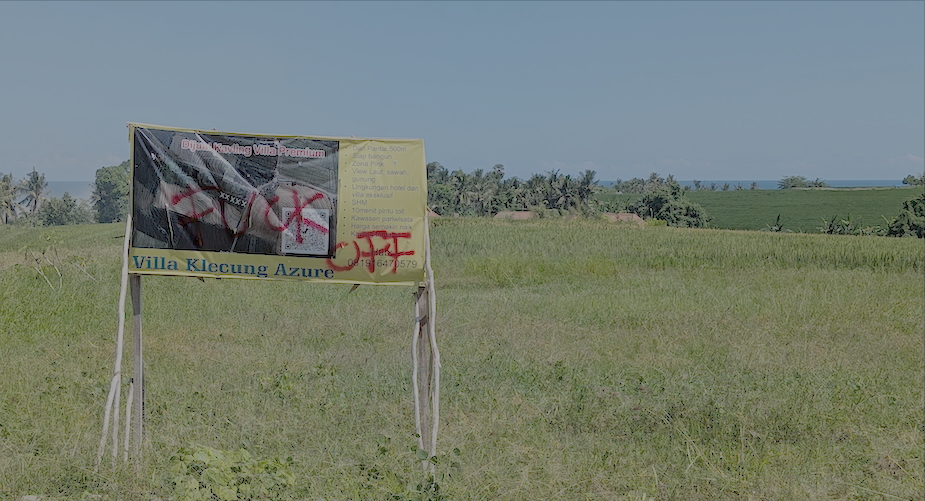
This didn't happen by accident. Building an unlicensed villa in Bali has, for years, been a perfectly rational thing to do. You can't drive down the road in a busy part of the island without seeing a sign promising a Return on Investment (ROI).
Resident foreigners snap up long leases, either to run as full-time Airbnbs or for the part of the year they are abroad. Most should be operating through a Foreign-Owned Limited Liability Company (PT PMA, Perseroan Terbatas Penanaman Modal Asing), which is the only legal way for non-citizens to rent out property. Plenty simply don't bother. Of those that do, many lack the correct licences, or use a Balinese friend or partner as the registered face of a company they control. If that does not work out, they can always sell to the next wave of arrivals chasing their version of the Bali dream.
The common complaint that locals are ‘selling’ their land to foreigners shows a lack of understanding of the regulatory and social context. In Indonesia foreigners cannot own freehold land. The two ways around this are: (1) a fixed-period leasehold — effectively long-term renting — or (2) purchase through a PT PMA, the foreign-owned company structure, which you can either own outright or access via a nominee. Setting up a PT PMA carries a Rp.10 billion minimum investment requirement. Consequently most investors avoid this overhead and complexity by leasing instead. If you could make more money than anyone in your family has ever seen by leasing a parcel of land that will return to you in 20 or 30 years, would you refuse?
The lure of Bali
It is also important to understand exactly who is buying property in Bali. Bali's ‘foreign’ population is not monolithic. It includes wealthy Jakartans, for example, who purchase holiday homes they may visit occasionally each year. Russians, many of whom have arrived since their country launched its full-scale war on Ukraine in 2022, have been building lives and raising families in Bali. Western crypto investors arrive on tourist visas — typically the B211A, valid for 60 days and extendable twice — conducting business they are not legally permitted to conduct, and rotating between visa runs every 60 days. Each group has its own relationship with the rules.
Indonesians from other islands are also moving to Bali, but for entirely different reasons. I chatted with a young Gojek driver who told me how full-time work as a barista in his home city of Malang in Java, earns him the same in a month as he can make in a week in Bali. Whilst some Balinese are being priced out of their neighbourhoods, other Indonesians are being drawn in.
The government is blamed for the lack of transparency and oversight of the sector, and this is fair up to a point. Rules change constantly and grey areas are abundant. It's genuinely hard to do everything completely by the book, which creates a Catch-22: if full compliance is nearly impossible, everything becomes a question of whom you've paid off. For example, locals living near a development consisting of 58 flats on 20 hectares were in an uproar over the project. Disgruntled locals (both Balinese and long term foreign residents) complained to each other, but there was no organised opposition.
False gods
What this produces is a particular kind of property boom. Inventory is produced quickly, cheaply, and is deteriorating just as rapidly. The model is simple. Build your villa as cheaply as possible, but with enough zeitgeisty touches that it looks appealing in photos. Sell it. Move to the next rice field. The following year, villa one is falling apart in the tropical weather, but you don't care because you've just banked a cheque for villa two and broken ground on villa three.
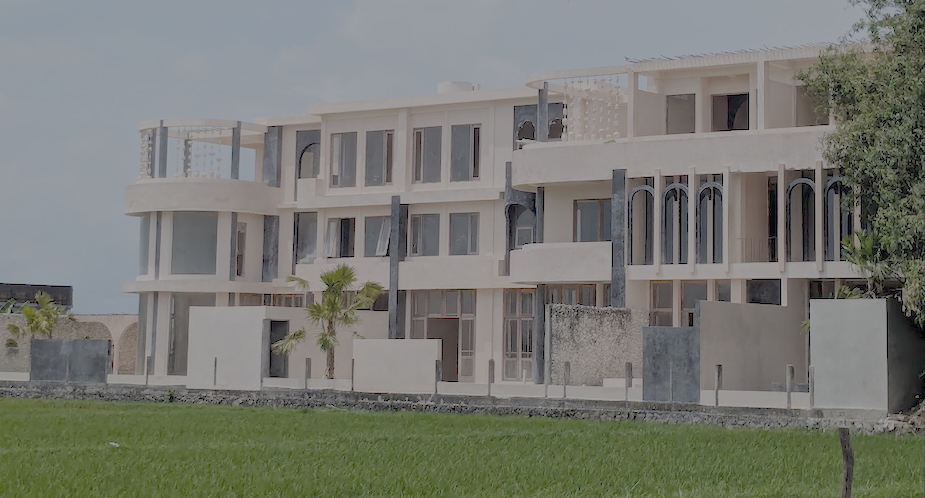
A huge number of post-COVID ‘build your life in Bali’ properties are now finished and stand empty. These are unappealing white concrete boxes that haven't lasted. Nobody is going to demolish them or do the renovation work required. It's easier to keep moving up the coast. The trail of sad, soggy boxes left behind are a disappointing legacy.
So who's filling them?
Travel is increasingly an aesthetic to be consumed, and nowhere is this more prevalent than Bali. Mid-range tourists would rather rent their own villa than stay in a traditional hotel that photographs less impressively, for example.
Never mind that the villa's view is often just a concrete wall, three palms and a plunge pool that will be flooding into the sunken living room come the next storm. The kitchen will go unused. Instead, they'll order countless meals via Gojek, not giving a second thought to the mountain of single-use packaging waste each one generates. The fantasy of an independent tropical life, fully outsourced.
A Balinese surf guide explained he was able to build a gorgeous villa on family land due to a loan from a foreign friend. He is building something genuinely generational, a property he will leave for his children to manage. He is also among the most vocal people I know about what Bali is losing, decrying those who see it merely as their playground. A ride to build, enjoy - and move on from.
His is the kind of story one hopes for in a development narrative. A local who has been able to build financial stability. Yet these stories are few and far between compared to the onslaught of development purely in foreign hands.
Efforts to regulate
The people who follow the rules, my friend points out, are quite simply competing against those who don't. For a long time, the accommodation rental platforms failed to make any distinction. Airbnb listings and Booking.com reviews mentioned the Balinese hosts as if they own the business, when most of the time they are simply employees who earn a meagre wage, whilst the profits are skimmed off into other hands.
In an interesting recent development, however, the same platforms that enable this trend are now being used to reverse this practice. The digital systems for taxes and visas, once separate, are now being integrated. In coordination with Airbnb and Booking.com, the Ministry of Tourism imposed a March 2026 deadline for all listed properties to display verified licence numbers or face removal.
Bali's governor originally threatened to ban Airbnb full stop. The Indonesian government stepped in to reassure the industry that would not be the case. This seems to have been an effective move to make the platforms take notice and collaborate with Bali’s government on the licences required.
The framing has sharpened from inside the central government also. After meeting Bali Governor Koster in November 2025, Deputy Minister of Investment Todotua Pasaribu told reporters the central government would now move to ‘balance and discipline foreign investors so that they are not merely doing business, but also give tangible contributions to the region and the country.’
Since the March 2026 deadline expat WhatsApp groups in Bali have been filled with panicked messages about how to obtain — or fake — licences that nobody has ever applied for. I'm not crying for them.
Whilst evidence of the new rules in use remains anecdotal, across the island there does seem to be a change. More stories about visits from immigration are being whispered about over breakfast and there are noticeably fewer social media promotions about investments with guaranteed ROIs.
Two months on from the original 31 March deadline, the actual scale of delisting remains undocumented. Airbnb hosts are reporting pop-ups and emails asking for codes, but no one has reported a listing being taken down. The hard deadline itself was pushed out to 31 May, described as a ‘second phase’. The government says it is building an integrated system to connect the booking platforms directly to the ministry and flag unlicensed properties automatically but has given no date for when it will go live. Industry consultancies, who were reporting feverishly on the regulation's approach in February and March, have gone quiet on what they expect to actually happen. Airbnb's Bali pages still include tens of thousands of listings.
Setting a (good) example?
If the new compliance machinery has teeth, Bali could become one of the clearest examples yet of a developing economy utilising the platforms that built the shadow economy, to now regulate it. If it doesn't, this will join the long list of Bali regulations that exist on only paper.
The likely outcome is partial enforcement. Some demolitions are for the cameras. A wave of delistings catching the most obvious foreign chancers, the ones who never bothered with even the pretence of a structure. Then subtle re-listings under properly papered PT PMAs. Some will be fronts, while others will follow the rules. In other words: something resembling the status quo.
The unlicensed villas with the right local connections will keep operating, as they always have. The expat WhatsApp groups will calm down. Whether this counts as the Balinese reasserting sovereignty depends on what you choose to measure. More tax collected than last year? Almost certainly. The structural pattern broken? Almost certainly not.
Lila Roberts (lilabroberts@gmail.com) is a British writer based in Bali. She writes about travel, place, and contradiction, with work in Geographical and Mekong Review.