The radical mnemonics of ‘Wong Mbesuk’
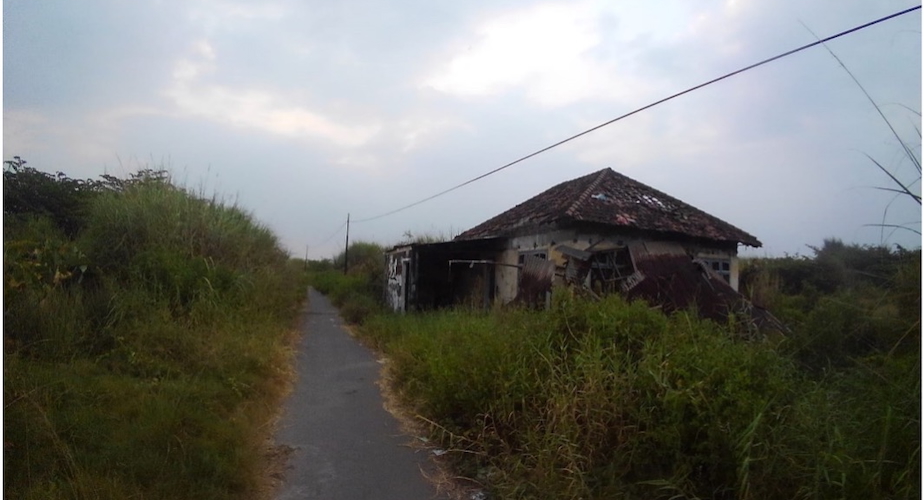
The school bell rang. Fika – still in high school at the time – and her friends hurried back home on their bicycles under the hot sun. It was about four kilometres to Fika’s house. Not far; Fika cycled to school every day. But one day Fika suddenly found herself separated from her friends. She was riding home on a different route, across a bridge over the Porong River. Fika stopped under a keres tree. She was shocked to realise that she was in an empty field, full of tall grasses as far as the eye could see. Instead of heading to Panggreh Village, Fika had unconsciously returned to her old home in the Besuki Timur area, a village that had been abandoned by its residents. ‘I don't know,’ she said later, ‘maybe I felt like I was sleeping there, so I unconsciously went there. Another time after dawn, just as the sun was about to appear, I went there alone. I again rode my bike to that place by the keres tree, in front of the house.’
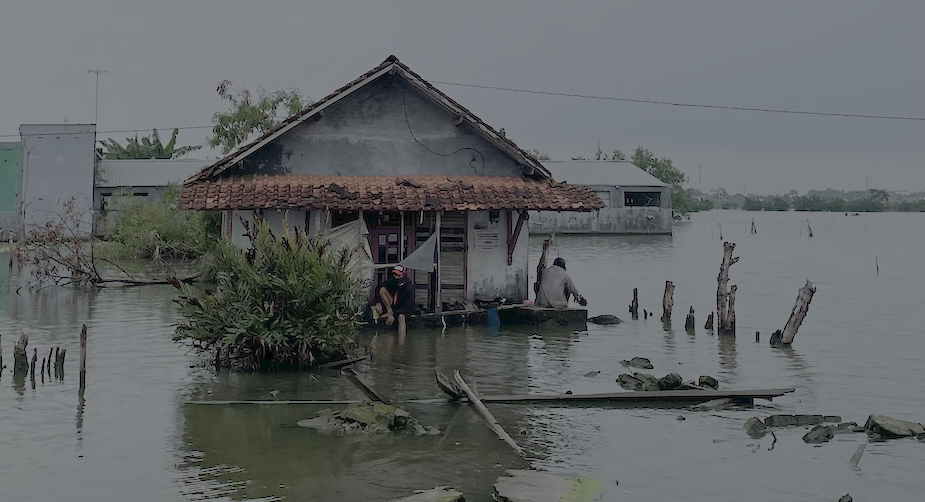
Two decades after a towering wall of boiling mud erupted as a result of oil and gas drilling in Porong, Sidoarjo, East Java, a new generation of survivors has come of age. Fika is one of thousands who have spent their entire lives living alongside the Lapindo mudflow. These young people have a bizarre ontological condition: their birthplace has been entirely erased from the official state map. While their physical homelands lie buried under a 15-meter plateau of hardened mud, their memories of these villages continue to exist as a ghostly socio-cultural landscape.
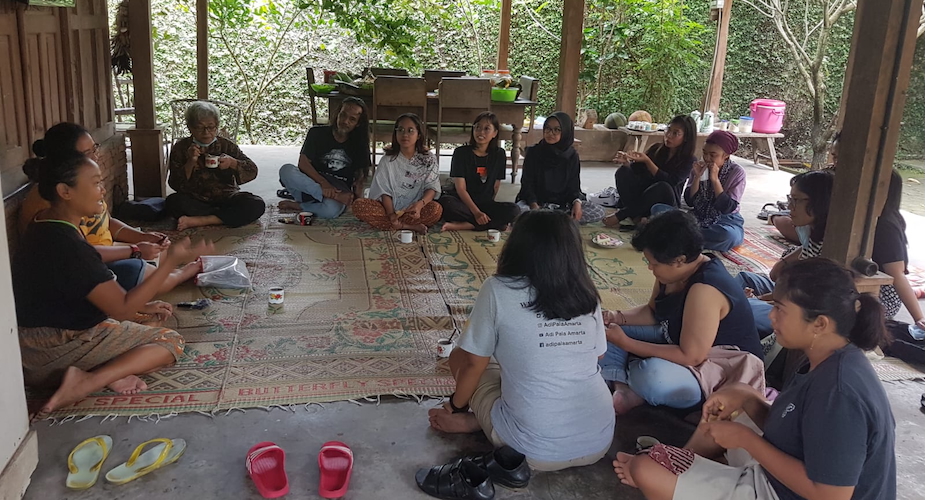
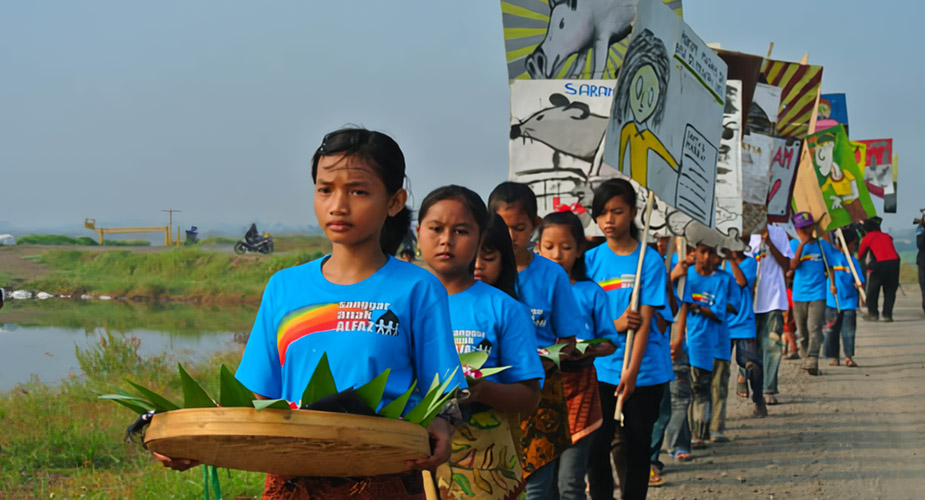
Besuki Timur is a small village on the eastern flank of the main containment dyke. For the children who belong there, the struggle to negotiate displacement has taken a remarkable turn. Whereas the older generations spent years fighting highly visible battles on the streets, or building monumental gravestones atop the mud dykes to preserve a legacy of trauma, these young survivors are engaging in a quieter, yet arguably more radical form of resistance: they are deliberately refusing to succumb to tragic victimhood. They celebrate childhood play and daily camaraderie, and they are unyielding in their preservation of an identity as ‘people of Besuki,’ ‘Wong Mbesuk’ in Javanese.
Uprooted suburbia
In the initial years following the May 2006 eruption, Besuki Timur occupied a perilous, liminal geography. Nestled between the towering earthen dykes and the Porong River, the village was sliced open by giant steel pipelines called spillways that constantly roared, pumping toxic grey slurry away from inhabited areas into the river basin. The landscape became an apocalyptic industrial combat zone. While neighbouring Besuki Barat was quickly evacuated under early presidential decrees, the residents of Besuki Timur were left behind in bureaucratic limbo, breathing in sulphurous gases and living less than a hundred meters from a precarious wall of mud.
It was within this crucible of ecological anxiety and structural neglect that Sanggar Alfaz was born in 2009. It was conceived by a group of activists on the terrace of the house of local community elder Cak Irsyad. Sanggar Alfaz was designed as a radical sanctuary for the village’s children— who came to be known as Arek-arek Alfaz.
At the time, the adult world was consumed by the aggressive, exhausting politics of survival. Parents spent their days blocking highways, clashing with corporate security, and navigating a deliberately convoluted legal labyrinth designed to frame what happened as a natural disaster – ‘an act of God’ - rather than corporate negligence. In this chaotic arena, the psychological needs of the children were inadvertently marginalised. They had lost their school, their playground, and the undivided attention of their deeply traumatised parents.
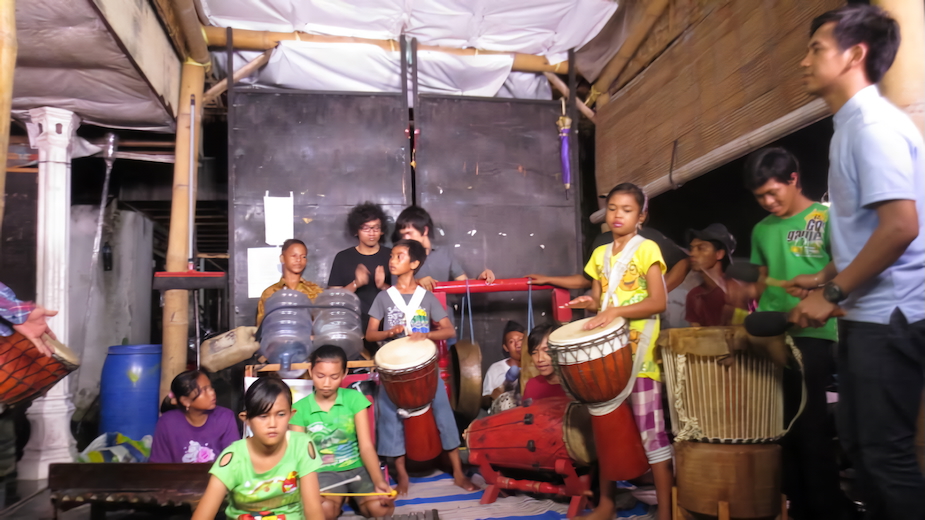
Sanggar Alfaz flipped this dynamic on its head. It became a vibrant ecosystem where children reclaimed their right to a childhood. Through painting, poetry workshops, traditional percussion rehearsals, and storytelling, the Arek-arek Alfaz transformed their immediate environment. Instead of internalizing the landscape as a site of pure terror, they re-anchored themselves to the land through collective play. The physical space also served the wider community: mothers used it for community health initiatives (jimpitan sehat), youth groups organised evening gatherings for economic sustainability, and fathers found a space to debate compensation strategies without the immediate oversight of state bureaucrats.
The failure of monuments
By 2014, the bureaucratic machinery had completed its slow work. Under Presidential Regulation No. 37/2012, Besuki Timur was officially zoned into the disaster map. Its residents were compensated under a problematic real-estate framework that treated their ancestral home merely as a commodity, calculated by the square meter, without regard for the costs of lost health and socioeconomic well-being. The village was levelled, leaving behind a solitary building: a mosque with its roof almost collapsing, standing amidst overgrown elephant grass. The community was scattered across the southern banks of the Porong River. Most were clustered in resettlement patches in the villages of Panggreh, Dukuhsari, and Kedungcangkring. Some have even spread out to the Pasuruan area.
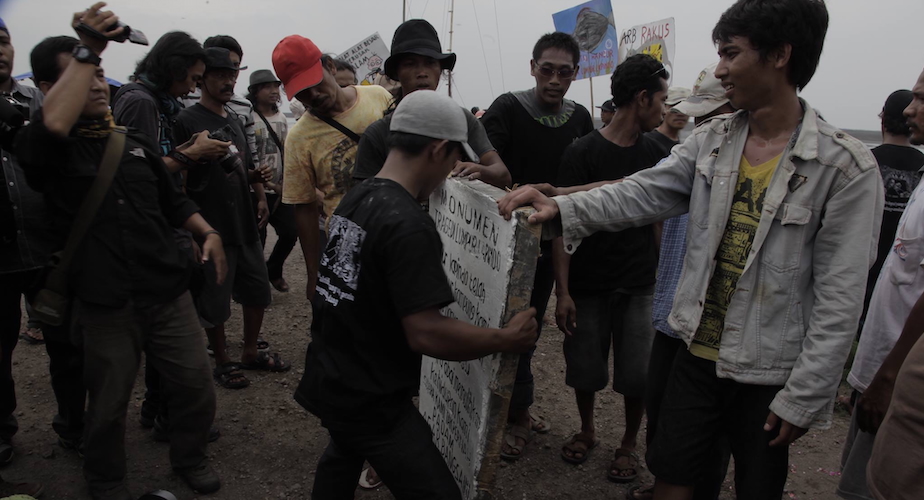
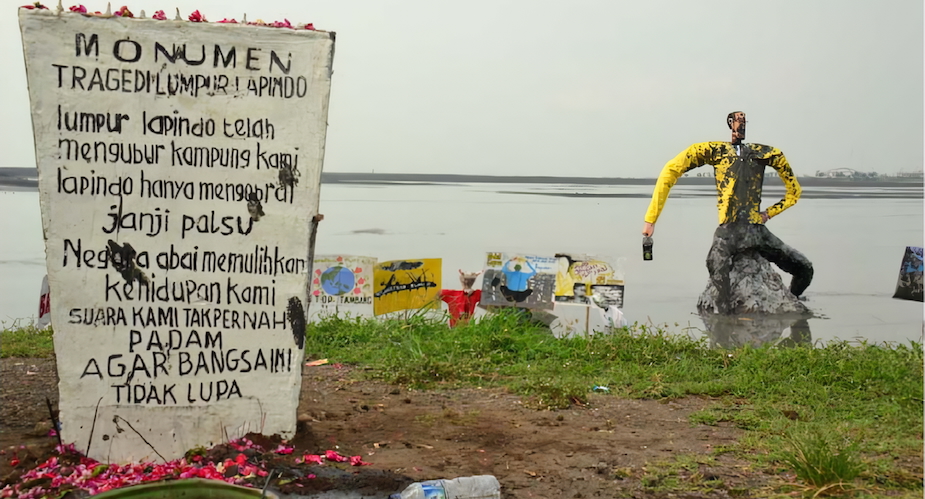
In the mid-2010s, the collective memory of the disaster became highly visible at Dyke Point 21 at Siring village (Tanggul Titik 21). This specific section of the levee became a focal point for annual protest rituals. Every 29 May, the people of Besuki Timur, Arek-arek Alfaz and survivors from various villages, would march to the crest of the dyke, burning giant effigies of Lapindo’s corporate tycoons and planting solemn stone tombstones into the sludge. These monuments bore fiercely defiant epitaphs:
‘Lapindo mud has buried our village. Lapindo is just giving fake promises. The state has neglected to restore our lives, but our voices will never be extinguished, so that this nation does not forget.’
However, as the years passed, a strange phenomenon occurred. The physical sites of memory began to experience what French historian Pierre Nora describes as the subordination of memory to history. The monuments on the dykes became static, as if frozen in time. Paradoxically, this allowed the broader public—and the state—to compartmentalise the disaster. Tanggul Titik 21 was cannibalised by fast-paced digital algorithms. It morphed into a spectacular curiosity for ‘dark tourism,’ or a neat historical footnote in environmental studies. The physical monuments, meant to provoke ongoing discomfort, instead acted as an anchor that allowed people to look, to feel a fleeting sense of pity, then forget it and move on.
Mnemonics of everyday life
By 2026, the 20th anniversary of the eruption, the Arek-arek Alfaz group had become fully grown young adults. Remarkably enough, they were nowhere to be seen near the protest monuments at Point 21. There were no theatrical performances on the levee, no banners unfurled, and no fiery speeches delivered to passing tourists. To an outside observer, it looked like the ultimate victory of state-sponsored amnesia.
The reality, however, is far more complex. The youth of Besuki Timur have subtly shifted their strategy from spectacular, performative memory to a localised, everyday practice of remembrance. They have realised that the stone monuments on the dyke are dead objects, whereas the true repository of their homeland is their own living bodies and daily routines.
Instead of reinforcing a traumatic identity rooted in a corporate crime, Arek-arek Alfaz reproduce their homeland through what can be termed ‘mundane mnemonics.’ For instance, young men like Haris and Nasikh frequently make short trips across the river just to sit on the margins of the ruined landscape (tenguk-tenguk). Haris can still recite with uncanny precision the layout of his childhood neighbourhood. He can tell you exactly whose house stood next to whose beneath the blank expanse of mud. Yogi is an avid angler. He continues to fish in the dangerous waters around the abandoned Sidoarjo-Malang toll road, treating the perimeter of the disaster zone not as an exclusion area of trauma, but as a space for the expression of memory.
Among the young women, this embodiment of memory is even more profound. Fika regularly finds herself riding her bike down familiar paths toward the dyke wall, arriving at the location of her former front door completely on autopilot. Others, like Nita and Putri, admit that when they close their eyes, their dreams are never set in their current concrete resettlement houses; they are always navigating the spacious, sunlit rooms of their lost homes in Besuki Timur. Today, when they take their own toddlers out for afternoon strolls (momong), they intentionally walk them along the edges of the containment wall, pointing up at the earthworks to explain exactly where their family history lies buried.
Paradox of identity politics
This unyielding loyalty to a ghost village has created an intriguing sociological friction in their new homes. By fiercely clinging to their identity as ‘Wong Mbesuk,’ these young survivors have constructed a protective cultural wall around themselves. In the resettlement areas of Panggreh and Dukuhsari, they rarely integrate with the long-established local populations. Instead, their social lives remain strictly confined to the tight clusters of resettlement land plots known as kavlingan.
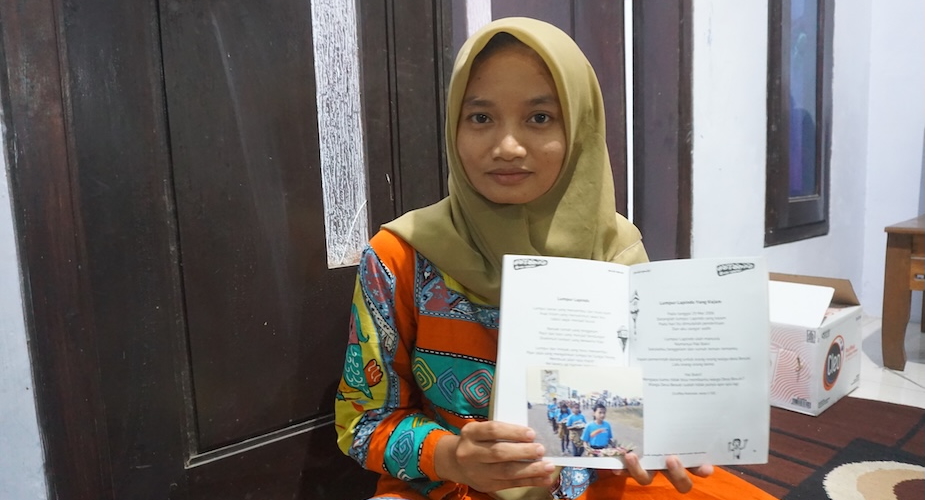
This cultural insularity is a deliberate strategy. It preserves a Javanese philosophy of the ancestral ethos, in which radical, borderless neighbourliness relies on mutual reliance rather than on economic transactions. By maintaining their old village traditions, such as autonomous neighbourhood night-watch rituals (ronda) and specific youth discussion circles, they keep the social fabric of Besuki Timur alive.
This fierce adherence to an erased geography does introduces a difficult socio-political paradox. To the native residents of the host villages, the refusal of the ‘Wong Mbesuk’ to adapt or dissolve into the existing local culture is often perceived as a stubborn, self-segregating threat to local social integration. The hosts retaliate by weaponizing identity, stamping the survivors with pejorative labels like ‘Wong Lapindo’ (Mud People) or ‘Wong Kavlingan.’
Herein lies the tragic irony of the post-disaster condition: the very identity that saves these young survivors from historical erasure also marks them as eternal outsiders in the places where they must build their futures.
Resistance against amnesia
For the Indonesian state and the corporate actors responsible for the Sidoarjo mudflow, time is the ultimate ally. The passing of decades softens public outrage, turns active crime scenes into dull topographies, and slowly replaces living witnesses with cold archival data. The recent passage of Sidoarjo Regional Regulation No. 4/2023, which formally dissolved the administrative existence of Besuki Timur, is a textbook example of this bureaucratic erasure. The state seeks a clean slate—a literal and figurative flattening of the land to make way for new industrial developments.
In this context, the everyday life choices of the Arek-arek Alfaz become profoundly political. By rejecting the grand, easily ignored performances of victimhood at Tanggul Titik 21, and choosing instead to stubbornly remain ‘Wong Mbesuk’ in their kitchens, neighbourhoods, coffee shops (warung kopi), and dreams, they disrupt the state's narrative of smooth recovery. Their living memory is a form of defiance against a deliberate systemic amnesia. They prove that while a village can be wiped off a map by a torrent of industrial sludge and a stroke of a bureaucrat's pen, it cannot be easily evicted from the bodies of those who once called it home.
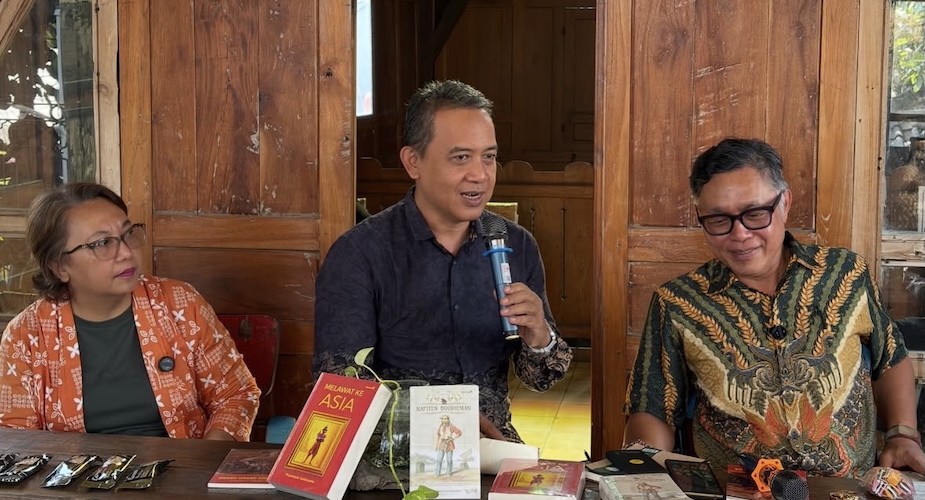
Muhammad Fahmi Nurcahyo (nurcahyamuhammadfahmi@gmail.com) is a video journalist and independent researcher. He is author of the book Aku Wong Mbesuk: politik memori masa kecil penyintas bencana lumpur Lapindo (Digdaya Book, 2026, contact the author to purchase). It is based on his 2023 MA thesis in Media and Cultural Studies at Gadjah Mada University entitled ‘Exhumation of memories in the mud: the politics of childhood memories of Lapindo mud disaster survivors.’
This article is part of a mini-series commemorating the 20th anniversary of the Lapindo disaster and marking Anti-Mining Day/Hari Anti-Tambang (HATAM), 29 May.