Many young educators soon learn that having a job does not guarantee a liveable income
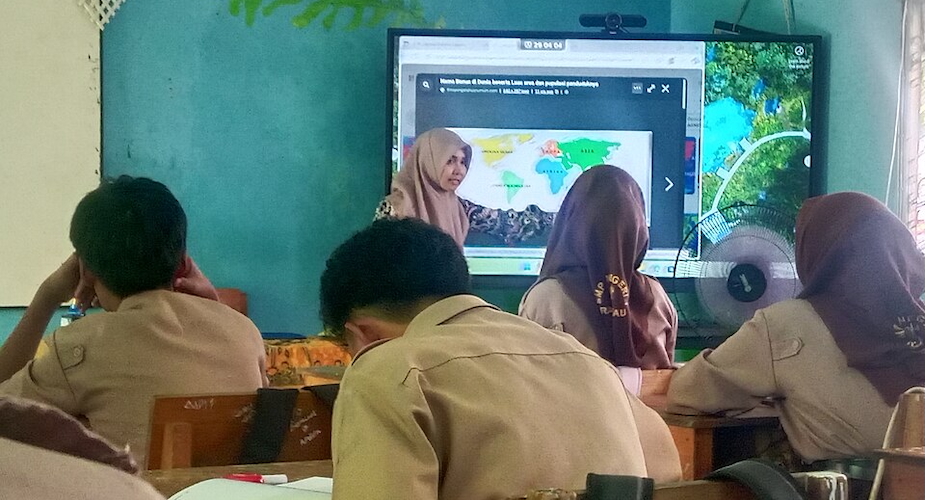
When the school day ends, the classroom empties. Chalk dust settles. Children sprint to the gate as if freedom is a competitive sport. But the teacher does not rest.
She checks her phone. There is another class to teach somewhere else; another Zoom link for tutoring. Another parent WhatsApp group. Another marketplace chat where a buyer asks, ‘Sis, ready?’ as she sells snacks like stik keju (cheese sticks) or makaroni goreng (fried macaroni).
She does not do this because she dreams of starting a culinary brand. She does it because she has bills to pay.
This is not an embarrassing anecdote. It is what happens when a society treats education work as a calling from the heart, then prices it like charity.
In Indonesia, we have a phrase that sounds noble and dangerous at the same time: ikhlas. Sincere. Devoted. Willing to sacrifice. Teachers are often called ‘pahlawan tanpa tanda jasa’, unsung heroes. Ikhlas is beautiful in religion and community life. But in the labor market, devotion does not replace a wage.
Why this matters beyond teachers
Every Indonesian has a relationship with the education sector. You were raised by it, disciplined by it, examined by it, and perhaps occasionally traumatised by it. You may now trust your children to it. You may argue about school fees, books, uniforms and the rising price of 'quality'.
But education is also an employer - a massive one.
Our analysis of the August 2024 National Labor Force Survey (Sakernas) focused on Gen Z urban wage earners with bachelor-equivalent education and above. The education sector employs the largest number of young graduates. It absorbs roughly 28 per cent of Gen Z in this education bracket. Wholesale and retail trade absorbs around 12 per cent, manufacturing 9.5 per cent, and business activities six per cent.
This matters because the education sector is where degree-holders are most likely to be doing work that matches their education level, especially professional teaching roles. In many other sectors, graduates end up in jobs that may not require a university degree. Economists call this educational mismatch. Put simply, the job and the degree do not line up.
Our analysis of the Sakernas 2024 reveals that in urban Indonesia almost 90 per cent of Gen Z degree-holders working in the education sector are in roles that match their level of education, such as teaching and other professional education roles. By comparison, in the information and communication sector, the match rate is only 33.5 per cent. In business activities it is 30 per cent, and in manufacturing 19 per cent.
If the question is only, ‘Are graduates employed in professional jobs?’ the education sector looks like a success story. Until you look at the pay.
A matched job, but not a decent wage
Across all sectors in our sample of Gen Z urban wage earners with bachelor-equivalent education or above, education sits at the bottom of monthly take-home pay for young degree-holders. The figures are based on net main-job income, with the very lowest and highest values trimmed to avoid outliers driving the comparison. The average monthly income for those working in education is Rp.1,900,000, compared to Gen Z workers in mining, who take home around Rp.6,000,000 a month. Mining is famously high paying, so perhaps that feels unfair. But even in agriculture and fisheries, Gen Z graduates earn around Rp.3,500,000 on average. That is still comfortably above education at Rp.1,900,000 a month for young graduate teachers.
Education is not slightly below average. It is at the bottom.
Nor does education’s lower recorded working time tell the full story. The average weekly working time in education is 35 hours. Manufacturing is 43 hours, retail 46 and mining 53. On paper, the education load looks lighter. Anyone who has taught knows better.
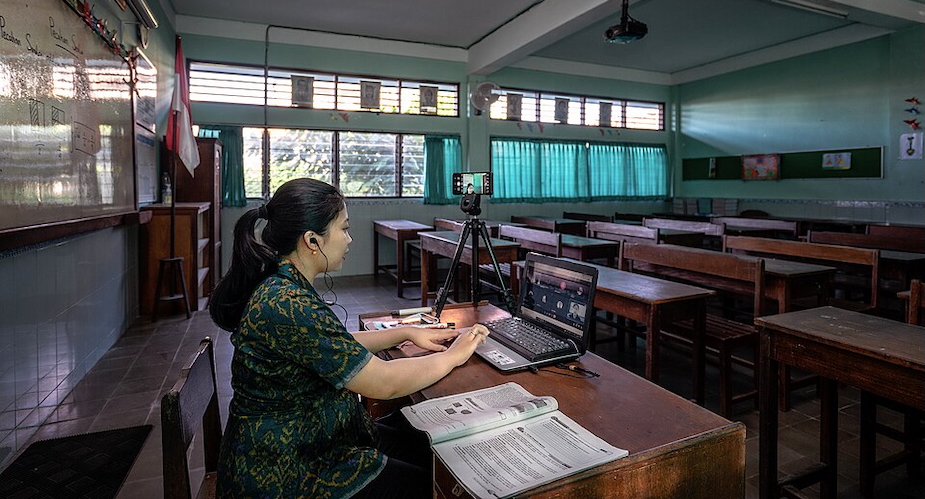
Teaching work spills beyond the timetable. Time is spent on lesson planning, grading, student counselling, meetings, curriculum changes and administration. There are messages from parents at night, extra classes on weekends and school events that quietly swallow rest time.
A teacher’s week is not short. It is fragmented. Fragmentation is expensive because it takes time, energy and sleep.
The cost of getting through the month
In many large Indonesian cities, such as Jakarta, Yogyakarta, Bandung and Surabaya a basic rented room can cost Rp.500,000 to Rp.1,200,000 a month, depending on the city and distance from work. Transport comes next. A young teacher commuting across the city may spend around Rp.20,000 to Rp.25,000 a day on travel, particularly when formal public transport is combined with angkot, local feeder services, or short ojol (online motorcycle taxi) trips to and from stations, bus stops or schools. If she relies more heavily on ojol, especially on busy days, the cost can rise to Rp.30,000 to Rp.50,000.
Multiply that by a month of teaching and tutoring routes, and the commute starts to look like a second rent.
A teacher in Jakarta told us, half-joking but not really, ‘Gaji masuk tanggal 1, tapi uang transport sudah habis tanggal 20’. The salary comes in on the first, but the transport money is gone by the twentieth.
That sentence is not poetry. It is budgeting. After rent and transport, everything else becomes improvisation: food, data packages, family support and emergencies.
Why low pay sticks
Education usually raises expected earnings and more education should mean better pay. But wages are not set by education-level or qualifications alone. They are shaped by rules, budgets and bargaining power.
Some sectors have stronger wage floors. Minimum wages are more likely to be enforced. Overtime is paid. Payroll systems are formal. Workers in other sectors may have more power to organise in ways that protect individual wages across various job-types, for example, or have the option to move to another employer.
Education stands on softer ground
Whilst Indonesia’s largest teachers’ union, Persatuan Guru Republik Indonesia (PGRI, National Teachers’ Association of Indonesia), is politically influential and covers a substantial share of the workforce, when it comes to wage protection at the individual teacher level the impacts of collective action are limited. Teachers sit in different budget and employment systems. Government employed teachers on fixed term contracts (Pegawai Pemerintah dengan Perjanjian Kerja, PPPK), honorary teachers, and private-school teachers, for example, do not necessarily receive the same level of protections.
In public schools, wages are tied to rigid budgets and local government decisions. In private schools, wages often depend on parents’ ability to pay fees and in some cases are run by small foundations where budgets can be tight and unstable.
Then there is contract culture. Guru honorer (honorary teachers) frequently work under short-term arrangements. Schools may rely on BOS operational funds to help cover staffing costs, so teachers are told to ‘come back next semester’. The work is professional in name, but treated as replaceable labour in practice.
For this reason, second jobs are extremely common. The Sakernas data shows that around 15 per cent of young graduates whose primary work is in education, have more than one job. Moreover, out of the total number of young employed graduates who juggle multiple jobs, nearly sixty per cent come from the education sector.
When your main professional job cannot support a basic urban cost of living, you do not wait for the system to become fair. You patch the system with your own resources. You trade sleep for cash. You become your own subsidy.
The local trap
The average young city-dwelling graduate is likely to have various options when it comes to job-seeking. Retail chains, logistics firms and factories compete for workers. If one employer pays too little, another may be nearby.
The education sector is more locally based. Schools are tied to neighbourhoods, and recruitment into public teaching posts is often mediated through district or provincial governments. For PPPK teachers, opportunities are not determined by national teacher shortages alone. The central government sets the recruitment framework, salary scales and final approvals, but local governments propose the formations and budget salaries through the local government budgets (APBD, Anggaran Pendapatan dan Belanja Daerah). These budgets are often supported by central transfers such as the General Allocation Fund (DAU, Dana Alokasi Umum), which help to equalise local fiscal capacity. So even when Indonesia needs more teachers, a teacher’s chance of securing a public school posting can still depend on whether their district or province opens and can fund the position.
School operational funds also matter. School Operational Assistance (BOS, Bantuan Operasional Sekolah), is the school operational fund for basic and secondary education within the broader Education Unit Operational Assistance framework (BOSP, Bantuan Operasional Satuan Pendidikan). It is meant to support day-to-day school operations and can, within limits, help cover honoraria. But because BOS allocations have long been closely tied to student numbers, schools with fewer students, often in poorer, rural or remote communities can face tighter budgets even when staffing needs remain urgent. Current rules, such as Permendikdasmen (Peraturan Menteri Pendidikan Dasar dan Menengah (Regulation of the Minister of Primary and Secondary Education) No. 8/2026, Article 25, still use student numbers as a central part of the formula, with regional unit costs and safeguards for some special-area schools.
The introduction of part-time PPPK in 2025 added yet another layer. It was designed as a transitional route for registered workers who are neither civil servants PNS (Pegawai Negeri Sipil) nor PPPK (Pegawai Pemerintah dengan Perjanjian Kerja) – known as non-ASN – including honorary teachers who had joined the 2024 civil-service or PPPK process but were not absorbed into available formations. But formal status on paper does not automatically bring financial stability or a clear path to a secure post. Under the part-time scheme work agreements are set yearly, working hours depend on agency budgets and job needs, and movement into full PPPK depends on budget availability and performance evaluation.
This is not a textbook case of one employer controlling everything. The fact is that in many places, education workers face limited opportunities. The public system provides many of the standards and frameworks for pay and job security, especially through PPPK and honorary teacher arrangements. Smaller private schools do not need to compete keenly for talent when the public sector benchmark for non-permanent teaching work is already weak.
That is why ‘just negotiate’ is not a solution. Negotiation requires leverage, which many early-career education workers lack. Novice teachers in Indonesia often begin as honorary teachers in public schools while waiting for the chance to take the civil service exam. But more experience does not automatically translate into stronger bargaining power. There is no direct pathway from honorary status to civil-servant status. Honorary teachers, even after many years of service, must still pass the civil service exam to secure a permanent public-school position; until then, they may possess weak bargaining power.
The gendered edge
Education work is closely tied to care. Care work, around the world, is often undervalued.
When a job is associated with patience, nurturing and ‘women’s work’, society expects it to be done for less. This is hard to ignore when, as indicated in the Sakernas data, roughly three out of every four Gen Z graduates working in education are female.
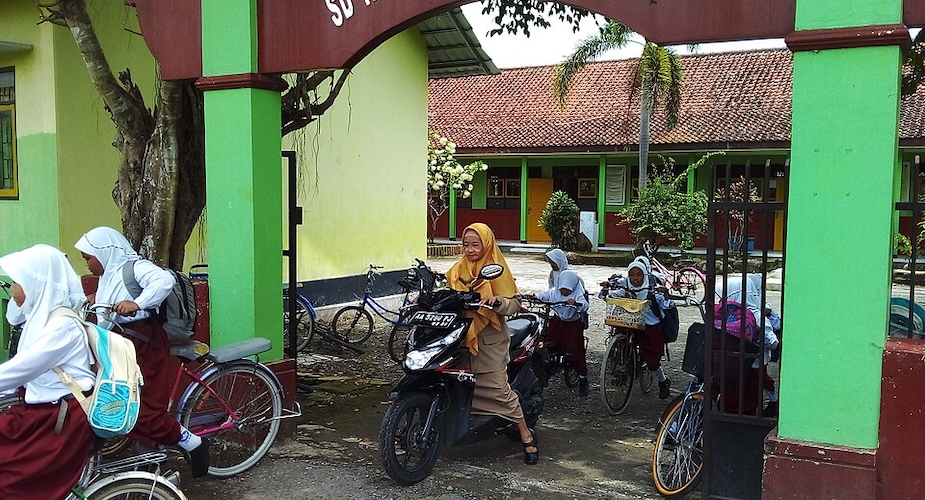
In a field so heavily feminised, wages are not just numbers. In a context where teachers are often described through moral language – ‘pahlawan tanpa tanda jasa, pengabdian, ketulusan, and ikhlas’ (‘unsung heroes, devotion, sincerity, selflessness’) – demands for increased pay also become moral signals. If you ask for a raise, are you still sincere? Are you still ikhlas? Are you still an unsung hero?
This expectation harms more than teachers. It shapes who enters the profession and who stays. Low pay pushes talented people out. Exhaustion becomes normal. Schools expend energy by replacing teachers instead of building quality. When school quality feels uneven, families with options look for schools they see as better, for example selective public schools, better-resourced private schools, or particularly schools with superior facilities and smaller classes. Families without those options stay with whatever the local system can provide. That is how inequality deepens. Indonesia often says teachers must be more competent, more digital, more creative and more accountable. Some of this may be true. But one sentence is missing: you cannot buy high-quality labor at a discount and still expect premium outcomes.
What to watch
If you want to know whether Indonesia is serious about education, watch early-career teachers.
Watch whether schools rely on short-term contract teachers year after year; whether a professional teacher can afford to be a teacher without selling snacks every evening and whether certification and training lead to a predictable wage ladder, or only a stack of documents.
This is how a country either builds human capital or quietly bleeds it.
The Indonesia Emas 2045 (Golden Indonesia 2045) outlines the long-term national vision for Indonesia’s centenary, with its major targets including improving human resource competitiveness through education; training; technology; innovation; creativity and health. This dream depends on better skills, better schools and better workers. It cannot be built while the people who produce human capital are asked to survive on devotion.
What would break the trap?
Start with some basic conditions that should not be radical: clear and enforceable contracts; automatic registration in BPJS, Indonesia’s national health and social security system and a wage floor for early-career educators that reflects urban living costs.
The next step is to fix progression. Certification and training should lead to a predictable pay ladder. If a teacher’s income still depends on endless side hustles, professional development loses meaning.
We also need to stop confusing ‘hours in class’ with ‘hours of work’. Payroll should recognise preparation, assessment, mentoring and the invisible labour that makes learning possible.
Finally, we need to be honest about the politics of education work. If Indonesia wants better learning outcomes, it cannot treat education labour as cheap. If it wants to retain talent, it cannot keep asking teachers to survive on sincerity.
Elita Pertiwi is a PhD candidate in Economics at the Department of Economics, Universitas Padjadjaran. Her research focuses on labor economics, especially educational mismatch, labour market inclusion, and employment outcomes among vulnerable groups in Indonesia. Raden Muhamad Purnagunawan is a lecturer and researcher at the Department of Economics, Universitas Padjadjaran. He holds a PhD in Economics from the Australian National University and works on employment dynamics, economic development and social welfare in emerging economies.