Lapindo demonstrates that a disaster is not merely a geological event, but a process of ‘disaster-making’ that goes on and on
Today’s advanced industrial societies have a voracious appetite for resources. Electric vehicles, for example, require a massive supply of metals and energy. Political ecology helps us understand that all these efforts to achieve ‘green progress’ in the global North tend to leave a trail of destruction in the South.
Indonesia has long been one such zone of devastation. Its history of colonialism has left it with problematic governance in the area of extractive industries. People overseas often focus on the giant mines and oil palm plantations in Indonesia’s outer regions. But the most harrowing illustration of what happens when industrial risks are ‘tamed’ for the interests of the elite is an extraction tragedy playing out in East Java. What happened there is not just an industrial accident. It is a tangible manifestation of a crucial transition: from ‘disasters of development’ towards ‘development of disasters.’
‘Creating’ risk
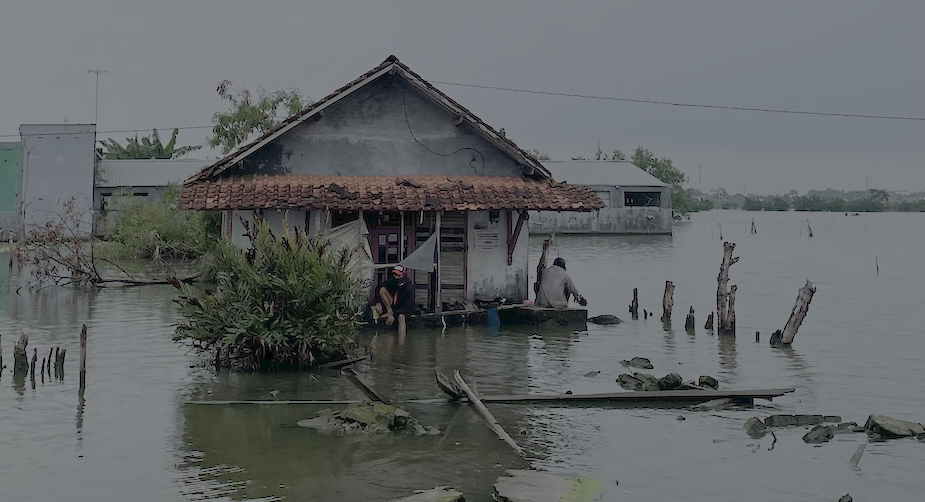
In the early hours of 29 May 2006, a mixture of gas and hot mud gushed out onto a rice field in the village of Renokenongo, Porong, East Java. The site of the eruption was close to the Banjar Panji-1 drilling well owned by Lapindo Brantas Inc. Geologists call it a ‘mud volcano.’ The eruption at Porong was the biggest mud volcano in the world, emitting up to 180,000 cubic metres every day. Mud continues to gush from the earth’s depths to this day. What the future holds remains a mystery. More than 800 hectares of land have been submerged, across 15 villages. Tens of thousands of residents have become displaced in their own homes.
The American anthropologist Anthony Oliver-Smith defines a ‘developmental disaster’ as the process of forcibly displacing people in the name of macroeconomic progress. Development thus becomes ‘uprooting people from their homes.’ I have expanded on Oliver-Smith’s argument by proposing the thesis of ‘disaster development,’ which challenges the popular idea that the ‘state was absent’ during the Lapindo mud flow crisis. After carefully examining many public documents, I could show that the state was, in fact, actively present even before the eruption occurred. Residents living near the mud flow are therefore victims of inept governance of the extractive industry. Financial gain was seen as more important than the wellbeing of society and ecology.
State apparatuses were actively involved since the pre-drilling phase. They granted drilling permits that contravened Sidoarjo’s spatial plan (RTRW). The Banjar Panji-1 well was situated very close to residential areas and to key infrastructure such as highways and an underground gas pipeline. The two authorities responsible for oil and gas governance - the Directorate General of Oil and Gas and BP Migas – failed to provide technical oversight during the drilling. This reinforces the argument that industrial risks were mitigated by political considerations. The state’s presence served not to protect and ensure the safety of residents, but rather to lay the groundwork for a systemic disaster.
Mapping
The map is one of the state’s most effective instruments in ‘disaster development.’ Long ago, anthropologist James Scott argued that maps are not merely geographical representations, but instruments of power designed to reshape social reality. In the case of the Lapindo mud flow, the state has used the ‘Map of Affected Areas’ (PAT) to categorise residents into rigid legal categories. ‘Victims within the map,’ were to be paid compensation by Lapindo; compensation for ‘victims outside the map’ was to be borne by the state; and ‘non-victims’ were left to survive in a damaged environment without legal status.

The periodic revision of maps constitutes a systematic effort to carry out forced evictions as the impact of the mud flow spreads. These maps create a tangible spatial injustice. They define a boundary - sometimes nothing more than a five-metre-wide village road - between areas deemed ‘habitable’ and ‘uninhabitable,’ even though ecological conditions on both sides of the road are equally dire. Rather than acting as a guarantor of its citizens’ basic rights, the state functions as a ‘middleman’ or broker in asset transactions, disregarding the human suffering behind a sheet of paper of a land title deed.
Slow disaster
Public attention tends to focus on sudden dam bursts or the drama surrounding compensation payments. Meanwhile another tragedy is unfolding more slowly. Lapindo is a slow disaster. It is causing permanent environmental degradation, that is affecting the health of local residents.
Our research conducted in 2021–2022 revealed the presence of ‘embodied risk’ among children growing up in a village on the eastern side of the mud embankment. Laboratory test results showed an increase in inorganic phosphorus levels in the blood of all the toddlers in the sample. This condition is thought to stem from the accumulation of pollutants in the air and water, which then enter the food chain, particularly affecting children. These levels inhibit calcium absorption and threaten children’s bone growth, resulting in high rates of stunting in the village.
It is an open secret that stunting is never merely a medical issue. It is a socio-political problem. For nearly two decades residents have been forced to live alongside hazardous gases and groundwater unfit for consumption. Disaster does not strike suddenly in a single monumental event. It creeps through the air people breathe and flows in the water they use every day. It creates a vicious cycle of infection and malnutrition that threatens the future of generations to come.
Beyond economic value
Government guidelines for addressing social impacts focus almost entirely on market-based compensation mechanisms: the buying and selling of assets. This technocratic view assumes that ‘loss’ can be resolved with money based on the size of land and buildings. However, for many survivors, land is not merely an economic commodity. It is a ‘dwelling’ (or Wohnung as Martin Heidegger called it), that is, a place where people nurture their own and their group’s identity and history.
A study I once conducted showed that relinquishing legal ‘ownership’ does not guarantee the relinquishment of a ‘sense of belonging.’ Many residents who have physically moved away are still reluctant to change their civil administrative registration. Emotional and historical ties to their home village still linger in their subconscious. Some residents told me they wake up and realise they have been dreaming of being back in their old village, now submerged in mud.
The compensation they received is often insufficient to restore lost livelihoods. Farmers who lost productive rice fields cannot afford to buy new rice fields of the same size elsewhere. Porong is seeing a process of ‘forced deagrarianisation,’ leading to structural impoverishment.
The compensation scheme exhibits a marked ‘urban bias.’ The rate for rice paddy land is set significantly lower than that for residential land. Yet rice paddies are the primary means of production within agrarian communities. Many survivors who were once economically self-sufficient are now forced to turn to the informal sector, where jobs are precarious.
Landscape of death, site of resistance
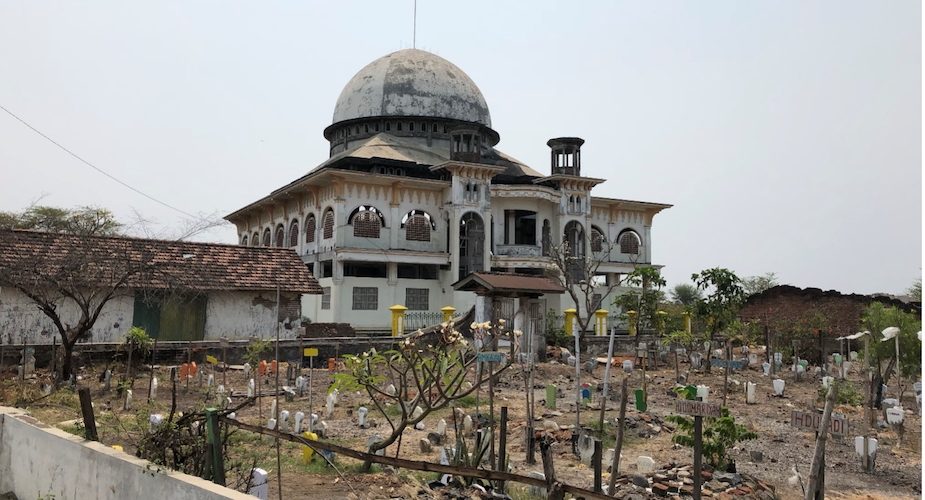
Amidst physical devastation, sacred spaces such as graves become the last bastion of memory and identity. For many survivors, submerged graves serve as ‘memory nodes’ connecting them to their ancestors. There is as yet no mechanism to compensate for the loss of such socio-cultural ties.
The tomb of Kiai Anas Al-Ayyubi in Jatirejo serves as a powerful example of how a crisis zone can be transformed into a site of resistance. This much-loved founder of a local religious school passed away in 2003, just before the disaster. Lapindo turned Jatirejo village into a mud lake, and buried his tomb. But Kiai Anas’s family chose not to sell their land. They built a mausoleum on the site of his submerged grave. It has become a centre of pilgrimage for residents who continue to live within the disaster zone. It is tangible evidence to the contrary of the government’s claim that all victims have received compensation. The mausoleum symbolises the hope of a future ‘return.’ It embodies a collective dream that, one day, the displaced people will be able to rebuild their lives upon the roofs of their submerged homes.
Memory
The Lapindo survivors have bequeathed sorrow, but also memories. They have held a commemoration every year on 29 May. These are symbolic acts to challenge those in power. In 2013, during the seventh-year commemoration of the mud flow, residents erected a tombstone-shaped monument on the embankment. Its inscription denounced the state’s neglect and the corporations’ false promises.
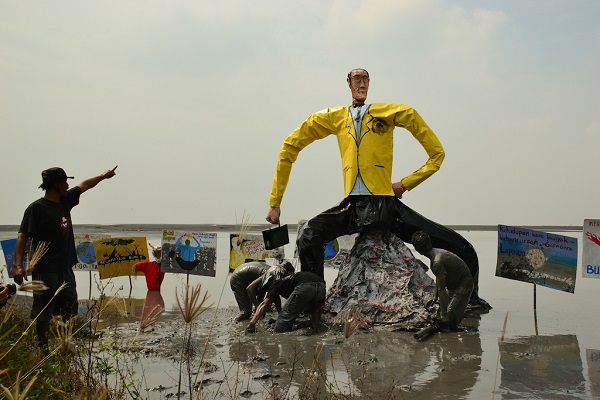
In the same year, they also destroyed an ogoh-ogoh (I wrote about this in Inside Indonesia). This fearsome-looking bamboo-and-paper demon representing all the negativity of the universe is traditionally burned for Nyepi in Bali. Today it is part of a protest tradition that has spread beyond Bali. In the East Jawa manifestation of 2013, the ogoh-ogoh was identified with an evil giant in the popular folk tale of Timun Mas, a brave girl who resists and finally defeats him. Performed on a muddy lake, the theatrical drama gave meaning to their struggle. Their giant figure looked remarkably like Aburizal Bakrie, Lapindo boss and Golkar chief held responsible for the disaster. Still wearing his yellow Golkar jacket and carrying a briefcase, he was depicted sinking into the mud as a result of the little girl’s resistance. Thus, they say, the political elites and corporations who instigated their sufferings must ultimately perish in the mud themselves.
This is merely one form of ‘habit-memory’ used to challenge attempts at normalisation and the erasure of history by official authorities and corporations. Residents also preserve memories in their daily lives. They regularly visit the remains of a mosque or family graves that are still accessible. They refer to it as ‘spiritual tourism.’ It is a way of preserving collective memories so they do not fade with time.
Full justice
The Lapindo mud flow tragedy provides a bitter illustration of the reality that local residents and their environment have never been guaranteed adequate protection. In a disaster zone such as Porong, political decisions often prioritise the smooth operation of the extractive industry. They protect corporate interests rather than human rights. Lapindo demonstrates that a disaster is not merely a geological event, but a process of ‘disaster-making’ that goes on and on through administrative mechanisms that exacerbate residents’ vulnerability by disregarding human values and environmental sustainability.
Recovery for the victims goes beyond the mere need to compensate for the loss of land and property. It demands comprehensive environmental justice. That involves environmental health restoration through a citizen science approach, recognition of socio-spatial rights, and respect for the collective memories forged by the mud. Two decades after the Lapindo mud flow started, the voices of survivors have still not been silenced. Behind the walls of the giant mud embankments in Sidoarjo, they continue to remind this nation of a basic truth: the real disaster happens when those in power build progress upon the destruction of homes and human dignity.
Anton Novenanto (nino@ub.ac.id) teaches sociology at Brawijaya University in Malang, East Jawa. He has written extensively on the Lapindo disaster, most recently this article: ‘Sacred ground, contested space: deathscapes in the aftermath of an environmental disaster in East Java, Indonesia.’ The present article is translated from his fully-referenced chapter in the book edited by Fathun Karib, David Effendi, and Gerry van Klinken, Bacaan Bumi: Tambang dan Perubahan Sosio-Ekologis di Indonesia (Yogyakarta: Insist Press), out on Anti-Mining Day (Hari Anti-Tambang, HATAM), 29 May 2026.
This article is part of a mini-series commemorating the 20th anniversary of the Lapindo disaster and marking Anti-Mining Day/Hari Anti-Tambang (HATAM), 29 May.