A man of action who focused on encouraging others
When I was twelve, I was sitting at our dining room table in Northcote, Melbourne reading through the draft of a hand-written speech about East Timor that I had prepared for a public speaking competition. Dad sat down beside me to check-in. He read through my speech, slowly and carefully. He didn’t correct anything, but he did make one important suggestion.
‘What if you finish with a call-to-action? Encourage the audience to write to their local MP, write to the newspaper or do something in their community to raise awareness about East Timor’, he suggested. And so I did.
My Dad put his core values into practice in all parts of his life. Thousands upon thousands of small interactions and decisions, brick-by-brick built a man, a family, a community and a working life that was beyond ordinary. His spirit of respect, curiosity and love infused everything he did.
He was a man of action, but even more than that, his action was often focused on encouraging others. He was also kind, thoughtful, creative and humble. And determined.
I would like to share some personal stories of Pat, including about his early life and some of the major influences on him.
Irish Catholic roots
Pat grew up in the 1940’s in a big Irish Australian Catholic family on a dairy farm in South Purrumbete, a small community in Western Victoria. He was the third of eight children. In Pat’s own words from his unpublished memoir,
‘we had no electricity, no water laid on, no shops, no telephone and no public transport. Children were expected to work, including fetching water and wood like the kids in East Timor… Necessity being the mother of invention, I learned to chop wood, light a fire, use a gun, ride a horse, milk a cow, trap rabbits, kill snakes, handle dogs, empty an outside dunny, turn socks with holes in the heel up the other way, mend a broken bike chain and puncture, light a kero lamp, use basic tools and generally fix things. Life was simple, economical and applied. We trapped and drank water off the roof, wore the same clothes much of the time, bathed once a week and walked a lot… The paddocks were our unsupervised playground’.
When I was young, he would tell my sisters and I stories of riding a horse to school, bare back down the dirt roads.
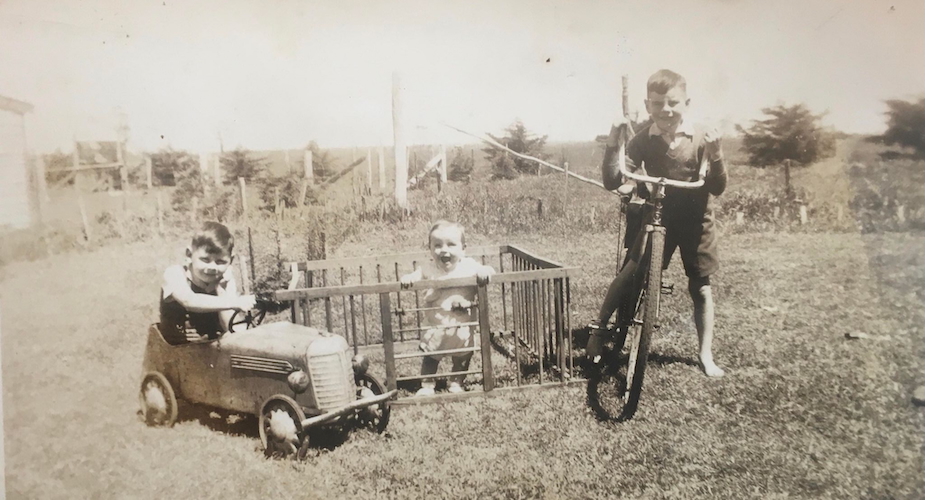
Pat’s father, Des, died at just 55 years old after a long struggle with tuberculosis. His mother, Ruth, was a community-focused person. He had enormous love and respect for her and the value she placed on education, the Church and local community.
At just 12 years old, Pat left home to live with his aunt and uncle in Cape Clear, Victoria and begin secondary education at St Patrick’s Catholic College, Ballarat with his cousins. It was a big step-up from his little one-teacher bush school.
In his second year there he attended a school retreat run by Father Bob Hyland from the Missionaries of the Sacred Heart (MSC). This was a turning point. Pat said he was ‘hooked’ by the vision of working in the Third World that Father Bob described. He then responded to an ad in an MSC magazine ‘offering information to any boy interested in exploring life with the MSC’. The next year Pat was accepted into the MSC junior seminary at Douglas Park, near Sydney. He wrote, ‘I was 14 years old … and the recipient of a free, first-class education that continued for ten years before I in turn became an educator.’
Pat really enjoyed his academic seminary studies, which included learning French, Latin and Greek. Students were encouraged to read widely and practised writing and publishing through a student magazine. Boarding school life was sometimes hard, and he found it difficult being so far from family (he only went home once a year). However, he also talked about having strong friendships through these years, playing soccer and tennis and fondly remembered taking on the role of Hamlet in a production of The Tragedy of Hamlet put on at the seminary.
After completing his secondary education, Pat moved to the new MSC monastery in Canberra to continue his training for the priesthood. He wrote that ‘the monastery was exciting educationally. Staff at our new establishment included several young priests who had recently returned from higher studies in Rome and were very tuned in to the latest intellectual developments in Europe and the winds of change blowing within the church’. It was the 1960s and the Church as well as society generally, was changing. His final three years of tertiary study was with the MSC in Croydon, Victoria.
In the final years of his theology study, Pat was inspired by the radical changes brought about by the Vatican II Council, and its determination to make the Church relevant to the modern world. Later in life, he reflected that its new theology both ‘inspired and sanctioned’ his future work and involvement in social justice and international human rights. Reflecting on this, he wrote ‘in my small way, I was to be the church in the modern world’.
Pioneering enthusiasm
Pat was ordained a priest at twenty-five years old, in July 1966 at St Patrick’s Cathedral, Melbourne. The next decade of his life as an MSC was defined by his commitment to supporting young people, including as a teacher at Monivae College in Hamilton.
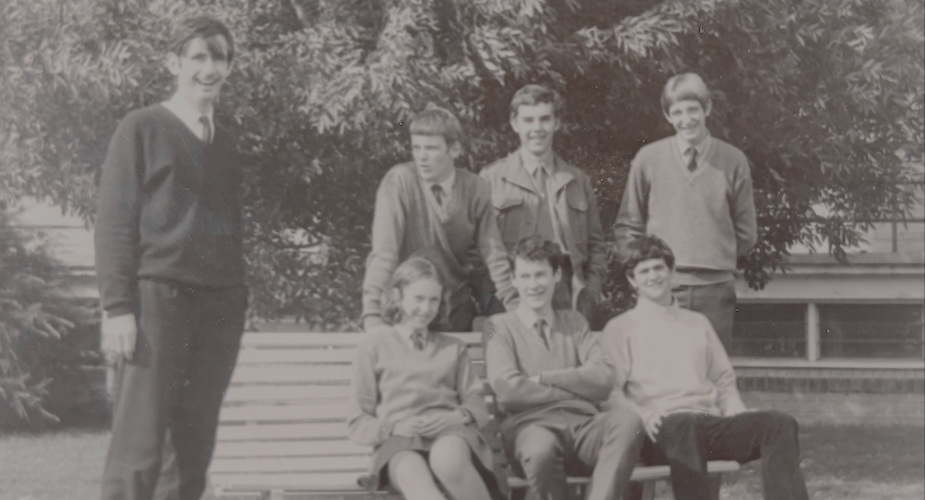
When asked to introduce Indonesian language studies at Monivae, he readily attended a six-week kursus kilat at Monash University before bravely standing up in front of the class. He said his pioneering enthusiasm made up for his shoe-string knowledge.
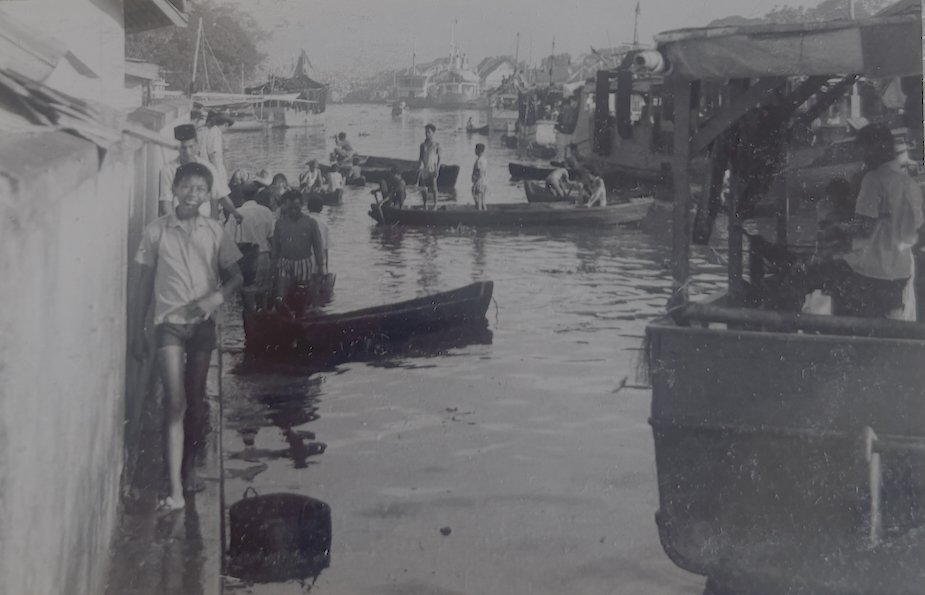
As a result of his outstanding results in the intensive course, Pat was awarded a grant to spend seven weeks in Indonesia in the summer of 1968-69, the first of what would be many trips ‘next door’.
Reflecting on this time, Pat recently wrote,
‘I visited as a page of history was being turned in Indonesia. I got to see firsthand the end of Dutch colonisation and the on-going prosecution of one of the worst atrocities of the 20th century.
The visit served to conscientise my innocent self. Moving around Jakarta, Bandung, Central and Eastern Java I could not help but realise the deep personal privilege I had been given. Besides pushbike, I used becak when I could. Indonesian style, I walked along railway tracks, used oplet mini-buses and crowded trains that cleared a way through slums on the outskirts of Java’s large cities. One prize that I kept for myself and still have is a papier-mâché statuette of a jamu lady, that I bought from a prison shop for an embarrassingly cheap Rp 2,750. Delicately and lovingly crafted by an anonymous political prisoner in Bandung, it is telling evidence that many talented Indonesians were denied, leaving Indonesia that much more culturally and intellectually impoverished’.
‘Evidence of what had transpired was clearly visible. Army personnel in green uniforms were thick on the ground. And such was the fear of being labelled PKI (Partai Komunis Indonesia) that many had taken refuge in religion, including by declaring themselves Catholic, i.e. not atheists. In Bandung, I remember feeling distinctly uneasy when a fully armed soldier stood beside me to check out a shop window. No-one else seemed to bother. His weaponised presence was normal. In Jogyakarta, I joined a Jesuit colleague from Sanata Dharma to ride our bikes to visit PKI inmates in an old Dutch prison. Note they were political prisoners. Their ‘crime’ was making the wrong political choice, not breaking the law’.
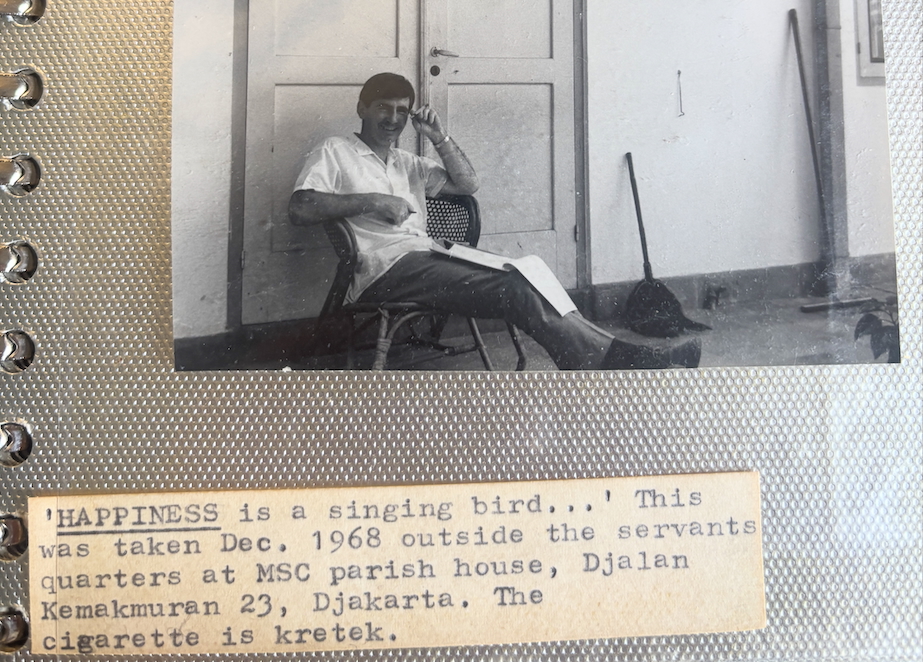
Growing up, the jamu lady statue was always on display somewhere in our house. In recent years she stood on the mantel above the fireplace in Pat’s study. At his funeral, we chose the jamu lady as one of the symbols of his life, representing his foundational belief that the dignity of every human being should be respected. As he himself said, ‘the Universal Declaration of Human Rights has ruled my working life like the ten commandments’.
Formative years
Back at Monivae College in Hamilton, in addition to teaching Pat took on other pastoral roles within the College and in the broader community. He introduced the Young Christian Students (YCS) group and over time established a coffee shop for the young people of Hamilton. In 1974 he left Monivae to become YCS National Chaplain, based in Melbourne. It was in this role that he really started to embrace and live his unique approach to ministry. I like to think of him in his 30s in the 1970s as a bit of a rebel Priest. These were formative years.
One example of this is that Pat requested permission from the MSC Order to live outside the Priest’s usual monastery-based institutional accommodation. He wanted to live within the community that he was serving.
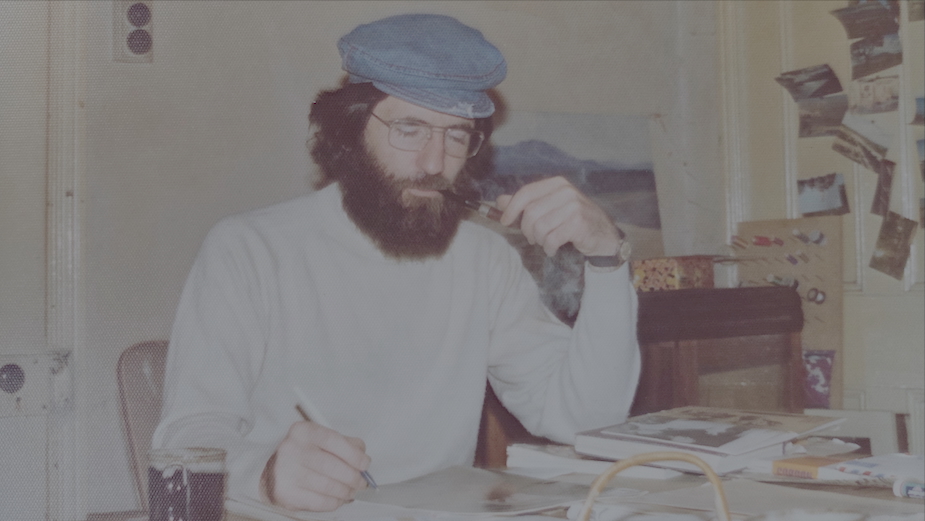
In 1975, with his love of Indonesia already deeply embedded, Pat was seriously following developments in nearby East Timor. He always said his engagement with East Timor started with Indonesia. He went to many meetings, joined the Australia East Timor Association and wrote his first report on East Timor in 1976 for the National YCS Subscription Service.
By the end of the 1970’s, Pat was reconsidering his role in the Church and decided to resign from the MSC.
A wedding and a cubby house
It was during his years working with the YCS that Pat met someone who later became a very special and central person in his life. At 39 years old, in 1981, he married his soulmate, Annie Keogh. They committed to a life together, standing side-by-side looking out at the world. For the next four and a half decades they built our happy, loving family at our home in Northcote. They loved each other deeply and supported each other unconditionally in all their individual and collective endeavours. As a child, I always liked seeing my Mum and Dad hold hands when they walked down the street. In fact, I still liked seeing this as an adult too – they never stopped holding hands.
In 1982, Pat and Annie dived headfirst into parenthood with identical twins, Suzannah and me, followed 5 years later by Patricia. When Suzannah and I were babies, Mum and Dad shared the parenting, both working part-time. Mum says they referred to their days at work as the day off! If Dad had meetings that couldn’t be rescheduled, he would take us with him.
Dad did some major parts of the renovation to our home. One day, he was using a broom to precariously hold a piece of plasterboard in place while a friend was up a ladder installing the ceiling when either Suzannah or I, we never established who, woke up from a nap and started crying in the next room. Oh dear. He always laughed when describing how he tried to console us without jeopardising their progress with the ceiling.
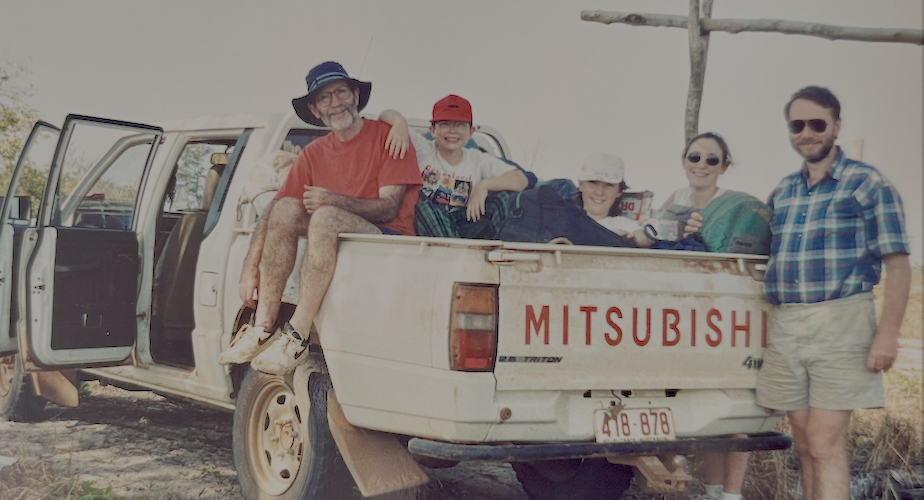
He also built us a cubby house, sandpit and seesaw, and was the instigator of several Sunday afternoon music performances for our neighbours. One of his favourite things was taking us to our Saturday morning tennis matches. I remember going on adventures with him around our neighbourhood in search of the best brick walls in the back streets to hit a tennis ball against. My sisters and I loved going to the airport in our pyjamas to welcome him home from any overseas trips.
In the morning before school, Dad would sit at the kitchen table while we all had breakfast and read the newspaper, commenting on articles and writing notes around the edges. In the evening we would eat dinner together, then watch the 6.30pm SBS news and halfway through jump across to the 7pm ABC news. While he was at St Vincent’s Hospital receiving cancer treatment last year, Mum would bring the newspaper in for him every morning. I was often with him in the evenings, and at 6.30pm we would leave his four-bed ward and slowly make our way out to the visitor’s area where there was a television so we could watch the news together.
Protest posters, overflowing bookshelves, campaign leaflets
During the 1980’s and 90’s he was equally devoted to his work on East Timor and his role as the first Director of the Australian Council for Overseas Aid’s (ACFOA) Human Rights Office. Others can tell the details of this work. For me, I remember visiting his ACFOA office at Napier St, Fitzroy. His desk was tucked away in the back corner, surrounded by piles of books and papers. The walls were covered in protest posters; there were overflowing bookshelves and boxes of campaign leaflets sitting on top of filing cabinets.
We always looked forward to days when we got to go to work with Dad because we had a day off school. We would find these large pillows and use them to slide down the stairs. And he would give us money to walk up to Gertrude St and get an ice cream.
At that office, Pat worked with colleagues on human rights issues in Australia’s indigenous and refugee communities, Tibet, Myanmar, Sri Lanka and the Philippines. His two passions always remained Indonesia and East Timor.
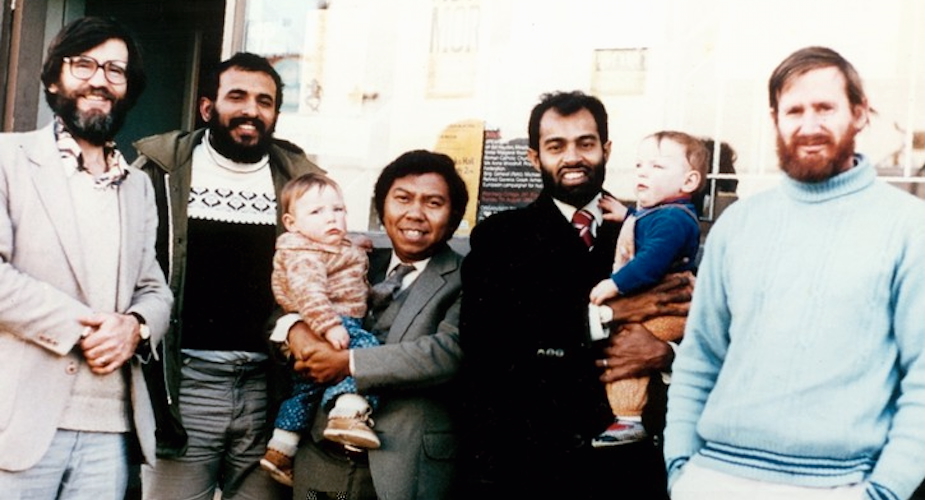
Adjacent to this ACFOA work, he was a central figure in establishing the Inside Indonesia magazine in 1981 and has written about this himself. I fondly remember growing up with the magazine’s office in the front room of our house for many years, with boxes of magazines and envelopes stored along the hallway or in the corner of the loungeroom.
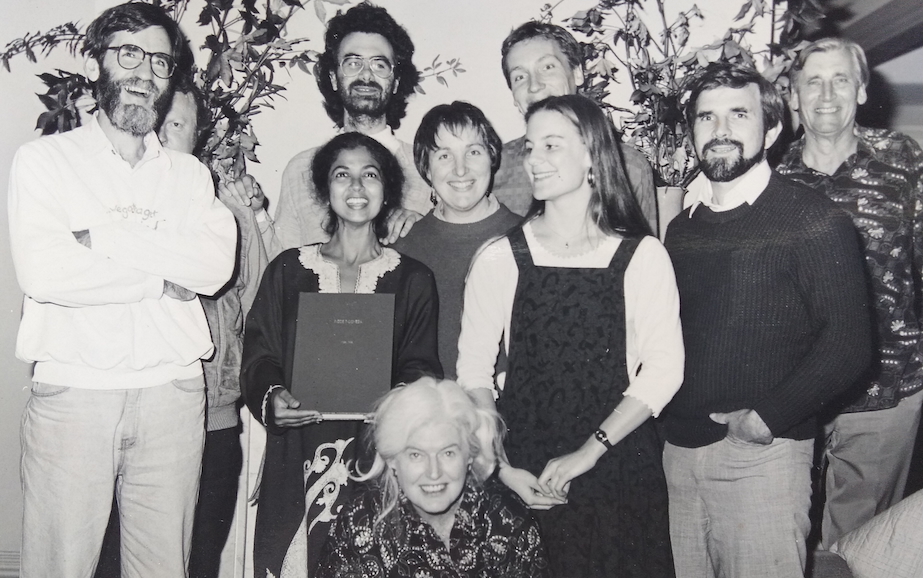
The volunteer-run quarterly mail-outs in the blue room downstairs at Napier St were always a highlight, with music playing and plenty of biscuits and cups of tea.
Dili
In 1999, Pat’s work on Timor intensified as the political situation developed. In August he joined the official Australian government delegation and flew in the Prime Minister’s jet to Dili to monitor the referendum. Back at home, we watched the news very closely. We were worried for him as the situation was precarious and we also understood that he absolutely needed to be there.
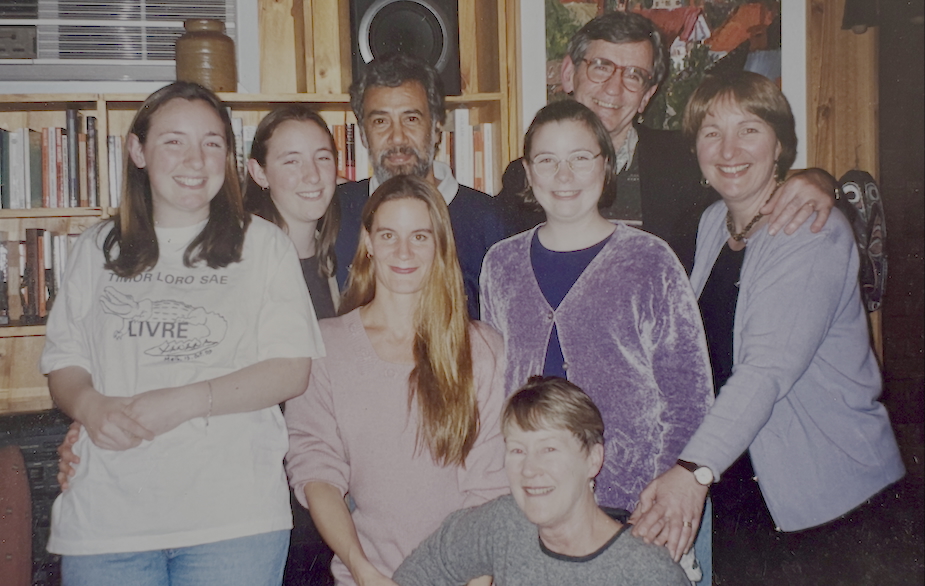
When the result of the referendum was announced, everyone in our house was overjoyed, including us kids. Having grown up in a family dedicated to supporting East Timor’s independence, we appreciated how momentous this outcome was. It therefore made sense to us when Dad and Mum picked us up from school at lunchtime so we could all attend a protest rally together in the city to call on the Australian government and the UN to intervene to stop the violence occurring as a result of the announcement.
On our first family visit to East Timor in December that year, Dad worked his magic and had our whole family, including us three teenage daughters and our two friends James and Steven, registered as aid workers so we could get in. It wasn’t long before Pat moved to Dili, Annie joined him there and they lived in Kampung Baru, Comoro for fourteen years. Suzannah, Patricia and I all lived in Timor at various times, including in Dili and Venilale.
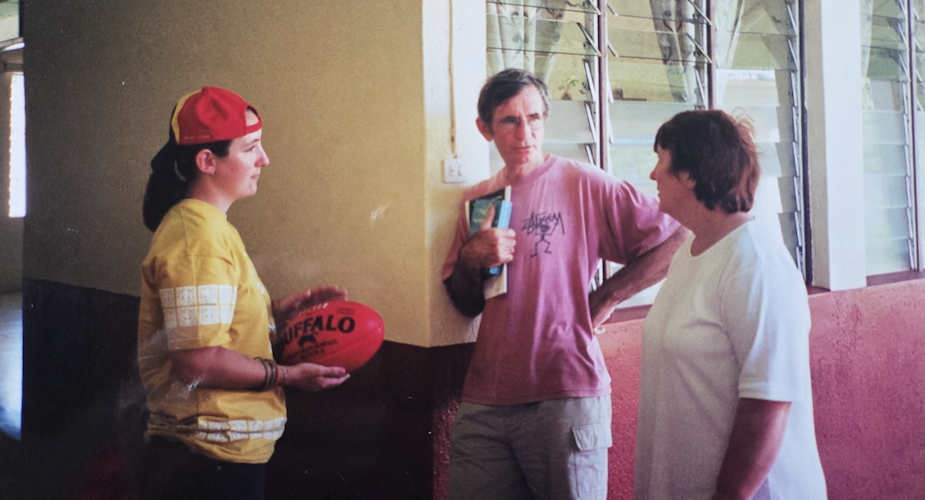
In the early years there, Pat and Annie lived in a little house in the tropical heat with no air-conditioning and regular power outages. I was lucky enough to visit often and live there with them too. The roads in Dili were atrocious, but I enjoyed driving with Dad as he would always take a moment to point out his favourite potholes. Over the years several Timorese families lived with them in Kampung Baru and all of them continue to be important parts of our extended family. One of my favourite family routines was seeing how many kids they could fit in their car on Sunday mornings for breakfast and a swim at the beach.
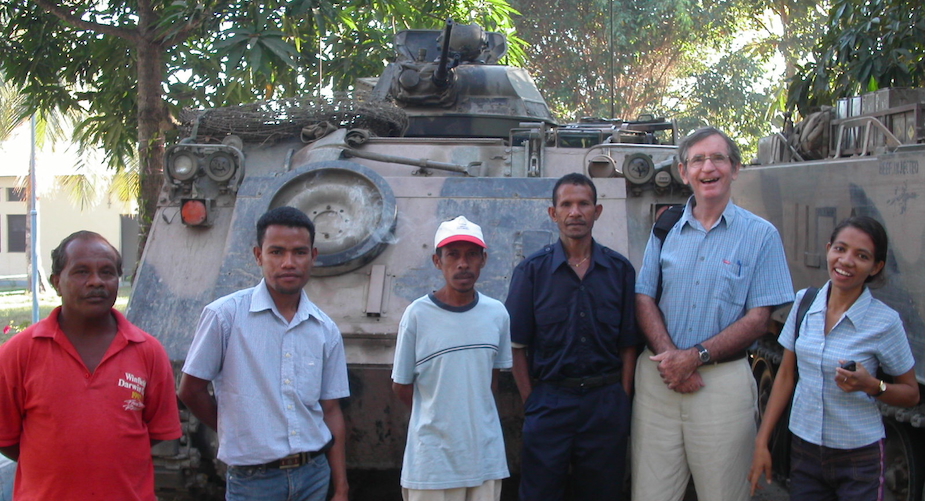
Over the next decade, Pat’s most significant and unique contribution in Timor-Leste was his work at the Commission for Reception, Truth and Reconciliation (CAVR). Others are telling this part of his story, so I will share with you some of his fun, thoughtful and varied side projects. He loved tennis and got to know some people who lived near a tennis court in Bebonuk as he would visit and play tennis with them. Over time, he and his friend, Jose Antonio established the Jospat tennis club, which is still running today with a new generation of coaches and young tennis players.
His interest in preserving history included a concern for heritage Portuguese buildings, so he applied for funding and facilitated the restoration of an historic building in rural Venilale that was turned into a public library and training centre. His love of photography resulted in a wonderful portrait exhibition held in Dili titled ‘Men in Hats’.
Creative productivity
In 2014, at seventy-three years old, Pat moved back to Melbourne with Annie. A major feature of the last decade of his life was his level of creative productivity. He published seven books in nine years! We hope to have all his public writing available on his website in the coming months.
In between book chapter reviews, public speaking events, overseas trips, photography, rewriting song lyrics for special occasions, publishing articles and chapters in other peoples’ books, collaboration with the Indigenous Yoorrook Justice Commission, his Indonesian poetry group and his important role as a member of the International Panel of Advisors to East Timor’s National Chega Centre, Pat delighted in hosting and visiting his seven grandchildren.
Accompanying grandad to the local café in the morning was a special treat that will be fondly remembered, as will picking his homegrown strawberries and digging up his potatoes in the front garden.
For me, my Dad’s driving force was that he cared deeply for people. Almost everything he did in his life was with, about or for people. He would attend an event, start a conversation with someone and get so deeply involved in the person and discussion that he would forget to eat and completely lose track of time. He believed fundamentally in the dignity of every person and treated everyone with respect.
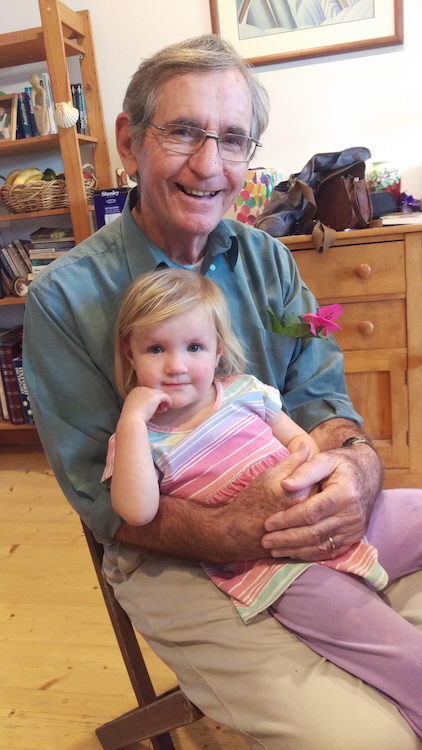
Juxtaposed with this was his tendency towards introspection and reflection. My Dad’s approach to his own life and to the world around him was observational. He took time to notice … people, trends, news, nature, information, details. This strength underpinned both his creative expression and strategic thinking.
While he was very, very sick in hospital for several months receiving chemotherapy treatment for plasmablastic lymphoma, he wrote three beautiful poems, put in a big effort to remember everyone’s names, continued to follow the news and held strategic work meetings about important projects. Several nurses commented that they had never seen someone have so many visitors.
My Dad was an amazing role model who always looked for ways to contribute.
He lived his life in service to humanity.
Vale Pat Walsh. May he rest in peace. We miss him every day.