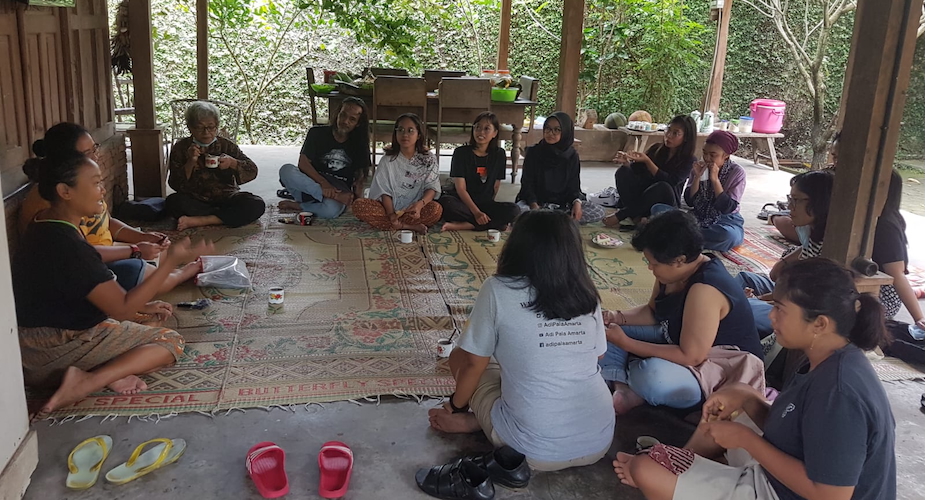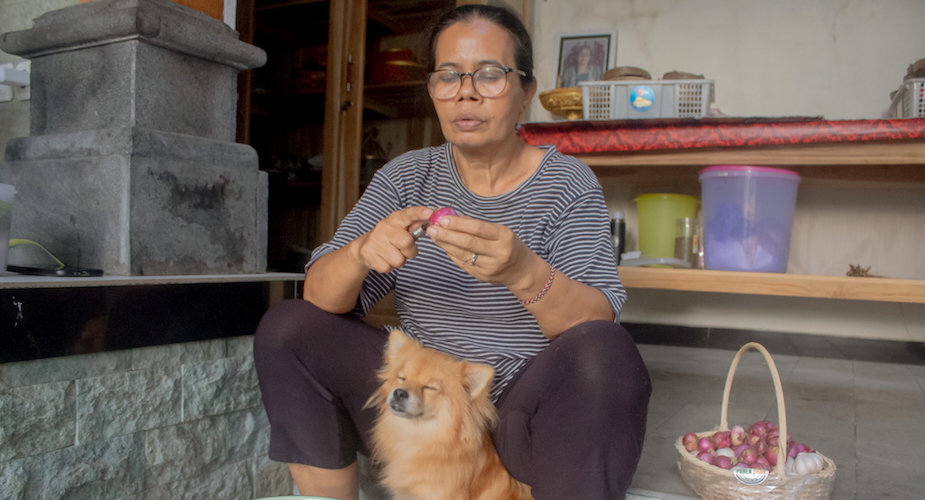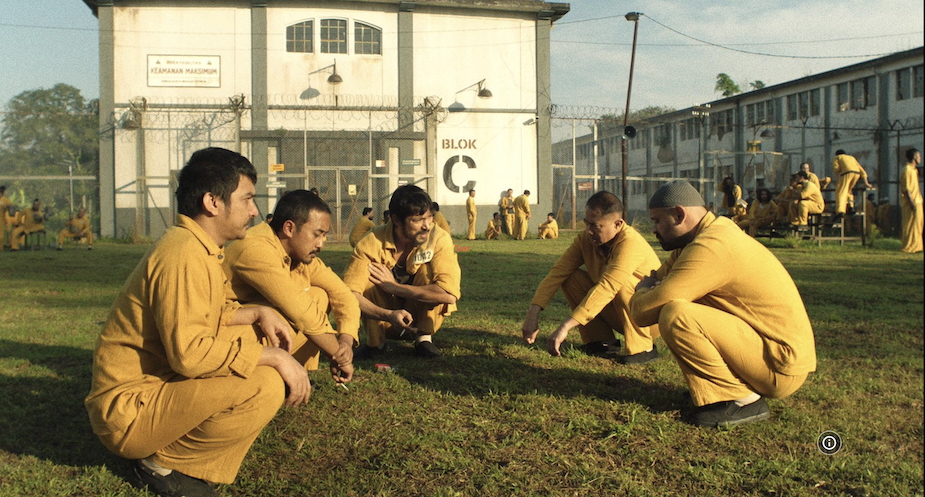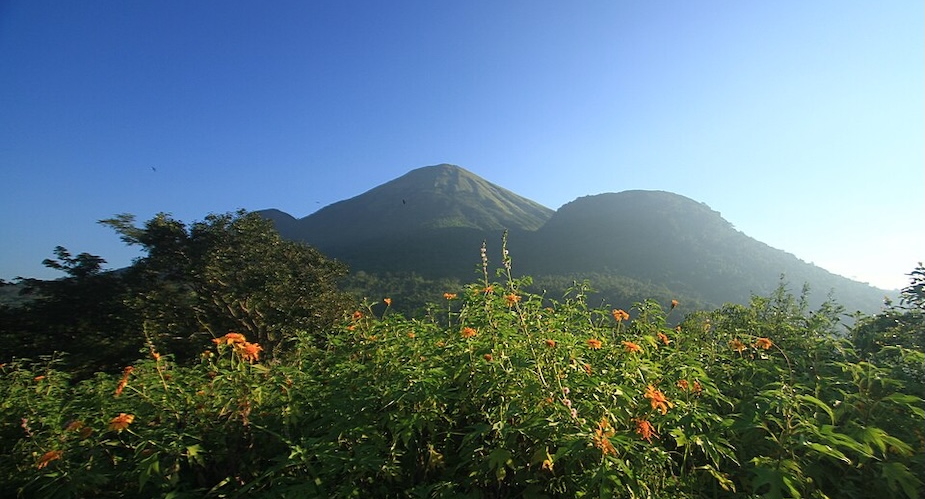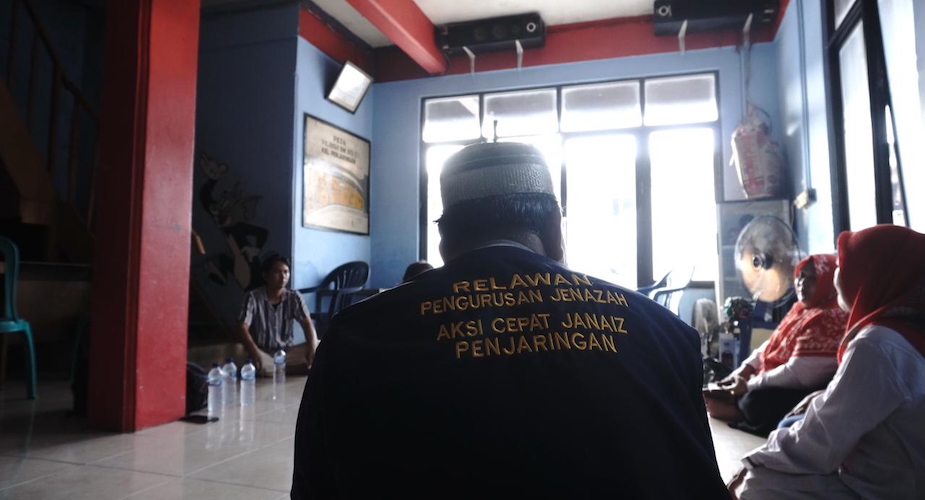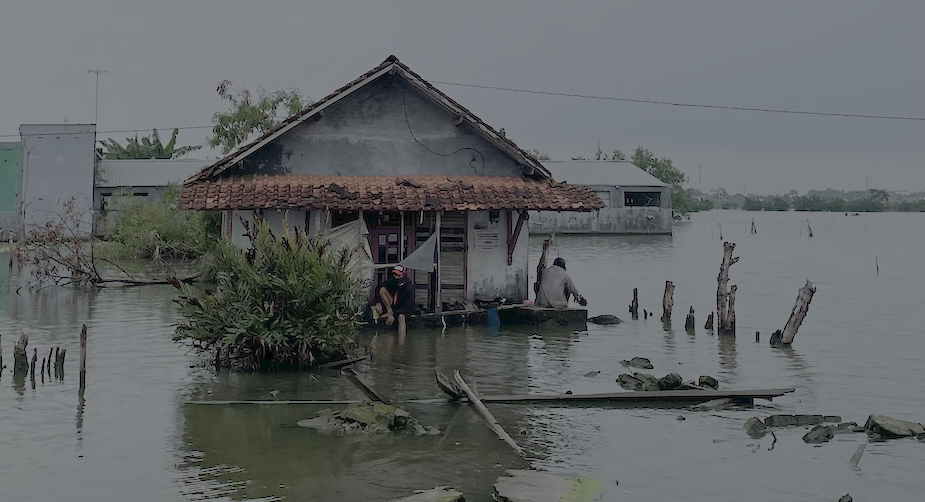
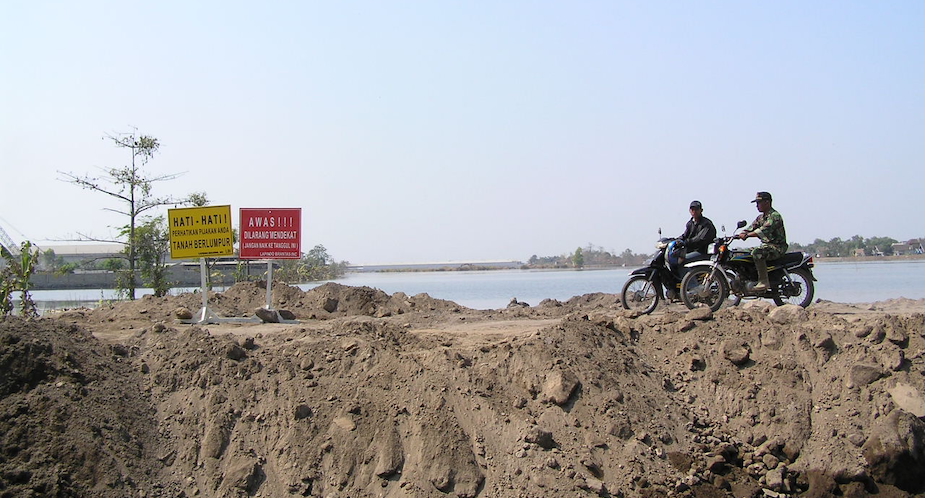
Documenting suffering caused by the Lapindo mudflow. Women continue to bear the burden.
|
Porong Lanskap Derita Nyai Ontosoroh Marsinah–Rahmawati Dibalik kuasa Sirkulasi kapital Perkebunan gula Tanam paksa Ekstrasi gas Lumpur panas Porong...lanskap...derita... Derita tanpa akhir... Derita tanpa henti... |
Porong, Landscape of Misery Nyai Ontosoroh Marsinah–Rahmawati Behind the power Of circulating capital Sugar plantations Forced cultivation Gas extraction Hot mud Porong… landscape… of misery Endless misery… Never-ending misery… |
‘Porong Lanskap Derita’ is a song on the 2024 album Pralaya Semesta (The End of the Universe), by the grind punk band Cryptical Death. It tells the story of three women, in three periods. One lived in the colonial early 20th century, one in the late 20th century, and the third in the early 21st century. Two are real-life figures, one is fictional. They are united by the same living space: Porong and Tulangan, part of Sidoarjo Regency in East Java. Porong is where the Lapindo mudflow occurred 20 years ago. Their bodies are embedded in the landscape of misery, shaped by a history of colonial and post-colonial capitalism.
Cryptical Death formed in Jakarta in 1997. Pralaya Semesta is their third album. It was released on 14 February 2024 to coincide with the general elections that marked the beginning of the ‘Dark Ages.’ All its songs address the forces of capital and power that lead to environmental crisis and threaten destruction. The track Porong Lanskap Derita highlights Porong as a landscape - the visible elements blending natural features such as mountains and rivers with man-made structures. Nature, humanity and place intersect within the landscape, which thus reflects the living spaces, natural scenery, as well as the cultural and historical traces of humanity across time.

In this song, Cryptical collaborated with Lia, the female vocalist from the hardcore band Moral. Lia’s vocal character represents the misery inherent in the female body within the Porong landscape. As capital penetrated Sidoarjo, it brought about socio-ecological change. Sites of production – plantations, factories, natural gas wells – began to set the rhythm of human as well as non-human life. The human body was part of this socio-ecological formation of the landscape. The female body became the most intimate space for the accumulation of misery. As capital changed the relationship between nature and humanity, it created new landscapes and transformed the human body into an archive of misery.
Porong Lanskap Derita draws lessons from the Lapindo mudflow disaster of 29 May 2006.
This totally altered the landscape as a result of operating a gas production site in Porong, Sidoarjo. Listeners are invited to imagine the suffering caused by the Lapindo mudflow, and then to link that to the history of landscape transformation dating back to the era of forced cultivation that Governor-General Van den Bosch initiated in 1830. The story runs from the colonial sugar plantations, through the New Order factories and their labour practices, to gas extraction in the early 21st century. Within this historical continuum, Porong and the female body emerge as a historical landscape, a place where misery unfolds ceaselessly.
Marsinah, working class body
When my local friends and I needed a break from research in Porong we would often head to Sidoarjo town to find somewhere to eat, or to Surabaya to hang out at Walhi East Java, the environmental organisation. One day, passing through Sidoarjo, right opposite the Gelora Delta Stadium and at the junction of Pahlawan Road, I spotted a blue monument that made me stop in my tracks. I asked my friend to pull over, got out, and walked across to take a photo. On it were several posters. One read ‘Working Class Hero,’ with a picture of Marsinah’s face. She has long been legendary, this female worker at a watch factory in the village of Siring, Porong District. The posters were part of the 2017 May Day actions. A small one in the right-hand corner still carried Marsinah’s spirit of resistance with the words ‘the struggle must continue.’
New Order industrial development absorbed many women into the workforce, also in factories. The landscape of Siring Village was transformed. Rice fields and sugar plantations dating back to the colonial era gave way to industrial estates. The same happened in other villages. Porong became an industrial area with dozens of factories and thousands of workers. Migrants from elsewhere in East Java flocked there seeking employment.
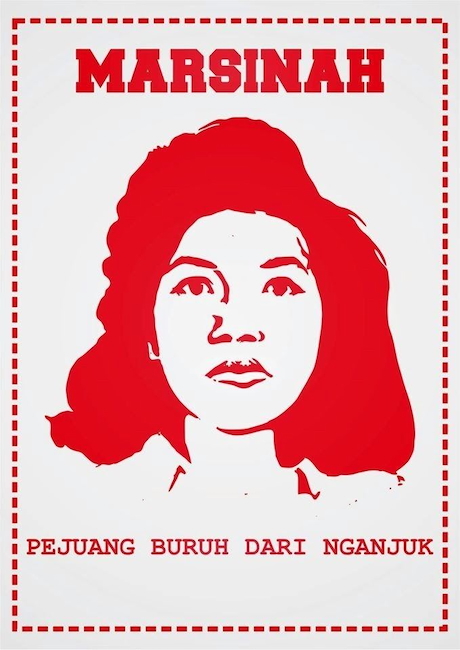
Indonesian women faced a double burden, as mothers and as cheap labour. Marsinah’s protests in the early 1990s became one of the best-known forms of labour resistance, part of a broader women’s labour movement. Marsinah fought against wage theft by the watch company Catur Putra Surya (CPS) in Siring Village. She organised around five hundred CPS workers, two hundred of them women. Tragically, Marsinah disappeared on 4 May 1993, two days after the CPS workers’ demonstration. A few days later her body was found in a rice field.
Reports differ on where they disposed of her body. Some say it was in a village in Porong, whilst others claim it was in the Nganjuk area well to the west of Porong. Regardless, Marsinah’s body became an archive of state violence against factory workers during the New Order. Marsinah’s body—as an archive—has been buried. But for the mostly working class people of Sidoarjo it has been transformed into a collective memory. During Labour Day commemorations she stands as an icon of the workers’ struggle in Sidoarjo. She is part of a landscape of misery linked to the past of the sugar plantations, the subsequent Lapindo mudflow disaster, and the future of the working class in Sidoarjo.
Rahmawati, industrial mutant body
Twenty-three years after Marsinah’s death, the same village was once again struck by a major disaster: a mudflow. The village of Siring in Porong District stands as a symbol of a landscape of misery that spans the period from the New Order to Reformasi. It has become a space where misery accumulates, from the bodies of factory workers exploited during the New Order, to the bodies of villagers affected by the chemical content of the mud during Reformasi. This is also where Mba Rahmawati was born and lives until today. The Lapindo mudflow turned her into an environmental activist.
During the first two years of the disaster, she lost her husband whilst pregnant with their second child. Siring Village lay submerged. She was living in a refugee camp. She told me the camp initially provided no special care for pregnant women. After five months, a health post began providing check-ups for pregnant women and children. Babies received medicines, vitamins and milk, but pregnant women received only medicines; they relied on the same food as the other camp residents. A month before giving birth, Mbak Rahma moved into a rented house. She had to pay for her delivery costs herself, without assistance from the company or the government. The company had once made promises - as it had done to her husband – but her healthcare needs during pregnancy remained unmet.
The accumulation of misery transformed Mbak Rahma into a community organiser in Porong. She met with activists from Walhi. She mobilised women to take part in meetings with representatives from the local parliament (DPRD), the government, and the company. The women’s community group she formed is called Ar Rohma.
Air and water pollution around the mudflow embankment is not felt only in the nearest villages, it spreads. At night, the smell of methane gas from the mud can be detected five kilometres away. Many women suffer headaches and shortness of breath caused by gas and by the dust that rises as mud dries out during the dry season.
Mba Rahma works as a motorcycle taxi driver (ojek) for tourists wishing to see the mud. She and her fellow drivers in the Paguyuban Ojek Tanggul Lumpur are in a highly vulnerable position. The methane and the mud contain toxic chemicals, which spread through the air and water. Their contaminated bodies become a sort of ‘toxic mud body.’ In my Inside Indonesia article ‘Empire, mining and our bodies,’ I refer to these bodies as ‘industrial mutants.’ That article discusses another song by Cryptical Death titled PLTU (Sea, Land, and Air Pollution). It depicts how exposure to toxins from the mining industry and waste causes the human body to undergo mutation. Those constantly exposed to industrial toxins are industrial mutants. That includes Mbak Rahma and the villagers living near the mud embankment.
Nyai Ontosoroh, the body of desire: sugar plantations
The rice fields that disappeared in Porong and across Sidoarjo Regency were once part of huge sugar plantations that the colonial Dutch started in the 1830s. The factories, and now the Lapindo mudflow, displaced expanses of rice fields and sugarcane. I first became aware of the long history of the area behind the mud embankment after a local resident told me that during his childhood, in the 1980s, there were still railway tracks to transport sugarcane. I realised that the Porong landscape, before it became a natural gas production site, was once a network of plantations linked to sugar factories scattered across Sidoarjo and throughout East Java.
We verified these accounts from Lapindo survivors by visiting one of the remaining factories, at Candi just north of Porong. In the East Java provincial archives we found a book on its history, by R.A. Quintus. Between 1832 and 1850, 13 factories were established in Sidoarjo. Candi Sugar Factory was the first, in 1832, followed by Buduran (1835), Waru (1835), Tanggulangin (1835), Porong (1838), Watutulis (1838), Popoh Wonoayu (1838), Balongbendo (1838), Krian (1839), Ketegan-Taman (1839), Sruni-Gedangan (1840), Krembung (1847), and Tulangan (1850). The growth of sugar production in Sidoarjo was linked to a production crisis in Cirebon and Pekalongan further west. This prompted the relocation of forced cultivation to East Java. Porong thus forms part of Sidoarjo’s evolving landscape, shaped by capital expansion linked to the sugar trade that also turned Surabaya into a major harbour city.
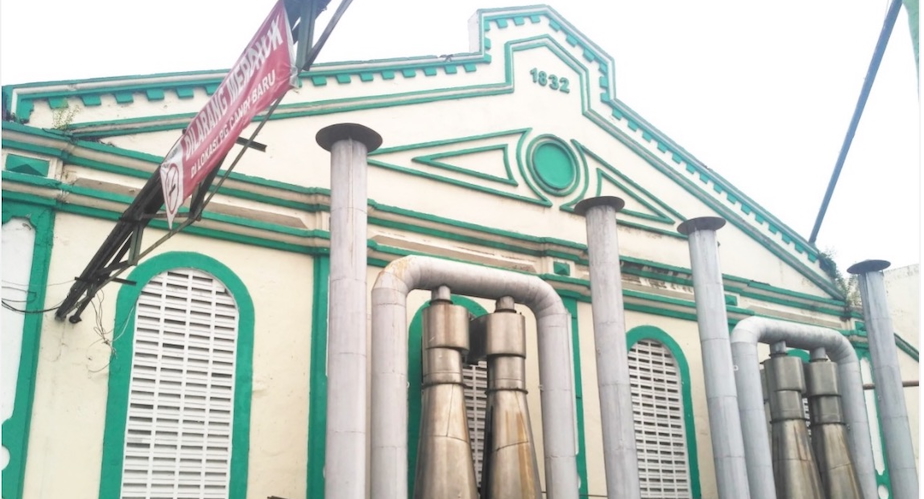
The question then is: how can we understand the experiences of women’s bodies in the colonial era - women who also bore the brunt of the suffering caused by these changes to the landscape? The archives and oral histories we have uncovered remain limited. We still have only a few accounts of women’s experiences during that era in Sidoarjo.
Pramoedya Ananta Toer’s novel Child of All Nations (Anak Semua Bangsa, 1981) is set in the early 20th century against the backdrop of a sugar plantation in Tulangan District, Sidoarjo. Sugar production in Java reached its peak in the years 1900–1930. Pramoedya depicts the experiences of farmers in that period. Many villages in Sidoarjo were part of the plantations owned by the 13 sugar factories. The Tulangan factory featured in the novel has in fact been in operation since 1850. It was one of only two still operating when we did our research a few years ago, along with the one at Candi. This is the link connecting the bodies in a landscape of misery with time, from the colonial era to the Lapindo mudflow disaster.
Nyai Ontosoroh is one of the key protagonists in the story. She takes her son-in law, Minke, on a holiday to her home village in Tulangan. They visit her brother, Sostro Kassier, cashier at the factory. There the dark story of Nyai Ontosoroh’s past unfolds. As a young girl, her father traded her body to the Dutch factory foreman. But she was not the only woman to be sold as a concubine. Sostro reveals that everyone who wanted a promotion handed their daughter over to the European foreman. Refusal could mean being cut off from access to wealth and status. The experience transformed her into an independent woman. She became capable of managing the plantation business owned by her European partner. And she grew more open-minded and critical of the notion of European superiority.
We sense in this fictional narrative how women’s bodies in Sidoarjo were treated as property, to be traded and sexually exploited for the profit of Dutch overseers. The imagination surrounding Nyai Ontosoroh’s body leads us to the plight of other women who fared no better. From plantation workers to women in prostitution, unfortunate young girls were often subjected to dual abuse, from the Dutch as well as from the men within their own families. What occurred in Tulangan can inform our imagination surrounding the bodies of colonial women in Porong. Whether in Tulangan, Porong, or other plantation areas in Sidoarjo, the accumulation of capital from sugar profits is linked to issues of social reproduction and the position of women. As labourers, they were cheaper; sexually, they became objects of desire for the overseers and tools for the mobility of indigenous families who sold their children’s bodies.
Capitalism’s curse on the body
What has happened to women’s bodies in Porong since the colonial era has not changed much since Indonesia gained independence in 1945, nor has it changed much after 20 years of the Lapindo mudflow. Many people within the community think of it as a kind of curse: as if the histories of Porong, Tulangan and other areas are destined to convey endless misery. The question is, why does the misery in this landscape keep repeating itself?
Through their song, Cryptical Death suggest that the curse persists because Porong and other areas are under the sway of the circulation of capital. This is the curse of capitalism: eras may change, rulers may shift from white to indigenous people of colour, but the social relations of capital and power persist unceasingly. ‘Porong: landscape of misery’ becomes a tale of the curse of capitalism that continues to haunt Porong and the women within it, in endless and unceasing misery.
Fathun Karib (karib.13@nus.edu.sg) is a sociologist. He is postdoctoral researcher under the ARI-DIJ Research Partnership on the Global Indo-Pacific at the Asia Research Institute, National University of Singapore, and vocalist with Cryptical Death. All photos are by the author.
This article is part of a mini-series commemorating the 20th anniversary of the Lapindo disaster and marking Anti-Mining Day/Hari Anti-Tambang (HATAM), 29 May.